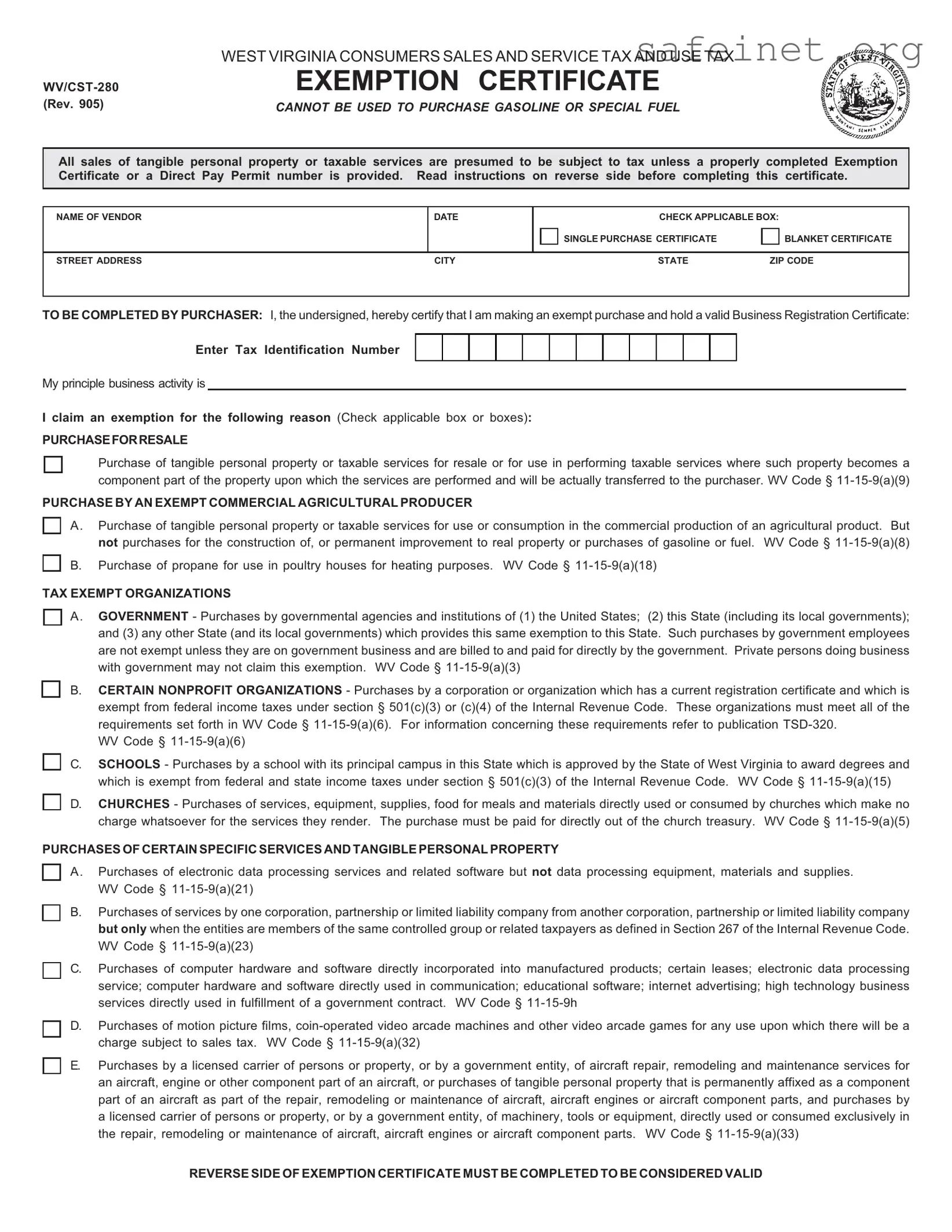
The West Virginia Consumers Sales and Service Tax and Use Tax Exemption Certificate, known as WV/CST-280, serves a crucial role for businesses and organizations seeking to make tax-exempt purchases. This form is essential for ensuring that tangible personal property or taxable services are not subject to sales tax when they meet specific criteria. It is important to note that this certificate cannot be used for purchasing gasoline or special fuel. To properly utilize the exemption, purchasers must provide their valid Business Registration Certificate number and clearly indicate the reason for the exemption, whether it be for resale, agricultural use, or purchases made by exempt organizations like government agencies, schools, and certain nonprofit entities. The form allows for both single purchase and blanket certificate options, offering flexibility for ongoing tax-exempt transactions. However, it is vital for both vendors and purchasers to complete the form accurately to avoid potential penalties and ensure compliance with state regulations. Understanding the requirements and responsibilities tied to the WV Tax Exempt form can save businesses and organizations a significant amount in taxes, while also keeping them in good standing with state tax authorities.
|
WEST VIRGINIA CONSUMERS SALES AND SERVICE TAX AND USE TAX |
EXEMPTION CERTIFICATE |
|
(Rev. 905) |
CANNOT BE USED TO PURCHASE GASOLINE OR SPECIAL FUEL |
All sales of tangible personal property or taxable services are presumed to be subject to tax unless a properly completed Exemption Certificate or a Direct Pay Permit number is provided. Read instructions on reverse side before completing this certificate.
NAME OF VENDOR
DATE
CHECK APPLICABLE BOX:
SINGLE PURCHASE CERTIFICATE
BLANKET CERTIFICATE
STREET ADDRESS |
CITY |
STATE |
ZIP CODE |
TO BE COMPLETED BY PURCHASER: I, the undersigned, hereby certify that I am making an exempt purchase and hold a valid Business Registration Certificate:
Enter Tax Identification Number
My principle business activity is
I claim an exemption for the following reason (Check applicable box or boxes):
PURCHASEFORRESALE
Purchase of tangible personal property or taxable services for resale or for use in performing taxable services where such property becomes a component part of the property upon which the services are performed and will be actually transferred to the purchaser. WV Code §
PURCHASE BY AN EXEMPT COMMERCIAL AGRICULTURAL PRODUCER
A. Purchase of tangible personal property or taxable services for use or consumption in the commercial production of an agricultural product. But not purchases for the construction of, or permanent improvement to real property or purchases of gasoline or fuel. WV Code §
B. Purchase of propane for use in poultry houses for heating purposes. WV Code §
TAX EXEMPT ORGANIZATIONS
A. GOVERNMENT - Purchases by governmental agencies and institutions of (1) the United States; (2) this State (including its local governments); and (3) any other State (and its local governments) which provides this same exemption to this State. Such purchases by government employees are not exempt unless they are on government business and are billed to and paid for directly by the government. Private persons doing business with government may not claim this exemption. WV Code §
B. CERTAIN NONPROFIT ORGANIZATIONS - Purchases by a corporation or organization which has a current registration certificate and which is exempt from federal income taxes under section § 501(c)(3) or (c)(4) of the Internal Revenue Code. These organizations must meet all of the requirements set forth in WV Code §
WV Code §
C. SCHOOLS - Purchases by a school with its principal campus in this State which is approved by the State of West Virginia to award degrees and which is exempt from federal and state income taxes under section § 501(c)(3) of the Internal Revenue Code. WV Code §
D. CHURCHES - Purchases of services, equipment, supplies, food for meals and materials directly used or consumed by churches which make no charge whatsoever for the services they render. The purchase must be paid for directly out of the church treasury. WV Code §
PURCHASES OF CERTAIN SPECIFIC SERVICES AND TANGIBLE PERSONAL PROPERTY
A. Purchases of electronic data processing services and related software but not data processing equipment, materials and supplies. WV Code §
B. Purchases of services by one corporation, partnership or limited liability company from another corporation, partnership or limited liability company but only when the entities are members of the same controlled group or related taxpayers as defined in Section 267 of the Internal Revenue Code. WV Code §
C. Purchases of computer hardware and software directly incorporated into manufactured products; certain leases; electronic data processing service; computer hardware and software directly used in communication; educational software; internet advertising; high technology business services directly used in fulfillment of a government contract. WV Code §
D. Purchases of motion picture films,
E. Purchases by a licensed carrier of persons or property, or by a government entity, of aircraft repair, remodeling and maintenance services for an aircraft, engine or other component part of an aircraft, or purchases of tangible personal property that is permanently affixed as a component part of an aircraft as part of the repair, remodeling or maintenance of aircraft, aircraft engines or aircraft component parts, and purchases by a licensed carrier of persons or property, or by a government entity, of machinery, tools or equipment, directly used or consumed exclusively in the repair, remodeling or maintenance of aircraft, aircraft engines or aircraft component parts. WV Code §
REVERSE SIDE OF EXEMPTION CERTIFICATE MUST BE COMPLETED TO BE CONSIDERED VALID
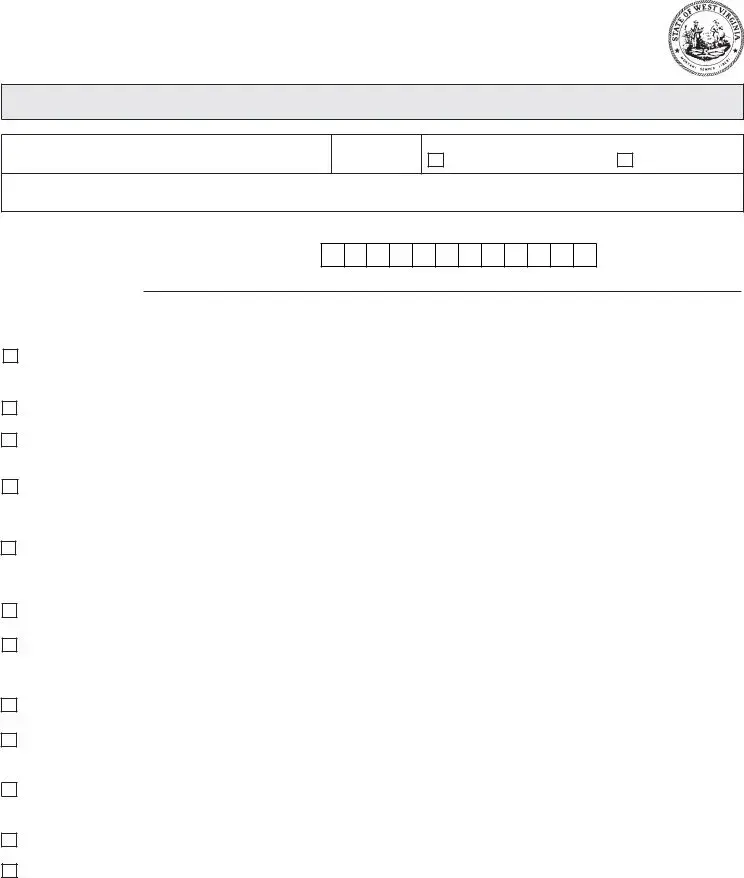
I understand that this certificate may not be used to make tax free purchases of items or services which are not for an exempt purpose and that I will pay the Consumers Sales or Use Tax on tangible personal property or services purchased pursuant to this certificate and subsequently used or consumed in a taxable manner. In addition, I understand that I will be liable for the tax due, plus substantial penalties and interest, for any erroneous or false use of this certificate.
NAME OF PURCHASER |
STREET ADDRESS |
|
|
|
|
SIGNATURE OF OWNER, PARTNER, OFFICER OF CORPORATION, ETC. |
CITY |
|
|
|
|
TITLE |
STATE |
ZIP CODE |
|
|
|
GENERALINSTRUCTIONS
An Exemption Certificate may be used only to claim exemption from tax upon a purchase of tangible personal property or services which will be used for an exempt purpose as stated on the front of this form.
ApurchasermayfileablanketExemptionCertificatewiththevendortocoveradditionalpurchasesofthesamegeneraltypeofproperty or service. However, each subsequent sales slip or purchase invoice evidencing a transaction covered by a blanket Exemption Certificate must show the purchaser’s name, address and Business Registration Certificate Number for purposes of certification.
INSTRUCTIONSFORPURCHASER
To purchase tangible personal property or services tax exempt, you must possess a valid Business Registration Certificate and you must properly complete this Exemption Certificate and present it to your supplier. To be properly completed, all entries on this Exemption Certificate must be filled in.
Your Business Registration Certificate (and any duplicates) may be suspended or revoked if you or someone acting on your behalf willfully issues this certificate for the purpose of making a tax exempt purchase of tangible personal property and/or services that is not used in a tax exempt manner (as stated on the front of this form).
When property or services are purchased tax exempt with an Exemption Certificate, but later used or consumed in a non exempt manner, the purchaser must pay Sales or Use Tax on the purchase price.
The willful issuance of a false or fraudulent Exemption Certificate with the intent to evade Sales or Use Tax is a misdemeanor.
Your misuse of this Certificate with intent to evade the Sales or Use Tax shall also result in your being subject to:
A penalty of fifty percent of the tax that would have been due
had there not been a misuse of such certificate.
This is in addition to any other penalty imposed by the Law.
In the event you make false or fraudulent use of this Certificate with intent to evade the tax, you may be assessed for the tax at any time subsequent to such use.
INSTRUCTIONSFORVENDOR
At the time the property is sold or the service is rendered, you must obtain from your customer this Certificate, properly completed, (or a Direct Pay Permit number issued by the West Virginia Department of Tax and Revenue), or the sale will be deemed a taxable sale, unless the property or service sold is exempt per se from Sales Tax. Your failure to collect tax on such taxable sale will make you personally liable for the tax, plus penalties and interest.
Additionalinformationmayberequiredtosubstantiatethatthesalewasforexemptpurposes. InorderforthisCertificatetobeproperly completed, it must be issued by a purchaser who has a valid Business Registration Certificate and must have all entries completed by the purchaser.
A timely received certificate which contains a material deficiency will be considered satisfactory if such deficiency is subsequently corrected.
You must keep this certificate for at least three years after the due date of the last return to which it relates, or the date when such return was filed, if later.
You must maintain a reasonable method of associating a particular exempt sale to a customer with the Exemption Certificate you have on file for such customer.
INSTRUCTIONSFORVENDORANDPURCHASER
If you, as vendor or as a purchaser, engage in any business activity in West Virginia without possessing a valid Business Registration Certificate (and you do not clearly qualify for an exemption), you shall be subject to a penalty in an amount not exceeding $100 for the first day on which such sales or purchases are made, plus an amount not exceeding $100 for each subsequent day on which such sales or purchases are made.
Please begin using this Certificate immediately.
| Fact Name | Details |
|---|---|
| Form Title | West Virginia Consumers Sales and Service Tax and Use Tax WV/CST-280 Exemption Certificate |
| Governing Law | West Virginia Code § 11-15-9 |
| Use Restrictions | This certificate cannot be used for purchasing gasoline or special fuel. |
| Validity Requirements | The reverse side of the exemption certificate must be completed for it to be considered valid. |
| Tax Exemption Types | Exemptions include purchases for resale, agricultural use, and purchases by tax-exempt organizations. |
| Consequences of Misuse | Misuse of the certificate can result in penalties, including a 50% penalty on the tax that would have been due. |
| Business Registration Certificate | A valid Business Registration Certificate is required to use this exemption certificate. |
| Record Retention | Vendors must retain completed certificates for at least three years after the last return due date. |
Filling out the West Virginia Tax Exempt form is a straightforward process. This form is essential for individuals or businesses seeking to make tax-exempt purchases. Proper completion ensures that the exemption is recognized and accepted by vendors. Follow the steps below to fill out the form accurately.
Once you have filled out the form, ensure that all sections are complete and accurate before presenting it to your vendor. This will help facilitate a smooth transaction and avoid any potential issues with tax exemptions.
What is the purpose of the WV Tax Exempt form?
The WV Tax Exempt form, officially known as the West Virginia Consumers Sales and Service Tax and Use Tax Exemption Certificate (WV/CST-280), allows certain purchasers to buy tangible personal property or taxable services without paying sales tax. This form is essential for businesses and organizations that qualify for tax exemptions under specific conditions outlined in West Virginia law. The form must be properly completed and presented to the vendor at the time of purchase to ensure the transaction is recognized as tax-exempt.
Who is eligible to use the WV Tax Exempt form?
Eligibility to use the WV Tax Exempt form is generally limited to businesses and organizations that hold a valid Business Registration Certificate. This includes purchases made for resale, by exempt commercial agricultural producers, government agencies, certain nonprofit organizations, schools, and churches. Each category has specific criteria that must be met. For example, nonprofit organizations must be registered under section 501(c)(3) or 501(c)(4) of the Internal Revenue Code to qualify. It is important to check the specific reasons for exemption listed on the form to determine eligibility.
What information is required to complete the form?
To complete the WV Tax Exempt form, the purchaser must provide their name, address, and Tax Identification Number. Additionally, they must indicate the type of exemption being claimed by checking the appropriate boxes. The form requires the vendor's name and address, the date of the transaction, and whether it is a single purchase or a blanket certificate. The reverse side of the certificate must also be filled out to ensure validity. Failing to complete all required fields can lead to the form being deemed invalid, resulting in the purchaser being responsible for paying the applicable sales tax.
What are the consequences of misusing the WV Tax Exempt form?
Misusing the WV Tax Exempt form can lead to serious consequences. If a purchaser uses the form for non-exempt purchases, they will be liable for the sales tax on those transactions. Additionally, substantial penalties and interest may apply for erroneous or false use of the certificate. Willfully issuing a false exemption certificate is considered a misdemeanor. Penalties can include a fine of fifty percent of the tax that would have been due, in addition to other legal penalties. It is crucial to understand the rules and ensure that the certificate is used appropriately to avoid these repercussions.
Incomplete Information: Failing to fill in all required fields, such as the name of the vendor, address, or tax identification number, can lead to the form being rejected. Each section must be completed accurately.
Incorrect Exemption Reason: Selecting the wrong exemption reason can result in tax liability. It is crucial to check the applicable box that accurately reflects the purpose of the purchase.
Not Signing the Form: The form must be signed by an authorized individual, such as the owner or an officer of the corporation. A missing signature renders the form invalid.
Using the Certificate for Non-Exempt Purchases: Utilizing the exemption certificate for items or services that do not qualify for tax exemption can lead to penalties. It is essential to ensure that the purchase aligns with the exemption criteria.
Failure to Provide a Business Registration Certificate: A valid Business Registration Certificate must be held and referenced on the form. Without it, the exemption cannot be claimed.
Incorrectly Identifying the Purchaser: The name and address of the purchaser must match the information on the Business Registration Certificate. Discrepancies can lead to complications.
Not Completing the Reverse Side: The reverse side of the exemption certificate contains important instructions and must be completed to ensure validity. Neglecting this step can invalidate the entire form.
Using the Certificate Beyond Its Intended Scope: The exemption certificate is limited to specific purchases. Attempting to use it for multiple or unrelated transactions can result in tax penalties.
Ignoring Record Keeping Requirements: Vendors must maintain a copy of the exemption certificate for at least three years. Failure to do so can lead to liability for unpaid taxes.
The West Virginia Tax Exempt form, officially known as the WV/CST-280 Exemption Certificate, is a crucial document for individuals and organizations seeking to make tax-exempt purchases. However, it often accompanies several other forms and documents that help clarify and support the exemption claims. Below is a list of commonly used forms and documents that may be required alongside the WV Tax Exempt form.
Understanding these accompanying forms and documents is vital for ensuring compliance with West Virginia tax laws. Proper documentation not only supports the legitimacy of tax-exempt purchases but also helps avoid potential penalties associated with improper use of the Exemption Certificate. Always ensure that all necessary paperwork is completed accurately to facilitate a smooth transaction.
The West Virginia Tax Exempt form is similar to the IRS Form 8862, which is used to claim the Earned Income Credit after a disallowance. Both documents require individuals to provide personal information and a certification of eligibility. In each case, the individual must affirm that they meet specific criteria to qualify for the exemption or credit. The purpose of both forms is to ensure that the benefits are only granted to those who truly qualify, thereby preventing misuse.
Another document that shares similarities is the IRS Form W-9. This form is used to provide taxpayer identification information to a business or individual. Like the West Virginia Tax Exempt form, it requires the individual to certify their information is correct and that they are not subject to backup withholding. Both forms facilitate compliance with tax regulations, ensuring that the appropriate parties receive the tax benefits or exemptions they are entitled to.
The IRS Form 990 also bears resemblance to the West Virginia Tax Exempt form. Nonprofit organizations use Form 990 to report their financial information and ensure compliance with tax-exempt status. Both documents require detailed information about the organization’s activities and finances, aiming to maintain transparency and accountability in tax-exempt operations.
Additionally, the State of West Virginia's Direct Pay Permit application is comparable. This document allows businesses to purchase items without paying sales tax upfront, similar to how the Tax Exempt form functions. Both forms require the applicant to demonstrate their eligibility for tax-exempt status, ensuring that the exemptions are granted only to qualified purchasers.
The IRS Form 1023 is another relevant document. Organizations seeking tax-exempt status under section 501(c)(3) must submit this form. Like the West Virginia Tax Exempt form, it requires the organization to provide detailed information about its purpose and activities. Both forms serve to verify that the applicant meets the necessary criteria for tax exemption.
Moreover, the IRS Form 720 is similar in that it is used to report and pay certain federal excise taxes. Both forms require accurate reporting and certification of information related to tax exemptions or liabilities. This ensures that the tax system functions correctly and that only eligible parties benefit from exemptions.
The West Virginia Sales Tax Exemption for Nonprofits form also aligns closely with the Tax Exempt form. Nonprofit organizations use this document to claim sales tax exemptions on purchases made for their charitable activities. Both forms require organizations to certify their nonprofit status and the intended use of the purchased items, ensuring that tax exemptions are used appropriately.
Lastly, the IRS Form 1099 is relevant, as it is used to report various types of income other than wages, salaries, and tips. Both the 1099 and the Tax Exempt form require the reporting of specific information to ensure compliance with tax regulations. They both play a role in maintaining the integrity of the tax system by ensuring that only eligible individuals and organizations benefit from exemptions or reportable income.
When filling out the West Virginia Tax Exempt form, there are several important actions to take and avoid to ensure compliance and validity. Below is a list of dos and don'ts.
Understanding the West Virginia Tax Exempt form can be challenging, and several misconceptions often arise. Here are ten common misunderstandings about the WV Tax Exempt form, along with clarifications:
By understanding these misconceptions, both purchasers and vendors can navigate the West Virginia Tax Exempt form more effectively and ensure compliance with state tax regulations.
Key Takeaways for Using the West Virginia Tax Exempt Form