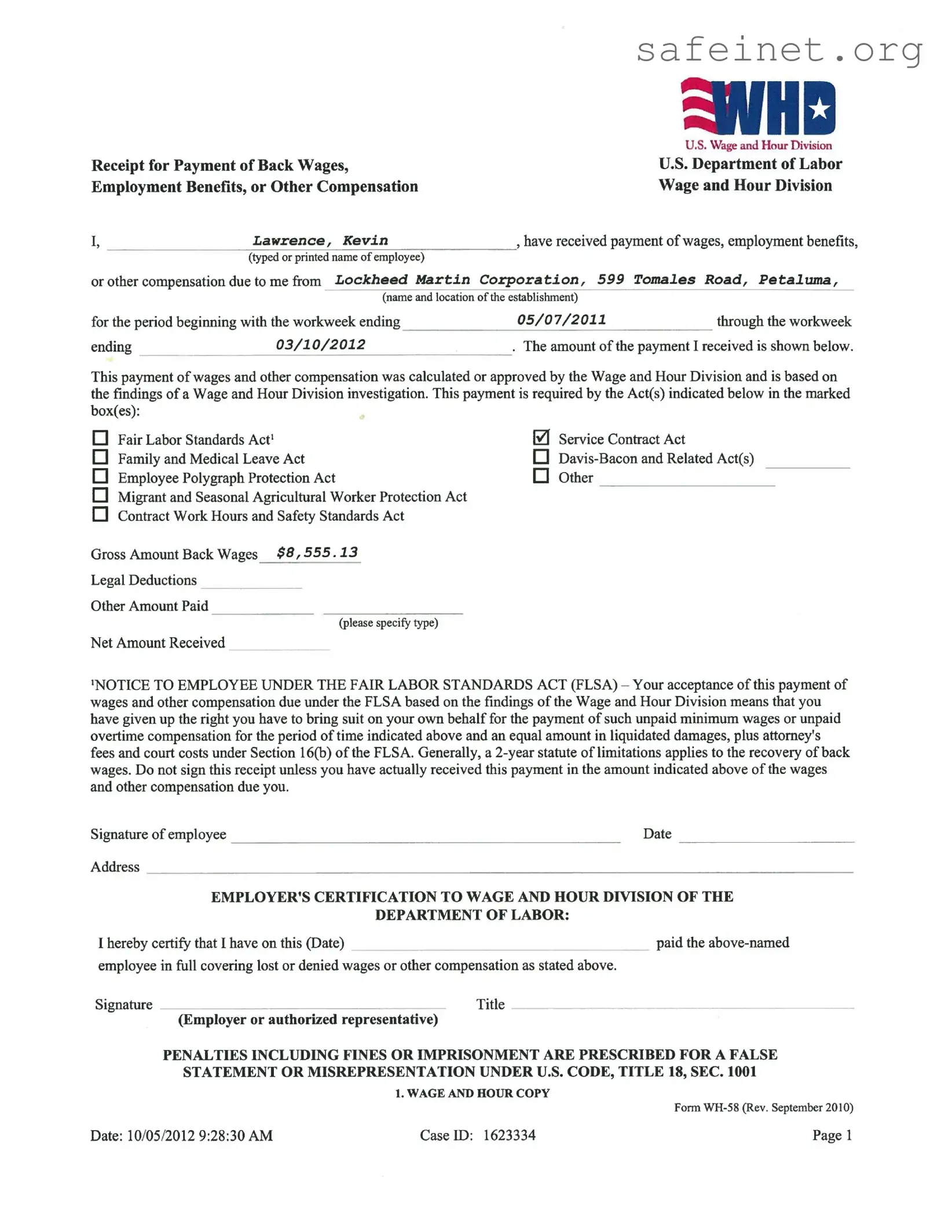
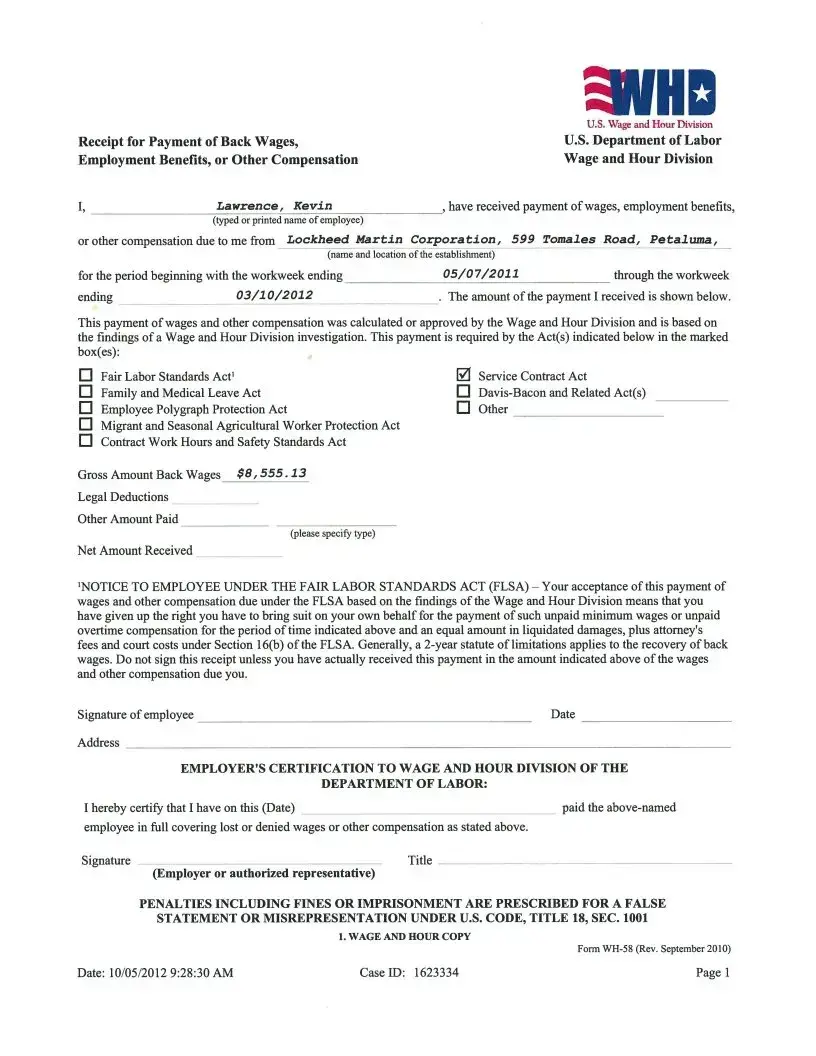
The WH-58 form serves as a crucial document in the realm of wage and hour regulations, particularly in the context of the U.S. Department of Labor's Wage and Hour Division. This form is primarily utilized to acknowledge the receipt of back wages, employment benefits, or other compensation owed to employees following an investigation by the Wage and Hour Division. It is essential for both employees and employers to understand its implications. When an employee, such as Kevin Lawrence in this instance, accepts the payment outlined on the WH-58 form, they also relinquish their right to pursue legal action for unpaid minimum wages or overtime compensation for the specified period. This acknowledgment is significant, as it is tied to various labor laws, including the Fair Labor Standards Act and the Family and Medical Leave Act, among others. The form also details the gross amount of back wages received, any legal deductions, and the net amount, ensuring transparency in the payment process. Additionally, it includes a certification section for employers, emphasizing the importance of accuracy and honesty in reporting. Failure to comply with these stipulations can lead to severe penalties, underscoring the form's role in protecting both employee rights and employer responsibilities.
|
3NHD |
|
U.S. Wage and Hour Division |
Receipt for Payment of Back Wages, |
U.S. Department of Labor |
Employment Benefits, or Other Compensation |
Wage and Hour Division |
I, _________________Lawrence,_ Kevin |
have received payment of wages, employment benefits, |
(typed or printed name ofemployee) |
|
or other compensation due to me from Lockheed Martin Corporation, 599 Tomales Road, Petaluma,
|
(name and location ofthe establishment) |
|
for the period beginning with the workweek ending |
05/07/2011______________ through the workweek |
|
ending |
03/10/2012 |
, The amount of the payment I received is shown below. |
This payment of wages and other compensation was calculated or approved by the Wage and Hour Division and is based on the findings of a Wage and Hour Division investigation. This payment is required by the Act(s) indicated below in the marked box(es):
П Fair Labor Standards Act1 |
0 Service Contract Act |
Family and Medical Leave Act |
О |
Employee Polygraph Protection Act |
Other |
Migrant and Seasonal Agricultural Worker Protection Act |
|
Contract Work Hours and Safety Standards Act |
|
Gross Amount Back Wages $0,555.13
Legal Deductions
Other Amount Paid
(please specify type)
Net Amount Received
‘NOTICE TO EMPLOYEE UNDER THE FAIR LABOR STANDARDS ACT (FLSA) - Your acceptance of this payment of wages and other compensation due under the FLSA based on the findings of the Wage and Hour Division means that you have given up the right you have to bring suit on your own behalf for the payment of such unpaid minimum wages or unpaid overtime compensation for the period of time indicated above and an equal amount in liquidated damages, plus attorney's fees and court costs under Section 16(b) of the FLSA. Generally, a
Signature of employee |
Date |
Address
EMPLOYER’S CERTIFICATION TO WAGE AND HOUR DIVISION OF THE
DEPARTMENT OF LABOR:
I hereby certify that I have on this (Date) |
paid the |
employee in full covering lost or denied wages or other compensation as stated above.
SignatureTitle
(Employer or authorized representative)
PENALTIES INCLUDING FINES OR IMPRISONMENT ARE PRESCRIBED FOR A FALSE
STATEMENT OR MISREPRESENTATION UNDER U.S. CODE, TITLE 18, SEC. 1001
1. WAGE AND HOUR COPY
Form
Date: 10/05/2012 9:28:30 AM |
Case ID: 1623334 |
Page 1 |
| Fact Name | Fact Description |
|---|---|
| Form Purpose | The WH-58 form is used to acknowledge receipt of back wages, employment benefits, or other compensation due to an employee. |
| Governing Laws | The form is governed by several laws, including the Fair Labor Standards Act, Family and Medical Leave Act, and others. |
| Employee Information | The form requires the employee's name and the name of the employer, along with the establishment's location. |
| Payment Details | It includes sections for gross amount of back wages, legal deductions, and net amount received. |
| Employee Rights | By signing the form, the employee waives the right to sue for unpaid minimum wages or overtime for the specified period. |
| Statute of Limitations | A 2-year statute of limitations generally applies to the recovery of back wages under the Fair Labor Standards Act. |
| Employer Certification | The employer must certify payment to the employee and confirm that it covers lost or denied wages. |
| Penalties | False statements or misrepresentations on the form can result in penalties, including fines or imprisonment. |
Completing the WH-58 form is an important step in acknowledging the receipt of back wages or other compensation. It is crucial to ensure that all information is accurate and complete before submission. The following steps will guide you through the process of filling out the form correctly.
Once you have completed the WH-58 form, ensure that all information is accurate and legible. After both parties have signed, keep a copy for your records and submit the form as required. This will help ensure that your acknowledgment of payment is properly documented.
What is the WH-58 form?
The WH-58 form is a receipt for payment of back wages, employment benefits, or other compensation. It is issued by the U.S. Wage and Hour Division of the Department of Labor. This form confirms that an employee has received payment due to them based on findings from an investigation by the Wage and Hour Division.
Who needs to use the WH-58 form?
Employees who have received back wages or compensation as a result of an investigation by the Wage and Hour Division should use the WH-58 form. It is essential for documenting the payment and acknowledging that the employee has received the specified amount.
What information is included on the WH-58 form?
The WH-58 form includes the employee's name, the employer's name and location, the period for which payment is made, the gross amount of back wages, any legal deductions, and the net amount received. It also contains a notice regarding the employee's rights under the Fair Labor Standards Act (FLSA).
What does signing the WH-58 form mean?
By signing the WH-58 form, the employee acknowledges that they have received the payment indicated. However, it also means that the employee gives up their right to bring a lawsuit for unpaid minimum wages or overtime compensation for the specified period. This includes potential liquidated damages, attorney's fees, and court costs.
What are the legal implications of the WH-58 form?
Signing the WH-58 form has significant legal implications. It serves as a waiver of the employee's right to pursue legal action for unpaid wages or overtime for the period covered by the payment. Employees should understand these implications before signing.
How long does an employee have to claim back wages?
Generally, there is a 2-year statute of limitations for recovering back wages under the Fair Labor Standards Act. This means employees have two years from the date of the violation to file a claim for unpaid wages.
What happens if the WH-58 form is not signed?
If the WH-58 form is not signed, the employee does not formally acknowledge receipt of the payment. This could potentially delay or complicate the payment process. It is important for employees to sign the form only after they have received the payment indicated.
What should I do if I believe my payment is incorrect?
If you believe the payment indicated on the WH-58 form is incorrect, do not sign the form. Instead, contact your employer or the Wage and Hour Division to address the discrepancy. It is crucial to resolve any issues before accepting the payment and signing the form.
Failing to provide a complete name. Ensure that the employee's name is typed or printed clearly. Incomplete or incorrect names can lead to processing delays.
Not including the correct employer information. The name and address of the establishment must be accurate. Double-check these details to avoid confusion.
Leaving out the payment period. It is crucial to specify the correct workweek dates. Omitting this information may result in rejection of the form.
Incorrectly calculating the amount received. The gross amount, legal deductions, and net amount must all be accurately reported. Miscalculations can lead to legal complications.
Signing the form without having received the payment. Employees should only sign if they have actually received the amount indicated. Signing prematurely can forfeit rights to further claims.
Not being aware of the implications of signing. Understand that signing the receipt means giving up the right to sue for unpaid wages or overtime. This should be carefully considered before signing.
The WH-58 form is an important document used in wage and hour disputes, specifically related to the payment of wages and other compensation. When dealing with wage claims, there are several other forms and documents that may accompany the WH-58. Each serves a unique purpose in the process of ensuring fair compensation for employees. Below is a list of some commonly used documents alongside the WH-58 form.
Understanding these forms and documents can significantly aid employees in navigating wage-related issues. Each plays a vital role in ensuring that workers receive the compensation they deserve and helps maintain transparency in employer-employee relationships.
The WH-58 form is similar to the WH-150 form, which is a receipt for back wages paid under the Fair Labor Standards Act (FLSA). Like the WH-58, the WH-150 serves to document the payment of wages owed to an employee. Both forms require the employee's signature to acknowledge receipt of payment, thereby waiving the right to pursue further claims for unpaid wages related to the specified period. The WH-150 also includes details about the employer's certification of payment, emphasizing the legal obligations of both parties.
Another comparable document is the WH-56 form, which is used to report the payment of unpaid wages under the FLSA. Similar to the WH-58, the WH-56 outlines the amounts owed and paid, and it requires the employee’s acknowledgment of receipt. This form also includes a certification section for the employer, reinforcing the importance of accurate reporting and compliance with labor laws. Both forms aim to protect the rights of employees while ensuring that employers fulfill their obligations.
The WH-58 form can also be compared to the WH-5 form, which serves as a notice of employee rights under the FLSA. While the WH-58 documents the payment of wages, the WH-5 provides essential information about an employee’s rights regarding minimum wage and overtime pay. Both forms are crucial in ensuring that employees are informed of their rights and entitlements, thus fostering transparency in wage-related matters.
Similar to the WH-58 is the WH-100 form, which is used to report wage violations and claims for unpaid wages. The WH-100 allows employees to formally assert their claims, while the WH-58 serves as evidence of payment once a claim is resolved. Both documents are integral to the wage recovery process, ensuring that employees can seek justice for unpaid wages while also providing a framework for employers to address these claims.
The WH-58 also shares similarities with the WH-12 form, which is a request for an investigation into wage and hour violations. The WH-12 initiates the process of seeking unpaid wages, while the WH-58 concludes it by documenting the payment made. Both forms play a significant role in the enforcement of labor laws, allowing employees to navigate the complexities of wage disputes effectively.
Another document akin to the WH-58 is the WH-4 form, which is used for reporting wage deductions. While the WH-58 focuses on the payment of wages, the WH-4 provides clarity on the deductions taken from those wages. Both forms require accurate information and signatures, ensuring that employees are aware of their earnings and any deductions that may apply.
The WH-58 form is also similar to the WH-15 form, which is a claim for unpaid overtime wages. Like the WH-58, the WH-15 documents the amounts owed and the basis for the claim. Both forms require the employee's acknowledgment and serve to protect their rights under labor laws. They emphasize the importance of proper documentation in resolving wage disputes.
Another related document is the WH-14 form, which is used to report violations of the Family and Medical Leave Act (FMLA). While the WH-58 deals specifically with wage payments, the WH-14 addresses the rights of employees regarding leave entitlements. Both forms highlight the need for employers to comply with federal regulations, ensuring that employees receive the benefits and compensation they are entitled to.
Finally, the WH-13 form, which is a request for a hearing regarding wage claims, is similar to the WH-58 in that both involve the resolution of wage disputes. The WH-13 allows employees to formally challenge wage-related issues, while the WH-58 serves as documentation of payment once those issues are resolved. Both forms are essential in the broader context of wage and hour law, providing mechanisms for employees to assert their rights and for employers to demonstrate compliance.
When filling out the WH-58 form, it’s important to follow certain guidelines to ensure accuracy and compliance. Here are some key points to consider:
Understanding the WH-58 form can be challenging, especially with the misconceptions that often arise around it. Here are eight common misunderstandings about the WH-58 form, along with clarifications to help demystify its purpose and implications.
This form is not limited to cases of denied wages. It is also used to document payments for back wages and other compensations that have been calculated or approved by the Wage and Hour Division.
While signing the form does mean you are giving up the right to sue for unpaid wages for the specified period, it does not prevent you from pursuing other claims in the future related to different time periods or issues.
The amounts are based on the findings of an investigation. However, if you believe there is an error, it's crucial to address it before signing the form.
This form applies to various employees across different sectors, including private and public employees, as long as the payment is related to federal wage laws.
It's important to take your time. Review the details carefully, and only sign if you are confident that the payment amount is correct and that you have received it.
Employers are required to provide this form when they make payments for back wages as part of compliance with wage laws.
This form is specifically designed for back wages and certain types of employment benefits, not for all forms of compensation.
While signing the form does indicate acceptance of the payment, it does not prevent you from discussing any concerns or discrepancies with your employer or the Wage and Hour Division.
By understanding these misconceptions, employees can better navigate the complexities surrounding the WH-58 form and make informed decisions regarding their wage claims.
Understanding the WH-58 form is essential for both employees and employers involved in wage disputes. Here are key takeaways regarding its use and completion:
Being informed about the WH-58 form can help ensure that employees receive the compensation they are entitled to while also protecting employers from potential legal issues.