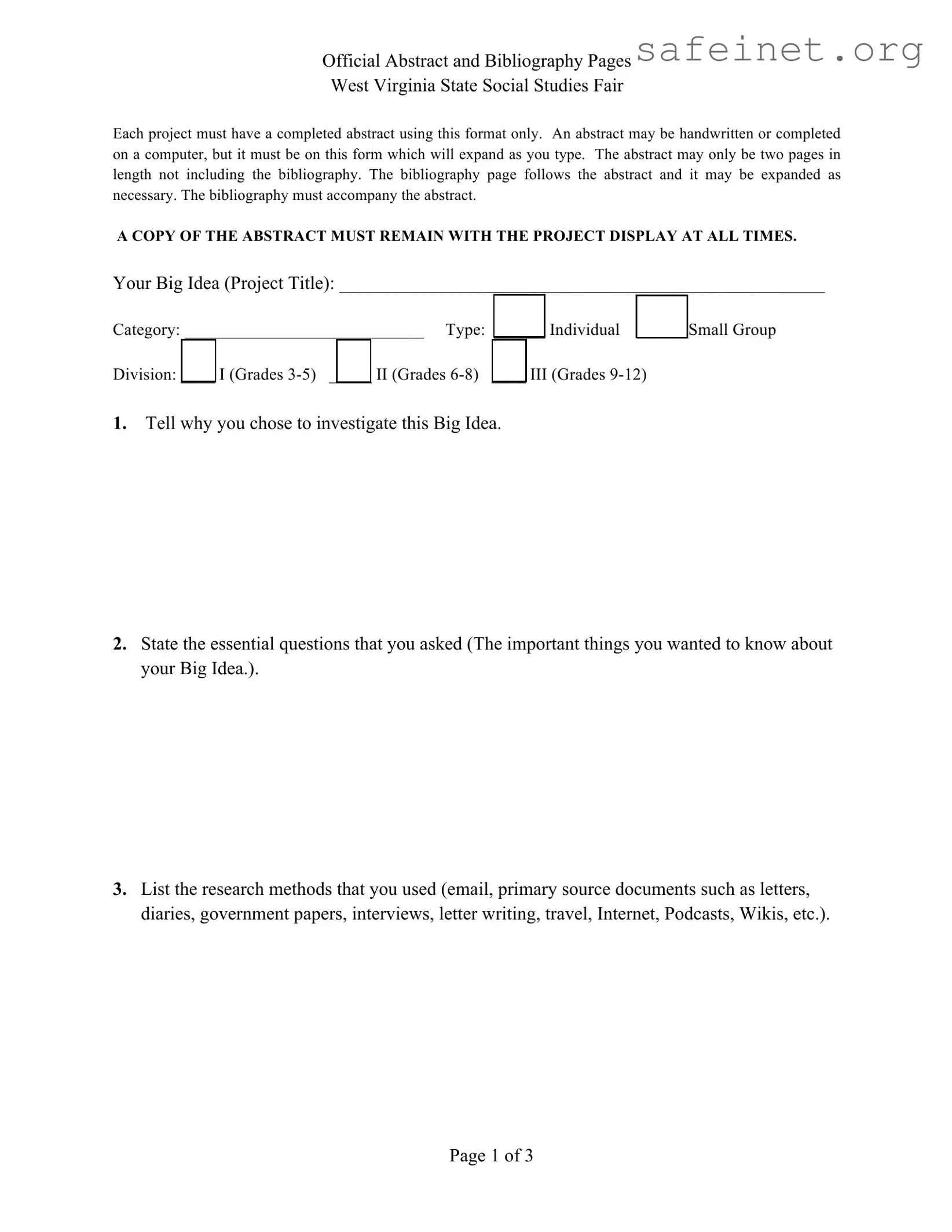
The West Virginia Abstract Social Studies Fair form serves as a vital component for students participating in the state's social studies fair. This form is designed to guide participants in presenting their research projects in a structured manner. Each project must include a completed abstract, which can be handwritten or typed, adhering to specific formatting requirements. The abstract is limited to two pages, not including the accompanying bibliography, which can be expanded as needed. Essential information such as the project title, category, type, and division must be filled out clearly. Participants are prompted to articulate their motivations for choosing their research topic, formulate essential questions, and outline the research methods employed. Furthermore, the form requires students to validate their sources and summarize their findings, culminating in a conclusion and suggestions for future improvements or predictions based on their research. A copy of the abstract must always remain with the project display, ensuring that judges and viewers have access to this crucial information. The bibliography, found on the following page, must follow a specific format, listing all sources used in the research, from books to interviews. This comprehensive approach not only helps students organize their thoughts but also prepares them for presenting their work effectively.

Official Abstract and Bibliography Pages
West Virginia State Social Studies Fair
Each project must have a completed abstract using this format only. An abstract may be handwritten or completed on a computer, but it must be on this form which will expand as you type. The abstract may only be two pages in length not including the bibliography. The bibliography page follows the abstract and it may be expanded as necessary. The bibliography must accompany the abstract.
A COPY OF THE ABSTRACT MUST REMAIN WITH THE PROJECT DISPLAY AT ALL TIMES.
Your Big Idea (Project Title): ____________________________________________________
Category: ____________________________ Type: ______ Individual ______Small Group
Division: ____ I (Grades
1.Tell why you chose to investigate this Big Idea.
2.State the essential questions that you asked (The important things you wanted to know about your Big Idea.).
3.List the research methods that you used (email, primary source documents such as letters, diaries, government papers, interviews, letter writing, travel, Internet, Podcasts, Wikis, etc.).
Page 1 of 3
4.How did you validate your sources of information?
5.Write a brief summary of your project.
6.State your conclusion.
7.Suggest a way to change or improve the outcome, or make a future prediction about what you anticipate based on what you have learned.
Complete Your Bibliography on the Following Page
Page 2 of 3
Bibliography Page
You must use a bibliographic format which includes the author, title, place of publication,
publisher, and publication date.
Here is one of many sites for bibliography formats that include audiovisuals, Internet,
newspapers,
http://www.fcps.edu/KeyMS/library/bibliography.html
Page 3 of 3
| Fact Name | Description |
|---|---|
| Abstract Format Requirement | Each project must use the official West Virginia State Social Studies Fair form for the abstract, which can be handwritten or typed. The form is designed to expand as you type. |
| Length Limit | The abstract is limited to two pages in length, not including the bibliography page, which can be expanded as needed. |
| Bibliography Requirement | A bibliography must accompany the abstract and follow it on the next page. It should include essential details like author, title, publication place, publisher, and date. |
| Project Display Copy | A copy of the abstract must remain with the project display at all times, ensuring that judges and viewers can access it easily. |
| Division Categories | Projects are categorized into three divisions based on grade levels: Division I (Grades 3-5), Division II (Grades 6-8), and Division III (Grades 9-12). |
| Research Methods | Participants must list the research methods used for their projects, which can include various sources such as emails, interviews, and online resources. |
To successfully fill out the West Virginia Abstract Social Studies Fair form, follow these steps carefully. Ensure that you provide all required information accurately and completely. This will help in presenting your project effectively.
Once you have completed the form, review it for accuracy and clarity. This will ensure that your project is presented in the best possible way during the fair.
What is the purpose of the West Virginia Abstract Social Studies Fair form?
The form serves as a structured way for students to present their research projects at the West Virginia State Social Studies Fair. It helps students articulate their ideas, methods, and findings clearly, ensuring that all essential components of their project are documented and organized. This is important for judges and viewers to understand the scope and significance of each project.
What should I include in my abstract?
Your abstract should summarize the key elements of your project. This includes why you chose your topic, the essential questions you sought to answer, the research methods you employed, how you validated your sources, a brief summary of your findings, your conclusions, and any suggestions for future improvements or predictions. Remember, the abstract should not exceed two pages, and it must be completed on the designated form.
Can I handwrite my abstract, or must it be typed?
What is the bibliography, and why is it important?
The bibliography is a list of all the sources you used during your research. It is important because it gives credit to the original authors and provides transparency about where your information came from. The bibliography must follow a specific format, including details like the author, title, place of publication, publisher, and publication date. This page should accompany your abstract and can be expanded as necessary.
How do I validate my sources of information?
Validating your sources involves checking the credibility and reliability of the information you use. This can include looking at the author's qualifications, the publication's reputation, and the date of the information. Using a mix of primary and secondary sources can also strengthen your project. Discussing how you validated your sources in your abstract demonstrates your critical thinking skills.
What happens if my abstract is not completed properly?
If your abstract is not completed according to the guidelines, it may not be accepted for the fair. This could affect your project's visibility and evaluation. To avoid this, carefully follow the instructions provided on the form and ensure all required sections are filled out thoroughly.
Do I need to keep a copy of the abstract with my project display?
Yes, a copy of your abstract must remain with your project display at all times. This allows judges and attendees to read about your project while viewing your display, enhancing their understanding of your work.
Is there a specific format for the bibliography?
Yes, your bibliography must follow a specific bibliographic format. This includes details such as the author's name, title of the work, place of publication, publisher, and date of publication. If you need help with formatting, various online resources are available to guide you. A well-structured bibliography reflects the thoroughness of your research.
What divisions are available for participants in the fair?
The fair has three divisions based on grade levels: Division I for grades 3-5, Division II for grades 6-8, and Division III for grades 9-12. Be sure to indicate your division on the form when you submit your project. This categorization helps ensure that projects are judged fairly against others at the same educational level.
Failing to adhere to the specified format for the abstract. The form must be used as provided, and any deviation may result in disqualification.
Not including a bibliography page. Every abstract must be accompanied by a bibliography that lists all sources used in the research.
Exceeding the two-page limit for the abstract. The abstract must be concise and focused, with the main content not exceeding two pages.
Neglecting to validate sources of information. It is crucial to explain how sources were verified to ensure credibility and reliability.
Omitting essential components of the project summary. Each section, including the Big Idea, essential questions, and conclusions, must be clearly addressed.
The West Virginia Abstract Social Studies Fair form serves as a critical component for students participating in the fair. However, several other documents complement this form and help to ensure a comprehensive presentation of each project. Below is a list of these documents, each serving a unique purpose in the overall process.
These additional forms and documents work together with the West Virginia Abstract Social Studies Fair form to create a well-rounded and thorough presentation. Each component plays a vital role in the research and presentation process, ultimately enhancing the educational experience for students.
The West Virginia Abstract Social Studies Fair form shares similarities with the National History Day (NHD) project submission guidelines. Both documents require students to present a clear and concise abstract that summarizes their research. The NHD guidelines also emphasize the importance of a bibliography, ensuring that students properly credit their sources. Both forms encourage critical thinking through essential questions and research methods, guiding students to articulate their findings effectively.
Another comparable document is the Science Fair project report template. Like the Social Studies Fair form, the Science Fair report requires an abstract that outlines the project's purpose and findings. Both documents serve to enhance students' research skills and promote a structured approach to presenting information. Additionally, both formats require a bibliography, which reinforces the importance of citing sources in academic work.
The International Baccalaureate (IB) Extended Essay guide is also similar in structure and purpose. It requires students to develop a research question and summarize their findings in an abstract. The emphasis on research methods and source validation in both documents encourages rigorous academic inquiry. Furthermore, the IB guide includes a bibliography section, mirroring the West Virginia form's requirement for proper citation of sources.
The Advanced Placement (AP) Research project guidelines share key features with the West Virginia form. Both documents require students to define a research question and provide a summary of their findings. They also emphasize the necessity of a bibliography to support claims made within the project. This alignment fosters a consistent approach to research across various academic disciplines.
The Project-Based Learning (PBL) framework similarly aligns with the West Virginia Abstract Social Studies Fair form. Both emphasize student choice in selecting a topic and require an abstract that encapsulates the research process. The PBL framework also encourages students to validate their sources and reflect on their findings, paralleling the requirements laid out in the Social Studies Fair form.
The Common Core State Standards for Writing include components that resonate with the West Virginia form. The standards emphasize the need for clear and coherent writing, including the ability to summarize and cite sources effectively. By aligning with these standards, the Social Studies Fair form promotes essential writing skills necessary for academic success.
The University of California's undergraduate admissions personal insight questions provide a similar structure in terms of requiring students to reflect on their experiences and articulate their findings. Both documents encourage critical thinking and self-assessment, allowing students to express their ideas clearly. The emphasis on well-structured responses is a common thread between the two formats.
The Capstone project guidelines at many high schools also reflect similarities with the West Virginia Abstract Social Studies Fair form. Both require students to present a comprehensive overview of their research in an abstract format. The need for a bibliography in both documents reinforces the importance of research integrity and proper source attribution.
Finally, the National Geographic Bee project guidelines align with the West Virginia form in requiring an abstract that summarizes the research conducted. Both documents promote inquiry-based learning and encourage students to think critically about their chosen topics. The inclusion of a bibliography in both formats underscores the necessity of credible sources in academic research.
When filling out the West Virginia Abstract Social Studies Fair form, it is important to follow specific guidelines to ensure clarity and compliance. Below is a list of things you should and shouldn't do during this process.
Here are five common misconceptions about the West Virginia Abstract Social Studies Fair form:
Filling out the West Virginia Abstract Social Studies Fair form requires attention to detail and adherence to specific guidelines. Here are key takeaways to ensure a successful submission: