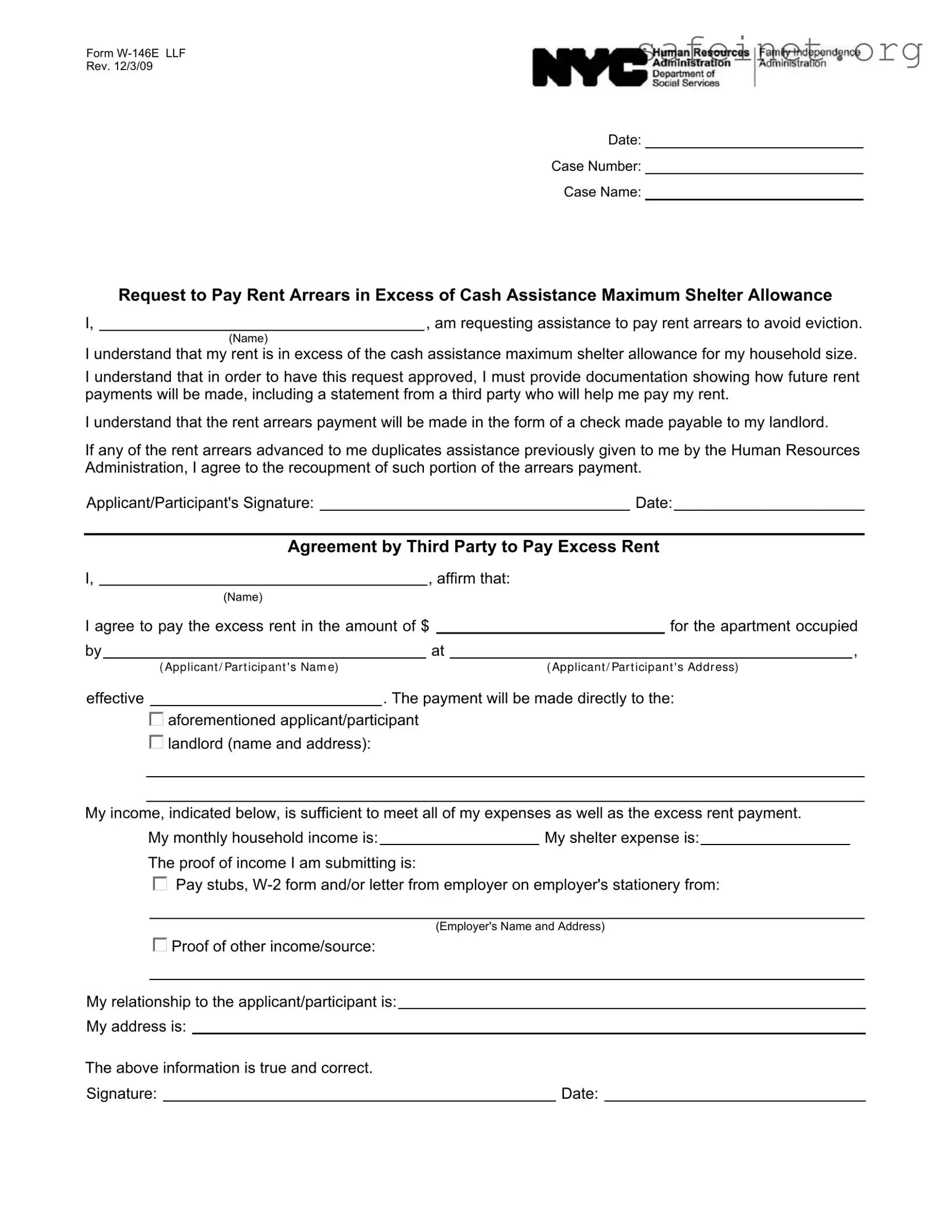
The W-146E form plays a crucial role for individuals facing financial challenges related to housing. Designed for those who are at risk of eviction due to rent arrears, this form serves as a formal request for assistance to cover unpaid rent that exceeds the cash assistance maximum shelter allowance. When completing the form, applicants must provide their name, case number, and a clear statement of their need for help. Additionally, it requires them to acknowledge that they must submit documentation to demonstrate how future rent payments will be managed. This includes a third-party statement confirming their commitment to assist with the rent. The payment, if approved, will be issued directly to the landlord in the form of a check. Importantly, if any part of the payment overlaps with previous assistance from the Human Resources Administration, the applicant agrees to allow recoupment of that amount. Furthermore, the form includes a section for a third party to affirm their agreement to cover the excess rent, detailing their income and relationship to the applicant. This comprehensive approach ensures that both the applicant's needs and the requirements for assistance are clearly outlined, promoting a smoother process for those seeking help.

Form
Rev. 12/3/09
Date:
Case Number:
Case Name:
|
Request to Pay Rent Arrears in Excess of Cash Assistance Maximum Shelter Allowance |
|
I, |
|
, am requesting assistance to pay rent arrears to avoid eviction. |
|
(Name) |
|
I understand that my rent is in excess of the cash assistance maximum shelter allowance for my household size.
I understand that in order to have this request approved, I must provide documentation showing how future rent payments will be made, including a statement from a third party who will help me pay my rent.
I understand that the rent arrears payment will be made in the form of a check made payable to my landlord.
If any of the rent arrears advanced to me duplicates assistance previously given to me by the Human Resources Administration, I agree to the recoupment of such portion of the arrears payment.
Applicant/Participant's Signature:Date:
Agreement by Third Party to Pay Excess Rent
I, |
|
, affirm that: |
|
|
|
|||||
|
|
|
(Name) |
|
|
|
|
|
|
|
I agree to pay the excess rent in the amount of $ |
|
|
for the apartment occupied |
|||||||
by |
|
|
at |
|
|
, |
||||
|
|
|
( App lican t / Par t icip an t ' s Nam e) |
|
|
|
|
( Ap plican t / Par t icipan t ' s Ad dr ess) |
||
effective |
|
. The payment will be made directly to the: |
||||||||
cef aforementioned applicant/participant cef landlord (name and address):
My income, indicated below, is sufficient to meet all of my expenses as well as the excess rent payment.
My monthly household income is:My shelter expense is: The proof of income I am submitting is:
cef Pay stubs,
(Employer's Name and Address)
cef Proof of other income/source:
My relationship to the applicant/participant is:
My address is:
The above information is true and correct.
Signature:Date:
| Fact Name | Description |
|---|---|
| Form Purpose | The W-146E form is a request for assistance to pay rent arrears that exceed the cash assistance maximum shelter allowance. |
| Eligibility Requirements | Applicants must provide documentation showing future rent payment plans and a statement from a third party who will assist with payments. |
| Payment Method | Payments for approved rent arrears will be issued as a check made payable directly to the landlord. |
| Recoupment Agreement | If any advanced rent arrears duplicate previous assistance, the applicant agrees to the recoupment of that portion. |
| Governing Law | This form is governed by regulations set forth by the Human Resources Administration in New York State. |
Filling out the W-146E form is an essential step in requesting assistance for rent arrears. Ensure that all required information is accurate and complete, as this will help facilitate the review process. After submitting the form, you may need to provide additional documentation to support your request. Follow these steps to fill out the form properly.
What is Form W-146E used for?
Form W-146E is a request for assistance to pay rent arrears that exceed the cash assistance maximum shelter allowance. Individuals facing eviction can use this form to seek help in covering past due rent. It requires the applicant to provide documentation that demonstrates how future rent payments will be managed.
Who should fill out Form W-146E?
This form should be completed by individuals who are struggling to pay rent and are at risk of eviction. The applicant must acknowledge that their rent exceeds the maximum shelter allowance for their household size. Additionally, a third party must be involved to affirm their willingness to assist with the excess rent payments.
What documentation is required when submitting Form W-146E?
When submitting Form W-146E, the applicant must provide documentation showing how they plan to make future rent payments. This includes a statement from a third party who agrees to help pay the excess rent. Proof of income, such as pay stubs or a W-2 form, must also be included to demonstrate the applicant’s financial situation.
How will the rent arrears payment be issued?
The payment for rent arrears will be issued in the form of a check made payable directly to the landlord. This ensures that the funds are used specifically for settling the overdue rent. It is important to note that if any of the advanced rent arrears duplicate prior assistance received, the applicant agrees to have that amount recouped.
What happens if the information provided is incorrect?
If any information provided on Form W-146E is found to be incorrect, it could lead to delays or denial of assistance. It is crucial for the applicant and the third party to ensure that all information is accurate and truthful. Misrepresentation can have serious consequences, including potential legal action.
Failing to provide complete personal information. When filling out the form, applicants often forget to include their full name, case number, and date. This omission can lead to delays in processing the request.
Not clearly stating the amount of rent arrears. It is crucial to specify the exact dollar amount being requested for rent arrears. Vague or incomplete figures can result in confusion and potential denial of the application.
Neglecting to include documentation of future rent payments. Applicants must demonstrate how they plan to make future rent payments. Without this documentation, the request may not be approved.
Omitting third-party information. If a third party is involved in paying the excess rent, their details must be clearly stated. This includes their name, address, and a statement affirming their commitment to assist.
Not providing proof of income. Applicants often forget to include necessary income documentation, such as pay stubs or a W-2 form. This proof is essential for verifying the applicant's ability to meet expenses.
Using incorrect or outdated forms. Submitting a version of the form that is not the most current can lead to complications. Always ensure that the latest version is being used.
Failing to sign and date the application. An unsigned form is essentially incomplete. Applicants must remember to sign and date their submission to validate their request.
Inaccurate or misleading information. Providing false information, whether intentionally or unintentionally, can have serious repercussions. It is vital that all details are accurate and truthful.
The W-146E form is an important document used to request assistance for paying rent arrears. When submitting this form, several other documents may also be required to support the application. Below is a list of commonly used forms and documents that often accompany the W-146E form.
Gathering these documents can streamline the process of applying for rent arrears assistance. Each document plays a role in providing a comprehensive view of the applicant's financial situation and the necessity for support.
The W-146E form shares similarities with the W-9 form, which is used to provide taxpayer identification information. Both forms require personal details, such as the name and address of the individual involved. The W-9 form, however, focuses on tax reporting, while the W-146E centers on rent arrears assistance. Each form demands a signature, affirming the accuracy of the information provided. In essence, both documents serve to establish a formal request, whether for tax purposes or assistance with housing costs.
Another document comparable to the W-146E is the Rental Assistance Application. Like the W-146E, this application seeks to provide aid to individuals facing financial difficulties regarding their housing. Both documents require applicants to disclose their financial situation, including income and expenses. While the Rental Assistance Application is typically more comprehensive, gathering extensive details about the applicant's circumstances, the W-146E specifically targets rent arrears, making it a focused request for immediate assistance.
The Eviction Prevention Form is also similar to the W-146E. This form is designed to help individuals who are at risk of losing their housing. Both forms highlight the urgency of the situation and require documentation to support the request for assistance. The Eviction Prevention Form may include additional details about the eviction process, whereas the W-146E specifically addresses the need for assistance with rent arrears, showcasing the applicant's commitment to resolving their housing issues.
Lastly, the Lease Agreement can be compared to the W-146E form. While the Lease Agreement outlines the terms and conditions of renting a property, it indirectly relates to the W-146E by establishing the financial obligations of the tenant. Both documents require clear identification of the parties involved and the property in question. The Lease Agreement serves as the foundation for the rental relationship, while the W-146E seeks to address a specific financial challenge within that relationship, demonstrating the interconnectedness of rental agreements and financial assistance requests.
When filling out the W-146E form, it is essential to follow specific guidelines to ensure accuracy and completeness. Below is a list of things to do and avoid during this process.
Misconceptions about the W-146E form can lead to confusion and hinder the assistance process. Below are some common misunderstandings, along with clarifications to help you navigate this important document.
When filling out the W-146E form, it's essential to be thorough and accurate. Here are some key takeaways to keep in mind:
Completing the W-146E form accurately and promptly is crucial to avoid delays in receiving the assistance you need. Be sure to double-check all information before submission.