The Virginia Transfer-on-Death Deed form offers a straightforward way for property owners to transfer their real estate to designated beneficiaries without the complexities of probate. This legal tool allows individuals to retain full control of their property during their lifetime, while ensuring that ownership automatically passes to the chosen heirs upon their death. By filling out this form, property owners can specify who will inherit their property, making the process smoother for loved ones during a difficult time. Importantly, the deed must be properly executed and recorded to be valid, ensuring that the transfer is legally recognized. Additionally, the form provides flexibility, allowing for multiple beneficiaries or even a contingent beneficiary in case the primary beneficiary is unable to inherit. Understanding the nuances of this deed can empower property owners to make informed decisions about their estate planning, ultimately providing peace of mind for both themselves and their heirs.
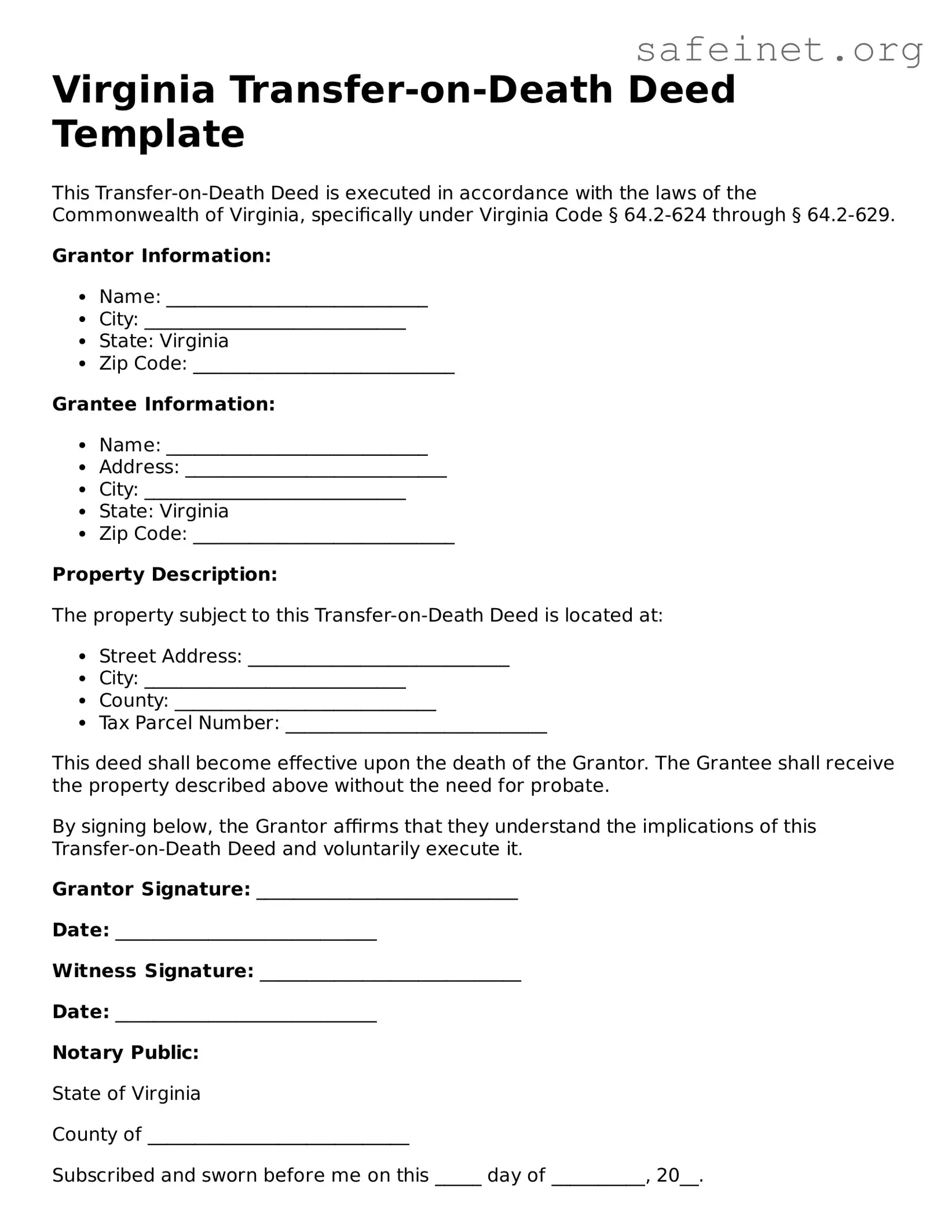
Virginia Transfer-on-Death Deed Template
This Transfer-on-Death Deed is executed in accordance with the laws of the Commonwealth of Virginia, specifically under Virginia Code § 64.2-624 through § 64.2-629.
Grantor Information:
Grantee Information:
Property Description:
The property subject to this Transfer-on-Death Deed is located at:
This deed shall become effective upon the death of the Grantor. The Grantee shall receive the property described above without the need for probate.
By signing below, the Grantor affirms that they understand the implications of this Transfer-on-Death Deed and voluntarily execute it.
Grantor Signature: ____________________________
Date: ____________________________
Witness Signature: ____________________________
Date: ____________________________
Notary Public:
State of Virginia
County of ____________________________
Subscribed and sworn before me on this _____ day of __________, 20__.
Notary Signature: ____________________________
My Commission Expires: ____________________________
| Fact Name | Description |
|---|---|
| Definition | A Transfer-on-Death Deed allows an individual to transfer real estate to a beneficiary upon their death without going through probate. |
| Governing Law | The Transfer-on-Death Deed in Virginia is governed by Virginia Code § 64.2-621. |
| Eligibility | Any individual who owns real estate in Virginia can create a Transfer-on-Death Deed. |
| Beneficiary Designation | The deed allows for one or more beneficiaries to be named, who will receive the property upon the owner's death. |
| Revocation | The owner can revoke or change the deed at any time before their death, provided they follow the proper procedures. |
| No Immediate Transfer | Ownership of the property does not transfer to the beneficiary until the owner's death. |
| Tax Implications | The transfer does not trigger any immediate tax consequences for the owner or the beneficiary. |
| Filing Requirement | The deed must be recorded in the local land records office to be effective. |
| Limitations | Transfer-on-Death Deeds cannot be used for all types of property, such as certain types of jointly owned properties. |
| Legal Advice | Consulting with an attorney is recommended to ensure that the deed meets all legal requirements and reflects the owner's wishes. |
Once you have the Virginia Transfer-on-Death Deed form in hand, you can begin the process of filling it out. This deed allows you to designate a beneficiary who will receive your property upon your passing, without going through probate. After completing the form, it will need to be signed, notarized, and recorded with the appropriate local government office to ensure its validity.
What is a Transfer-on-Death Deed in Virginia?
A Transfer-on-Death Deed (TODD) is a legal document that allows an individual to transfer real estate to a beneficiary upon their death. This deed enables property owners to pass on their property without going through the probate process, making it a simpler and often quicker way to transfer ownership.
Who can use a Transfer-on-Death Deed in Virginia?
Any individual who owns real estate in Virginia can use a Transfer-on-Death Deed. This includes homeowners, co-owners, and individuals holding property in various forms of ownership. However, it’s important to note that the deed must be properly executed and recorded to be valid.
How do I create a Transfer-on-Death Deed?
To create a Transfer-on-Death Deed, you need to fill out the form with the necessary information, including the property details and the beneficiary’s information. After completing the form, you must sign it in the presence of a notary public. Finally, the deed must be recorded with the local land records office in the jurisdiction where the property is located.
Can I change or revoke a Transfer-on-Death Deed?
Yes, you can change or revoke a Transfer-on-Death Deed at any time before your death. To do this, you must create a new deed that either revokes the previous one or designates a different beneficiary. It’s essential to record any changes with the local land records office to ensure that the new deed is recognized.
What happens if the beneficiary dies before me?
If the beneficiary named in the Transfer-on-Death Deed passes away before you, the property will not automatically transfer to that individual’s heirs. Instead, the property will remain in your estate and can be transferred according to your will or state intestacy laws if you do not have a will.
Are there any tax implications with a Transfer-on-Death Deed?
Generally, there are no immediate tax implications when creating a Transfer-on-Death Deed. The property is not considered part of the beneficiary's estate until the owner passes away. However, it’s advisable to consult a tax professional to understand any potential estate or inheritance tax implications that may arise after the transfer occurs.
Do I need an attorney to create a Transfer-on-Death Deed?
While it is not legally required to have an attorney to create a Transfer-on-Death Deed, consulting one can be beneficial. An attorney can help ensure that the deed is completed correctly and meets all legal requirements, reducing the risk of complications in the future.
Not Including All Required Information: One common mistake is failing to provide all the necessary details. The form requires specific information about the property, the owner, and the beneficiary. Omitting even a single piece of information can render the deed invalid.
Incorrectly Identifying the Property: People often misidentify the property they wish to transfer. It’s crucial to accurately describe the property, including its address and parcel number. Errors in this section can lead to complications or disputes later on.
Not Signing the Deed: A deed without a signature is not a deed at all. Individuals sometimes forget to sign the document or fail to have it notarized. Both signatures are essential to ensure the deed is legally binding.
Failing to Record the Deed: After completing the form, some people neglect to record it with the appropriate local government office. Recording the deed is vital; without it, the transfer may not be recognized upon the owner's death.
Not Understanding the Implications: Many individuals overlook the long-term effects of creating a Transfer-on-Death Deed. It's important to consider how this decision may impact estate planning and the rights of other potential heirs.
The Virginia Transfer-on-Death Deed allows individuals to transfer real property to beneficiaries upon their death without the need for probate. While this deed is a crucial document in estate planning, several other forms and documents are often used in conjunction with it to ensure a comprehensive approach to managing assets and intentions. Below is a list of related documents that may complement the Transfer-on-Death Deed.
Each of these documents plays a vital role in estate planning and asset management. Together, they help individuals articulate their wishes clearly and ensure that their intentions are honored after their passing. Properly preparing and organizing these documents can facilitate a smoother transition of assets to beneficiaries and reduce potential disputes among family members.
The Virginia Transfer-on-Death Deed form shares similarities with a Last Will and Testament. Both documents allow individuals to express their wishes regarding the distribution of their assets upon death. However, a key difference lies in the fact that a Transfer-on-Death Deed allows for the immediate transfer of property outside of probate, while a will typically requires the probate process to validate and execute the distribution of assets. This can lead to a quicker transfer of property to beneficiaries in the case of a Transfer-on-Death Deed.
A Durable Power of Attorney is another document that bears resemblance to the Transfer-on-Death Deed. Both documents involve the designation of individuals to manage or receive property on behalf of another. In the case of a Durable Power of Attorney, the designated agent can manage financial matters during the principal's lifetime, while the Transfer-on-Death Deed specifically addresses the transfer of property upon death. Each document serves to facilitate the management of assets, albeit at different stages of life.
The Beneficiary Designation form is similar in that it allows individuals to specify who will receive certain assets upon their death. Commonly used for accounts such as life insurance policies or retirement accounts, this form ensures that assets pass directly to the named beneficiaries without going through probate. Like the Transfer-on-Death Deed, this method promotes a streamlined transfer process, although it applies to different types of assets.
The Joint Tenancy with Right of Survivorship agreement also shares characteristics with the Transfer-on-Death Deed. Both methods allow for the transfer of property to a surviving owner upon the death of one owner. However, Joint Tenancy creates a shared ownership during both parties' lifetimes, whereas the Transfer-on-Death Deed does not require co-ownership and only takes effect upon death. Each method provides a way to facilitate the transfer of property, though they operate under different ownership structures.
Lastly, the Life Estate Deed is comparable to the Transfer-on-Death Deed in that both documents allow for the transfer of property while retaining certain rights. A Life Estate Deed enables an individual to retain the right to live in or use the property during their lifetime, while the property automatically transfers to a designated beneficiary upon death. The Transfer-on-Death Deed, on the other hand, transfers ownership without any retained rights, simplifying the process for beneficiaries once the owner passes away.
When filling out the Virginia Transfer-on-Death Deed form, it is essential to follow certain guidelines to ensure the document is valid and effective. Here are five things you should and shouldn't do:
By following these guidelines, you can help ensure that your Transfer-on-Death Deed is properly executed and serves its intended purpose.
The Virginia Transfer-on-Death (TOD) Deed is a useful tool for estate planning, allowing property owners to transfer real estate to beneficiaries without going through probate. However, several misconceptions surround this deed. Here are ten common misunderstandings:
Many believe that TOD deeds are only beneficial for those with significant assets. In reality, anyone who owns property can utilize this deed to simplify the transfer process.
Some think that the TOD deed automatically transfers ownership of the property immediately upon death. However, the transfer only occurs when the owner passes away, and the deed must be properly executed and recorded.
Many assume that revoking a TOD deed requires extensive legal action. In fact, the property owner can revoke the deed at any time by executing a new deed or a revocation document.
Some people worry that using a TOD deed will impact their eligibility for government benefits like Medicaid. In most cases, this is not true, as the property is not considered part of the owner's estate until their death.
It is a common belief that all heirs must consent to the transfer of property via a TOD deed. However, the property owner has the right to designate beneficiaries without needing approval from other heirs.
Some think that a TOD deed allows for only a single beneficiary. In reality, property owners can name multiple beneficiaries and even specify how the property will be divided among them.
Many believe that TOD deeds can be used for any asset type. However, they are specifically designed for real estate and do not apply to personal property or bank accounts.
Some people think that having a TOD deed means they no longer need a will. While a TOD deed simplifies property transfer, a will is still essential for addressing other aspects of an estate.
There is a misconception that anyone can easily create a TOD deed without legal help. While it is possible to fill out the form independently, consulting with a lawyer can ensure that the deed is executed correctly and meets all legal requirements.
Lastly, some believe that once a TOD deed is established, it cannot be changed. This is not the case; property owners can modify or revoke the deed as their circumstances change.
Understanding these misconceptions can help individuals make informed decisions about their estate planning. A Transfer-on-Death Deed can be a valuable asset, but it’s essential to grasp its limitations and proper use.
When filling out and using the Virginia Transfer-on-Death Deed form, it is essential to understand the following key points:
Understanding these points can help ensure that the Transfer-on-Death Deed is filled out correctly and serves its intended purpose.