When a loved one passes away, managing their estate can feel overwhelming, especially during such an emotional time. In Virginia, the Small Estate Affidavit offers a streamlined process for settling the affairs of a deceased individual whose estate is valued at $50,000 or less. This form allows certain heirs or beneficiaries to claim property without the need for formal probate proceedings, simplifying what can often be a complex and lengthy legal process. By using this affidavit, individuals can gain access to the deceased's assets, including bank accounts and personal property, while ensuring that debts and taxes are appropriately addressed. However, it’s essential to understand the eligibility requirements and the specific steps involved in completing the form correctly to avoid potential complications. This article will guide you through the ins and outs of the Virginia Small Estate Affidavit, helping you navigate this important tool with confidence and clarity.
Virginia Small Estate Affidavit
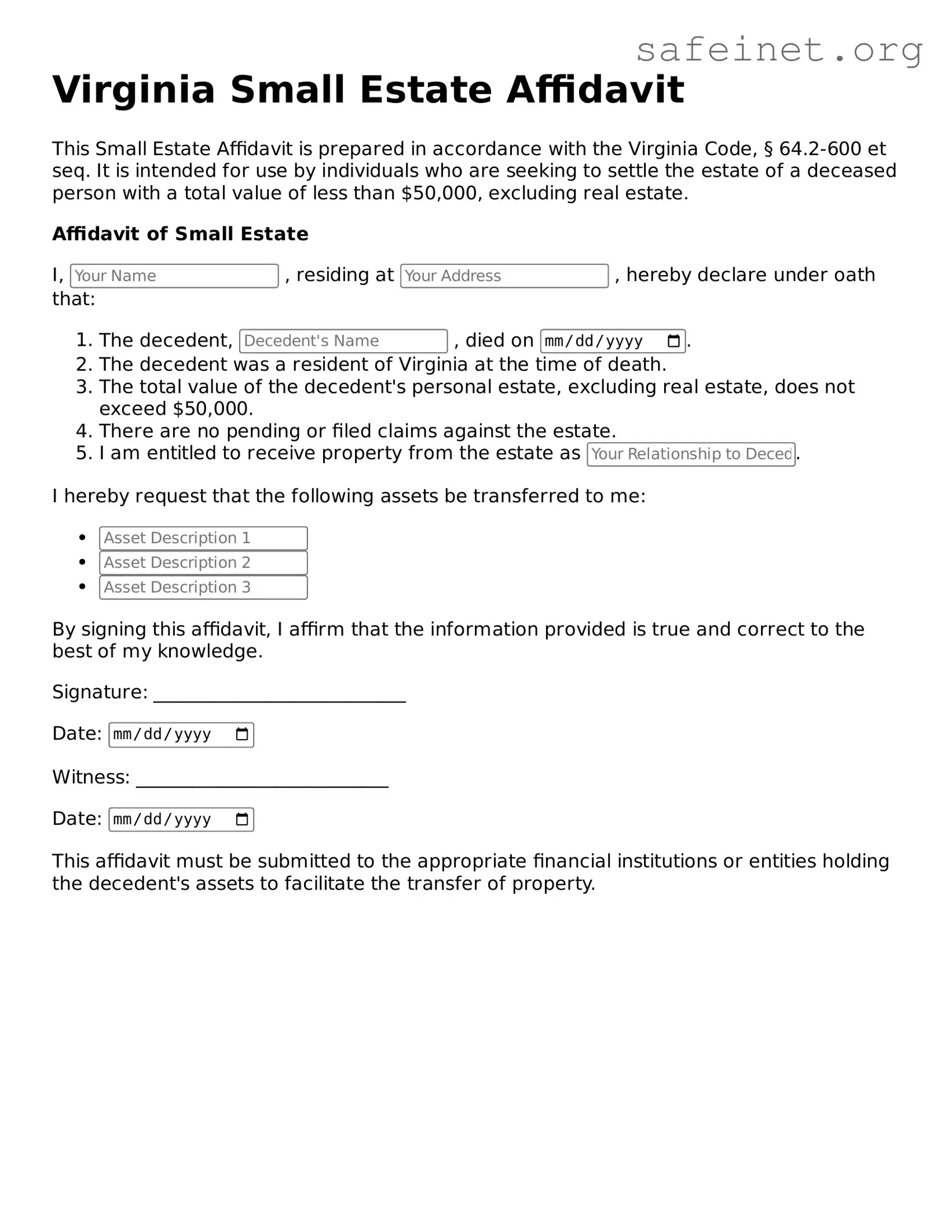
This Small Estate Affidavit is prepared in accordance with the Virginia Code, § 64.2-600 et seq. It is intended for use by individuals who are seeking to settle the estate of a deceased person with a total value of less than $50,000, excluding real estate.
Affidavit of Small Estate
I, , residing at , hereby declare under oath that:
I hereby request that the following assets be transferred to me:
By signing this affidavit, I affirm that the information provided is true and correct to the best of my knowledge.
Signature: ___________________________
Date:
Witness: ___________________________
Date:
This affidavit must be submitted to the appropriate financial institutions or entities holding the decedent's assets to facilitate the transfer of property.
| Fact Name | Detail |
|---|---|
| Purpose | The Virginia Small Estate Affidavit is used to simplify the process of settling small estates without going through formal probate. |
| Eligibility | The affidavit can be used when the total value of the estate is $50,000 or less, excluding real estate. |
| Governing Law | This form is governed by Virginia Code § 64.2-600. |
| Who Can Use It | Heirs or beneficiaries of the deceased can use the affidavit to claim assets. |
| Required Information | The affidavit must include the decedent's name, date of death, and a list of assets. |
| Filing Process | The completed affidavit is submitted to the financial institution or entity holding the assets. |
| Notarization | The affidavit must be signed in the presence of a notary public. |
| Debts and Liabilities | Affidavit users must affirm that the estate has no outstanding debts or that debts have been paid. |
| Real Estate Exclusion | The small estate affidavit cannot be used to transfer real property; separate procedures are required. |
| Timeframe | There is no specific deadline for using the affidavit, but it should be done promptly to settle the estate efficiently. |
After gathering all necessary information and documentation, you are ready to complete the Virginia Small Estate Affidavit form. This process involves providing accurate details about the deceased individual, their estate, and the heirs. Following these steps will help ensure that the form is filled out correctly.
What is a Virginia Small Estate Affidavit?
The Virginia Small Estate Affidavit is a legal document that allows individuals to settle the estate of a deceased person without going through the lengthy probate process. This form is typically used when the total value of the deceased person's assets is below a certain threshold, making it a simpler and more efficient option for heirs and beneficiaries.
Who is eligible to use the Small Estate Affidavit in Virginia?
In Virginia, any individual who is entitled to inherit from the deceased can use the Small Estate Affidavit. This includes heirs, beneficiaries named in a will, or even individuals who would inherit under state law if there is no will. However, the total value of the estate must not exceed $50,000, excluding real estate, for the affidavit to be applicable.
What assets are included in the Small Estate Affidavit?
When filling out the Small Estate Affidavit, you can include various types of assets. This generally encompasses bank accounts, personal property, and other items that do not require formal probate. Real estate, however, is not included in the $50,000 limit and must be handled separately.
How do I complete the Small Estate Affidavit?
Completing the Small Estate Affidavit involves gathering information about the deceased’s assets and debts. You will need to provide details such as the deceased's name, date of death, and a list of assets. After filling out the form, you must sign it in front of a notary public to ensure its validity. Make sure all information is accurate to avoid delays.
What happens after I submit the Small Estate Affidavit?
Once the Small Estate Affidavit is completed and notarized, you can present it to financial institutions, banks, or other entities that hold the deceased's assets. They will review the affidavit and, if everything checks out, will release the assets to you or the other entitled heirs. This process is typically much quicker than going through formal probate.
Can I still use the Small Estate Affidavit if there is a will?
Yes, you can still use the Small Estate Affidavit even if there is a will. However, the will must be submitted to the local probate court for record-keeping purposes. The affidavit allows you to collect the assets without undergoing the full probate process, making it a convenient option for settling the estate.
Not including all required information. Make sure to fill out every section of the form. Missing details can delay the process.
Forgetting to sign the affidavit. A signature is crucial. Without it, the affidavit is not valid.
Using outdated forms. Always check for the latest version of the Small Estate Affidavit. Using an old form can lead to complications.
Neglecting to provide accurate asset values. List the correct values for all assets. Underestimating or overestimating can cause issues.
Failing to list all heirs. Include every person entitled to inherit. Omitting an heir can lead to disputes later.
Not having the affidavit notarized. A notary's signature is often required. Without it, the affidavit may not be accepted.
Ignoring local laws. Each locality may have specific requirements. Familiarize yourself with local rules to avoid mistakes.
Overlooking deadlines. There may be time limits for filing the affidavit. Keep track of these dates to ensure compliance.
Not seeking help when needed. If unsure about any part of the form, consult a professional. Getting assistance can prevent costly errors.
When navigating the process of settling a small estate in Virginia, several key documents are often required alongside the Virginia Small Estate Affidavit form. These documents help clarify the estate's assets and ensure a smooth transfer of property. Below are four important forms that may be needed.
Having these documents prepared and organized can significantly streamline the process of settling a small estate in Virginia. By understanding what is needed, you can take proactive steps to ensure a smoother transition during this challenging time.
The Virginia Small Estate Affidavit is often compared to the Affidavit of Heirship. This document serves a similar purpose by allowing heirs to claim assets of a deceased individual without going through the lengthy probate process. An Affidavit of Heirship is typically used when the decedent did not leave a will, and it provides a way for heirs to establish their rights to the deceased's property. Just like the Small Estate Affidavit, it must be signed in front of a notary and may require additional proof of the relationship between the heirs and the deceased.
Another document that shares similarities with the Virginia Small Estate Affidavit is the Petition for Summary Administration. This petition is used in some states to expedite the probate process for small estates. Like the Small Estate Affidavit, it allows for a quicker resolution, enabling beneficiaries to access the decedent's assets without the need for a full probate proceeding. Both documents aim to simplify the transfer of property and minimize legal complexities, making it easier for families to handle their loved one's affairs.
The Affidavit of Collection is yet another form that operates in a similar realm. This document allows individuals to collect personal property of a deceased person without going through probate, provided the estate meets certain criteria. Much like the Small Estate Affidavit, the Affidavit of Collection can be used for small estates and requires the affiant to affirm their right to collect the assets. Both documents help streamline the process of asset distribution, ensuring that beneficiaries can access what they are entitled to without unnecessary delays.
Lastly, the Declaration of Informal Probate is comparable to the Virginia Small Estate Affidavit in that it allows for a simplified probate process under specific circumstances. This declaration is utilized when the decedent had a will, but the estate is small enough to qualify for informal proceedings. Similar to the Small Estate Affidavit, it helps reduce the burden on families during a difficult time, allowing for a more straightforward approach to settling the estate. Both documents provide an avenue for beneficiaries to receive their inheritance while bypassing the full probate process.
When it comes to filling out the Virginia Small Estate Affidavit form, following the right steps can make the process smoother. Here’s a handy list of dos and don’ts to keep in mind.
By keeping these tips in mind, you can navigate the Small Estate Affidavit process with confidence and ease. Remember, attention to detail is key!
Misconception 1: The Small Estate Affidavit can only be used for estates worth less than $15,000.
Many individuals believe that the Small Estate Affidavit in Virginia is strictly limited to estates valued at $15,000 or less. However, this is not entirely accurate. The threshold applies to the total value of personal property, excluding real estate. If the estate meets certain conditions, it can still qualify even if the value exceeds this amount, depending on the specific circumstances.
Misconception 2: Only heirs can file a Small Estate Affidavit.
Some people think that only heirs of the deceased can initiate the Small Estate Affidavit process. In reality, any individual who is entitled to the property, such as a beneficiary named in a will, can file the affidavit. This opens up the process to a wider range of individuals who may have a legitimate claim to the estate.
Misconception 3: The Small Estate Affidavit eliminates the need for probate.
While the Small Estate Affidavit simplifies the process for certain estates, it does not completely eliminate the need for probate in all cases. If there are disputes among heirs, or if the estate includes real property, probate may still be necessary. Understanding the nuances of each situation is crucial for determining the appropriate legal path.
Misconception 4: Filing a Small Estate Affidavit is a quick and easy process.
Many assume that completing and filing a Small Estate Affidavit is straightforward and will lead to a quick resolution. While the form itself may be simple, gathering the necessary documentation and ensuring compliance with all requirements can take time. It is important to approach the process with careful preparation to avoid delays.
The Virginia Small Estate Affidavit is a useful tool for settling the estate of a deceased individual without the need for formal probate proceedings. Here are key takeaways regarding its use: