The Virginia Self-Proving Affidavit form plays a crucial role in the estate planning process, particularly in simplifying the probate of a will. This legal document allows a testator and witnesses to affirm the validity of the will without requiring their physical presence in court after the testator's death. By incorporating this form, individuals can streamline the probate process, reducing the time and costs associated with proving the will's authenticity. The affidavit typically includes essential details such as the testator's name, the date of the will, and the signatures of both the testator and witnesses. This form can provide peace of mind, ensuring that the intentions of the deceased are honored while minimizing potential disputes among heirs. Understanding the significance and proper use of the Virginia Self-Proving Affidavit can empower individuals to make informed decisions about their estate planning needs.
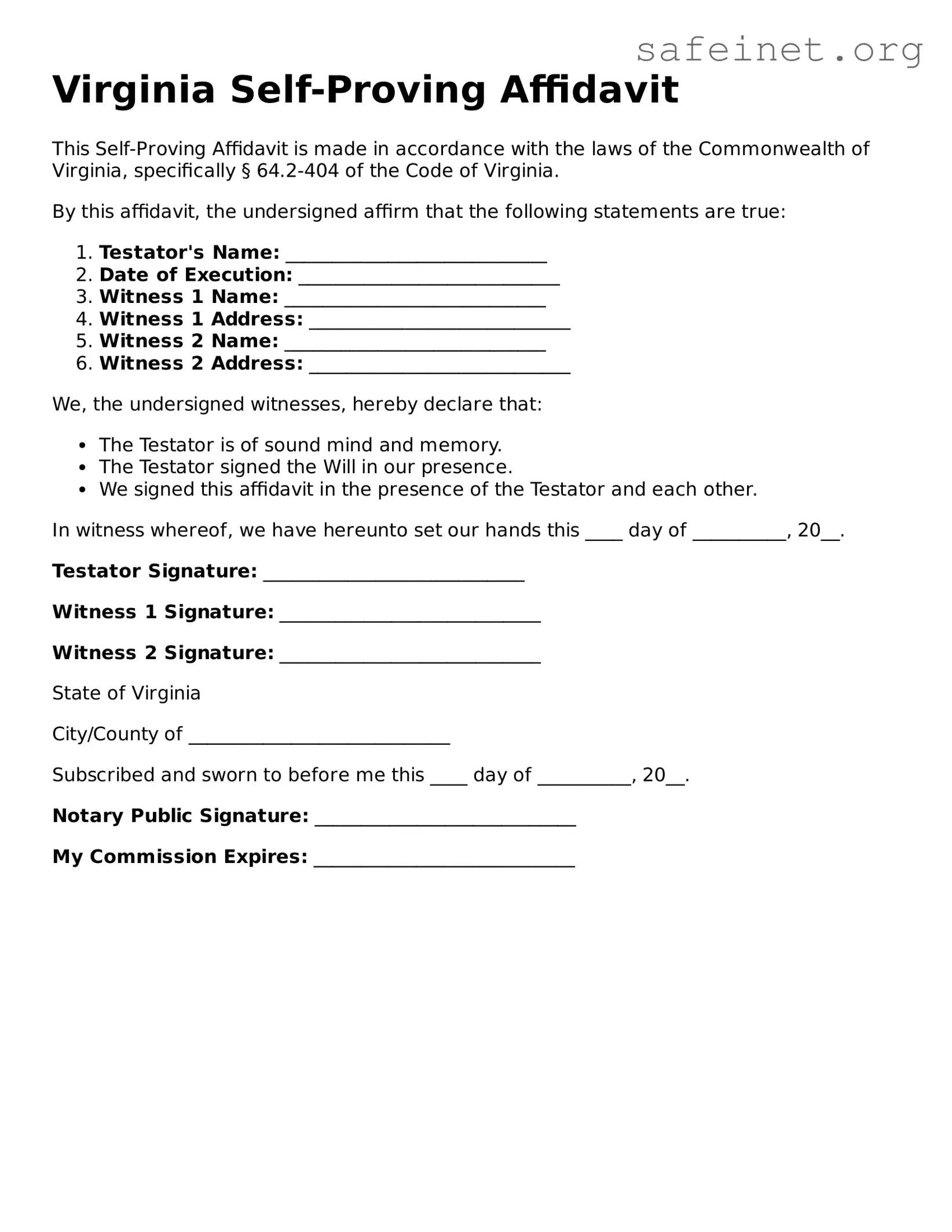
Virginia Self-Proving Affidavit
This Self-Proving Affidavit is made in accordance with the laws of the Commonwealth of Virginia, specifically § 64.2-404 of the Code of Virginia.
By this affidavit, the undersigned affirm that the following statements are true:
We, the undersigned witnesses, hereby declare that:
In witness whereof, we have hereunto set our hands this ____ day of __________, 20__.
Testator Signature: ____________________________
Witness 1 Signature: ____________________________
Witness 2 Signature: ____________________________
State of Virginia
City/County of ____________________________
Subscribed and sworn to before me this ____ day of __________, 20__.
Notary Public Signature: ____________________________
My Commission Expires: ____________________________
| Fact Name | Details |
|---|---|
| Definition | A Virginia Self-Proving Affidavit is a legal document that allows a will to be validated without the need for witnesses to testify in court. |
| Governing Law | The use of the Self-Proving Affidavit is governed by Virginia Code § 64.2-404. |
| Purpose | This affidavit simplifies the probate process by affirming the will's authenticity at the time of signing. |
| Requirements | The affidavit must be signed by the testator and witnessed by at least two individuals who are present at the same time. |
| Form Availability | The Self-Proving Affidavit form can be found through the Virginia Secretary of the Commonwealth's website or legal resources. |
| Effectiveness | This affidavit becomes effective upon the signing of the will, provided it is properly executed. |
Once you have the Virginia Self-Proving Affidavit form ready, you can proceed to fill it out. This form is essential for validating a will, and completing it accurately will help ensure that your intentions are honored. Follow these steps to complete the form correctly.
After completing the form, make sure to keep it with your will. This will help streamline the probate process when the time comes.
What is a Virginia Self-Proving Affidavit?
A Virginia Self-Proving Affidavit is a legal document that helps validate a will. It allows the will to be accepted by the court without needing the witnesses to testify. This affidavit is typically signed at the same time as the will, making the process smoother for the executor and beneficiaries after the person has passed away.
Why should I use a Self-Proving Affidavit?
Using a Self-Proving Affidavit simplifies the probate process. It saves time and effort by eliminating the need for witnesses to appear in court. This can be especially helpful if witnesses are unavailable or if their testimony might be difficult to obtain.
Who can sign the Self-Proving Affidavit?
The affidavit must be signed by the testator (the person making the will) and at least two witnesses. All parties must be present at the same time when signing the document. It’s important that the witnesses are not beneficiaries of the will to avoid potential conflicts of interest.
Is a Self-Proving Affidavit required in Virginia?
No, a Self-Proving Affidavit is not required to make a will valid in Virginia. However, including one can make the probate process easier and faster. It’s a helpful tool to ensure that the will can be accepted by the court without additional testimony.
How do I complete a Self-Proving Affidavit?
To complete the affidavit, you will need to fill out the form with the necessary information, including the names and addresses of the testator and witnesses. Everyone involved must sign the document in front of a notary public, who will then notarize the affidavit to confirm its authenticity.
Where can I find the Self-Proving Affidavit form?
The Self-Proving Affidavit form can typically be obtained from legal websites, law offices, or local probate courts in Virginia. It’s important to ensure that you are using the most current version of the form to comply with state laws.
Can I revoke a Self-Proving Affidavit?
Yes, you can revoke a Self-Proving Affidavit. If you create a new will or modify an existing one, the new document should include a new affidavit. The old affidavit becomes invalid when the new will is executed. Always ensure that the new will clearly states that it revokes any prior wills.
What happens if I don’t use a Self-Proving Affidavit?
If you choose not to use a Self-Proving Affidavit, the will can still be valid. However, the probate process may take longer. The court may require witnesses to testify about the will’s validity, which can complicate matters and delay the distribution of assets.
Is there a fee for filing a Self-Proving Affidavit?
There is no specific fee for filing a Self-Proving Affidavit itself, as it is typically included with the will during the probate process. However, there may be fees associated with filing the will in court or hiring legal assistance. Check with your local probate court for any applicable fees.
Can I create a Self-Proving Affidavit without a lawyer?
Yes, you can create a Self-Proving Affidavit without a lawyer. Many people choose to do this using templates or online resources. However, consulting with a lawyer can provide additional guidance and ensure that the document meets all legal requirements in Virginia.
Incorrect Signatures: One common mistake is not having the testator and witnesses sign the affidavit in the correct order. Ensure that all parties sign in the presence of each other.
Missing Dates: Failing to include the date of signing can lead to complications. Always write the date clearly next to each signature.
Not Notarizing: The affidavit must be notarized to be valid. Forgetting this step can invalidate the document.
Inaccurate Information: Double-check all personal information. Mistakes in names, addresses, or other details can create issues later on.
Using an Outdated Form: Always use the most current version of the Self-Proving Affidavit. Laws can change, and using an outdated form can lead to legal challenges.
Neglecting Witnesses: Not having the required number of witnesses present during the signing can invalidate the affidavit. Make sure to have at least two competent witnesses.
Filing Errors: When submitting the affidavit, ensure that it is filed with the appropriate court. Misfiling can lead to delays in the probate process.
The Virginia Self-Proving Affidavit is an important document that allows a will to be validated without the need for witnesses to testify in court. It serves to streamline the probate process. Along with this affidavit, several other forms and documents are commonly used in estate planning and administration. Below is a list of these documents, along with brief descriptions of each.
Each of these documents plays a vital role in the estate planning process. Properly preparing and executing them can help ensure that an individual's wishes are honored and that their loved ones are provided for. Consulting with a legal professional can help navigate these important decisions.
The Virginia Self-Proving Affidavit is similar to the Affidavit of Execution. Both documents serve to verify the authenticity of a will. The Affidavit of Execution is typically signed by witnesses who affirm that they observed the testator sign the will. In contrast, the Self-Proving Affidavit allows the testator and witnesses to provide sworn statements, simplifying the probate process by eliminating the need for witnesses to appear in court.
Another comparable document is the Self-Proving Will. This type of will includes a self-proving affidavit within its structure. By incorporating the affidavit, the will can be admitted to probate without the need for additional witness testimony. This streamlines the legal process and provides a clear declaration of the testator's intentions.
The Durable Power of Attorney shares similarities with the Self-Proving Affidavit in that both documents require the principal’s and witnesses’ signatures. While the Durable Power of Attorney grants authority to another person to act on behalf of the principal, the Self-Proving Affidavit confirms the will's validity. Both documents emphasize the importance of having reliable witnesses to avoid disputes later on.
The Living Will is another document that bears resemblance to the Self-Proving Affidavit. Both documents are designed to express the individual's wishes. A Living Will outlines medical treatment preferences, while the Self-Proving Affidavit ensures that the testator’s estate plan is honored. Each document requires clear, unequivocal statements to be effective.
The Revocable Trust Agreement also parallels the Self-Proving Affidavit. Both are used to manage assets and ensure that an individual’s wishes are respected after their death. A Revocable Trust can be modified during the grantor's lifetime, while the Self-Proving Affidavit is a fixed declaration confirming the will's execution. Both documents aim to simplify the transfer of assets and reduce the burden on heirs.
The Last Will and Testament is perhaps the most direct comparison to the Self-Proving Affidavit. The will outlines how a person's assets should be distributed upon their death, while the Self-Proving Affidavit serves as proof that the will was properly executed. Both documents are essential in the estate planning process and must be carefully prepared to ensure that the testator's wishes are carried out.
The Affidavit of Heirship is another document that shares a purpose with the Self-Proving Affidavit. It is often used to establish the heirs of a deceased individual, particularly when no will exists. While the Self-Proving Affidavit confirms the validity of a will, the Affidavit of Heirship provides clarity regarding the distribution of assets when the decedent did not leave a will, ensuring that the estate is settled fairly.
The Certificate of Trust can also be likened to the Self-Proving Affidavit. This document provides evidence of the existence of a trust and outlines the powers of the trustee. Similar to the Self-Proving Affidavit, the Certificate of Trust helps to avoid probate by confirming the authority to manage and distribute assets according to the trust's terms.
Lastly, the Codicil is a legal document that modifies an existing will, much like the Self-Proving Affidavit affirms the original will's validity. A Codicil must be executed with the same formalities as a will, and it can clarify, add, or revoke provisions. Both documents are integral to ensuring that a person's final wishes are accurately reflected and legally recognized.
When filling out the Virginia Self-Proving Affidavit form, it is essential to follow specific guidelines to ensure the document is valid and effective. Here are some important dos and don'ts:
The Virginia Self-Proving Affidavit is an important legal document, yet many people hold misconceptions about it. Below are seven common misunderstandings along with clarifications.
It is only necessary for wills with large estates. Many believe that only those with significant assets need a self-proving affidavit. In reality, it can benefit any will, regardless of estate size, by simplifying the probate process.
It replaces the need for witnesses. Some think that having a self-proving affidavit eliminates the need for witnesses. However, witnesses are still required at the time of signing the will; the affidavit simply confirms their signatures later.
It must be filed with the court immediately. Many assume that the affidavit must be submitted to the court right away. In fact, it is typically presented during the probate process when the will is filed.
Only lawyers can prepare a self-proving affidavit. There is a belief that only legal professionals can create this document. While a lawyer can help, individuals can also prepare it as long as they follow the correct format and guidelines.
It is not valid if the testator changes their mind. Some people think that once a self-proving affidavit is signed, it cannot be altered. This is incorrect; the testator can revoke or change their will at any time, and the affidavit will no longer apply.
It is only needed in Virginia. While this affidavit is specific to Virginia, many states have similar provisions. People often overlook the fact that each state has its own requirements for self-proving wills.
It guarantees that the will will not be contested. A common misconception is that having a self-proving affidavit makes a will immune to challenges. However, it does not prevent disputes; it merely streamlines the process if the will is contested.
Understanding these misconceptions can help individuals navigate the complexities of estate planning more effectively.
When dealing with the Virginia Self-Proving Affidavit form, it’s crucial to understand its significance in the estate planning process. Here are some key takeaways to keep in mind:
Taking these steps seriously can help ensure that your wishes are honored and that your loved ones are protected. Don’t delay in addressing your estate planning needs!