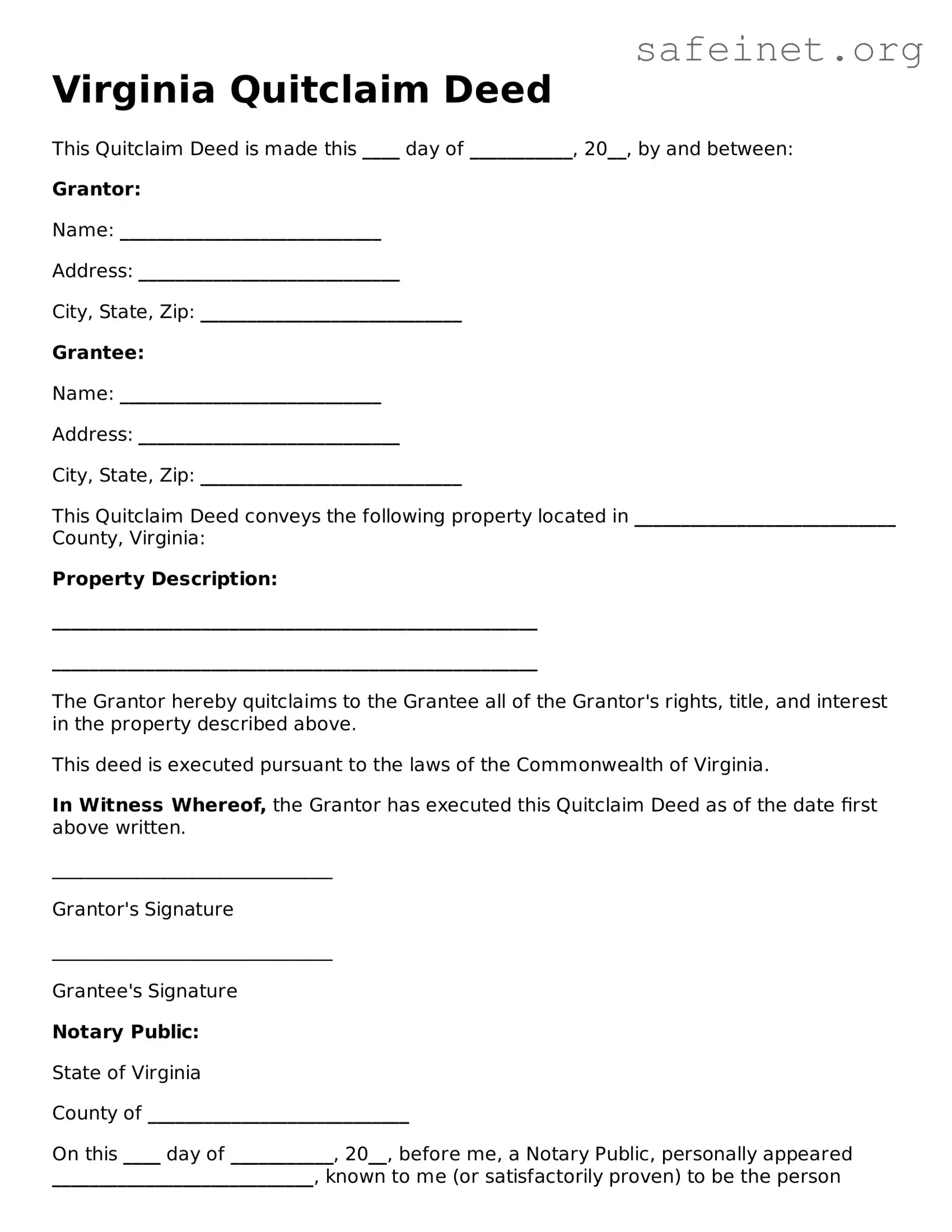
In Virginia, the Quitclaim Deed serves as a crucial tool for property owners looking to transfer their interest in real estate without the complexities often associated with other types of deeds. This form is particularly useful in situations where the transferor may not guarantee a clear title or when the parties involved have a pre-existing relationship, such as family members or business partners. Unlike warranty deeds, which offer assurances about the title, a quitclaim deed simply conveys whatever interest the grantor has, if any, in the property. This makes it an appealing option for quick transfers, such as during divorce settlements or when adding a spouse to a property title. Additionally, the form must be properly executed and recorded to ensure that the transfer is legally recognized. Understanding the nuances of the Virginia Quitclaim Deed can help individuals navigate property transfers more effectively and avoid potential disputes down the line.
Virginia Quitclaim Deed
This Quitclaim Deed is made this ____ day of ___________, 20__, by and between:
Grantor:
Name: ____________________________
Address: ____________________________
City, State, Zip: ____________________________
Grantee:
Name: ____________________________
Address: ____________________________
City, State, Zip: ____________________________
This Quitclaim Deed conveys the following property located in ____________________________ County, Virginia:
Property Description:
____________________________________________________
____________________________________________________
The Grantor hereby quitclaims to the Grantee all of the Grantor's rights, title, and interest in the property described above.
This deed is executed pursuant to the laws of the Commonwealth of Virginia.
In Witness Whereof, the Grantor has executed this Quitclaim Deed as of the date first above written.
______________________________
Grantor's Signature
______________________________
Grantee's Signature
Notary Public:
State of Virginia
County of ____________________________
On this ____ day of ___________, 20__, before me, a Notary Public, personally appeared ____________________________, known to me (or satisfactorily proven) to be the person whose name is subscribed to the within instrument, and acknowledged that he/she executed the same for the purposes therein contained.
In Witness Whereof, I hereunto set my hand and official seal.
______________________________
Notary Public Signature
My Commission Expires: ____________________________
| Fact Name | Details |
|---|---|
| Definition | A quitclaim deed is a legal document used to transfer ownership of real estate without any warranties or guarantees. |
| Governing Law | The Virginia Quitclaim Deed is governed by Virginia Code § 55.1-600 et seq. |
| Use Cases | Commonly used among family members, to clear up title issues, or in divorce settlements. |
| Requirements | The deed must be signed by the grantor and notarized for it to be valid. |
| Limitations | A quitclaim deed does not guarantee that the grantor has good title to the property. |
After gathering the necessary information and understanding the purpose of the Virginia Quitclaim Deed form, you are ready to fill it out. This document will require specific details about the property and the parties involved. Follow the steps below to complete the form accurately.
Once you have filled out the form and ensured all information is accurate, the next step involves recording the deed with the local county clerk's office. This action will officially document the transfer of property ownership.
What is a Virginia Quitclaim Deed?
A Virginia Quitclaim Deed is a legal document used to transfer ownership of real property from one party to another. This type of deed does not guarantee that the grantor has clear title to the property. Instead, it simply conveys whatever interest the grantor may have in the property at the time of the transfer. It is often used in situations where the parties know each other well, such as family transfers or divorces.
When should a Quitclaim Deed be used?
A Quitclaim Deed is typically used in specific scenarios, including transferring property between family members, clearing up title issues, or transferring property into or out of a trust. It is important to note that this deed does not provide any warranties regarding the property's title, making it less suitable for transactions involving unknown parties or for sales where a warranty is desired.
How do I complete a Virginia Quitclaim Deed?
To complete a Virginia Quitclaim Deed, you need to provide essential information such as the names of the grantor and grantee, a legal description of the property, and the date of the transfer. The document must be signed by the grantor in the presence of a notary public. After signing, it should be recorded with the local county clerk's office to ensure that the transfer is legally recognized.
Is notarization required for a Quitclaim Deed in Virginia?
Yes, notarization is required for a Quitclaim Deed in Virginia. The grantor must sign the deed in front of a notary public. The notary will verify the identity of the grantor and witness the signing of the document, which adds a layer of authenticity to the deed.
What are the tax implications of using a Quitclaim Deed?
Using a Quitclaim Deed may have tax implications, particularly regarding property taxes and potential capital gains taxes. In Virginia, transferring property through a Quitclaim Deed may not trigger immediate tax consequences, but it is advisable to consult with a tax professional to understand any potential liabilities that may arise from the transfer.
Can a Quitclaim Deed be revoked?
A Quitclaim Deed cannot be revoked once it has been executed and recorded. However, if the grantor wishes to regain ownership of the property, they would need to execute a new deed to transfer the property back, which may involve additional legal steps. It is essential to consider the implications of the transfer before executing a Quitclaim Deed.
Where can I obtain a Quitclaim Deed form in Virginia?
Quitclaim Deed forms can be obtained from various sources, including online legal form providers, local real estate offices, or legal stationery stores. It is important to ensure that the form complies with Virginia state laws and includes all necessary information for the transfer to be valid.
Incorrect Property Description: Failing to accurately describe the property can lead to confusion or disputes. Make sure to include the correct address, parcel number, and any relevant details.
Missing Signatures: All parties involved must sign the deed. Omitting a signature can invalidate the document.
Not Notarizing the Document: A Quitclaim Deed typically requires notarization. Without a notary's signature, the deed may not be legally binding.
Improperly Identifying Grantors and Grantees: Ensure that the names of the individuals or entities transferring and receiving the property are correctly listed. Mistakes here can lead to ownership issues.
Failure to Include Consideration: The deed should state the consideration, or payment, for the transfer. Not mentioning this can create legal complications.
Omitting the Date: Failing to include the date of the transfer can lead to confusion regarding when ownership changes hands.
Not Following Local Requirements: Each locality may have specific requirements for recording a Quitclaim Deed. Ignoring these can result in rejection by the recording office.
Not Providing a Legal Description: A general address is not sufficient. A legal description, often found in previous deeds, is essential for clarity.
Failing to Record the Deed: After completing the Quitclaim Deed, it must be recorded with the appropriate local government office. Neglecting this step can leave the transfer unprotected.
The Virginia Quitclaim Deed is a crucial document used to transfer property ownership. However, several other forms and documents often accompany it to ensure a smooth transaction. Below is a list of these documents, each serving a specific purpose in the property transfer process.
In summary, these additional forms and documents play a vital role in the property transfer process in Virginia. Ensuring that all necessary paperwork is completed can help prevent issues and facilitate a smoother transaction.
A Warranty Deed is similar to a Quitclaim Deed in that both are used to transfer property ownership. However, a Warranty Deed provides a guarantee that the seller holds clear title to the property and has the right to sell it. This means the buyer is protected against any claims or disputes regarding ownership. In contrast, a Quitclaim Deed makes no such guarantees, leaving the buyer with less protection.
A Bargain and Sale Deed also transfers property ownership, but it implies that the seller has the right to sell the property without providing warranties. Like a Quitclaim Deed, it does not guarantee that the title is free from defects. The main difference lies in the implication of ownership rights; a Bargain and Sale Deed suggests some level of ownership interest, while a Quitclaim Deed does not.
A Deed of Trust is similar in that it involves property but serves a different purpose. It is used to secure a loan with real estate as collateral. The borrower transfers the property to a trustee, who holds it until the loan is repaid. Unlike a Quitclaim Deed, which transfers ownership outright, a Deed of Trust maintains the lender's interest in the property until the debt is settled.
An Easement Deed grants a right to use a portion of someone else's property for a specific purpose, such as accessing a road. While it does not transfer ownership like a Quitclaim Deed, both documents involve real property rights. The key difference is that an Easement Deed allows limited use rather than full ownership transfer.
A Lease Agreement allows one party to use another's property for a specified time in exchange for payment. While it does not transfer ownership, it shares similarities with a Quitclaim Deed in that both involve rights to real property. The primary distinction is that a Lease Agreement is temporary and does not convey ownership.
A Life Estate Deed grants ownership of a property for the duration of someone's life. After the person's death, the property passes to another party. This document is similar to a Quitclaim Deed in that it transfers property rights but differs in that it creates a life interest rather than an outright transfer of ownership.
A Transfer on Death Deed allows property owners to transfer their real estate to beneficiaries upon their death without going through probate. While it does not convey ownership during the owner’s lifetime, it shares the Quitclaim Deed's simplicity in transferring property rights, albeit with a focus on future transfer rather than immediate ownership.
A Partition Deed is used when co-owners of a property decide to divide their interests. It transfers specific portions of property to each owner. While a Quitclaim Deed can also be used to transfer ownership, a Partition Deed specifically addresses the division of jointly owned property, making it a more tailored option for co-owners.
Finally, a Grant Deed is similar to a Quitclaim Deed in that both are used to transfer property. However, a Grant Deed includes warranties that the property has not been sold to anyone else and that it is free from encumbrances. This provides more security to the buyer compared to the lack of warranties in a Quitclaim Deed.
When filling out the Virginia Quitclaim Deed form, it's important to approach the task with care. Here are some key points to consider.
Things You Should Do:
Things You Shouldn't Do:
By following these guidelines, you can help ensure that your Quitclaim Deed is filled out correctly and processed without issues.
There are several misconceptions about the Virginia Quitclaim Deed form that can lead to confusion. Here’s a clear breakdown of these misunderstandings:
Understanding these misconceptions can help individuals make informed decisions when dealing with property transfers in Virginia.
When filling out and using the Virginia Quitclaim Deed form, keep these key takeaways in mind: