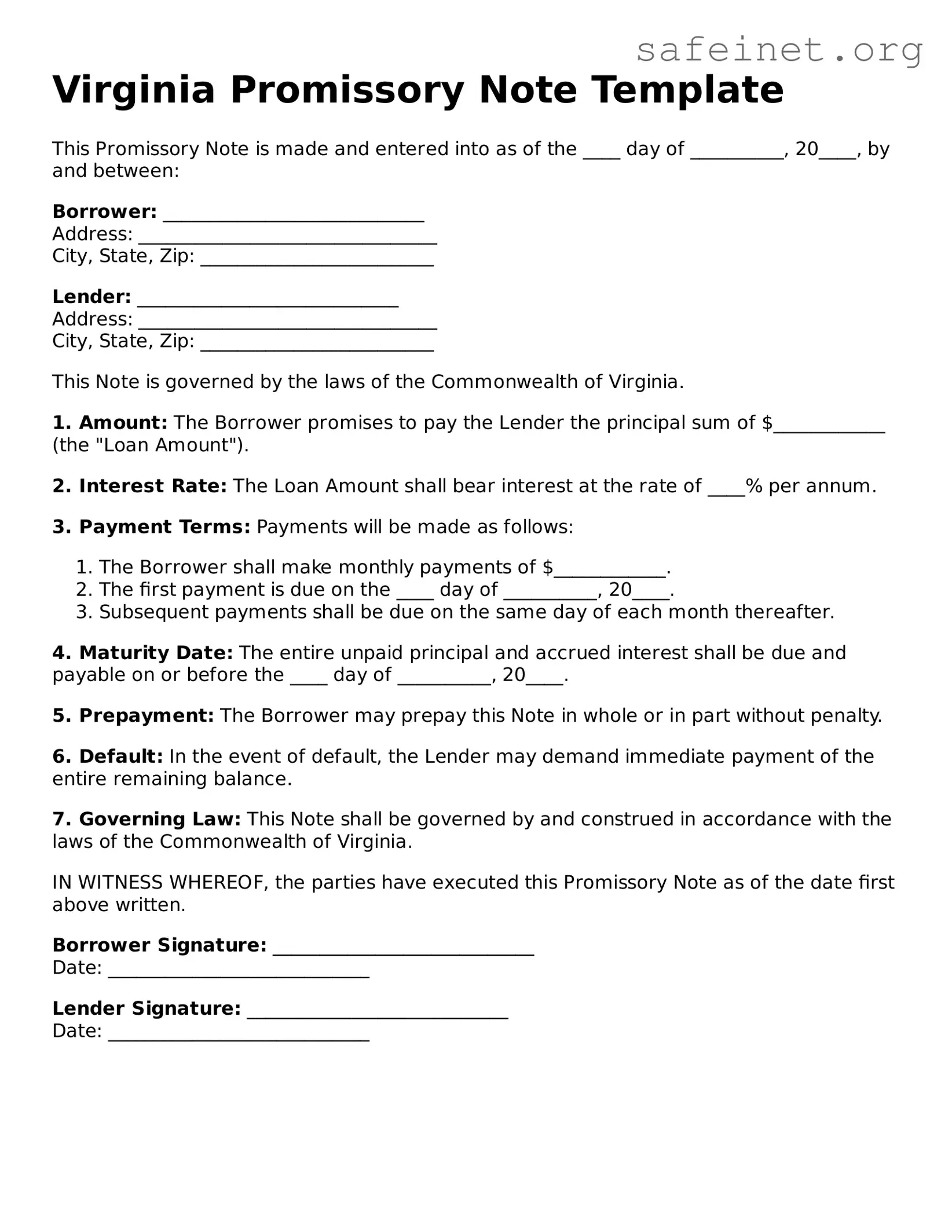
The Virginia Promissory Note form is an essential document for anyone involved in lending or borrowing money in Virginia. This legal instrument outlines the terms of a loan agreement, ensuring that both parties understand their rights and obligations. Typically, it includes key elements such as the principal amount borrowed, the interest rate, and the repayment schedule. Additionally, it may specify any collateral involved, which provides security for the lender. The form also covers what happens in case of default, detailing the consequences for the borrower. Understanding these components is crucial for both lenders and borrowers, as they establish a clear framework for the transaction. By using a properly drafted promissory note, individuals can avoid misunderstandings and protect their interests in financial dealings.
Virginia Promissory Note Template
This Promissory Note is made and entered into as of the ____ day of __________, 20____, by and between:
Borrower: ____________________________
Address: ________________________________
City, State, Zip: _________________________
Lender: ____________________________
Address: ________________________________
City, State, Zip: _________________________
This Note is governed by the laws of the Commonwealth of Virginia.
1. Amount: The Borrower promises to pay the Lender the principal sum of $____________ (the "Loan Amount").
2. Interest Rate: The Loan Amount shall bear interest at the rate of ____% per annum.
3. Payment Terms: Payments will be made as follows:
4. Maturity Date: The entire unpaid principal and accrued interest shall be due and payable on or before the ____ day of __________, 20____.
5. Prepayment: The Borrower may prepay this Note in whole or in part without penalty.
6. Default: In the event of default, the Lender may demand immediate payment of the entire remaining balance.
7. Governing Law: This Note shall be governed by and construed in accordance with the laws of the Commonwealth of Virginia.
IN WITNESS WHEREOF, the parties have executed this Promissory Note as of the date first above written.
Borrower Signature: ____________________________
Date: ____________________________
Lender Signature: ____________________________
Date: ____________________________
| Fact Name | Description |
|---|---|
| Definition | A Virginia Promissory Note is a written promise to pay a specified amount of money to a designated person or entity at a future date. |
| Governing Law | The Virginia Promissory Note is governed by the Virginia Uniform Commercial Code (UCC), specifically Article 3. |
| Parties Involved | The note involves two main parties: the maker (borrower) and the payee (lender). |
| Interest Rate | The interest rate can be fixed or variable and should be clearly stated in the note. |
| Payment Terms | The payment terms, including due dates and installment amounts, must be explicitly outlined. |
| Signatures | The note must be signed by the maker to be legally binding. A witness or notary is not required but can add an extra layer of verification. |
| Default Clauses | Default clauses can be included to outline the consequences if the maker fails to make payments as agreed. |
After you have gathered the necessary information, you are ready to fill out the Virginia Promissory Note form. This document will require specific details about the loan, the parties involved, and the terms of repayment. Careful attention to each section will ensure that the form is completed correctly.
Once you have completed the form, ensure that both parties keep a copy for their records. This will help prevent misunderstandings in the future.
What is a Virginia Promissory Note?
A Virginia Promissory Note is a written agreement between a borrower and a lender. It outlines the terms of a loan, including the amount borrowed, the interest rate, and the repayment schedule. This document serves as a legal record of the debt and the borrower's promise to repay it under specified conditions.
Who can use a Virginia Promissory Note?
Anyone who needs to borrow or lend money can use a Virginia Promissory Note. This includes individuals, businesses, and organizations. It’s important that both parties understand the terms and conditions outlined in the note before signing.
What information is included in a Virginia Promissory Note?
A typical Virginia Promissory Note includes the names and addresses of the borrower and lender, the loan amount, the interest rate, the repayment schedule, and any late fees or penalties for missed payments. It may also include clauses about prepayment and default.
Is a Virginia Promissory Note legally binding?
Yes, once signed by both parties, a Virginia Promissory Note is legally binding. This means that the borrower is obligated to repay the loan according to the terms specified in the note. If the borrower fails to repay, the lender has the right to take legal action to recover the debt.
Do I need a lawyer to create a Virginia Promissory Note?
While it’s not required to have a lawyer, consulting one can be beneficial. A lawyer can help ensure that the note is properly drafted and complies with Virginia laws. This can prevent potential disputes in the future and provide peace of mind for both parties.
Can a Virginia Promissory Note be modified?
Yes, a Virginia Promissory Note can be modified if both the borrower and lender agree to the changes. Any modifications should be documented in writing and signed by both parties to ensure clarity and enforceability.
Failing to include all required information.
Many individuals overlook the necessity of providing complete details. This includes the names and addresses of both the borrower and the lender, the loan amount, and the interest rate.
Not specifying the repayment terms.
It is essential to clearly outline how and when the borrower will repay the loan. Vague terms can lead to misunderstandings and disputes later on.
Ignoring the date of the agreement.
The date the Promissory Note is signed should always be included. This date serves as a reference point for the start of the loan and the repayment schedule.
Neglecting to sign the document.
Both parties must sign the Promissory Note for it to be legally binding. A missing signature can invalidate the agreement.
A Virginia Promissory Note is a crucial document for outlining the terms of a loan agreement between a borrower and a lender. However, several other forms and documents often accompany it to ensure clarity and legal protection for both parties involved. Below are some commonly used documents that work alongside the Promissory Note.
Utilizing these additional documents alongside the Virginia Promissory Note can help both parties navigate the lending process more smoothly. Understanding each document's purpose ensures that all terms are clear, reducing the potential for disputes in the future.
A loan agreement is similar to a promissory note in that it outlines the terms of borrowing money. Both documents specify the amount borrowed, the interest rate, and the repayment schedule. However, a loan agreement typically includes more detailed terms regarding the rights and responsibilities of both the borrower and lender. It may also address what happens in the event of default, providing a more comprehensive framework for the loan relationship.
A mortgage is another document that shares similarities with a promissory note. While a promissory note is a promise to pay back borrowed money, a mortgage secures that promise with collateral, usually the property being purchased. The mortgage document outlines the lender's rights to the property if the borrower fails to repay the loan. Both documents work together to facilitate real estate transactions, ensuring that lenders have a legal claim to the property if necessary.
An installment agreement is akin to a promissory note in that it details a repayment plan for a debt. This document specifies the total amount owed, the installment amounts, and the payment schedule. Like a promissory note, it serves as a written acknowledgment of the debt. However, installment agreements are often used for smaller debts and may involve different terms regarding late payments and penalties.
A personal guarantee is similar to a promissory note in that it involves a commitment to repay a debt. In this case, a third party agrees to be responsible for the debt if the primary borrower defaults. While a promissory note is a direct promise from the borrower, a personal guarantee adds an extra layer of security for the lender. It provides assurance that the lender can seek repayment from another source if needed.
A credit agreement also shares characteristics with a promissory note. This document outlines the terms under which a lender extends credit to a borrower. It includes details such as the credit limit, interest rates, and repayment terms. While a promissory note is often used for a specific loan, a credit agreement can cover a broader range of borrowing, allowing for ongoing access to funds as long as the borrower remains within the agreed terms.
When filling out the Virginia Promissory Note form, it is important to follow certain guidelines to ensure accuracy and legal validity. Here are five things to consider:
Understanding the Virginia Promissory Note form is essential for anyone involved in lending or borrowing money. However, several misconceptions can lead to confusion. Here are four common misunderstandings:
While notarization can add an extra layer of security, it is not a legal requirement for a promissory note to be enforceable in Virginia. The essential elements are the agreement between the parties and the intent to repay.
In fact, a clear repayment schedule is crucial. It provides both parties with a mutual understanding of when payments are due and helps avoid potential disputes.
Virginia law does regulate interest rates. Lenders must comply with state usury laws, which limit the maximum interest rate that can be charged. Failing to adhere to these laws can render the note unenforceable.
While both documents relate to borrowing and lending, they serve different purposes. A promissory note is a simple promise to repay, whereas a loan agreement often includes additional terms, conditions, and obligations beyond the repayment promise.
When filling out and using the Virginia Promissory Note form, consider the following key takeaways: