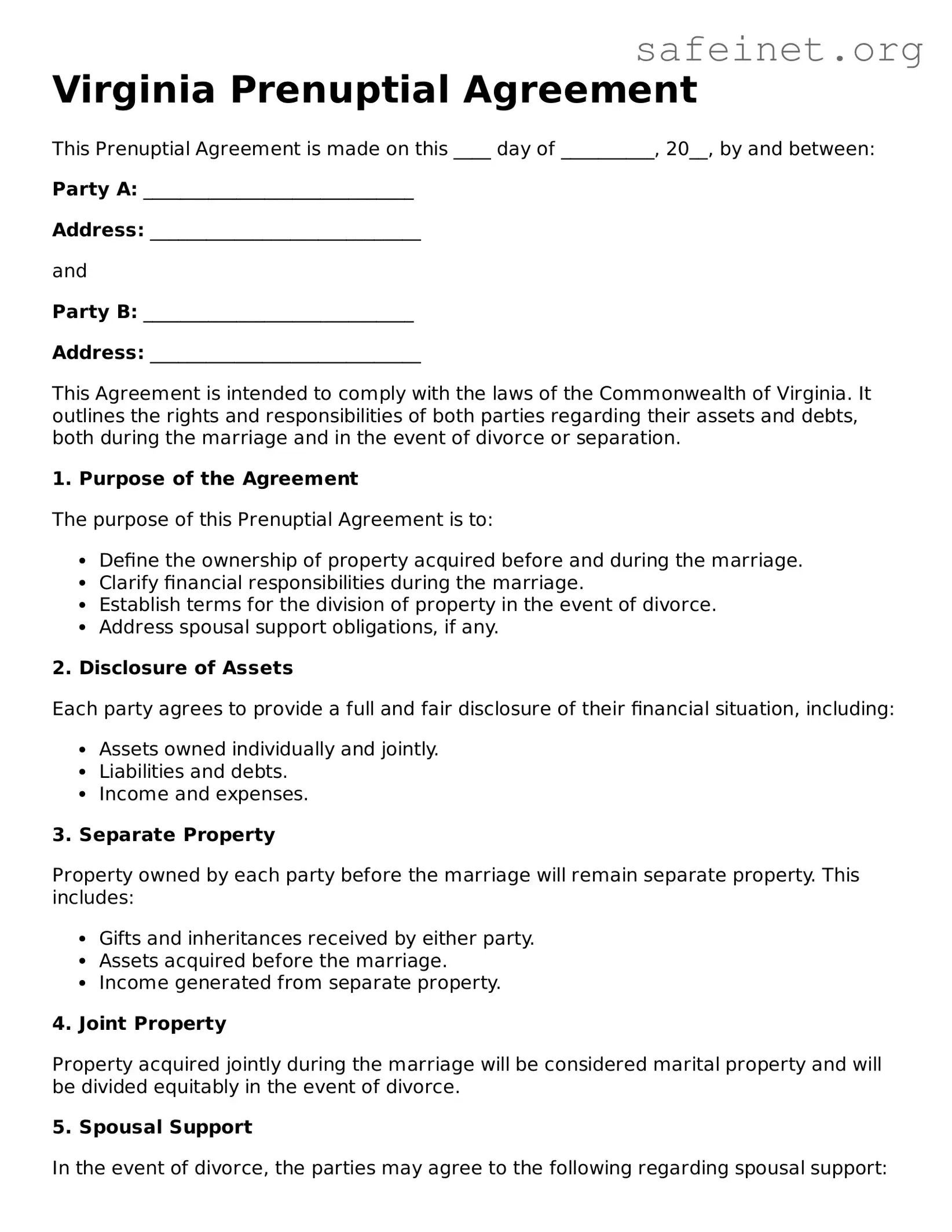
In Virginia, a prenuptial agreement serves as a vital tool for couples planning to marry, allowing them to outline their financial rights and responsibilities before tying the knot. This legally binding document addresses key aspects such as the division of property, debt management, and spousal support in the event of divorce or separation. Couples can customize the agreement to reflect their unique financial situations and future goals, ensuring clarity and protection for both parties. By discussing these matters openly and honestly, individuals can foster a sense of security in their relationship. The Virginia prenuptial agreement form provides a structured format for these discussions, making it easier for couples to articulate their wishes and expectations. With careful consideration and proper execution, this agreement can help mitigate potential conflicts and misunderstandings, ultimately contributing to a healthier partnership.
Virginia Prenuptial Agreement
This Prenuptial Agreement is made on this ____ day of __________, 20__, by and between:
Party A: _____________________________
Address: _____________________________
and
Party B: _____________________________
Address: _____________________________
This Agreement is intended to comply with the laws of the Commonwealth of Virginia. It outlines the rights and responsibilities of both parties regarding their assets and debts, both during the marriage and in the event of divorce or separation.
1. Purpose of the Agreement
The purpose of this Prenuptial Agreement is to:
2. Disclosure of Assets
Each party agrees to provide a full and fair disclosure of their financial situation, including:
3. Separate Property
Property owned by each party before the marriage will remain separate property. This includes:
4. Joint Property
Property acquired jointly during the marriage will be considered marital property and will be divided equitably in the event of divorce.
5. Spousal Support
In the event of divorce, the parties may agree to the following regarding spousal support:
6. Governing Law
This Agreement shall be governed by and construed in accordance with the laws of the Commonwealth of Virginia.
7. Amendments
This Agreement may only be amended in writing, signed by both parties.
8. Severability
If any provision of this Agreement is found to be unenforceable, the remaining provisions shall remain in effect.
IN WITNESS WHEREOF, the parties hereto have executed this Prenuptial Agreement as of the day and year first above written.
Party A Signature: _____________________________
Date: ____________
Party B Signature: _____________________________
Date: ____________
Witness Signature: _____________________________
Date: ____________
| Fact Name | Details |
|---|---|
| Definition | A prenuptial agreement is a contract between two people before they get married, outlining how assets and debts will be handled in case of divorce or separation. |
| Governing Law | The Virginia Prenuptial Agreement is governed by Virginia state law, specifically under the Virginia Uniform Premarital Agreement Act. |
| Purpose | These agreements help clarify financial rights and responsibilities, providing peace of mind for both parties. |
| Enforceability | For a prenuptial agreement to be enforceable in Virginia, it must be in writing and signed by both parties. |
| Disclosure Requirement | Full financial disclosure is required. Both parties must provide a complete picture of their assets and debts. |
| Amendments | Parties can amend the agreement after marriage, but this also needs to be in writing and signed by both. |
| Limitations | Virginia law does not allow prenuptial agreements to include provisions regarding child custody or child support. |
| Timing | It’s advisable to create the prenuptial agreement well in advance of the wedding to allow time for negotiation and review. |
| Legal Advice | Both parties should seek independent legal advice to ensure that the agreement is fair and understood by both. |
Filling out a Virginia Prenuptial Agreement form is an important step for couples planning to marry. It allows both parties to outline their financial rights and responsibilities in the event of a divorce. Below are the steps to complete the form correctly.
What is a prenuptial agreement in Virginia?
A prenuptial agreement, often called a prenup, is a legal contract between two people before they marry. It outlines how assets and debts will be handled in the event of divorce or separation. In Virginia, these agreements can address property division, spousal support, and other financial matters.
Why should I consider a prenuptial agreement?
A prenuptial agreement can protect your assets and clarify financial responsibilities. It can be particularly important if one or both parties have significant assets, children from previous relationships, or if there is a disparity in income. It helps set expectations and can reduce conflict in the event of a divorce.
What are the requirements for a valid prenuptial agreement in Virginia?
For a prenuptial agreement to be valid in Virginia, it must be in writing and signed by both parties. It must be entered into voluntarily, without coercion. Additionally, both parties should fully disclose their financial situations to ensure fairness.
Can a prenuptial agreement be changed after marriage?
Yes, a prenuptial agreement can be modified or revoked after marriage. Both parties must agree to the changes, and the new agreement must also be in writing and signed by both parties. It is advisable to consult with a lawyer when making modifications.
What happens if we don't have a prenuptial agreement?
If a couple does not have a prenuptial agreement, Virginia law will determine how assets and debts are divided in the event of a divorce. This may not align with the couple's wishes, potentially leading to disputes and a lengthy legal process.
Can a prenup include provisions for child custody and support?
While a prenuptial agreement can address many financial matters, it cannot dictate child custody or child support arrangements. Virginia courts prioritize the best interests of the child, and these issues are determined separately during divorce proceedings.
How much does it cost to create a prenuptial agreement in Virginia?
The cost of creating a prenuptial agreement can vary significantly based on the complexity of the agreement and the attorney's fees. Generally, couples can expect to pay anywhere from a few hundred to a few thousand dollars. Investing in a well-drafted prenup can save money and stress in the long run.
Do both parties need to have their own lawyers?
While it is not legally required for both parties to have separate lawyers, it is highly recommended. Having independent legal representation ensures that both parties understand their rights and obligations, which can help avoid future disputes about the agreement's validity.
How do we start the process of creating a prenuptial agreement?
To begin the process, both parties should discuss their financial situations and what they want to include in the agreement. It is advisable to consult with a lawyer who specializes in family law to draft the agreement. Open communication is key to ensuring that both parties are satisfied with the final document.
Is a prenuptial agreement enforceable in Virginia?
Yes, a properly executed prenuptial agreement is generally enforceable in Virginia, provided it meets the legal requirements. However, courts may not enforce certain provisions that are deemed unconscionable or unfair at the time of enforcement. Consulting with a legal professional can help ensure that the agreement is enforceable.
Incomplete Information: One common mistake is not providing all necessary details. Each party should fully disclose their assets, debts, and income. Omitting information can lead to disputes later.
Not Seeking Legal Advice: Many individuals fill out the form without consulting an attorney. Legal guidance can help ensure that the agreement is fair and enforceable.
Using Ambiguous Language: Clarity is crucial in a prenuptial agreement. Vague terms can create confusion and lead to different interpretations. Be specific about rights and obligations.
Failing to Update the Agreement: Life changes, such as the birth of children or changes in financial status, may require updates to the prenup. Regular reviews can keep the agreement relevant and effective.
A Virginia Prenuptial Agreement is an important document for couples planning to marry. It outlines the division of assets and responsibilities in the event of a divorce or separation. Along with this agreement, several other forms and documents may be beneficial to ensure a comprehensive understanding of financial and legal matters. Below is a list of commonly used documents that often accompany a prenuptial agreement.
Each of these documents plays a vital role in establishing clear expectations and protecting individual interests. Consulting with a legal professional can provide guidance tailored to your specific situation. Taking these steps can lead to a more secure and harmonious marriage.
The Virginia Prenuptial Agreement form shares similarities with a Cohabitation Agreement. Both documents aim to outline the financial and personal responsibilities of individuals entering into a relationship. A Cohabitation Agreement is typically used by couples who choose to live together without marrying. Like a prenuptial agreement, it addresses issues such as property ownership, debt responsibility, and support obligations. This ensures that both parties have a clear understanding of their rights and responsibilities, which can help prevent disputes in the future.
Another document similar to the Virginia Prenuptial Agreement is the Postnuptial Agreement. This agreement is executed after a couple gets married and serves a similar purpose as a prenuptial agreement. It outlines the division of assets and liabilities in the event of a divorce or separation. Both agreements require full disclosure of assets and debts, promoting transparency between partners. A postnuptial agreement can be particularly useful if circumstances change after marriage, such as a significant increase in income or the acquisition of new assets.
The Virginia Prenuptial Agreement also resembles a Separation Agreement. This document comes into play when a couple decides to separate but not yet divorce. A Separation Agreement outlines the terms of the separation, including asset division, child custody, and support arrangements. Like a prenuptial agreement, it aims to clarify expectations and responsibilities, which can reduce conflict during a difficult time. Both agreements serve to protect the interests of each party and provide a framework for moving forward.
Lastly, the Virginia Prenuptial Agreement is akin to a Marital Settlement Agreement. This type of agreement is typically used during divorce proceedings to finalize the terms of the divorce. It covers property division, spousal support, and child custody arrangements. Both prenuptial and marital settlement agreements focus on asset distribution and financial responsibilities. They serve to minimize disputes by providing clear guidelines for both parties, ultimately facilitating a smoother transition during a significant life change.
When preparing to fill out a Virginia Prenuptial Agreement form, it's essential to approach the process with care. Here’s a helpful list of what you should and shouldn’t do:
By following these guidelines, you can create a solid foundation for your prenuptial agreement. It’s about protecting both parties and ensuring clarity moving forward.
Understanding prenuptial agreements is crucial for anyone considering marriage. Unfortunately, many misconceptions exist about these legal documents, especially in Virginia. Here are ten common misconceptions:
Addressing these misconceptions can help couples make informed decisions about prenuptial agreements. Open communication and proper legal guidance are essential in this process.
When considering a prenuptial agreement in Virginia, it is essential to understand its implications and requirements. Here are some key takeaways that can guide you through the process of filling out and utilizing the Virginia Prenuptial Agreement form:
By keeping these points in mind, individuals can navigate the complexities of a prenuptial agreement more effectively, ensuring that their interests are protected while fostering open communication with their partner.