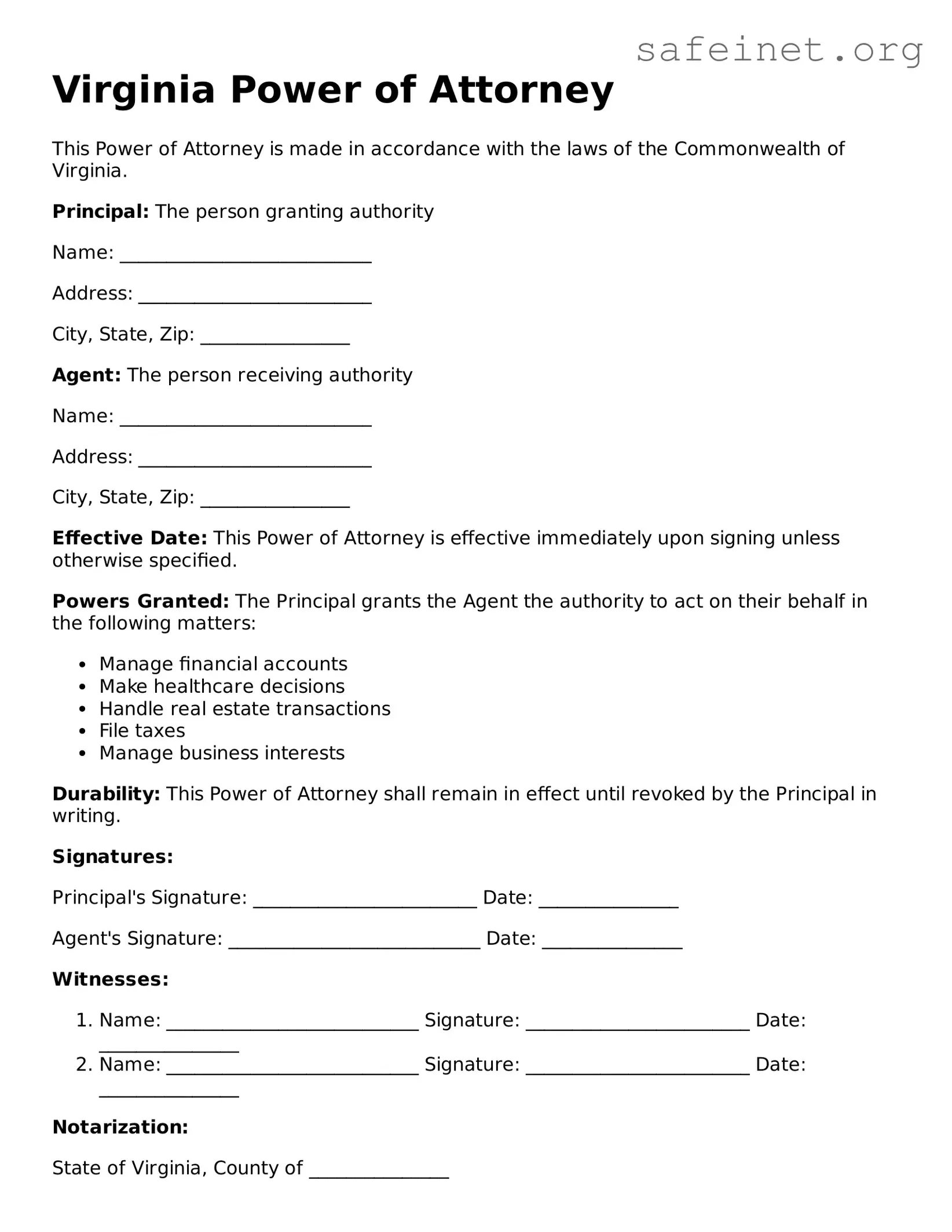
The Virginia Power of Attorney form is an essential legal document that allows individuals to appoint someone they trust to make decisions on their behalf when they are unable to do so. This form is particularly important for managing financial matters, healthcare decisions, and other personal affairs. It can be tailored to fit specific needs, whether for a temporary situation or a more permanent arrangement. The appointed person, known as the agent or attorney-in-fact, gains the authority to act in the best interest of the principal, who is the person granting the power. Importantly, the form outlines the extent of the agent's powers, which can be broad or limited, depending on the principal's preferences. Additionally, the Virginia Power of Attorney form requires proper execution, including signatures and, in some cases, notarization, to ensure its validity. Understanding the nuances of this form can help individuals make informed decisions about their future and provide peace of mind knowing that their affairs will be handled by a trusted person in times of need.
Virginia Power of Attorney
This Power of Attorney is made in accordance with the laws of the Commonwealth of Virginia.
Principal: The person granting authority
Name: ___________________________
Address: _________________________
City, State, Zip: ________________
Agent: The person receiving authority
Name: ___________________________
Address: _________________________
City, State, Zip: ________________
Effective Date: This Power of Attorney is effective immediately upon signing unless otherwise specified.
Powers Granted: The Principal grants the Agent the authority to act on their behalf in the following matters:
Durability: This Power of Attorney shall remain in effect until revoked by the Principal in writing.
Signatures:
Principal's Signature: ________________________ Date: _______________
Agent's Signature: ___________________________ Date: _______________
Witnesses:
Notarization:
State of Virginia, County of _______________
Subscribed and sworn before me on this _____ day of __________, 20__.
Notary Public: ___________________________
My commission expires: ___________________
| Fact Name | Details |
|---|---|
| Definition | A Power of Attorney (POA) allows one person to act on behalf of another in legal and financial matters. |
| Types | Virginia recognizes several types of POAs, including General, Limited, and Durable Power of Attorney. |
| Durable Power of Attorney | This type remains effective even if the principal becomes incapacitated, ensuring continuous management of affairs. |
| Governing Law | The Virginia Uniform Power of Attorney Act governs the use and creation of POAs in Virginia. |
| Execution Requirements | To be valid, the POA must be signed by the principal and acknowledged before a notary public. |
| Revocation | The principal can revoke the POA at any time, as long as they are mentally competent. |
| Agent's Authority | The agent's authority can be broad or limited, depending on how the POA is drafted. |
| Common Uses | POAs are commonly used for managing finances, real estate transactions, and healthcare decisions. |
Filling out the Virginia Power of Attorney form is a straightforward process. Once completed, this document allows you to designate someone to act on your behalf in financial or legal matters. Follow these steps carefully to ensure the form is filled out correctly.
What is a Power of Attorney in Virginia?
A Power of Attorney (POA) is a legal document that allows one person to give another person the authority to act on their behalf. In Virginia, this can cover a wide range of decisions, including financial, medical, and legal matters. The person who creates the POA is known as the principal, while the person who receives the authority is called the agent or attorney-in-fact.
What types of Power of Attorney are available in Virginia?
Virginia offers several types of Power of Attorney forms. The most common include the General Power of Attorney, which grants broad powers to the agent, and the Limited Power of Attorney, which restricts the agent's authority to specific tasks or time periods. There is also a Medical Power of Attorney, which allows the agent to make healthcare decisions if the principal is unable to do so.
Do I need to have my Power of Attorney form notarized?
Yes, in Virginia, a Power of Attorney must be signed in the presence of a notary public to be valid. This notarization serves to verify the identity of the principal and ensures that the document is legally enforceable. In some cases, witnesses may also be required, depending on the type of POA.
Can I revoke a Power of Attorney in Virginia?
Yes, you can revoke a Power of Attorney at any time as long as you are mentally competent. To do this, you should create a written revocation document and notify your agent and any relevant institutions or individuals that the POA is no longer in effect. It’s important to keep a copy of the revocation for your records.
What happens if I become incapacitated and have not set up a Power of Attorney?
If you become incapacitated without a Power of Attorney in place, your family may need to go through a legal process called guardianship or conservatorship to make decisions on your behalf. This process can be lengthy, costly, and may not align with your wishes, which is why setting up a POA in advance is highly recommended.
Can I change my Power of Attorney after it has been established?
Yes, you can change your Power of Attorney. If you wish to appoint a new agent or modify the powers granted, you will need to create a new Power of Attorney document. It is crucial to revoke the previous POA to avoid any confusion about who has authority to act on your behalf.
Failing to specify the powers granted. Individuals often overlook the importance of detailing the specific powers they wish to grant to their agent. This can lead to confusion and potential disputes.
Not including a date. A common oversight is neglecting to date the document. Without a date, the validity of the Power of Attorney may be questioned.
Using outdated forms. Laws change, and using an old version of the Power of Attorney form can result in legal complications. Always ensure the form is current.
Not signing in the presence of a notary. Many people forget that a Power of Attorney must be notarized to be legally binding. This step is crucial.
Overlooking witness requirements. In Virginia, certain types of Powers of Attorney require witnesses. Failing to include witnesses can invalidate the document.
Granting too broad powers. While it may seem convenient to grant broad authority, this can lead to misuse. It's better to be specific about the powers you wish to grant.
Not considering alternate agents. People often name only one agent without considering what happens if that agent is unable to serve. Including an alternate can prevent issues.
Ignoring state-specific requirements. Each state has its own rules regarding Powers of Attorney. Ignoring Virginia's specific requirements can lead to invalidation of the document.
Failing to communicate with the agent. Individuals sometimes fill out the form without discussing it with their chosen agent. Open communication is essential to ensure the agent understands their responsibilities.
Not reviewing the document regularly. Life circumstances change, and so do needs. Regularly reviewing and updating the Power of Attorney ensures it remains relevant.
When preparing a Virginia Power of Attorney, it's essential to consider additional documents that may complement or enhance the authority granted. These documents can provide clarity, ensure compliance, and protect the interests of all parties involved. Below is a list of commonly used forms and documents that often accompany a Power of Attorney in Virginia.
Incorporating these documents can help ensure that the Power of Attorney functions smoothly and effectively. It is advisable to consult with a legal professional to determine which documents are most relevant to your specific situation.
The Virginia Power of Attorney form shares similarities with the Living Will. Both documents serve to express an individual's wishes regarding personal matters. A Living Will specifically outlines medical treatment preferences in case of incapacitation, while a Power of Attorney designates someone to make financial or legal decisions on behalf of the individual. In essence, both documents empower a trusted person to act according to the individual's desires, ensuring that their preferences are respected during critical times.
Another document comparable to the Power of Attorney is the Health Care Proxy. This form allows an individual to appoint someone to make health care decisions when they are unable to do so themselves. Like the Power of Attorney, it relies on trust and clear communication. While the Power of Attorney can cover a broad range of decisions, the Health Care Proxy is specifically focused on medical choices, ensuring that a person's health care preferences are honored.
The Advance Directive is also similar to the Power of Attorney, as it combines elements of both a Living Will and a Health Care Proxy. An Advance Directive provides guidance on medical treatment preferences and designates a person to make health care decisions. This dual function makes it a comprehensive document for individuals seeking to ensure their health care wishes are known and respected, much like the Power of Attorney does for financial and legal matters.
A Trust Agreement can be compared to the Power of Attorney in that both documents facilitate the management of assets. While a Power of Attorney allows someone to act on another's behalf during their lifetime, a Trust Agreement typically takes effect upon the individual's death. A Trust can help manage and distribute assets according to specified terms, ensuring that the individual’s wishes are followed, similar to how a Power of Attorney ensures decisions align with their preferences during their life.
Lastly, the Bill of Sale shares a connection with the Power of Attorney through the transfer of authority. A Bill of Sale is a legal document that records the transfer of ownership of personal property from one party to another. While it is more focused on the sale of goods, both documents require clear identification of parties involved and the intention to delegate rights or ownership. In this way, they both serve to formalize and document significant decisions regarding property and authority.
Filling out a Power of Attorney form in Virginia can be a straightforward process if you keep a few key points in mind. Here’s a list of things you should and shouldn’t do to ensure everything is completed correctly.
By following these guidelines, you can help ensure that your Power of Attorney form serves its intended purpose effectively and without complications.
Many people have misunderstandings about the Virginia Power of Attorney form. Here are some common misconceptions:
Understanding these misconceptions can help individuals make informed decisions about their Power of Attorney needs.
When filling out and using the Virginia Power of Attorney form, keep these key takeaways in mind: