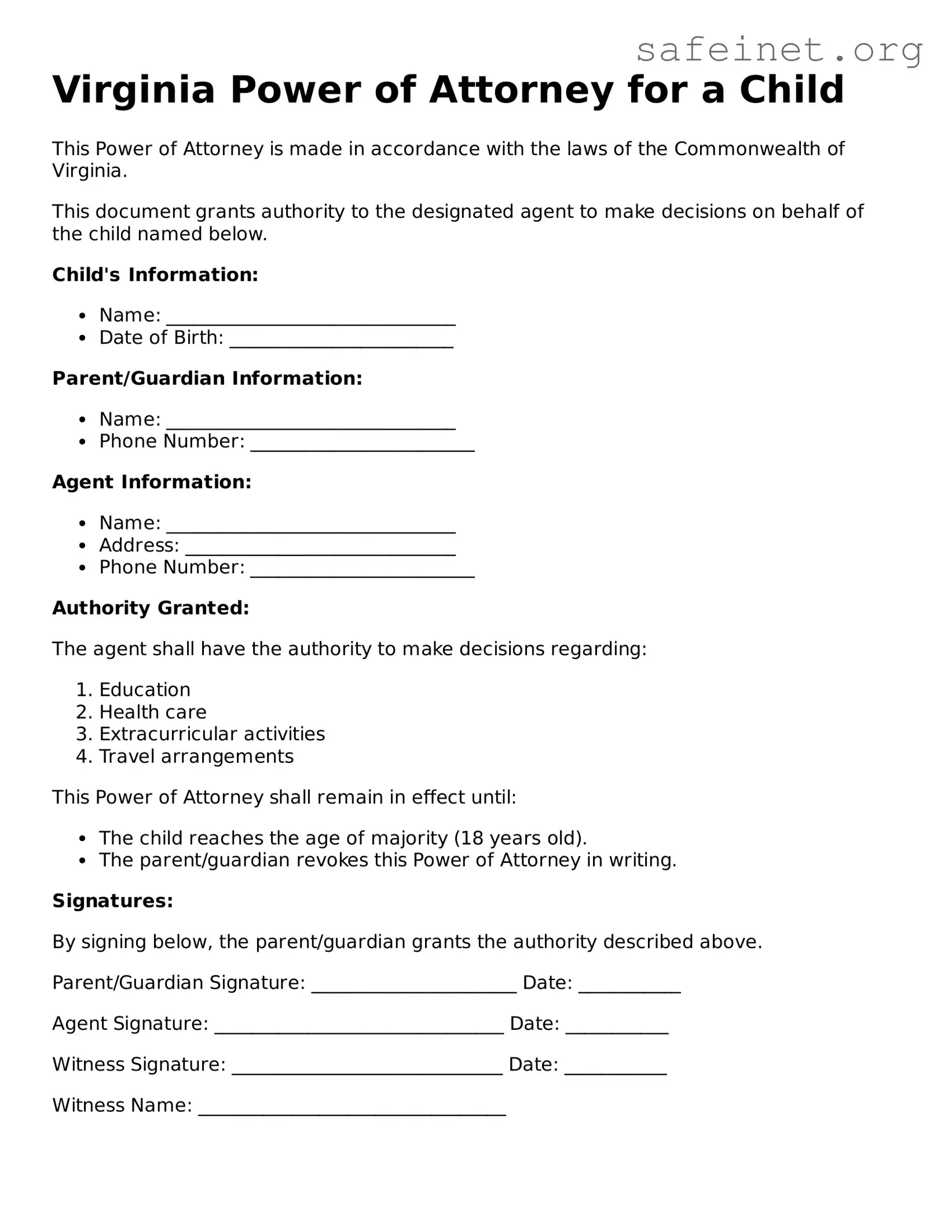
In Virginia, the Power of Attorney for a Child form serves as a vital tool for parents and guardians who need to delegate their authority for a child's care and decision-making. This legal document allows a designated adult to make important choices regarding the child's health, education, and welfare in the absence of the parent or guardian. It is particularly useful for situations such as travel, medical emergencies, or when parents are temporarily unable to fulfill their responsibilities. The form outlines the specific powers granted to the agent, ensuring that the child's best interests are prioritized. Additionally, it includes provisions for the duration of the authority, allowing parents to specify how long the arrangement will last. By understanding this form, parents can ensure their child's well-being is maintained, even when they are not physically present to make decisions.
Virginia Power of Attorney for a Child
This Power of Attorney is made in accordance with the laws of the Commonwealth of Virginia.
This document grants authority to the designated agent to make decisions on behalf of the child named below.
Child's Information:
Parent/Guardian Information:
Agent Information:
Authority Granted:
The agent shall have the authority to make decisions regarding:
This Power of Attorney shall remain in effect until:
Signatures:
By signing below, the parent/guardian grants the authority described above.
Parent/Guardian Signature: ______________________ Date: ___________
Agent Signature: _______________________________ Date: ___________
Witness Signature: _____________________________ Date: ___________
Witness Name: _________________________________
| Fact Name | Description |
|---|---|
| Purpose | The Virginia Power of Attorney for a Child form allows a parent or legal guardian to designate another adult to make decisions on behalf of their child in their absence. |
| Duration | This power of attorney remains effective until it is revoked by the parent or legal guardian, or until the child reaches the age of majority, which is 18 years old in Virginia. |
| Governing Law | The form is governed by Virginia Code § 20-166.2, which outlines the legal framework for powers of attorney concerning minors. |
| Requirements | The form must be signed by the parent or legal guardian and notarized to ensure its validity. It is recommended to keep a copy for personal records. |
Filling out the Virginia Power of Attorney for a Child form is a straightforward process. Once completed, you will have a document that allows another adult to make decisions for your child in your absence. Here’s how to fill it out step-by-step.
What is a Power of Attorney for a Child in Virginia?
A Power of Attorney for a Child in Virginia is a legal document that allows a parent or guardian to grant another adult the authority to make decisions on behalf of their child. This can include decisions related to education, healthcare, and general welfare. It is often used when a parent is temporarily unavailable due to travel, work commitments, or other reasons.
Who can be appointed as an agent in a Power of Attorney for a Child?
Any responsible adult can be appointed as an agent in a Power of Attorney for a Child. This can be a family member, friend, or trusted neighbor. It is important to choose someone who is reliable and capable of making decisions in the best interest of the child.
How long does a Power of Attorney for a Child last?
The Power of Attorney for a Child remains in effect until the specified expiration date, if one is included, or until the parent or guardian revokes it. It is essential to communicate with the appointed agent about the duration of the authority granted. If circumstances change, such as the return of the parent or guardian, the document can be revoked at any time.
Do I need to have the Power of Attorney for a Child notarized?
Yes, in Virginia, the Power of Attorney for a Child must be signed in the presence of a notary public to be legally valid. This ensures that the document is authentic and that the parent or guardian is making the decision voluntarily. It is advisable to keep a copy of the notarized document for your records and provide a copy to the appointed agent.
Failing to provide complete information about the child. This includes the child's full name, date of birth, and current address.
Not including the full names and addresses of both the parent(s) and the designated agent. This information is crucial for identification.
Leaving the form unsigned. Without signatures, the document holds no legal weight.
Not having the form notarized. Virginia law requires notarization for the Power of Attorney to be valid.
Using outdated forms. Always ensure you are using the most current version of the Power of Attorney for a Child form.
Failing to specify the powers granted to the agent. Be clear about what decisions the agent can make on behalf of the child.
Not including an expiration date. Indicate when the Power of Attorney will end to avoid confusion later.
Ignoring state-specific requirements. Each state may have unique rules, so familiarize yourself with Virginia's regulations.
When preparing a Power of Attorney for a Child in Virginia, you may also need several other documents to ensure that all legal and caregiving aspects are covered. Each of these documents serves a specific purpose and can help clarify responsibilities and authority.
Having these documents prepared alongside the Virginia Power of Attorney for a Child can help ensure that caregivers have the authority and information needed to make decisions in the best interest of the child. Each document serves to clarify roles and responsibilities, providing peace of mind for both parents and caregivers.
The Virginia Power of Attorney for a Child form shares similarities with the General Power of Attorney. Both documents allow individuals to designate someone else to make decisions on their behalf. While the General Power of Attorney can cover a wide range of decisions, including financial and medical matters, the Power of Attorney for a Child specifically focuses on decisions related to the care and welfare of a minor. This targeted approach ensures that the designated individual can act in the best interests of the child, providing a sense of security for parents who may be temporarily unavailable.
Another document akin to the Virginia Power of Attorney for a Child is the Medical Power of Attorney. This form empowers someone to make healthcare decisions for another person when they are unable to do so themselves. While the Medical Power of Attorney applies to adults, its purpose parallels that of the Power of Attorney for a Child in that it grants authority to someone trusted to make important decisions. In both cases, the appointed individual must act in the best interest of the person they represent, ensuring that their needs are met during times of incapacity.
The Child Custody Agreement also shares a connection with the Power of Attorney for a Child. This legal document outlines the arrangements for the care and custody of a child, typically in situations involving divorce or separation. While the Power of Attorney allows for temporary decision-making authority, a Child Custody Agreement establishes longer-term arrangements. Both documents prioritize the child's welfare, but they differ in duration and scope, with the custody agreement providing a more permanent solution to living arrangements and parental responsibilities.
Lastly, the Guardianship Agreement is another document that resembles the Virginia Power of Attorney for a Child. A Guardianship Agreement is established when a court appoints an individual to care for a child, often in cases where the parents are unable to fulfill their roles. Like the Power of Attorney for a Child, it focuses on the child's well-being and ensures that a responsible adult is available to make decisions. However, guardianship typically involves a more formal process and grants broader authority over the child's upbringing compared to the more limited powers granted by a Power of Attorney.
When filling out the Virginia Power of Attorney for a Child form, it's important to approach the task with care. Here are some helpful guidelines to follow:
Following these guidelines can help ensure that the Power of Attorney for a Child form is completed correctly and effectively.
Understanding the Virginia Power of Attorney for a Child form is crucial for parents and guardians. However, several misconceptions can lead to confusion. Here are nine common misconceptions:
Addressing these misconceptions can help ensure that the Power of Attorney for a Child form is used effectively and appropriately.
When considering the Virginia Power of Attorney for a Child form, it’s essential to understand its purpose and implications. This document allows a parent or legal guardian to grant authority to another individual to make decisions on behalf of their child. Here are some key takeaways to keep in mind:
By keeping these points in mind, parents can effectively utilize the Virginia Power of Attorney for a Child form, ensuring their child's needs are met even in their absence.