The Virginia Operating Agreement form is an essential document for anyone looking to establish a limited liability company (LLC) in Virginia. This form outlines the management structure, roles, and responsibilities of the members involved. It serves as a roadmap for how the business will operate, detailing how profits and losses will be shared among members. Additionally, the agreement addresses important aspects such as decision-making processes, member contributions, and procedures for adding or removing members. By clearly defining these elements, the Operating Agreement helps prevent misunderstandings and disputes down the line. Having a well-drafted agreement can also enhance the credibility of the LLC and provide legal protection for its members. Understanding the key components of this form is crucial for any business owner looking to navigate the complexities of running an LLC in Virginia.
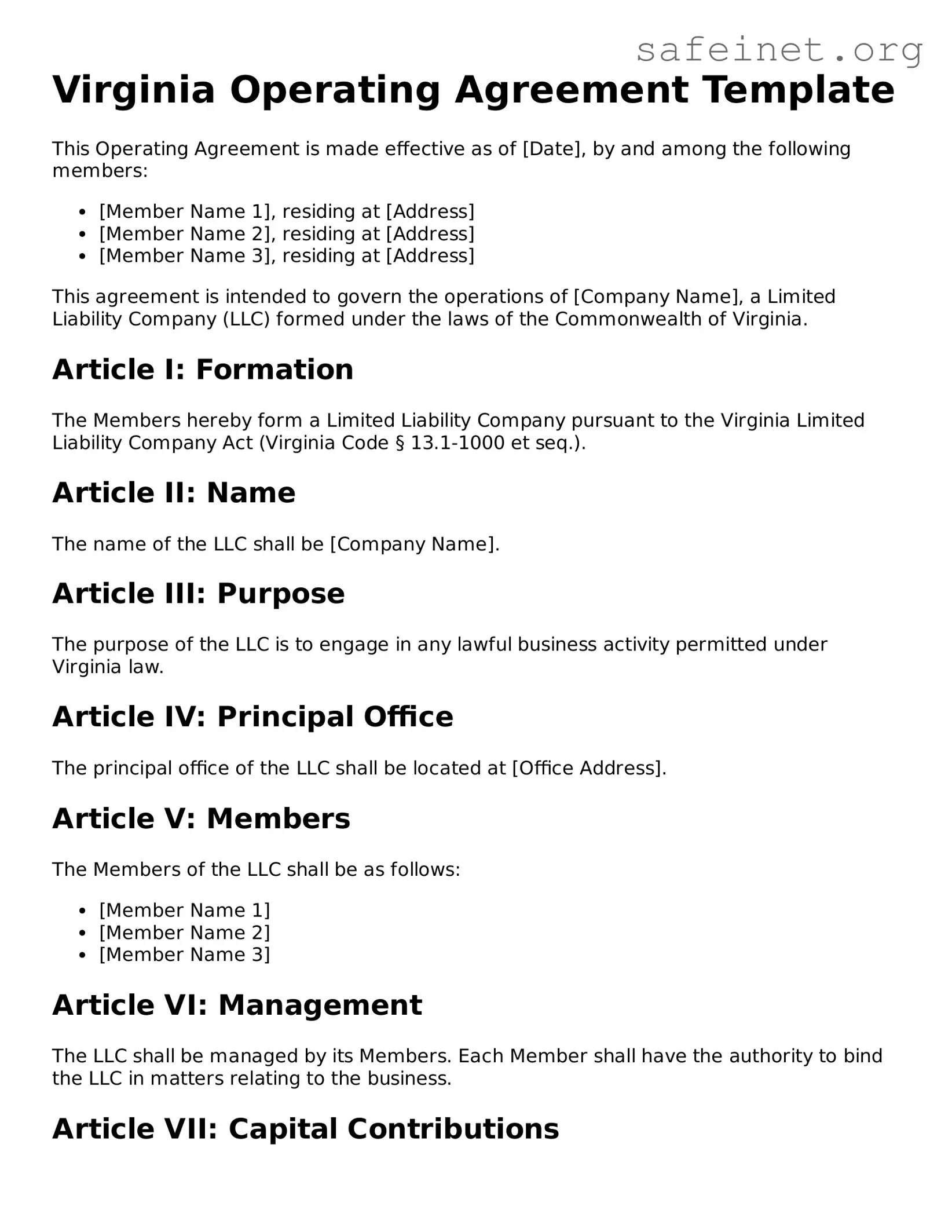
Virginia Operating Agreement Template
This Operating Agreement is made effective as of [Date], by and among the following members:
This agreement is intended to govern the operations of [Company Name], a Limited Liability Company (LLC) formed under the laws of the Commonwealth of Virginia.
Article I: Formation
The Members hereby form a Limited Liability Company pursuant to the Virginia Limited Liability Company Act (Virginia Code § 13.1-1000 et seq.).
Article II: Name
The name of the LLC shall be [Company Name].
Article III: Purpose
The purpose of the LLC is to engage in any lawful business activity permitted under Virginia law.
Article IV: Principal Office
The principal office of the LLC shall be located at [Office Address].
Article V: Members
The Members of the LLC shall be as follows:
Article VI: Management
The LLC shall be managed by its Members. Each Member shall have the authority to bind the LLC in matters relating to the business.
Article VII: Capital Contributions
The Members agree to contribute capital to the LLC as follows:
Article VIII: Distributions
Distributions of profits and losses shall be allocated to the Members in proportion to their respective capital contributions.
Article IX: Indemnification
The LLC shall indemnify its Members to the fullest extent permitted by Virginia law against any and all expenses and liabilities incurred in connection with the LLC.
Article X: Amendments
This Operating Agreement may be amended only by a written agreement signed by all Members.
Article XI: Governing Law
This Agreement shall be governed by and construed in accordance with the laws of the Commonwealth of Virginia.
IN WITNESS WHEREOF, the Members have executed this Operating Agreement as of the date first above written.
__________________________ [Member Name 1]
__________________________ [Member Name 2]
__________________________ [Member Name 3]
| Fact Name | Description |
|---|---|
| Governing Law | The Virginia Operating Agreement is governed by the Virginia Limited Liability Company Act. |
| Purpose | This document outlines the management structure and operating procedures of a Virginia LLC. |
| Member Rights | It defines the rights and responsibilities of each member within the LLC. |
| Flexibility | The agreement allows for flexibility in management and profit distribution among members. |
| Not Required | While it is not legally required, having an Operating Agreement is highly recommended for LLCs. |
| Dispute Resolution | The document can include provisions for resolving disputes among members. |
| Amendments | Members can amend the Operating Agreement as needed, following the procedures outlined within it. |
| Duration | The agreement can specify the duration of the LLC's existence, which can be perpetual or limited. |
| Confidentiality | It may include confidentiality clauses to protect sensitive business information. |
| Compliance | Having a well-drafted Operating Agreement helps ensure compliance with state laws and regulations. |
Filling out the Virginia Operating Agreement form is an important step for establishing the internal rules and structure of your business. This document will outline the management and operational procedures of your company. Once completed, it will serve as a guiding framework for your business operations.
After completing the form, review it carefully to ensure all information is accurate and complete. Keep a copy for your records and consider filing it with your state, if required. This document will play a crucial role in the governance of your LLC.
What is a Virginia Operating Agreement?
A Virginia Operating Agreement is a legal document that outlines the internal operations of a limited liability company (LLC) in Virginia. It serves as a foundational agreement among members, detailing how the business will be managed, how profits and losses will be distributed, and the rights and responsibilities of each member. While Virginia law does not require an Operating Agreement, having one is highly recommended to prevent disputes and ensure smooth operations.
Who should create an Operating Agreement?
All members of an LLC in Virginia should create an Operating Agreement, regardless of the size or structure of the company. This includes single-member LLCs, as having a written agreement can help clarify the owner's intentions and protect their personal assets. For multi-member LLCs, it is essential to define each member's role and contributions clearly, which helps prevent misunderstandings in the future.
What key elements should be included in a Virginia Operating Agreement?
A comprehensive Virginia Operating Agreement typically includes several key elements. These may consist of the LLC's name and principal office address, the purpose of the business, the names and contributions of each member, the management structure, profit and loss distribution, procedures for adding or removing members, and guidelines for resolving disputes. Including these elements helps create a clear framework for the LLC's operations.
Is an Operating Agreement legally binding?
Yes, an Operating Agreement is a legally binding document among the members of the LLC. Once signed, it establishes the rules and expectations for the members. However, it is important to note that the agreement must comply with Virginia law to be enforceable. If any provisions conflict with state law, those specific provisions may be deemed invalid, while the rest of the agreement remains intact.
Can an Operating Agreement be amended?
Yes, an Operating Agreement can be amended. Members may find that changes are necessary as the business evolves or as new members join. To amend the agreement, members should follow the procedures outlined in the original Operating Agreement. Typically, this involves obtaining a majority or unanimous vote from the members, depending on the terms set forth in the agreement.
What happens if an LLC does not have an Operating Agreement?
If an LLC does not have an Operating Agreement, Virginia state law will govern the operations and management of the business. This could lead to unintended consequences, such as disputes among members or difficulties in decision-making. Without a clear framework, members may find themselves relying on default laws that may not reflect their intentions or needs, potentially leading to conflicts.
How can I create a Virginia Operating Agreement?
Creating a Virginia Operating Agreement can be done in several ways. Members can draft the agreement from scratch, using templates available online as a guide. Alternatively, seeking assistance from a legal professional can ensure that the agreement meets all legal requirements and adequately addresses the needs of the members. It is important to customize the agreement to reflect the specific circumstances of the LLC.
Do I need to file the Operating Agreement with the state?
No, you do not need to file the Operating Agreement with the state of Virginia. The document is maintained internally among the members of the LLC. However, it is advisable to keep the agreement in a safe place, as it may be needed for reference in the future, especially in the event of disputes or changes in membership.
Incomplete Information: One of the most common mistakes is failing to provide all required information. Each section of the form must be filled out accurately. Omitting details such as the names of members or the purpose of the business can lead to complications.
Incorrect Member Percentages: Members must clearly define their ownership percentages. Errors in calculating these percentages can result in disputes later on. Ensure that the total ownership percentages add up to 100% to avoid any confusion.
Not Including an Operating Procedure: An operating agreement should outline how the business will be managed. Failing to include procedures for decision-making or profit distribution can create uncertainty. This can lead to disagreements among members down the line.
Neglecting to Review State Requirements: Each state has specific requirements for operating agreements. Ignoring Virginia's legal standards can render the agreement ineffective. It's crucial to ensure that the form complies with state laws to protect the interests of all members.
The Virginia Operating Agreement is an essential document for limited liability companies (LLCs) in Virginia. It outlines the management structure and operating procedures of the LLC. Along with this agreement, several other forms and documents may be necessary for the proper functioning and compliance of your LLC. Below is a list of these documents.
Having these documents in order can help ensure that your LLC operates smoothly and remains compliant with state regulations. Proper documentation protects the interests of all members and clarifies the operational framework of the company.
The Virginia Operating Agreement is similar to the Partnership Agreement, which outlines the terms and conditions under which a partnership operates. Both documents define the roles and responsibilities of each partner, including profit-sharing arrangements and decision-making processes. Just as an Operating Agreement governs the internal workings of a limited liability company (LLC), a Partnership Agreement serves a similar purpose for partnerships, ensuring all parties are aligned on their obligations and rights.
Another comparable document is the Bylaws of a corporation. Bylaws serve as the governing document for corporations, detailing the rules for management, meetings, and shareholder rights. Like an Operating Agreement, Bylaws provide structure and clarity, ensuring that all stakeholders understand their roles and the procedures for decision-making. Both documents aim to prevent conflicts by establishing clear guidelines for operation.
The Shareholders Agreement is also similar in function. This document outlines the rights and obligations of shareholders within a corporation. It addresses issues such as share transfers, voting rights, and dispute resolution. Similar to an Operating Agreement, it seeks to protect the interests of all parties involved and provides a framework for governance and conflict resolution.
The Membership Agreement is another relevant document, particularly for LLCs. This agreement details the rights and responsibilities of each member in an LLC. It often includes provisions for capital contributions, profit distribution, and management authority. Like the Operating Agreement, it aims to clarify expectations and responsibilities among members, fostering a cooperative environment.
A Joint Venture Agreement shares similarities as well. This document governs the terms of collaboration between two or more parties for a specific project or business activity. It outlines each party’s contributions, responsibilities, and profit-sharing arrangements. Much like an Operating Agreement, it provides a framework for cooperation and helps prevent misunderstandings.
The Limited Partnership Agreement is another document that resembles the Operating Agreement. This agreement governs limited partnerships, specifying the roles of general and limited partners. It details the management structure, profit distribution, and liability limitations. Both documents serve to clarify the relationships and responsibilities of the parties involved, ensuring smooth operations.
The Franchise Agreement also has similarities, particularly in its structure and purpose. This document outlines the terms between a franchisor and franchisee, detailing rights, responsibilities, and operational guidelines. Like an Operating Agreement, it establishes clear expectations and procedures, helping to maintain consistency and compliance within the franchise system.
Lastly, the Service Agreement can be compared to the Operating Agreement. This document outlines the terms under which services are provided between parties. It specifies the scope of work, payment terms, and responsibilities of each party. Similar to an Operating Agreement, it aims to create a clear understanding of expectations and obligations, reducing the potential for disputes.
When filling out the Virginia Operating Agreement form, it is important to follow certain guidelines to ensure accuracy and compliance. Here are some things you should and shouldn't do:
When it comes to the Virginia Operating Agreement form, several misconceptions can lead to confusion for business owners and members of limited liability companies (LLCs). Understanding these misconceptions is crucial for effective business management. Here are four common misunderstandings:
Many people believe that an Operating Agreement is optional for LLCs in Virginia. While it is true that the state does not require an Operating Agreement to be filed, having one is highly beneficial. This document outlines the management structure, member responsibilities, and operational procedures, helping to prevent disputes among members.
Some individuals assume that there is a standard template for Operating Agreements that can be used by all LLCs. In reality, each Operating Agreement should be tailored to the specific needs and goals of the business. Factors such as the number of members, the nature of the business, and the desired management structure can all influence the content of the agreement.
There is a belief that once an Operating Agreement is finalized and signed, it cannot be altered. However, this is not the case. Members can amend the Operating Agreement as needed, provided that all members agree to the changes. Regularly reviewing and updating the agreement ensures it remains relevant to the business's evolving needs.
Some think that the benefits of an Operating Agreement are limited to the members of the LLC. In truth, this document also provides clarity and structure for external parties, such as lenders and investors. By clearly defining the roles and responsibilities of members, the Operating Agreement can foster trust and confidence in the business.
When filling out and using the Virginia Operating Agreement form, consider the following key takeaways:
By keeping these points in mind, you can create a comprehensive and effective Operating Agreement that serves your business well.