The Virginia Notice to Quit form serves as a critical tool in the landlord-tenant relationship, particularly when disputes arise regarding lease agreements. This document outlines the necessary steps a landlord must take to formally notify a tenant of their intent to terminate the rental agreement. It typically includes essential details such as the reason for eviction, the specific date by which the tenant must vacate the premises, and any relevant state or local laws that apply. Timeliness is paramount; landlords must ensure that the notice is delivered within the legally mandated timeframes to uphold their rights. Tenants, on the other hand, should understand their responsibilities upon receiving this notice, including their options for responding or rectifying the situation. Understanding the nuances of the Virginia Notice to Quit form can significantly impact both parties, making it essential to approach this process with clarity and urgency.
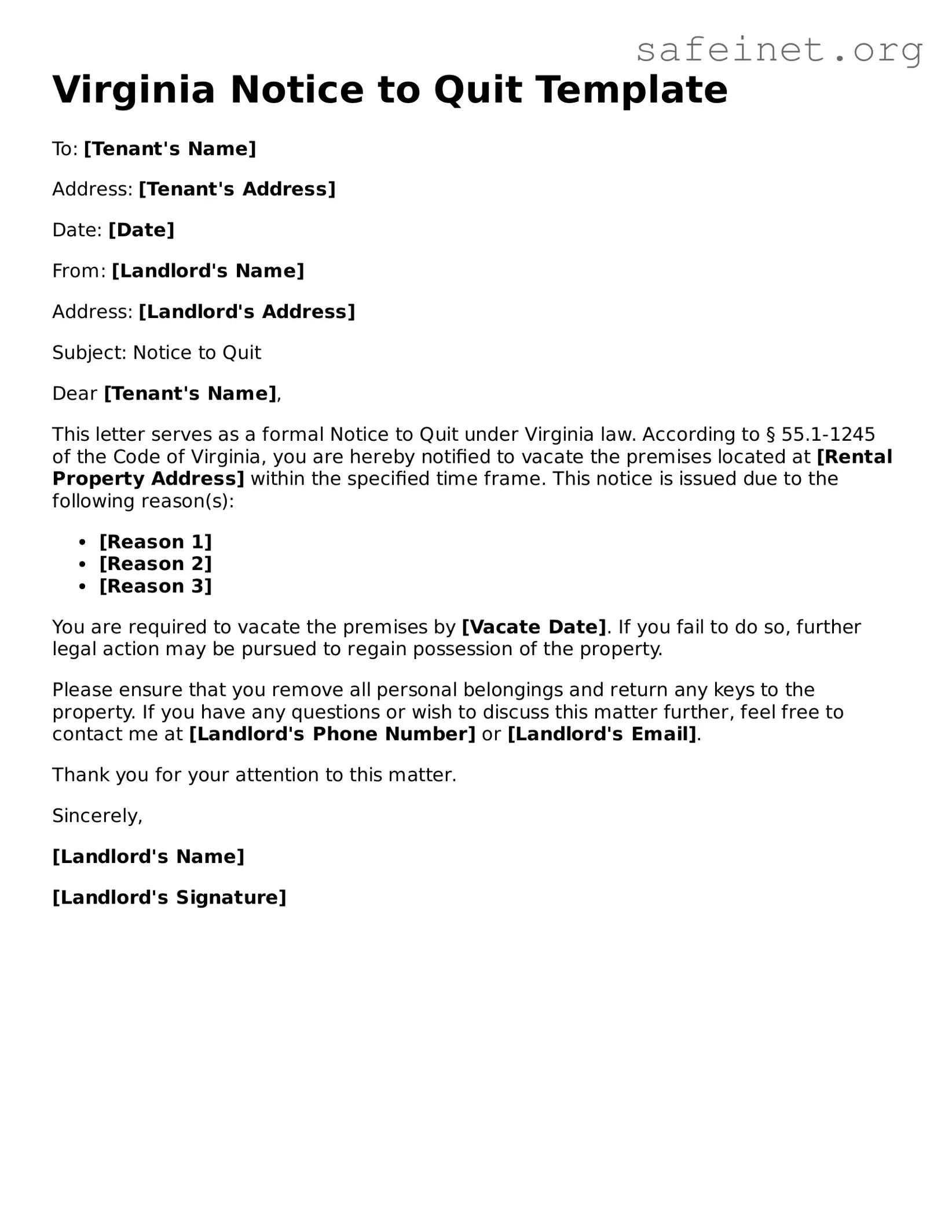
Virginia Notice to Quit Template
To: [Tenant's Name]
Address: [Tenant's Address]
Date: [Date]
From: [Landlord's Name]
Address: [Landlord's Address]
Subject: Notice to Quit
Dear [Tenant's Name],
This letter serves as a formal Notice to Quit under Virginia law. According to § 55.1-1245 of the Code of Virginia, you are hereby notified to vacate the premises located at [Rental Property Address] within the specified time frame. This notice is issued due to the following reason(s):
You are required to vacate the premises by [Vacate Date]. If you fail to do so, further legal action may be pursued to regain possession of the property.
Please ensure that you remove all personal belongings and return any keys to the property. If you have any questions or wish to discuss this matter further, feel free to contact me at [Landlord's Phone Number] or [Landlord's Email].
Thank you for your attention to this matter.
Sincerely,
[Landlord's Name]
[Landlord's Signature]
| Fact Name | Description |
|---|---|
| Purpose | The Virginia Notice to Quit form is used by landlords to formally notify tenants of the intent to terminate a lease agreement. |
| Governing Law | This form is governed by the Virginia Residential Landlord and Tenant Act, specifically § 55.1-124. |
| Notice Period | Typically, a landlord must provide a 30-day notice to terminate a month-to-month lease. |
| Delivery Methods | The notice can be delivered in person, by mail, or posted on the property. |
| Tenant's Rights | Tenants have the right to contest the notice in court if they believe it was issued improperly. |
| Form Requirements | The form must include specific information such as the tenant's name, address, and the reason for termination. |
| Signature Requirement | The landlord or an authorized agent must sign the notice for it to be valid. |
| Legal Consequences | Failure to comply with the notice can lead to eviction proceedings. |
| Additional Resources | Landlords and tenants can find more information on the Virginia Department of Housing and Community Development website. |
Once you have the Virginia Notice to Quit form ready, it's time to fill it out accurately. This form serves as a formal notification to a tenant regarding the termination of their lease. Completing it correctly is essential for ensuring that the process moves forward smoothly.
After filling out the form, ensure that it is delivered to the tenant in a manner that complies with Virginia law. Keep a copy for your records, as this may be needed for any future proceedings.
What is a Virginia Notice to Quit form?
The Virginia Notice to Quit form is a legal document that a landlord uses to inform a tenant that they must vacate the rental property. This notice typically outlines the reasons for eviction, such as non-payment of rent or lease violations, and provides a specific timeframe for the tenant to leave the premises.
When is a Notice to Quit required in Virginia?
A Notice to Quit is required in situations where a landlord seeks to terminate a lease agreement due to specific issues. Common reasons include failure to pay rent, violation of lease terms, or if the landlord wishes to reclaim the property for personal use. The notice must be served before any legal eviction proceedings can begin.
How much notice must be given to tenants?
The amount of notice required can vary depending on the reason for eviction. For example, if the eviction is due to non-payment of rent, Virginia law typically requires a 5-day notice. For other lease violations, a 30-day notice may be appropriate. Always check local laws, as they can differ.
How should a Notice to Quit be delivered?
The Notice to Quit can be delivered in several ways, including personally handing it to the tenant, sending it via certified mail, or posting it on the property if the tenant cannot be reached. It is crucial to keep a record of how and when the notice was delivered, as this may be important in any future legal proceedings.
What happens if the tenant does not comply with the Notice to Quit?
If the tenant does not vacate the property by the deadline specified in the Notice to Quit, the landlord may proceed with legal action to evict the tenant. This typically involves filing an unlawful detainer action in court. The court will then schedule a hearing where both parties can present their case.
Can a tenant contest a Notice to Quit?
Yes, a tenant has the right to contest a Notice to Quit. If they believe the notice is unjust or that they have rectified the issue (like paying overdue rent), they can present their case in court. It is advisable for tenants to seek legal counsel to understand their rights and options.
Is there a specific format for the Notice to Quit in Virginia?
While there is no mandated format, the Notice to Quit should clearly state the reason for eviction, the date by which the tenant must vacate, and any relevant details about the lease. It is often beneficial to use a template or consult with a legal professional to ensure that all necessary information is included.
What are the consequences of not using a Notice to Quit?
Failing to provide a Notice to Quit can lead to complications in the eviction process. If a landlord skips this step and proceeds directly to court, the judge may dismiss the case. This means the landlord would need to start the process over, which can be time-consuming and costly.
Failing to provide accurate tenant information. Ensure that the names of all tenants listed on the lease are included. Omitting a tenant can lead to complications.
Incorrectly stating the reason for the notice. Be clear and specific about why you are issuing the Notice to Quit. Ambiguity can result in delays or disputes.
Not including the correct date. The date on the notice must reflect when the tenant is required to vacate the property. Double-check this to avoid confusion.
Neglecting to sign the form. A signature is essential to validate the notice. Without it, the notice may be considered invalid.
Failing to deliver the notice properly. The method of delivery matters. Ensure you follow the legal requirements for serving the Notice to Quit.
Using outdated forms. Always use the most current version of the Notice to Quit form. Laws and regulations can change, making older forms potentially invalid.
In the context of landlord-tenant relationships in Virginia, the Notice to Quit form serves as an important document for landlords seeking to terminate a tenancy. However, this form is often accompanied by several other documents that help clarify the situation and outline the rights and responsibilities of both parties involved. Below is a list of these forms and documents, each playing a crucial role in the eviction process or the management of rental agreements.
Understanding these various forms and documents is essential for both landlords and tenants navigating the complexities of rental agreements and eviction processes in Virginia. Each document serves a distinct purpose, contributing to the overall legal framework that governs landlord-tenant relationships.
The Virginia Notice to Quit form serves as a formal request for tenants to vacate a rental property. It is similar to the Eviction Notice, which landlords use to inform tenants of their intent to terminate the lease due to specific violations. Both documents detail the reasons for termination, such as non-payment of rent or lease violations, and set a timeline for the tenant to leave the premises. However, the Eviction Notice often includes additional information regarding the legal process that may follow if the tenant does not comply.
Another document comparable to the Virginia Notice to Quit is the Lease Termination Letter. This letter is typically used by either party to end a rental agreement at the conclusion of the lease term. While the Notice to Quit is usually employed when there are breaches of the lease, the Lease Termination Letter is more straightforward, simply indicating that the lease will not be renewed. Both documents require clear communication and adherence to timelines, but the Lease Termination Letter does not cite specific violations.
The Demand for Rent is also similar to the Virginia Notice to Quit. This document is issued when a tenant has failed to pay rent on time. It serves as a formal request for payment and may precede the Notice to Quit if the tenant does not respond. While the Demand for Rent focuses solely on the financial aspect, the Notice to Quit encompasses broader lease violations, making it a more comprehensive document in cases of termination.
The Notice of Non-Renewal is another document that aligns with the Virginia Notice to Quit. It is issued by landlords to inform tenants that their lease will not be renewed at the end of its term. While the Notice to Quit can be used for immediate termination due to violations, the Notice of Non-Renewal provides a more amicable approach, allowing tenants to prepare for their move without the implication of wrongdoing.
Similarly, the Notice to Cure is a document that landlords may issue when tenants violate lease terms. This notice provides tenants with an opportunity to correct the issue before further action is taken. Like the Virginia Notice to Quit, it emphasizes communication and the need for compliance. However, the Notice to Cure specifically seeks resolution rather than outright termination of the lease.
The Five-Day Notice is a specific type of notice used in some states to inform tenants of their failure to pay rent. This document gives tenants a short window to pay overdue rent before further legal actions are initiated. It shares similarities with the Virginia Notice to Quit in terms of urgency and the potential for eviction, but it is more focused on the financial obligation rather than lease violations.
The Notice of Default is another related document. It is commonly used in mortgage agreements rather than rental agreements. This notice informs borrowers that they have defaulted on their loan obligations. While it serves a different purpose, both the Notice of Default and the Virginia Notice to Quit signal a serious breach of agreement, prompting action from the affected party.
The Written Warning is also akin to the Virginia Notice to Quit. This document is often the first step in addressing lease violations. It serves to inform tenants of their misconduct and may outline the potential consequences if the behavior continues. While the Virginia Notice to Quit may follow if the issues are not resolved, the Written Warning aims to provide an opportunity for tenants to rectify their actions before further steps are taken.
Lastly, the Termination of Tenancy Notice is similar in that it formally communicates the end of a tenant's right to occupy a property. This notice may be issued for various reasons, including lease expiration or tenant misconduct. It shares the same goal of ensuring that tenants are aware of their need to vacate, but the specific circumstances and legal implications may differ from those outlined in the Virginia Notice to Quit.
When filling out the Virginia Notice to Quit form, it's essential to follow certain guidelines to ensure the process goes smoothly. Here are some important dos and don'ts to keep in mind:
Understanding the Virginia Notice to Quit form is essential for both landlords and tenants. However, several misconceptions can lead to confusion. Here’s a list of common misunderstandings about this important document:
Understanding these misconceptions can help both landlords and tenants navigate their rights and responsibilities more effectively. Clarity about the Notice to Quit form is crucial for maintaining a fair rental process.
The Virginia Notice to Quit form serves as a crucial document in landlord-tenant relationships. Below are key takeaways regarding its use and completion.