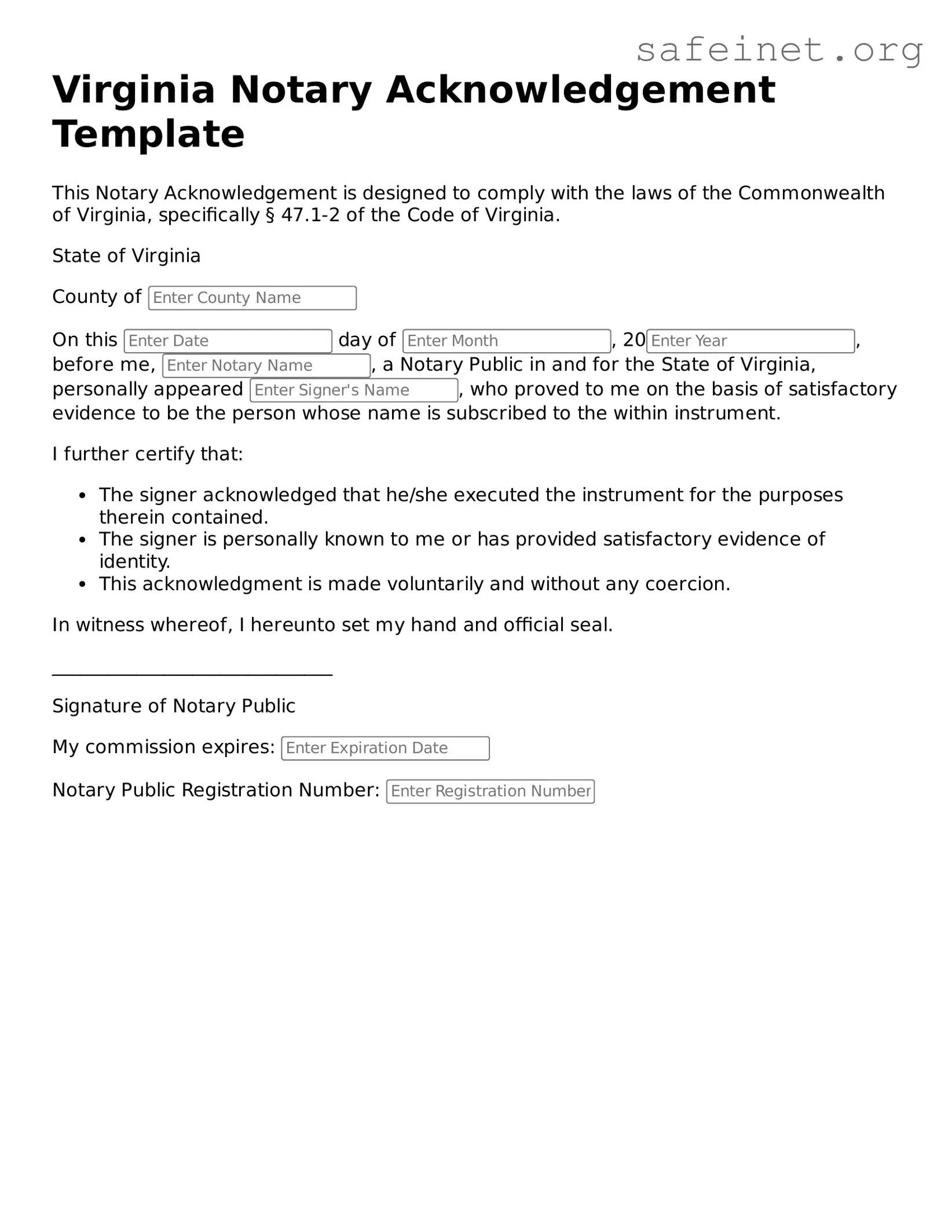
The Virginia Notary Acknowledgement form serves as an essential tool in the realm of legal documentation, ensuring that signatures on important documents are verified and authenticated. This form is primarily used to confirm that the individual signing a document has done so willingly and understands the contents of the document. In Virginia, the notary public plays a crucial role in this process, acting as an impartial witness who can affirm the identity of the signer. The form typically includes key details such as the name of the signer, the date of the acknowledgment, and the notary's signature and seal. It may also require the notary to provide information about their commission, including the expiration date. By utilizing this form, individuals and businesses can enhance the credibility of their documents, thereby reducing the risk of fraud and disputes. Understanding the components and purpose of the Virginia Notary Acknowledgement form is vital for anyone involved in the execution of legal documents in the state.
Virginia Notary Acknowledgement Template
This Notary Acknowledgement is designed to comply with the laws of the Commonwealth of Virginia, specifically § 47.1-2 of the Code of Virginia.
State of Virginia
County of
On this day of , 20, before me, , a Notary Public in and for the State of Virginia, personally appeared , who proved to me on the basis of satisfactory evidence to be the person whose name is subscribed to the within instrument.
I further certify that:
In witness whereof, I hereunto set my hand and official seal.
______________________________
Signature of Notary Public
My commission expires:
Notary Public Registration Number:
| Fact Name | Description |
|---|---|
| Purpose | The Virginia Notary Acknowledgement form is used to verify the identity of the signer and confirm that they willingly signed the document. |
| Governing Law | The form is governed by the Virginia Notary Act, specifically § 47.1-2 of the Code of Virginia. |
| Signature Requirement | The signer must personally appear before the notary public when the acknowledgment is made. |
| Notary Seal | A notary public must affix their official seal to the form, which serves as a mark of authenticity. |
| Document Types | This acknowledgment can be used for various documents, including deeds, contracts, and affidavits. |
| Record Keeping | Notaries are required to keep a record of each acknowledgment performed in their notary journal. |
| Expiration | The Virginia Notary Acknowledgement form does not have an expiration date; however, it must be completed at the time of signing. |
After you complete the Virginia Notary Acknowledgement form, you will need to ensure that it is properly signed and dated. This step is crucial for the document to be valid. Following these instructions will help you fill out the form accurately.
What is a Virginia Notary Acknowledgement form?
The Virginia Notary Acknowledgement form is a document used to confirm that a person has signed a document in the presence of a notary public. This form serves as proof that the signature is genuine and that the signer has acknowledged their intent to sign the document voluntarily.
When do I need to use a Notary Acknowledgement?
You typically need a Notary Acknowledgement when you are signing important documents, such as real estate deeds, powers of attorney, or other legal agreements. It ensures that the document is legally valid and can be used in court if necessary.
How do I complete the Notary Acknowledgement form?
To complete the form, you will need to provide the name of the person signing the document, the type of document being signed, and the date of the signing. The notary public will then witness the signature and complete their section of the form, which includes their signature, seal, and commission details.
Is there a fee for notarization in Virginia?
Yes, notaries in Virginia are allowed to charge a fee for their services. The maximum fee is set by state law, and it is usually around $5 per signature. It's always a good idea to confirm the fee with the notary before the service is provided.
Can a Notary Acknowledgement be done remotely?
Yes, Virginia allows for remote online notarization. This means you can have your documents notarized using video conferencing technology. However, both the signer and the notary must follow specific guidelines to ensure the process is valid.
How long is a Notary Acknowledgement valid?
A Notary Acknowledgement remains valid as long as the document it accompanies is valid. However, it's important to note that certain documents may have specific timeframes for their validity, so always check the requirements for your particular situation.
Incorrect Signer Information: Ensure that the name of the person signing the document is spelled correctly. Any discrepancies can lead to issues with the validity of the notarization.
Missing Date: The date of the acknowledgment must be filled out. Leaving this blank can create confusion about when the notarization took place.
Failure to Include Notary Seal: A notary's seal is essential for the acknowledgment to be considered valid. Always check that the seal is present and clearly visible.
Notary Signature Issues: The notary must sign the form in the designated area. An unclear or missing signature can invalidate the acknowledgment.
When dealing with notary services in Virginia, several other forms and documents often accompany the Virginia Notary Acknowledgement form. Understanding these documents can help streamline the process and ensure that everything is in order. Below is a list of commonly used forms.
Having these documents prepared and notarized can make transactions smoother and more secure. Always consult with a professional if you have questions about any of these forms or their requirements.
The Virginia Notary Acknowledgment form shares similarities with the Affidavit. Both documents serve to affirm the truthfulness of statements made within them. An affidavit is a written statement confirmed by oath or affirmation, often used in legal proceedings. Just as a notary acknowledgment verifies the identity of the signer and their willingness to sign, an affidavit requires the affiant to declare that the information provided is accurate to the best of their knowledge. This process adds a layer of authenticity and trustworthiness to the statements made in both documents, ensuring that they can be relied upon in legal contexts.
Another document akin to the Virginia Notary Acknowledgment is the Power of Attorney. This legal document allows one person to grant another the authority to act on their behalf in various matters, such as financial or medical decisions. Both the Power of Attorney and the Notary Acknowledgment require the signature of the individual granting authority or making a declaration. The notary's role in both instances is to verify the identity of the signers and confirm that they are acting voluntarily. This safeguard helps prevent fraud and ensures that the intentions of the parties involved are honored.
Lastly, the Certification of Signature bears resemblance to the Virginia Notary Acknowledgment. This document is used to confirm that a signature on a specific document is genuine. Similar to the notary acknowledgment, the certification involves a notary public who witnesses the signing of the document and verifies the identity of the signer. Both documents serve to authenticate signatures, thereby enhancing the reliability of the agreements or contracts they accompany. This process is crucial in preventing disputes regarding the validity of signatures in legal and business transactions.
When filling out the Virginia Notary Acknowledgment form, it's important to follow specific guidelines to ensure the document is valid. Here’s a list of things you should and shouldn't do:
Understanding the Virginia Notary Acknowledgement form is essential for anyone involved in legal documentation. However, several misconceptions can lead to confusion. Below are eight common misconceptions, along with clarifications.
While both involve a notary, a Notary Acknowledgement specifically verifies that a signer has willingly signed a document in the notary's presence. Notarization can encompass a broader range of notarial acts.
Not every document needs a Notary Acknowledgement. It is typically required for certain legal documents, such as deeds or powers of attorney, but not for all types of paperwork.
The Acknowledgement must be performed at the time of signing. The notary needs to witness the signer’s signature to provide a valid acknowledgment.
Anyone signing a document in Virginia can use this form, regardless of their state of residence. The key factor is that the signing occurs within Virginia.
While it is helpful for a notary to know the signer, it is not a requirement. The notary must verify the signer's identity through acceptable forms of identification.
Notaries must adhere to specific guidelines. They cannot refuse an Acknowledgement without a valid reason, such as lack of proper identification or suspicion of fraud.
The Notary Acknowledgement does not confirm that the signer comprehends the content of the document. It merely verifies the signature and identity of the signer.
Notarization does not automatically make a document legally binding. Other factors, such as the content of the document and applicable laws, play a significant role in its enforceability.
By clarifying these misconceptions, individuals can better navigate the process of using the Virginia Notary Acknowledgement form and ensure their documents are properly executed.
Filling out and using the Virginia Notary Acknowledgement form requires attention to detail and understanding of its purpose. Here are key takeaways to consider:
Understanding these points will help ensure that the Virginia Notary Acknowledgement form is filled out correctly and used effectively.