In the realm of business and professional relationships, confidentiality plays a crucial role in protecting sensitive information. The Virginia Non-disclosure Agreement (NDA) form serves as a vital tool for individuals and organizations looking to safeguard their proprietary data, trade secrets, and other confidential materials from unauthorized disclosure. This legally binding document outlines the obligations of the parties involved, ensuring that sensitive information remains secure. Key aspects of the Virginia NDA include the definition of confidential information, the duration of the confidentiality obligation, and the permissible uses of the disclosed information. Additionally, the agreement often specifies the consequences of breaching its terms, reinforcing the importance of trust and accountability in professional interactions. By establishing clear expectations and responsibilities, the Virginia NDA helps foster a secure environment for collaboration and innovation.
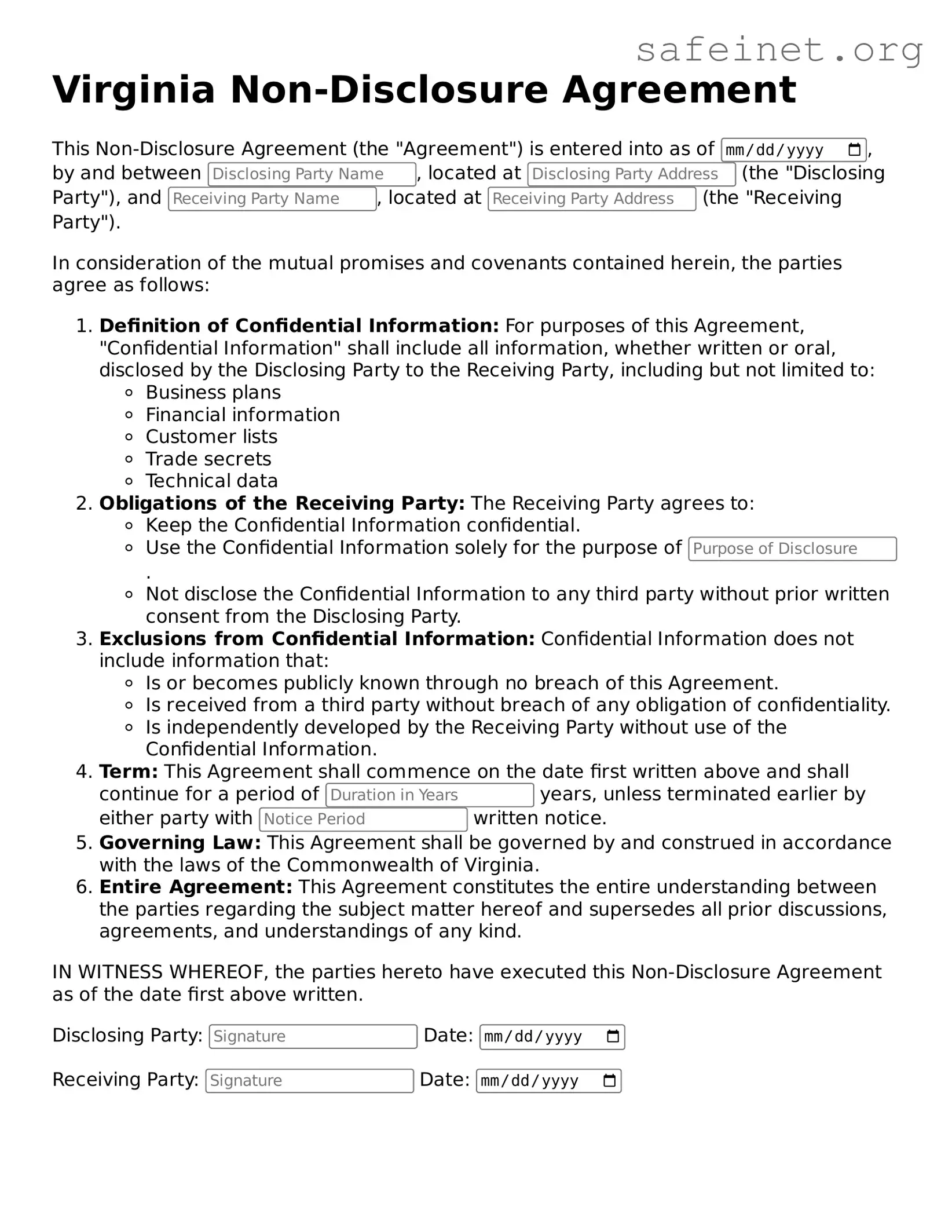
Virginia Non-Disclosure Agreement
This Non-Disclosure Agreement (the "Agreement") is entered into as of , by and between , located at (the "Disclosing Party"), and , located at (the "Receiving Party").
In consideration of the mutual promises and covenants contained herein, the parties agree as follows:
IN WITNESS WHEREOF, the parties hereto have executed this Non-Disclosure Agreement as of the date first above written.
Disclosing Party: Date:
Receiving Party: Date:
| Fact Name | Description |
|---|---|
| Purpose | The Virginia Non-disclosure Agreement (NDA) is designed to protect confidential information shared between parties. |
| Governing Law | This agreement is governed by the laws of the Commonwealth of Virginia. |
| Parties Involved | The NDA typically involves at least two parties: the disclosing party and the receiving party. |
| Duration of Confidentiality | The NDA specifies the duration for which the information must remain confidential, often ranging from one to five years. |
Filling out the Virginia Non-disclosure Agreement form is an important step in protecting sensitive information. After completing the form, you will be ready to proceed with the next steps in your process, ensuring that confidentiality is maintained.
What is a Virginia Non-disclosure Agreement (NDA)?
A Virginia Non-disclosure Agreement is a legal contract that protects confidential information shared between parties. It ensures that sensitive information remains private and is not disclosed to unauthorized individuals or entities. NDAs are commonly used in business relationships, employment situations, and during negotiations to safeguard proprietary information.
Who should use a Non-disclosure Agreement in Virginia?
Any individual or business that plans to share confidential information with another party should consider using an NDA. This includes entrepreneurs discussing business ideas, employers sharing trade secrets with employees, or companies collaborating on projects. An NDA helps establish trust and protects valuable information from being misused.
What types of information can be protected by an NDA?
NDAs can protect a wide range of information, including trade secrets, business plans, financial data, customer lists, and proprietary technology. Essentially, any information that gives a business a competitive edge can be safeguarded through an NDA, as long as it is clearly defined in the agreement.
How long does the confidentiality obligation last under a Virginia NDA?
The duration of the confidentiality obligation can vary based on the terms set forth in the NDA. Typically, NDAs specify a time frame during which the information must remain confidential, which can range from a few years to indefinitely. It is essential to clearly outline this duration in the agreement to avoid any ambiguity.
What happens if someone breaches the NDA?
If a party breaches the NDA, the affected party may seek legal remedies. This can include monetary damages, injunctive relief to prevent further disclosures, or other legal actions. The specific consequences for breaching an NDA should be detailed in the agreement to ensure all parties understand the potential repercussions.
Can an NDA be enforced in Virginia?
Yes, NDAs can be enforced in Virginia, provided they are properly drafted and meet legal requirements. Courts generally uphold NDAs as long as they are reasonable in scope and duration. However, if the agreement is overly broad or vague, it may not be enforceable.
Is it necessary to have a lawyer draft the NDA?
While it is not strictly necessary to have a lawyer draft an NDA, it is highly advisable. A legal professional can ensure that the agreement complies with Virginia law, addresses specific needs, and includes appropriate clauses. Having a well-drafted NDA can help prevent disputes and provide clarity for all parties involved.
Can an NDA be modified after it is signed?
Yes, an NDA can be modified after it is signed, but both parties must agree to the changes. Modifications should be documented in writing and signed by both parties to ensure enforceability. It is crucial to keep a record of any amendments to avoid misunderstandings in the future.
What should I do if I need to disclose information covered by an NDA?
If you find yourself in a situation where you need to disclose information protected by an NDA, review the agreement carefully. Look for any clauses that allow for disclosure under specific circumstances, such as legal obligations or with the consent of the other party. If necessary, consult with a legal professional to ensure compliance with the NDA.
Incomplete Information: Many individuals fail to provide all required details. Missing names, addresses, or dates can render the agreement ineffective.
Incorrect Signatures: Some people overlook the necessity of signing the document. Both parties must sign for the agreement to be legally binding.
Failure to Define Confidential Information: A common mistake is not clearly specifying what constitutes confidential information. Ambiguity can lead to misunderstandings later.
Ignoring Duration of Agreement: Not specifying how long the confidentiality obligation lasts is another frequent error. The duration should be clearly stated to avoid future disputes.
Not Reviewing the Terms: Some individuals skip reviewing the entire agreement before signing. Understanding all terms is crucial to ensure compliance and protection.
Neglecting Legal Advice: Many people attempt to fill out the form without seeking legal guidance. Consulting a legal professional can help clarify any confusing aspects of the agreement.
The Virginia Non-Disclosure Agreement (NDA) is an essential document for protecting sensitive information shared between parties. It is often accompanied by other forms and documents that further define the relationship and responsibilities of the parties involved. Below is a list of commonly used documents that complement the NDA.
Using these documents alongside the Virginia Non-Disclosure Agreement can help clarify the terms of confidentiality and the expectations of all parties involved. Properly executed, they can serve as a strong foundation for a secure business relationship.
A Confidentiality Agreement is quite similar to a Non-disclosure Agreement (NDA). Both documents aim to protect sensitive information shared between parties. In a Confidentiality Agreement, the focus is often on the information being shared, detailing what is considered confidential and how it should be handled. Like an NDA, it establishes the obligations of the parties involved, ensuring that proprietary information remains secure and is not disclosed to unauthorized individuals.
An Employment Agreement can also resemble a Non-disclosure Agreement. This document often includes clauses that protect the employer’s confidential information. When an employee joins a company, they may be required to sign an Employment Agreement that outlines their responsibilities, including keeping trade secrets and sensitive data private. This ensures that the company’s interests are safeguarded during and after the employment period.
Finally, a Proprietary Information Agreement (PIA) closely aligns with a Non-disclosure Agreement. A PIA specifically focuses on protecting proprietary information, which includes trade secrets, business plans, and other sensitive data. This agreement outlines the responsibilities of the parties involved regarding the handling of proprietary information, ensuring that it is not disclosed without permission. Both PIAs and NDAs aim to prevent the unauthorized sharing of valuable information.
When filling out the Virginia Non-disclosure Agreement (NDA) form, it's important to approach the process with care. Here are some essential dos and don’ts to consider:
By following these guidelines, you can help ensure that the NDA is completed correctly and serves its intended purpose effectively.
Non-disclosure agreements (NDAs) are often misunderstood. Here are ten common misconceptions about the Virginia Non-disclosure Agreement form, along with clarifications to help you better understand this important legal document.
All NDAs are the same. Many people believe that all NDAs are identical. In reality, each agreement can be tailored to fit specific situations and needs. The terms can vary significantly based on the parties involved and the information being protected.
NDAs are only for businesses. While businesses frequently use NDAs, individuals can also utilize them. Anyone sharing sensitive information may find an NDA beneficial, whether for personal or professional reasons.
Signing an NDA means you can't talk to anyone. This is not entirely true. NDAs typically allow for discussions with certain parties, like legal counsel or employees, as long as those parties are also bound to confidentiality.
NDAs are enforceable in all situations. Some NDAs may not be enforceable if they are overly broad or if they restrict a person's ability to work. Courts may refuse to uphold an NDA that is deemed unreasonable.
Once signed, an NDA lasts forever. Many believe that NDAs are indefinite. However, most agreements specify a time frame during which the information must remain confidential, after which the obligations may expire.
NDAs can prevent legal action. Some think that signing an NDA prevents them from taking legal action. In fact, an NDA does not waive a party's right to report illegal activities or seek legal recourse.
Only written NDAs are valid. While written agreements are the most common, verbal NDAs can also exist. However, proving the terms of a verbal agreement can be challenging.
NDAs are only for trade secrets. Many associate NDAs solely with trade secrets. In truth, they can protect a wide range of sensitive information, including business plans, client lists, and proprietary data.
You cannot negotiate NDA terms. Some individuals believe that the terms of an NDA are set in stone. However, parties can negotiate terms to ensure that the agreement meets their needs.
NDAs are only necessary for large companies. This is a common misconception. Small businesses and even freelancers should consider NDAs when sharing sensitive information to protect their interests.
Understanding these misconceptions can help individuals and businesses navigate the complexities of non-disclosure agreements more effectively.
When dealing with sensitive information, a Non-disclosure Agreement (NDA) is essential. Here are key takeaways regarding the Virginia Non-disclosure Agreement form:
Understanding these key points can help ensure that the NDA serves its purpose effectively, safeguarding sensitive information for all parties involved.