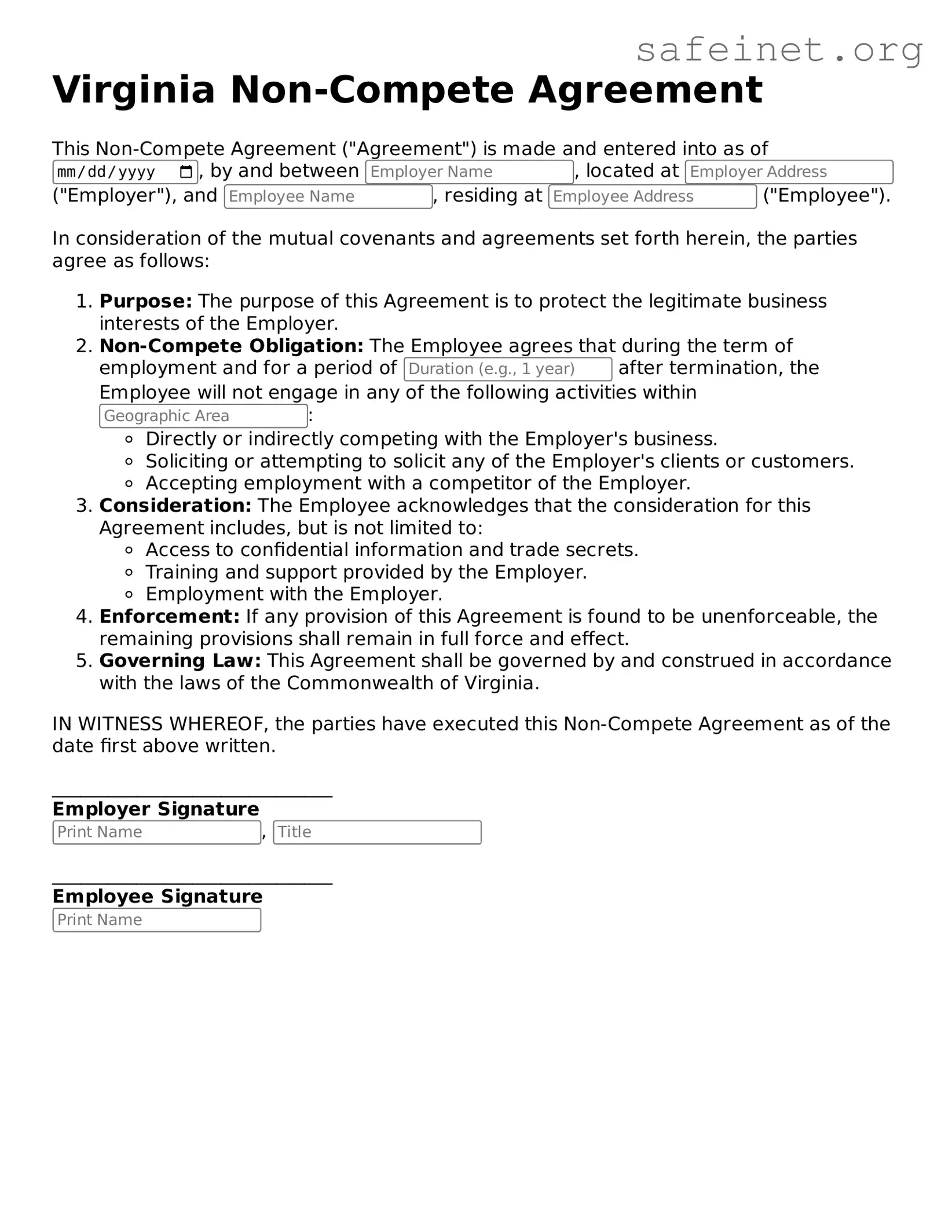
In Virginia, the Non-compete Agreement form serves as a crucial tool for employers seeking to protect their business interests while ensuring that employees understand their obligations after leaving a job. This form outlines the specific terms under which an employee agrees not to engage in competitive activities that could harm the employer's business. Key components typically include the duration of the non-compete period, the geographical area covered, and the types of activities that are restricted. Employers must ensure that the terms are reasonable and not overly broad to be enforceable in court. Additionally, the form may address considerations such as compensation during the non-compete period and any potential consequences for violation. Understanding these elements is essential for both employers and employees to navigate the complexities of employment relationships and protect their respective rights.
Virginia Non-Compete Agreement
This Non-Compete Agreement ("Agreement") is made and entered into as of , by and between , located at ("Employer"), and , residing at ("Employee").
In consideration of the mutual covenants and agreements set forth herein, the parties agree as follows:
IN WITNESS WHEREOF, the parties have executed this Non-Compete Agreement as of the date first above written.
______________________________
Employer Signature
,
______________________________
Employee Signature
| Fact Name | Description |
|---|---|
| Definition | A non-compete agreement is a contract between an employer and employee that restricts the employee from working in competing businesses for a specified period after leaving the company. |
| Governing Law | In Virginia, non-compete agreements are governed by the Virginia Code, specifically § 40.1-28.7:7. |
| Enforceability | Virginia courts will enforce non-compete agreements if they are reasonable in scope, duration, and geographic area. |
| Consideration | For a non-compete agreement to be valid, there must be consideration, such as employment or a promotion, provided to the employee. |
| Limitations | Non-compete agreements cannot be overly broad; they must protect legitimate business interests without unduly restricting an employee's right to work. |
Once you have the Virginia Non-compete Agreement form in hand, it's important to fill it out accurately. This ensures that all parties understand the terms and conditions clearly. Follow these steps to complete the form correctly.
What is a Non-compete Agreement in Virginia?
A Non-compete Agreement is a legal contract that restricts an employee from working for competitors or starting a similar business for a specified period after leaving their current employer. In Virginia, these agreements must be reasonable in scope, duration, and geographic area to be enforceable.
Are Non-compete Agreements enforceable in Virginia?
Yes, Non-compete Agreements can be enforceable in Virginia, but they must meet certain criteria. The agreement should protect legitimate business interests, be reasonable in duration and geographic scope, and not impose an undue hardship on the employee.
How long can a Non-compete Agreement last in Virginia?
The duration of a Non-compete Agreement can vary, but generally, courts in Virginia tend to favor shorter time frames. A period of six months to two years is often considered reasonable, depending on the circumstances of the employment and the nature of the business.
What geographic area can a Non-compete Agreement cover?
The geographic scope of a Non-compete Agreement should be limited to areas where the employer conducts business. Overly broad restrictions may be deemed unenforceable. It's crucial to define the area clearly to ensure the agreement is fair and reasonable.
Can I negotiate the terms of a Non-compete Agreement?
Yes, employees can negotiate the terms of a Non-compete Agreement before signing. It's important to discuss any concerns with your employer and seek modifications that make the agreement more acceptable. Clear communication can lead to a more balanced contract.
What happens if I violate a Non-compete Agreement?
If you violate a Non-compete Agreement, your former employer may take legal action against you. This could result in a court enforcing the agreement, which might include injunctions to stop you from working for a competitor or financial damages.
Are there any exceptions to Non-compete Agreements in Virginia?
Yes, certain exceptions exist. For instance, Virginia law prohibits Non-compete Agreements for low-wage employees, defined as those earning less than a specific threshold. Additionally, if the agreement is overly broad or unreasonable, it may be challenged in court.
Do I need a lawyer to create a Non-compete Agreement?
While it's not strictly necessary to hire a lawyer, consulting with one is highly advisable. A legal professional can help ensure that the agreement is fair, complies with Virginia law, and protects your interests effectively.
Can a Non-compete Agreement be enforced after I leave my job?
Yes, a Non-compete Agreement is typically enforced after you leave your job. However, the enforceability will depend on whether the agreement meets the legal requirements and is reasonable in its terms.
What should I do if I’m asked to sign a Non-compete Agreement?
If you are asked to sign a Non-compete Agreement, take your time to read it thoroughly. Consider discussing it with a legal professional to understand its implications. Make sure you feel comfortable with the terms before signing.
Inadequate Definition of Restricted Activities: Many individuals fail to clearly define what constitutes restricted activities. A vague description can lead to misunderstandings and potential legal challenges.
Improper Geographic Scope: Some people set an overly broad geographic area for the non-compete clause. This can make the agreement unenforceable in Virginia, where the scope must be reasonable.
Neglecting Duration of the Agreement: A common mistake is not specifying the duration of the non-compete. An indefinite period may be seen as unreasonable, which could invalidate the agreement.
Failure to Consider Consideration: Individuals often overlook the need for consideration, which refers to the benefits received in exchange for signing the agreement. Without adequate consideration, the agreement may not hold up in court.
Not Seeking Legal Review: Many people skip the step of having a lawyer review the agreement. Legal professionals can provide essential insights and ensure that the document complies with Virginia law.
When entering into a Virginia Non-compete Agreement, several additional documents may be necessary to ensure clarity and legal compliance. These forms help outline the terms of employment, protect intellectual property, and establish clear expectations between employers and employees. Below is a list of commonly used documents that accompany a Non-compete Agreement.
These documents work together to create a comprehensive legal framework that protects both the employer's interests and the employee's rights. Understanding each of these forms can help ensure a smoother transition into and out of employment, while also fostering a positive working environment.
The Virginia Non-Compete Agreement form shares similarities with the Non-Disclosure Agreement (NDA). Both documents aim to protect sensitive information. While the Non-Compete Agreement restricts an employee from working with competitors after leaving a job, the NDA prevents them from sharing confidential information during and after their employment. Companies often use both to safeguard their interests and ensure that proprietary knowledge remains protected.
Another document similar to the Virginia Non-Compete Agreement is the Employment Agreement. This agreement outlines the terms of employment, including duties, compensation, and termination conditions. While the Employment Agreement focuses on the relationship between the employer and employee, it may also include non-compete clauses. This integration helps ensure that employees understand their responsibilities and the limitations placed on them after leaving the company.
The Virginia Non-Compete Agreement is also akin to a Proprietary Information Agreement. This document specifically addresses the handling of proprietary information, ensuring that employees do not disclose trade secrets or sensitive data. Like the Non-Compete Agreement, it serves to protect a company’s competitive edge. However, it focuses more on information security rather than employment restrictions after leaving the job.
Similarly, the Confidentiality Agreement serves a related purpose. This document requires employees to keep certain information private. While it doesn’t directly restrict future employment, it complements the Non-Compete Agreement by ensuring that employees understand the importance of confidentiality. Together, they create a comprehensive approach to protecting a company’s interests.
The Independent Contractor Agreement also bears similarities to the Virginia Non-Compete Agreement. This document is used when hiring freelancers or contractors. It may contain non-compete clauses to prevent contractors from taking on similar projects with competitors. This ensures that companies can work with independent contractors while still safeguarding their business interests.
Lastly, the Partnership Agreement can resemble the Non-Compete Agreement in certain contexts. This document outlines the terms of a partnership, including responsibilities and profit-sharing. In some cases, it may include non-compete provisions to prevent partners from starting competing businesses. This helps maintain a harmonious working relationship and protects the investment each partner has made in the venture.
When filling out the Virginia Non-compete Agreement form, it's important to be careful and thorough. Here are five things you should and shouldn't do:
Non-compete agreements can often be misunderstood. Here are eight common misconceptions about the Virginia Non-compete Agreement form, along with clarifications to help you navigate this important legal document.
Many believe that all non-compete agreements are valid and enforceable. However, Virginia law requires these agreements to be reasonable in scope, duration, and geographic area to be upheld in court.
Some think that once a non-compete agreement is presented, it cannot be changed. In reality, employees can negotiate terms before signing, especially if they feel the terms are too restrictive.
It’s a common misconception that all non-compete agreements follow a standard format. Each agreement can vary significantly based on the nature of the business and the specific role of the employee.
Many believe that only high-level executives are subject to non-compete agreements. However, these agreements can apply to employees at various levels, depending on their access to sensitive information.
Some think that signing a non-compete agreement completely bars them from working in their industry. In fact, most agreements specify a limited time frame and geographic area where competition is restricted.
There’s a belief that only employees need to worry about non-compete agreements. However, independent contractors and consultants may also be asked to sign these agreements.
Some individuals assume that non-compete agreements hold no legal weight. In Virginia, if properly drafted, these agreements can be enforced in court, making it crucial to understand their implications.
Finally, many think they can simply disregard a non-compete agreement after leaving a job. Violating the terms of an agreement can lead to legal action, so it’s important to take these documents seriously.
Understanding these misconceptions can help you make informed decisions regarding non-compete agreements in Virginia. Always consider seeking legal advice if you have questions about your specific situation.
When considering a Non-compete Agreement in Virginia, it is essential to understand several key points to ensure that the document is effective and enforceable. Here are ten important takeaways:
By paying attention to these key points, individuals and businesses can navigate the complexities of Non-compete Agreements in Virginia more effectively.