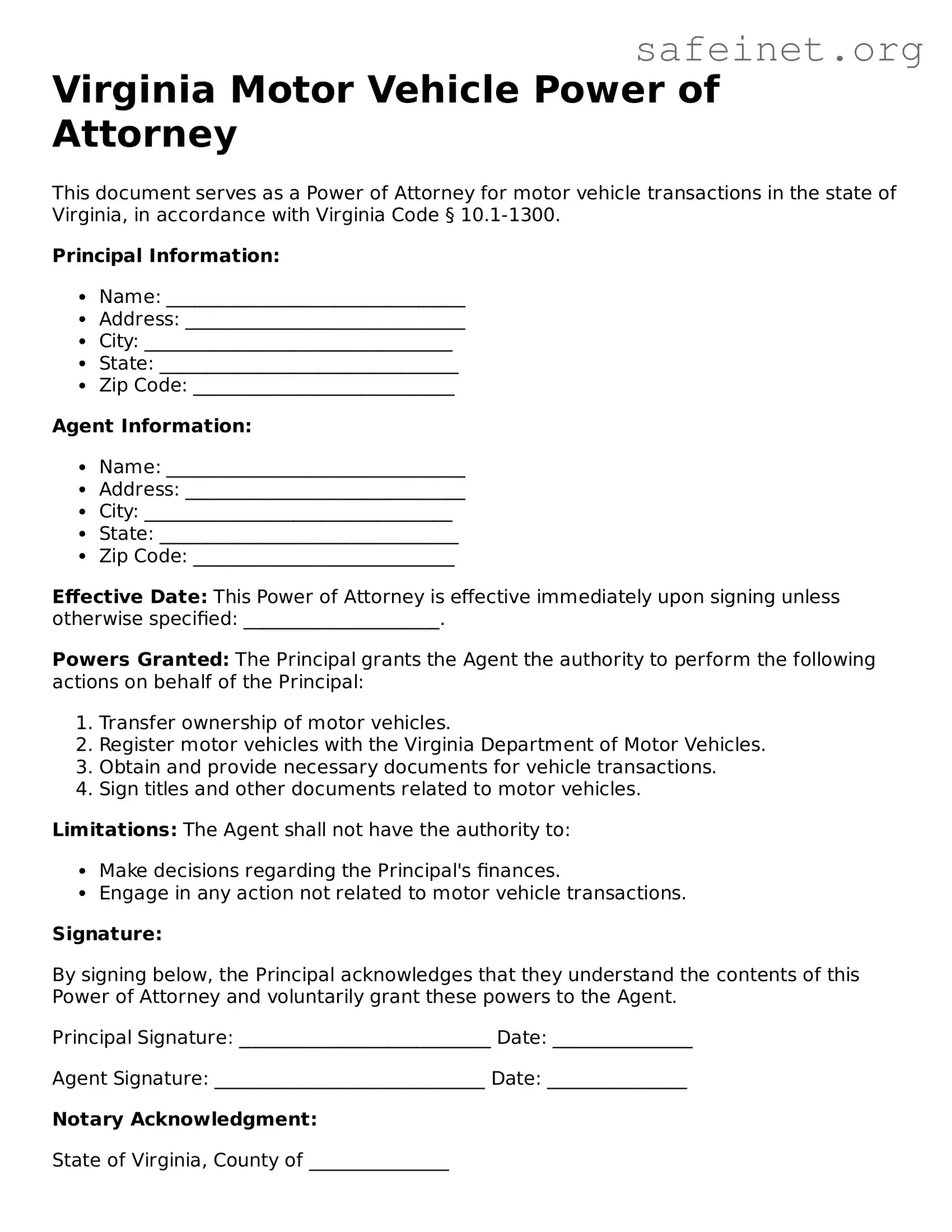
In Virginia, the Motor Vehicle Power of Attorney form serves as a vital tool for individuals who need to delegate authority over their vehicle-related matters to another person. This form allows the appointed agent to handle a variety of tasks, such as registering a vehicle, transferring ownership, or obtaining a title on behalf of the vehicle owner. By using this document, individuals can ensure that their interests are represented even when they cannot be present to manage these important affairs themselves. It's particularly useful in situations where the owner may be out of state, incapacitated, or simply unable to attend to these responsibilities due to other commitments. Understanding the nuances of this form can help individuals make informed decisions about who they trust to act on their behalf, ensuring that their vehicle transactions proceed smoothly and efficiently. With the right information and proper execution, the Motor Vehicle Power of Attorney can streamline processes that might otherwise become complicated and time-consuming.
Virginia Motor Vehicle Power of Attorney
This document serves as a Power of Attorney for motor vehicle transactions in the state of Virginia, in accordance with Virginia Code § 10.1-1300.
Principal Information:
Agent Information:
Effective Date: This Power of Attorney is effective immediately upon signing unless otherwise specified: _____________________.
Powers Granted: The Principal grants the Agent the authority to perform the following actions on behalf of the Principal:
Limitations: The Agent shall not have the authority to:
Signature:
By signing below, the Principal acknowledges that they understand the contents of this Power of Attorney and voluntarily grant these powers to the Agent.
Principal Signature: ___________________________ Date: _______________
Agent Signature: _____________________________ Date: _______________
Notary Acknowledgment:
State of Virginia, County of _______________
Subscribed and sworn to before me this _____ day of ______________, 20__.
Notary Public: _____________________________
My Commission Expires: _____________________
| Fact Name | Description |
|---|---|
| Purpose | The Virginia Motor Vehicle Power of Attorney form allows an individual to authorize another person to handle motor vehicle-related transactions on their behalf. |
| Governing Law | This form is governed by the Virginia Code, specifically § 54.1-2131, which outlines powers of attorney in the state. |
| Signatories | The form must be signed by the principal (the person granting authority) and the agent (the person receiving authority). |
| Notarization | While notarization is not always required, having the document notarized can enhance its validity and acceptance. |
| Scope of Authority | The agent can perform various tasks, including transferring ownership, registering vehicles, and obtaining titles. |
| Revocation | The principal can revoke the power of attorney at any time, provided they notify the agent and any relevant parties. |
Completing the Virginia Motor Vehicle Power of Attorney form is a straightforward process that enables an individual to designate another person to act on their behalf regarding motor vehicle matters. After filling out the form, you will need to ensure that it is signed and notarized to be valid.
What is a Virginia Motor Vehicle Power of Attorney form?
The Virginia Motor Vehicle Power of Attorney form is a legal document that allows one person (the principal) to authorize another person (the agent) to act on their behalf in matters related to motor vehicles. This can include tasks such as transferring ownership, registering a vehicle, or obtaining a title. It's particularly useful when the principal cannot be present to handle these matters themselves.
Who can be designated as an agent in this form?
Any adult can be designated as an agent in the Virginia Motor Vehicle Power of Attorney form. This could be a family member, friend, or even a professional, such as a lawyer or a car dealership representative. The key is that the person you choose should be trustworthy and capable of handling the responsibilities you are assigning to them.
Do I need to have the form notarized?
Yes, the Virginia Motor Vehicle Power of Attorney form must be notarized to be valid. This means that a notary public needs to witness the signing of the document. Notarization helps ensure that the signatures are authentic and that the parties involved understand the contents of the document.
Can I revoke a Power of Attorney once it is established?
Absolutely. You can revoke a Power of Attorney at any time, as long as you are mentally competent. To do so, you should create a written revocation document and notify your agent and any relevant institutions, such as the Virginia Department of Motor Vehicles, to prevent any future actions based on the original Power of Attorney.
What happens if my agent cannot fulfill their duties?
If your agent is unable to fulfill their duties due to illness, unavailability, or any other reason, the Power of Attorney may become ineffective. It’s a good idea to have a backup agent designated in the form, or you can create a new Power of Attorney to appoint someone else if necessary.
Is there a specific format for the Virginia Motor Vehicle Power of Attorney form?
While there is no strict format mandated by law, it’s important that the form includes specific elements, such as the names of the principal and agent, a clear statement of the powers being granted, and the principal's signature along with notarization. Using a standardized form can help ensure that all necessary information is included.
Can I use this form for transactions outside of Virginia?
The Virginia Motor Vehicle Power of Attorney form is primarily intended for use within Virginia. If you need to conduct vehicle transactions in another state, it's advisable to check that state’s requirements. They may have their own forms or regulations that you must follow.
Is there a fee associated with using this form?
There is typically no fee for creating a Power of Attorney form itself, but there may be fees associated with notarization and any transactions that occur as a result of the Power of Attorney, such as title transfers or registration fees. Always check with your local Department of Motor Vehicles for specific costs related to your situation.
How long does a Power of Attorney last?
The duration of a Power of Attorney can vary based on the terms outlined in the document. It can be set to last for a specific period, until a certain event occurs, or until it is revoked. If you want your Power of Attorney to remain in effect until revoked, make sure to state that clearly in the document.
Inaccurate Information: One common mistake is providing incorrect or incomplete information. This can include misspelling names, entering wrong vehicle identification numbers (VINs), or omitting important details such as the date of birth of the principal.
Not Signing the Form: Failing to sign the form is a critical error. The form must be signed by the principal to be valid. Without a signature, the document lacks legal authority.
Improper Witnessing: Some individuals overlook the requirement for witnesses. In Virginia, the Power of Attorney may need to be signed in the presence of a notary or witnesses, depending on the specific circumstances.
Not Specifying Powers Clearly: It is essential to clearly outline the powers being granted. Vague language can lead to confusion and may result in the agent not having the authority to act as intended.
The Virginia Motor Vehicle Power of Attorney form is essential for delegating authority regarding vehicle-related matters. However, several other documents may accompany this form to ensure a smooth process. Here are some commonly used forms and documents:
Utilizing these documents in conjunction with the Virginia Motor Vehicle Power of Attorney form can streamline the process of managing vehicle transactions and ownership changes. Each document plays a crucial role in ensuring clarity and legality in vehicle-related matters.
The Virginia Motor Vehicle Power of Attorney form shares similarities with the General Power of Attorney. Both documents allow an individual, known as the principal, to designate another person, called the agent, to make decisions on their behalf. The General Power of Attorney is broader in scope, covering various aspects of a person's life, such as financial matters and healthcare decisions. In contrast, the Motor Vehicle Power of Attorney is specifically tailored for vehicle-related transactions, like registering a car or transferring ownership. This focused approach makes it easier for individuals to delegate authority for specific tasks without overwhelming the agent with unrelated responsibilities.
Another document that resembles the Virginia Motor Vehicle Power of Attorney is the Durable Power of Attorney. Like the Motor Vehicle Power of Attorney, the Durable Power of Attorney enables a principal to appoint someone to act on their behalf. However, the key difference lies in the durability aspect. A Durable Power of Attorney remains effective even if the principal becomes incapacitated, ensuring that the agent can continue to manage the principal's affairs. This is particularly important for long-term planning and can be beneficial when dealing with ongoing vehicle-related issues, such as maintenance or insurance, even when the principal is unable to make decisions.
The Vehicle Title Application also shares a connection with the Virginia Motor Vehicle Power of Attorney. While the Motor Vehicle Power of Attorney allows someone to act on behalf of the principal in vehicle transactions, the Vehicle Title Application is the formal document used to register a vehicle or transfer its title. Both documents are often used in tandem during the buying or selling process. When a principal cannot be present to sign the title application, the Motor Vehicle Power of Attorney provides the necessary authorization for the agent to complete the application on their behalf, ensuring a smooth transaction.
Lastly, the Bill of Sale is another document that has a relationship with the Virginia Motor Vehicle Power of Attorney. A Bill of Sale serves as a legal record of the sale of a vehicle, detailing the terms and conditions agreed upon by the buyer and seller. In situations where the seller cannot be present to sign the Bill of Sale, the Motor Vehicle Power of Attorney allows the agent to sign on their behalf, ensuring that the sale is legally binding. This connection emphasizes the importance of having the right documents in place to facilitate vehicle transactions, making the process easier for all parties involved.
When filling out the Virginia Motor Vehicle Power of Attorney form, it is essential to follow specific guidelines to ensure accuracy and compliance. Here are seven things you should and shouldn't do:
When dealing with the Virginia Motor Vehicle Power of Attorney form, several misconceptions often arise. Understanding these misconceptions can help individuals navigate the process more effectively. Here are eight common misunderstandings:
Many believe that this form is solely for transferring ownership of a vehicle. However, it can also be used for other purposes, such as registering a vehicle, obtaining title documents, or handling other motor vehicle-related matters.
Some think that a licensed attorney must prepare the Power of Attorney form. In reality, individuals can complete it themselves, as long as they understand the requirements and follow the proper guidelines.
While notarization can add an extra layer of authenticity, it is not always required for the form to be valid. Depending on the specific situation, some may be able to use the form without notarization.
Many assume that the Power of Attorney is limited to a single transaction. In fact, it can be drafted to cover multiple transactions or a specific period, providing flexibility for the designated agent.
Some individuals mistakenly believe that signing the form is a permanent decision. In reality, the principal can revoke the Power of Attorney at any time, as long as they follow the proper procedures.
It is a common misconception that only one agent can be designated. However, individuals can appoint multiple agents to act jointly or separately, depending on their preferences.
While this form is specific to Virginia, some believe it is only valid within state lines. However, it may be recognized in other states, provided it meets certain criteria.
Many think that a verbal agreement or trust in family members is sufficient. However, having a formal Power of Attorney in place ensures that your wishes are clearly documented and legally enforceable.
Addressing these misconceptions can empower individuals to make informed decisions regarding their motor vehicle transactions and ensure that their interests are adequately protected.
When filling out and using the Virginia Motor Vehicle Power of Attorney form, it is important to keep the following key takeaways in mind:
These steps can help ensure that the process goes smoothly and that your vehicle-related matters are managed according to your wishes.