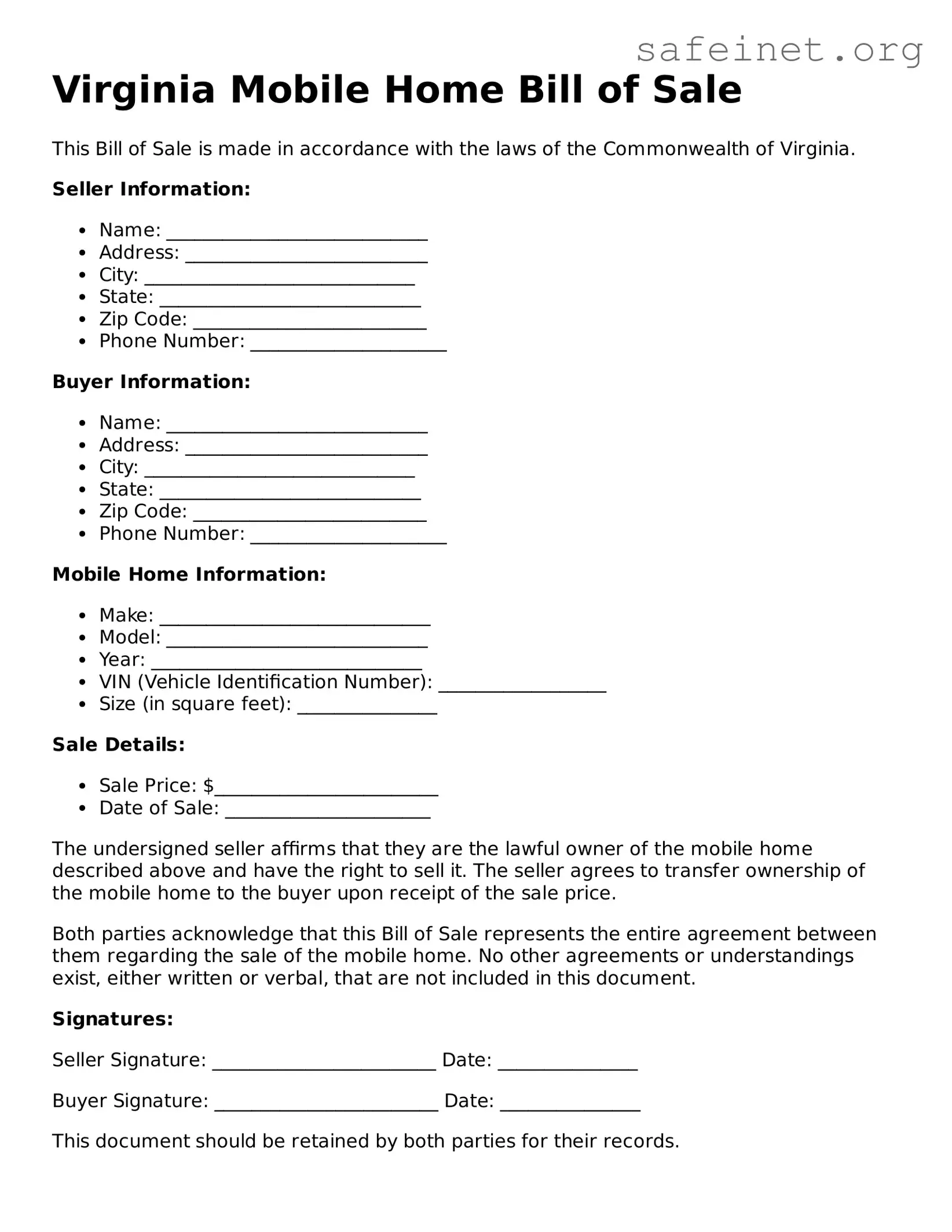
The Virginia Mobile Home Bill of Sale form serves as a crucial document in the transfer of ownership for mobile homes within the state. This form outlines essential details such as the names and addresses of both the seller and buyer, ensuring that all parties involved are clearly identified. It includes specific information about the mobile home itself, including its make, model, year, and vehicle identification number (VIN), which helps to prevent any confusion regarding the item being sold. Additionally, the form addresses the sale price and payment terms, providing clarity on the financial aspects of the transaction. Notably, it may also include any warranties or representations made by the seller about the condition of the mobile home, thereby protecting the buyer’s interests. By utilizing this form, both parties can ensure that the sale is documented properly, reducing the likelihood of future disputes and facilitating a smoother transfer of ownership.
Virginia Mobile Home Bill of Sale
This Bill of Sale is made in accordance with the laws of the Commonwealth of Virginia.
Seller Information:
Buyer Information:
Mobile Home Information:
Sale Details:
The undersigned seller affirms that they are the lawful owner of the mobile home described above and have the right to sell it. The seller agrees to transfer ownership of the mobile home to the buyer upon receipt of the sale price.
Both parties acknowledge that this Bill of Sale represents the entire agreement between them regarding the sale of the mobile home. No other agreements or understandings exist, either written or verbal, that are not included in this document.
Signatures:
Seller Signature: ________________________ Date: _______________
Buyer Signature: ________________________ Date: _______________
This document should be retained by both parties for their records.
| Fact Name | Description |
|---|---|
| Purpose | The Virginia Mobile Home Bill of Sale form is used to transfer ownership of a mobile home from one party to another. |
| Governing Law | This form is governed by the Virginia Code § 46.2-653, which outlines regulations for mobile homes and their sale. |
| Parties Involved | The form requires information from both the seller and the buyer, including their names and addresses. |
| Mobile Home Details | Specific details about the mobile home, such as make, model, year, and VIN, must be included in the form. |
| Consideration | The sale price or consideration for the mobile home should be clearly stated in the document. |
| Signatures | Both the seller and the buyer must sign the form to validate the transaction. |
| Notarization | While notarization is not required, it is recommended to enhance the document's credibility. |
Once you have the Virginia Mobile Home Bill of Sale form in hand, it’s important to complete it accurately to ensure a smooth transaction. Gather the necessary information and follow the steps outlined below to fill out the form correctly.
After completing the form, make copies for both parties. This will provide proof of the transaction and protect everyone's interests.
What is a Virginia Mobile Home Bill of Sale?
A Virginia Mobile Home Bill of Sale is a legal document used to transfer ownership of a mobile home from one party to another. This form provides essential details about the transaction, including the names of the buyer and seller, the description of the mobile home, and the purchase price. It serves as proof of the sale and can be used for registration purposes with the state.
Is a Bill of Sale required for selling a mobile home in Virginia?
While a Bill of Sale is not legally required in Virginia, it is highly recommended. This document protects both the buyer and the seller by clearly outlining the terms of the sale. Without it, disputes may arise regarding ownership or payment, making the transaction more complicated.
What information is needed to complete the Bill of Sale?
To complete the Virginia Mobile Home Bill of Sale, you will need the following information: the names and addresses of both the buyer and seller, the mobile home’s identification number, make, model, year, and any additional details that may be relevant. The sale price and date of the transaction should also be included.
Can the Bill of Sale be used for financing a mobile home?
Yes, a Bill of Sale can be used when financing a mobile home. Lenders often require this document to verify ownership and the terms of the sale. However, additional paperwork may be necessary to complete the financing process, depending on the lender's requirements.
Do I need to notarize the Bill of Sale?
Notarization is not mandatory for a Virginia Mobile Home Bill of Sale, but it is a good practice. Having the document notarized can provide an extra layer of protection, confirming the identities of the parties involved and the legitimacy of the transaction.
What should I do after completing the Bill of Sale?
After completing the Bill of Sale, both the buyer and seller should keep a copy for their records. The seller should also provide the buyer with the original document. If applicable, the buyer will need to take the Bill of Sale to their local Department of Motor Vehicles (DMV) to register the mobile home in their name.
Are there any fees associated with the Bill of Sale?
There are typically no fees specifically associated with creating a Bill of Sale in Virginia. However, if you choose to have the document notarized, there may be a small fee for that service. Additionally, registration of the mobile home with the DMV may involve fees, which vary based on local regulations.
What if the mobile home has a lien on it?
If the mobile home has a lien, it is essential to address this before completing the sale. The seller should disclose any outstanding liens to the buyer. The lien must be paid off, or arrangements made to satisfy it, before the Bill of Sale can be executed to ensure clear ownership transfer.
Can I use a generic Bill of Sale template for my mobile home?
While you can use a generic Bill of Sale template, it is advisable to use a specific Virginia Mobile Home Bill of Sale form. This ensures that all necessary details are included and complies with state requirements, reducing the likelihood of issues arising during the sale.
What should I do if I lose the Bill of Sale?
If the Bill of Sale is lost, it is important to create a duplicate as soon as possible. Both parties should agree on the contents of the original document and sign the duplicate to acknowledge its validity. Keeping a copy in a safe place can help prevent future complications.
Incorrect Buyer and Seller Information: Ensure that the names and addresses of both the buyer and seller are accurate. A small typo can lead to significant issues later.
Missing Signatures: Both parties must sign the form. If one signature is absent, the document may be considered invalid.
Failure to Include Vehicle Identification Number (VIN): Always include the VIN of the mobile home. This number uniquely identifies the vehicle and is crucial for registration.
Omitting Sale Price: Clearly state the sale price of the mobile home. Leaving this blank can create confusion and potential disputes later.
Not Notarizing the Document: While notarization may not be mandatory, having the document notarized adds an extra layer of authenticity and can help avoid future disputes.
Ignoring Local Regulations: Different counties may have specific requirements for mobile home sales. Check local laws to ensure compliance before finalizing the sale.
When completing a transaction involving a mobile home in Virginia, several documents may accompany the Virginia Mobile Home Bill of Sale form. Each document serves a specific purpose and helps ensure a smooth transfer of ownership.
Having these documents prepared and organized can facilitate a successful transaction. Each plays a vital role in ensuring that both parties are protected and that the transfer of ownership is legally recognized.
The Virginia Vehicle Bill of Sale serves a similar purpose to the Mobile Home Bill of Sale. Both documents facilitate the transfer of ownership from one party to another. In the case of the Vehicle Bill of Sale, it typically includes details such as the vehicle's make, model, year, and Vehicle Identification Number (VIN). Similarly, the Mobile Home Bill of Sale contains information about the mobile home, including its make, model, and serial number. Both documents serve as legal proof of the transaction and can be used to register the vehicle or mobile home with the appropriate state authorities.
The Virginia Real Estate Purchase Agreement is another document that shares similarities with the Mobile Home Bill of Sale. While the Real Estate Purchase Agreement is primarily used for traditional property transactions, both documents outline the terms of sale, including the purchase price and any contingencies. The Mobile Home Bill of Sale captures the specifics of the mobile home transaction, while the Real Estate Purchase Agreement focuses on land and immovable structures. Both documents are essential for establishing a clear understanding between buyer and seller regarding the terms of the sale.
The Virginia Title Transfer form is also comparable to the Mobile Home Bill of Sale. This form is used to officially transfer ownership of a vehicle or mobile home from one party to another. Both documents require the seller's signature and may necessitate notarization to ensure authenticity. The Title Transfer form often accompanies the Mobile Home Bill of Sale in the transaction process, as it provides the necessary legal documentation to update the ownership records with the state. Each document plays a critical role in ensuring that ownership is properly transferred and recorded.
Lastly, the Virginia Affidavit of Title is akin to the Mobile Home Bill of Sale in that it serves to confirm ownership and the legitimacy of the sale. An Affidavit of Title is often used when a seller cannot provide a title due to loss or other circumstances. In such cases, the Mobile Home Bill of Sale can still serve as a supporting document to affirm the transaction. Both documents help to protect the interests of the buyer and seller, ensuring that the transfer of ownership is documented and legally recognized.
When filling out the Virginia Mobile Home Bill of Sale form, it's important to follow certain guidelines to ensure the process goes smoothly. Here are some dos and don'ts to keep in mind:
Understanding the Virginia Mobile Home Bill of Sale form is essential for anyone involved in buying or selling a mobile home. However, several misconceptions can lead to confusion. Here are ten common misunderstandings:
By clarifying these misconceptions, individuals can navigate the process of buying or selling a mobile home in Virginia with greater confidence.
When filling out and using the Virginia Mobile Home Bill of Sale form, it is essential to understand the following key points: