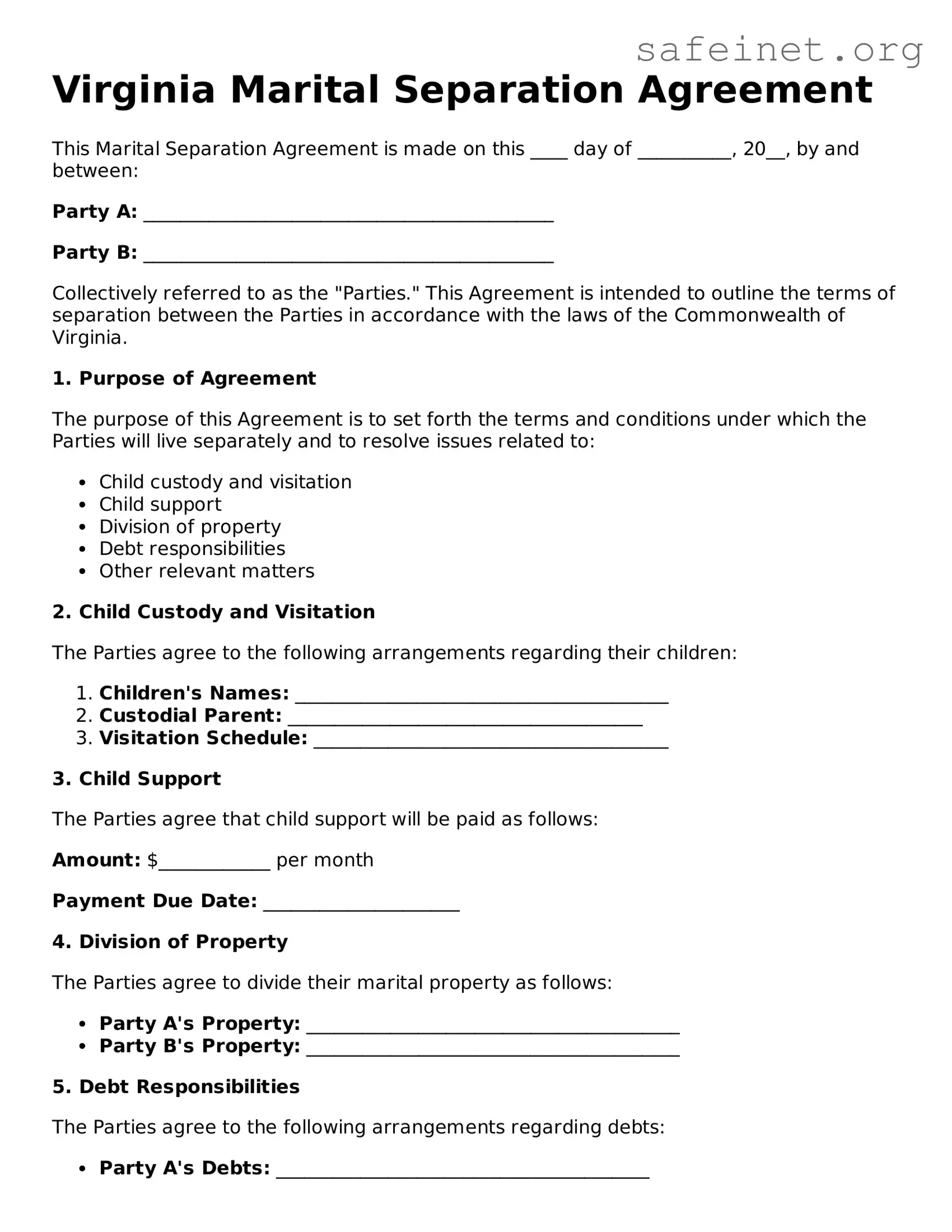
In Virginia, a Marital Separation Agreement serves as a crucial document for couples who have decided to live apart but are not yet ready to pursue divorce. This agreement outlines the terms and conditions of the separation, addressing key issues such as the division of property, child custody arrangements, and financial responsibilities. By clearly defining these aspects, the agreement helps to minimize conflict and provides a structured framework for both parties during a potentially tumultuous time. It can include provisions related to spousal support, visitation schedules, and the handling of debts, ensuring that both individuals have a mutual understanding of their rights and obligations. While the Marital Separation Agreement is not a legally binding divorce decree, it can serve as a valuable tool for negotiating terms amicably and may even influence future divorce proceedings. Understanding the components and significance of this form is essential for anyone navigating the separation process in Virginia.
Virginia Marital Separation Agreement
This Marital Separation Agreement is made on this ____ day of __________, 20__, by and between:
Party A: ____________________________________________
Party B: ____________________________________________
Collectively referred to as the "Parties." This Agreement is intended to outline the terms of separation between the Parties in accordance with the laws of the Commonwealth of Virginia.
1. Purpose of Agreement
The purpose of this Agreement is to set forth the terms and conditions under which the Parties will live separately and to resolve issues related to:
2. Child Custody and Visitation
The Parties agree to the following arrangements regarding their children:
3. Child Support
The Parties agree that child support will be paid as follows:
Amount: $____________ per month
Payment Due Date: _____________________
4. Division of Property
The Parties agree to divide their marital property as follows:
5. Debt Responsibilities
The Parties agree to the following arrangements regarding debts:
6. Miscellaneous Provisions
This Agreement shall be governed by the laws of the Commonwealth of Virginia. The Parties understand that they have the right to seek independent legal advice before signing this Agreement.
7. Signatures
By signing below, the Parties acknowledge that they have read and understood this Agreement and agree to its terms.
Party A Signature: ___________________________ Date: __________
Party B Signature: ___________________________ Date: __________
This document serves as a template and should be tailored to fit the specific needs of the Parties involved.
| Fact Name | Description |
|---|---|
| Definition | A Virginia Marital Separation Agreement is a legal document that outlines the terms of separation between spouses. |
| Governing Law | The agreement is governed by Virginia state law, specifically Title 20 of the Code of Virginia. |
| Purpose | It serves to clarify the rights and responsibilities of each spouse during the separation period. |
| Content Requirements | The agreement typically includes terms related to property division, debt allocation, child custody, and support. |
| Voluntary Nature | Both parties must voluntarily agree to the terms outlined in the document. |
| Not a Divorce | A separation agreement does not end the marriage; it merely establishes terms for living apart. |
| Enforceability | If properly executed, the agreement can be enforceable in court, similar to a contract. |
| Modification | Changes to the agreement can be made if both parties consent and document the modifications in writing. |
| Legal Advice | It is advisable for each spouse to seek independent legal counsel before signing the agreement. |
Once you have the Virginia Marital Separation Agreement form in front of you, it's time to fill it out accurately. Completing this form is a crucial step in the separation process. Following the instructions carefully will help ensure that all necessary information is provided.
After completing the form, you will need to file it with the appropriate court. This is a necessary step to formalize your separation. Be sure to keep copies for your records.
What is a Virginia Marital Separation Agreement?
A Virginia Marital Separation Agreement is a legal document that outlines the terms and conditions agreed upon by spouses who are separating. This agreement can address various issues, including the division of assets, debts, child custody, and support obligations. While it is not a divorce decree, it serves as a foundation for the separation process and can simplify future divorce proceedings.
Is a Marital Separation Agreement legally binding in Virginia?
Yes, a Marital Separation Agreement is legally binding in Virginia once both parties have signed it. This means that the terms outlined in the agreement must be followed by both spouses. However, if circumstances change, either party may seek to modify the agreement, but this typically requires mutual consent or a court order.
Do I need an attorney to draft a Marital Separation Agreement?
While it is not mandatory to have an attorney draft a Marital Separation Agreement, it is highly recommended. An attorney can help ensure that the agreement is comprehensive, fair, and compliant with Virginia laws. They can also provide guidance on specific issues, such as child custody and support, which may have long-term implications.
What should be included in a Marital Separation Agreement?
A well-drafted Marital Separation Agreement should include several key components. These typically encompass the division of marital property and debts, arrangements for child custody and visitation, child support obligations, and spousal support (if applicable). Additionally, the agreement may outline how future disputes will be resolved and any other specific terms both parties agree upon.
Can a Marital Separation Agreement be modified?
Yes, a Marital Separation Agreement can be modified if both parties agree to the changes. This may occur due to changes in circumstances, such as a significant change in income or living arrangements. To modify the agreement, it is advisable to document the changes in writing and have both parties sign the new terms to ensure clarity and enforceability.
What happens if one party violates the Marital Separation Agreement?
If one party violates the terms of the Marital Separation Agreement, the other party may seek legal remedies. This could involve filing a motion with the court to enforce the agreement. Courts generally take violations seriously, especially in matters concerning child custody and support. It is crucial to keep detailed records of any violations to support any legal actions taken.
How does a Marital Separation Agreement affect divorce proceedings?
A Marital Separation Agreement can significantly streamline divorce proceedings. Since the agreement outlines many of the terms that would otherwise need to be negotiated during the divorce, it can reduce conflict and expedite the process. However, it is important to note that the agreement may still need to be incorporated into the final divorce decree for it to be enforceable in court.
Incomplete Information: One common mistake is failing to fill out all required sections of the form. Each part of the agreement is important for clarity and legal validity.
Incorrect Dates: Providing wrong or inconsistent dates can lead to confusion. Ensure that all dates related to the separation are accurate and match throughout the document.
Vague Language: Using ambiguous terms can create misunderstandings later. Be specific about obligations, such as support payments or property division.
Not Including All Assets: Omitting assets can lead to disputes down the line. List all property, including shared and individual assets, to avoid future complications.
Ignoring State Requirements: Each state has specific requirements for separation agreements. Failing to adhere to Virginia’s regulations may render the agreement unenforceable.
Overlooking Signatures: Forgetting to sign or have the other party sign the agreement is a frequent oversight. Both parties must sign for the agreement to be valid.
Not Seeking Legal Advice: Some individuals skip consulting a lawyer. Legal guidance can help ensure that the agreement is fair and meets all legal standards.
Failing to Update the Agreement: Life changes, such as job loss or relocation, may require modifications to the agreement. Regularly review and update it to reflect current circumstances.
A Virginia Marital Separation Agreement is often accompanied by several other important documents. These documents help clarify the terms of separation and ensure that both parties understand their rights and responsibilities. Below is a list of common forms and documents that may be used alongside the Marital Separation Agreement.
These documents work together to create a comprehensive framework for a smooth separation process. It is advisable to consult with a legal professional to ensure all agreements are fair and enforceable.
The Virginia Marital Separation Agreement is similar to a Divorce Settlement Agreement. Both documents outline the terms of a couple's separation or divorce, including asset division, child custody, and support arrangements. While the Marital Separation Agreement may be used when couples are not yet ready to divorce, the Divorce Settlement Agreement finalizes the terms after the divorce has been filed and is often incorporated into the final divorce decree.
Another document similar to the Virginia Marital Separation Agreement is the Child Custody Agreement. This document focuses specifically on the arrangements for the care and custody of children after separation. It addresses visitation rights, decision-making responsibilities, and other parenting issues, ensuring that both parents have a clear understanding of their roles and responsibilities.
The Property Settlement Agreement also shares similarities with the Virginia Marital Separation Agreement. This document specifically deals with the division of marital property and debts. It details how assets such as homes, vehicles, and bank accounts will be divided, providing a clear framework for both parties to follow during the separation process.
A Cohabitation Agreement is another relevant document. Although typically used by unmarried couples living together, it can serve a similar purpose to a Marital Separation Agreement by outlining the rights and responsibilities of each partner. This agreement can address property division and financial obligations, similar to how a Marital Separation Agreement would for a married couple.
The Prenuptial Agreement is also comparable, as it establishes terms for asset division and support in the event of a separation or divorce. While a Prenuptial Agreement is created before marriage, it serves to protect the interests of both parties, much like a Marital Separation Agreement does during or after a separation.
In some cases, a Legal Separation Agreement may be used. This document formalizes the terms of a couple's separation without dissolving the marriage. It can cover similar topics as the Virginia Marital Separation Agreement, including child custody, support, and property division, allowing couples to live apart while still being legally married.
Lastly, a Separation Maintenance Agreement is similar in that it outlines financial support arrangements during the separation period. This document specifies how much one spouse will pay the other for living expenses, similar to spousal support provisions in a Marital Separation Agreement. It ensures that both parties have financial clarity while they navigate their separation.
When filling out the Virginia Marital Separation Agreement form, it is important to follow certain guidelines to ensure accuracy and compliance. Here are four key do's and don'ts:
Misconceptions about the Virginia Marital Separation Agreement can lead to confusion and misinformed decisions. Here are seven common misconceptions:
When navigating the Virginia Marital Separation Agreement form, several key points can help ensure a smooth process. Understanding these takeaways can provide clarity and guidance.
By keeping these points in mind, individuals can better navigate the complexities of the Virginia Marital Separation Agreement and work toward a resolution that meets their needs.