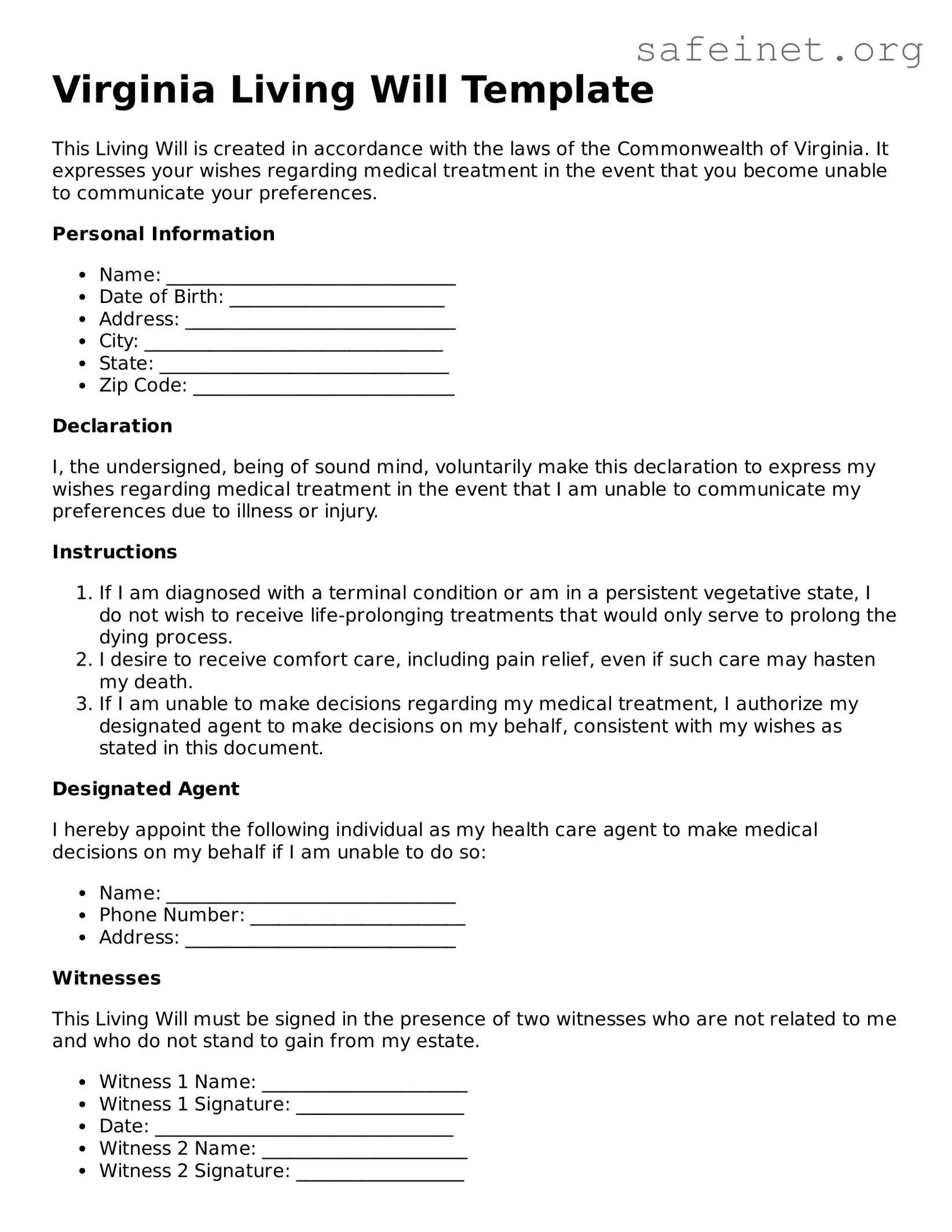
In Virginia, the Living Will form serves as a crucial document that allows individuals to express their wishes regarding medical treatment in the event they become unable to communicate those preferences themselves. This legal tool empowers people to make decisions about their end-of-life care, ensuring that their values and desires are respected. The form typically outlines specific medical interventions that an individual may or may not want, such as resuscitation efforts, mechanical ventilation, or feeding tubes. It provides clarity to healthcare providers and family members during emotionally charged moments, reducing uncertainty about what the person would have wanted. Moreover, the Living Will can be complemented by a Medical Power of Attorney, which designates someone to make healthcare decisions on behalf of the individual if they are incapacitated. Understanding how to properly complete and execute this form is essential for anyone looking to safeguard their healthcare preferences and ensure that their voice is heard when it matters most.
Virginia Living Will Template
This Living Will is created in accordance with the laws of the Commonwealth of Virginia. It expresses your wishes regarding medical treatment in the event that you become unable to communicate your preferences.
Personal Information
Declaration
I, the undersigned, being of sound mind, voluntarily make this declaration to express my wishes regarding medical treatment in the event that I am unable to communicate my preferences due to illness or injury.
Instructions
Designated Agent
I hereby appoint the following individual as my health care agent to make medical decisions on my behalf if I am unable to do so:
Witnesses
This Living Will must be signed in the presence of two witnesses who are not related to me and who do not stand to gain from my estate.
Signature
By signing below, I affirm that I understand the contents of this Living Will and that it reflects my wishes regarding my medical treatment.
Signature: _______________________________
Date: ___________________________________
| Fact Name | Description |
|---|---|
| Definition | A Virginia Living Will is a legal document that outlines a person's wishes regarding medical treatment in the event they become unable to communicate their preferences. |
| Governing Law | The Virginia Living Will is governed by the Virginia Code, specifically Title 54.1, Chapter 29.1. |
| Eligibility | Any adult resident of Virginia can create a Living Will, provided they are of sound mind. |
| Signature Requirement | The document must be signed by the individual creating the Living Will, and it should be witnessed by two individuals or notarized. |
| Content Requirements | A Living Will should clearly state the individual's preferences regarding life-sustaining treatment, including the use of ventilators, feeding tubes, and resuscitation. |
| Revocation | Individuals can revoke their Living Will at any time, provided they do so in writing or verbally in the presence of a witness. |
| Durability | The Virginia Living Will remains effective until it is revoked or the individual passes away. |
| Healthcare Proxy | A Living Will can be used in conjunction with a Healthcare Proxy, allowing someone to make decisions on behalf of the individual if they are incapacitated. |
| Distribution | It is advisable to provide copies of the Living Will to family members, healthcare providers, and anyone involved in the individual's care. |
| Legal Assistance | While individuals can create a Living Will on their own, seeking legal assistance can ensure that the document meets all legal requirements and accurately reflects their wishes. |
After obtaining the Virginia Living Will form, you will need to carefully complete it to ensure your wishes regarding medical treatment are clearly communicated. Follow these steps to fill out the form accurately.
What is a Virginia Living Will?
A Virginia Living Will is a legal document that allows you to express your wishes regarding medical treatment in the event that you become unable to communicate your preferences. It specifically addresses scenarios where you may be facing a terminal illness or are in a persistent vegetative state. This document ensures that your healthcare providers and loved ones understand your desires regarding life-sustaining treatments.
Who should create a Living Will?
Anyone over the age of 18 who is capable of making their own medical decisions should consider creating a Living Will. It's especially important for individuals with serious health conditions, those approaching significant medical procedures, or anyone who simply wants to ensure their wishes are known. This document can provide peace of mind for both you and your family.
How do I create a Living Will in Virginia?
Creating a Living Will in Virginia can be straightforward. You can either use a template or draft one yourself, ensuring it meets state requirements. It must clearly state your medical treatment preferences and be signed by you. Additionally, it should be witnessed by two individuals who are not related to you and who will not benefit from your estate. Consider consulting with a legal professional to ensure that your document is valid and accurately reflects your wishes.
Can I change or revoke my Living Will?
Yes, you can change or revoke your Living Will at any time as long as you are mentally competent. To make changes, you can create a new document that explicitly states your updated wishes, or you can write a statement revoking the previous document. It’s essential to inform your healthcare providers and loved ones about any changes you make to avoid confusion in the future.
Is a Living Will the same as a Durable Power of Attorney for Healthcare?
No, a Living Will and a Durable Power of Attorney for Healthcare are not the same, although they can work together. A Living Will outlines your specific wishes regarding medical treatment, while a Durable Power of Attorney designates a person to make healthcare decisions on your behalf if you are unable to do so. Having both documents can provide comprehensive guidance for your healthcare in various situations.
What happens if I don’t have a Living Will?
If you do not have a Living Will, your loved ones may face difficult decisions regarding your medical care without knowing your preferences. In such cases, family members or healthcare providers may have to rely on state laws to determine how to proceed. This can lead to disagreements among family members and may not align with your personal wishes, making it crucial to have a Living Will in place.
Will my Living Will be honored in other states?
Generally, a Virginia Living Will should be honored in other states, but this can vary based on local laws. Many states recognize Living Wills created in other jurisdictions, especially if they meet the basic requirements of the state where you are receiving care. However, it’s wise to check the specific laws of the state where you may be traveling or residing to ensure your wishes will be respected.
Can I include specific medical treatments in my Living Will?
Yes, you can specify which medical treatments you want or do not want in your Living Will. Common topics include resuscitation efforts, mechanical ventilation, tube feeding, and pain management. Being clear about your preferences helps ensure that your healthcare team understands your wishes and can act accordingly in critical situations.
Do I need a lawyer to create a Living Will?
While you do not necessarily need a lawyer to create a Living Will, consulting with one can be beneficial. A legal professional can help ensure that your document complies with Virginia laws and accurately reflects your wishes. They can also provide guidance on related documents, such as a Durable Power of Attorney for Healthcare, to create a comprehensive plan for your medical care.
Not Clearly Specifying Preferences: Individuals often fail to clearly articulate their wishes regarding medical treatment. This can lead to confusion for healthcare providers and family members.
Inadequate Witness Signatures: Some people overlook the requirement for proper witnesses. The form must be signed by two witnesses who are not related to the individual or beneficiaries.
Failing to Update the Document: Life circumstances change. Many individuals neglect to revise their Living Will after significant life events, such as marriage, divorce, or the birth of a child.
Using Ambiguous Language: Vague terms can create uncertainty. It is essential to use specific language to ensure that the intended medical decisions are understood.
Not Discussing Wishes with Family: Failing to communicate preferences with family members can lead to disagreements during critical moments. Open discussions help ensure that everyone understands the individual's wishes.
Neglecting to Store the Document Safely: After completing the form, it is important to store it in an accessible location. Many individuals forget to inform their loved ones where the document is kept.
A Virginia Living Will is an important document that outlines an individual's wishes regarding medical treatment in the event they become unable to communicate. However, several other forms and documents are often used in conjunction with a Living Will to ensure comprehensive planning for healthcare decisions. Below is a list of these related documents.
Each of these documents serves a unique purpose in healthcare planning. Together, they provide a clearer picture of an individual's preferences and ensure that their wishes are respected during critical moments.
The Virginia Living Will form shares similarities with the Durable Power of Attorney for Health Care. Both documents allow individuals to express their healthcare preferences in advance. While the Living Will specifically addresses end-of-life decisions and the types of medical treatment one wishes to receive or refuse, the Durable Power of Attorney for Health Care designates a trusted person to make healthcare decisions on behalf of the individual if they become unable to do so. Together, they provide a comprehensive approach to managing health care preferences and ensuring that a person's wishes are respected during critical moments.
Another document that parallels the Virginia Living Will is the Do Not Resuscitate (DNR) order. A DNR order is a specific medical directive that instructs healthcare providers not to perform cardiopulmonary resuscitation (CPR) if a person's heart stops or they stop breathing. Like the Living Will, a DNR communicates a person's wishes regarding life-sustaining treatment. However, the DNR is more focused on the immediate response to a medical emergency, while the Living Will encompasses a broader range of medical decisions and scenarios.
The Advance Directive is also akin to the Virginia Living Will. An Advance Directive is a general term that includes both the Living Will and the Durable Power of Attorney for Health Care. It serves as a comprehensive document outlining an individual’s healthcare preferences and appointing a surrogate decision-maker. The Living Will component specifies what types of medical treatments an individual would want or refuse, while the Durable Power of Attorney allows someone else to make decisions when the individual cannot. This combination ensures that a person's healthcare choices are clearly articulated and legally recognized.
Lastly, the Physician Orders for Life-Sustaining Treatment (POLST) form is similar to the Virginia Living Will. The POLST form is designed for individuals with serious illnesses or those who are nearing the end of life. It translates a person's wishes about treatment into actionable medical orders that healthcare providers must follow. Like the Living Will, the POLST form addresses specific medical interventions, but it does so in a way that is immediately actionable and tailored to the individual's current health status. Both documents aim to ensure that a person’s preferences regarding medical treatment are honored, but the POLST is often used in more urgent care settings.
When filling out the Virginia Living Will form, it’s important to approach the task with care. This document allows individuals to express their wishes regarding medical treatment in the event they become unable to communicate those wishes themselves. Below is a list of things you should and shouldn't do when completing this important form.
Completing the Virginia Living Will form thoughtfully can provide peace of mind for both you and your loved ones. By following these guidelines, you can help ensure that your healthcare preferences are respected and understood.
Understanding the Virginia Living Will form is crucial for ensuring that your healthcare wishes are honored. However, several misconceptions can lead to confusion. Here’s a list of common misunderstandings about this important document:
By clarifying these misconceptions, individuals can make informed decisions about their healthcare preferences and ensure their wishes are respected.
Here are some key takeaways about filling out and using the Virginia Living Will form: