When renting a property in Virginia, having a clear and comprehensive lease agreement is essential for both landlords and tenants. This legal document outlines the terms and conditions of the rental arrangement, ensuring that both parties understand their rights and responsibilities. Key aspects of the Virginia Lease Agreement include the duration of the lease, rental payment details, security deposit requirements, and maintenance responsibilities. Additionally, it addresses issues such as late fees, termination clauses, and rules regarding pets or subletting. By clearly defining these elements, the lease helps prevent misunderstandings and disputes, fostering a positive rental experience. Whether you are a first-time renter or an experienced landlord, understanding the components of this agreement is crucial for a smooth and successful tenancy.
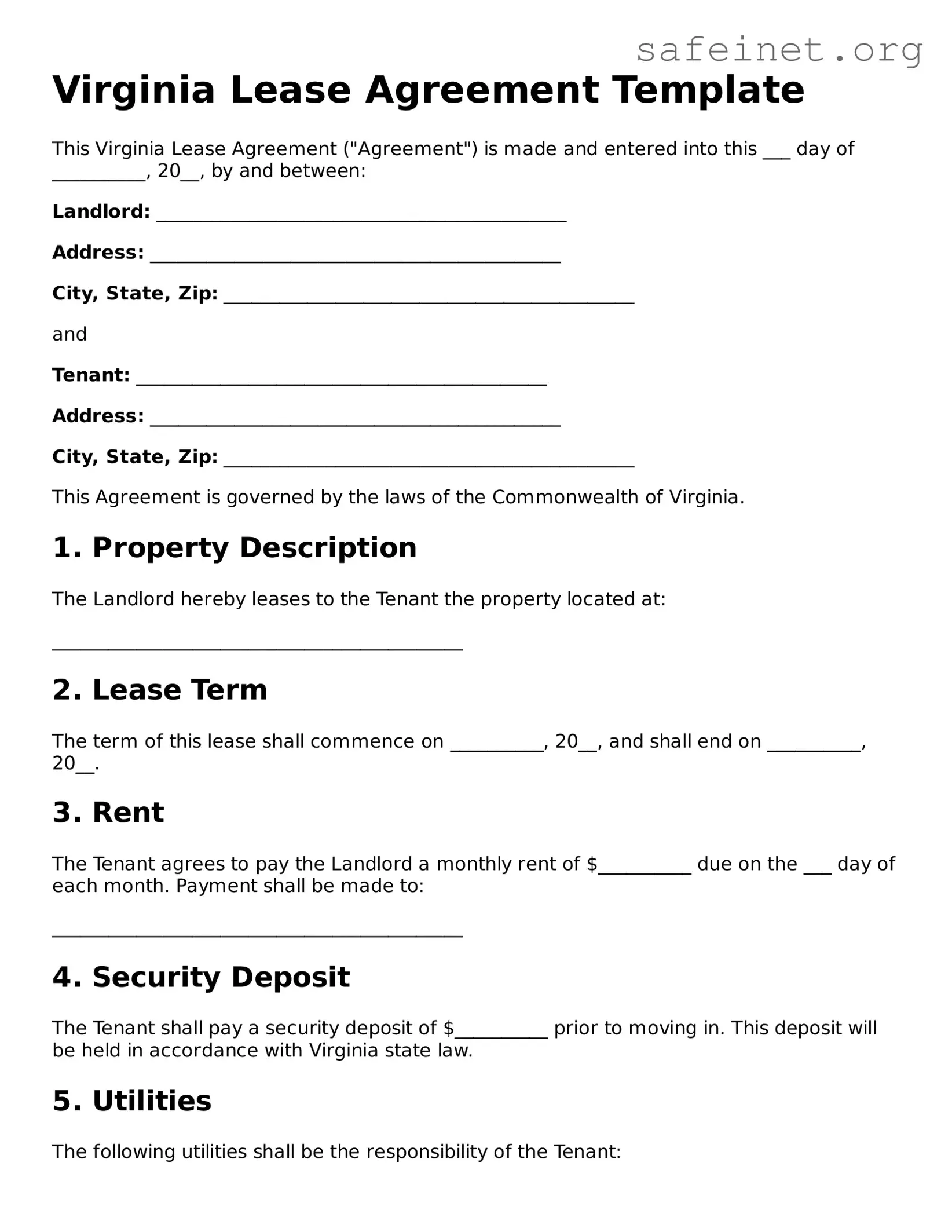
Virginia Lease Agreement Template
This Virginia Lease Agreement ("Agreement") is made and entered into this ___ day of __________, 20__, by and between:
Landlord: ____________________________________________
Address: ____________________________________________
City, State, Zip: ____________________________________________
and
Tenant: ____________________________________________
Address: ____________________________________________
City, State, Zip: ____________________________________________
This Agreement is governed by the laws of the Commonwealth of Virginia.
1. Property Description
The Landlord hereby leases to the Tenant the property located at:
____________________________________________
2. Lease Term
The term of this lease shall commence on __________, 20__, and shall end on __________, 20__.
3. Rent
The Tenant agrees to pay the Landlord a monthly rent of $__________ due on the ___ day of each month. Payment shall be made to:
____________________________________________
4. Security Deposit
The Tenant shall pay a security deposit of $__________ prior to moving in. This deposit will be held in accordance with Virginia state law.
5. Utilities
The following utilities shall be the responsibility of the Tenant:
6. Maintenance and Repairs
The Tenant agrees to maintain the premises in good condition. The Landlord shall be responsible for major repairs unless damage is caused by the Tenant.
7. Termination
Either party may terminate this Agreement by providing a written notice of at least 30 days prior to the intended termination date.
8. Governing Law
This Agreement shall be governed by the laws of the Commonwealth of Virginia. Any disputes arising under this Agreement shall be resolved in the appropriate court in the locality where the property is located.
9. Signatures
By signing below, both parties agree to the terms outlined in this Lease Agreement.
Landlord Signature: ___________________________ Date: __________
Tenant Signature: ___________________________ Date: __________
| Fact Name | Details |
|---|---|
| Governing Law | The Virginia Lease Agreement is governed by the Virginia Residential Landlord and Tenant Act (VRLTA). |
| Required Information | Landlords must include tenant names, rental property address, lease term, and rent amount in the agreement. |
| Security Deposit | In Virginia, the maximum security deposit is limited to two months' rent for leases longer than 12 months. |
| Termination Notice | For month-to-month leases, either party must provide at least 30 days' written notice to terminate the agreement. |
Filling out the Virginia Lease Agreement form is a straightforward process that requires careful attention to detail. This document outlines the terms of the rental arrangement between a landlord and a tenant. By completing this form accurately, both parties can ensure a clear understanding of their rights and responsibilities.
What is a Virginia Lease Agreement form?
A Virginia Lease Agreement form is a legally binding document that outlines the terms and conditions under which a landlord rents property to a tenant in Virginia. This agreement typically includes details such as the rental amount, lease duration, responsibilities for maintenance, and rules for the use of the property. It serves to protect both parties by clearly defining their rights and obligations.
What should be included in a Virginia Lease Agreement?
When drafting a Virginia Lease Agreement, it’s essential to include several key elements. Start with the names of both the landlord and tenant, followed by the property address. Specify the rental amount and payment due dates. Include the lease term—whether it’s month-to-month or a fixed term—and any security deposit requirements. Additionally, outline maintenance responsibilities, rules regarding pets, and conditions for terminating the lease. Clarity in these areas helps prevent disputes down the road.
How long is a typical lease term in Virginia?
In Virginia, lease terms can vary widely. Most residential leases are either month-to-month or last for a fixed term of 6 to 12 months. A month-to-month lease offers flexibility, allowing either party to terminate the agreement with proper notice. On the other hand, a fixed-term lease provides stability and is often preferred by both landlords and tenants for longer commitments.
Can a landlord raise the rent during a lease term?
Generally, landlords cannot raise the rent during a fixed lease term unless the lease specifically allows for it. For month-to-month leases, however, landlords can increase the rent, but they must provide proper notice, typically 30 days in Virginia. It’s crucial for tenants to understand the terms of their lease regarding rent increases to avoid surprises.
What happens if a tenant needs to break the lease early?
If a tenant needs to break the lease early, it’s important to review the lease agreement for any specific terms related to early termination. In many cases, tenants may be responsible for paying rent until a new tenant is found or until the lease term ends. Open communication with the landlord can lead to a mutually agreeable solution, such as subletting the apartment or negotiating a lease termination fee.
Are there any specific laws governing lease agreements in Virginia?
Yes, Virginia has specific laws that govern lease agreements, including the Virginia Residential Landlord and Tenant Act. This law outlines the rights and responsibilities of both landlords and tenants, addressing issues such as security deposits, eviction procedures, and maintenance obligations. Familiarizing yourself with these laws can help ensure compliance and protect your rights as either a landlord or tenant.
Failing to include all tenant names. It’s important to list everyone who will be living in the rental unit. This ensures that all parties are legally bound by the lease terms.
Not specifying the lease term. Clearly stating the duration of the lease, whether it’s month-to-month or for a fixed term, helps avoid confusion later.
Overlooking rental payment details. Be sure to include the amount of rent due, the due date, and acceptable payment methods. This clarity prevents disputes.
Ignoring maintenance responsibilities. Clearly outline who is responsible for repairs and maintenance. This can prevent misunderstandings regarding property upkeep.
Neglecting to include pet policies. If pets are allowed or not, this should be clearly stated. It helps avoid issues with unauthorized pets in the property.
Not addressing security deposits. Clearly state the amount of the security deposit, the conditions for its return, and any deductions that may apply.
Failing to include termination conditions. Specify how either party can terminate the lease, including notice periods. This ensures both parties understand their rights.
Leaving out rules regarding subletting. If tenants are allowed to sublet, include the process and any restrictions. This helps maintain control over who occupies the property.
Not reviewing the lease before signing. It’s crucial to read through the entire document carefully. Understanding every clause can prevent future disputes.
When entering into a rental agreement in Virginia, several additional forms and documents may be beneficial or necessary to ensure clarity and legal protection for both landlords and tenants. Understanding these documents can help facilitate a smoother rental experience.
Utilizing these forms alongside the Virginia Lease Agreement can help both parties navigate their responsibilities and rights more effectively. Having the right documentation in place fosters a respectful and transparent rental relationship.
The Virginia Lease Agreement form shares similarities with the Rental Agreement, which is often used interchangeably with a lease. Both documents outline the terms under which a tenant can occupy a property, including the duration of the rental period, the amount of rent due, and the responsibilities of both parties. However, a rental agreement typically covers shorter-term arrangements, such as month-to-month tenancies, while a lease usually signifies a longer commitment, often spanning a year or more.
Another document akin to the Virginia Lease Agreement is the Sublease Agreement. This form allows a tenant to rent out their leased space to another individual, known as the subtenant. Like the lease agreement, the sublease outlines the terms of occupancy, including rent and responsibilities. However, it is essential to note that the original tenant remains responsible to the landlord, creating a layered relationship between the landlord, tenant, and subtenant.
The Commercial Lease Agreement is another relevant document. This type of lease is specifically tailored for businesses renting commercial space. While both the Virginia Lease Agreement and the Commercial Lease outline the terms of occupancy, the latter often includes provisions specific to business operations, such as zoning laws and modifications to the space for commercial use. These differences reflect the distinct needs of residential versus commercial tenants.
The Month-to-Month Lease Agreement is closely related as well. This document provides flexibility for both landlords and tenants, allowing them to terminate the agreement with relatively short notice, usually 30 days. Like the Virginia Lease Agreement, it specifies rent and responsibilities, but the lack of a long-term commitment distinguishes it from a standard lease, making it more suitable for transient living situations.
A Lease Option Agreement also bears resemblance to the Virginia Lease Agreement. This document not only allows a tenant to lease a property but also grants them the option to purchase it at a later date. It combines elements of both leasing and purchasing, providing tenants with an opportunity to invest in their living situation while still enjoying the benefits of renting. The terms of the lease and the option to buy are carefully outlined, ensuring clarity for both parties.
The Rent-to-Own Agreement is another document that parallels the Virginia Lease Agreement. This arrangement allows tenants to rent a property with the intention of buying it after a specified period. Similar to a Lease Option Agreement, it outlines rental terms and the purchase price, often incorporating a portion of the rent paid into the eventual down payment. This agreement is particularly appealing to those who may not have immediate access to financing but wish to secure a home.
The Eviction Notice is a different type of document that, while not a lease agreement, is closely tied to the landlord-tenant relationship. This notice is issued when a landlord seeks to terminate a lease due to a tenant's failure to adhere to the lease terms, such as non-payment of rent. Like the Virginia Lease Agreement, it must comply with specific legal requirements and timelines, ensuring that both parties are treated fairly in the process.
Lastly, the Tenant Application Form is relevant in the leasing context. While not a lease itself, this document is typically filled out by prospective tenants to provide landlords with information about their rental history, income, and references. The information gathered helps landlords make informed decisions about whom to lease their property to, ensuring that the eventual lease agreement is established with a responsible tenant.
When filling out the Virginia Lease Agreement form, it's important to keep certain best practices in mind. Here’s a list of things you should and shouldn’t do:
By following these guidelines, you can help ensure a smooth leasing experience in Virginia.
When it comes to the Virginia Lease Agreement form, many people hold misconceptions that can lead to confusion or mistakes. Here are ten common misunderstandings, clarified for better understanding:
Many believe that all lease agreements follow a standard format. In reality, lease agreements can vary significantly based on state laws and individual landlord preferences.
Some tenants think that a verbal agreement with a landlord is enough. However, having a written lease is crucial for legal protection and clarity.
It’s a common myth that security deposits cannot be refunded. In Virginia, landlords must return the deposit within a specific timeframe after the lease ends, minus any legitimate deductions.
Many tenants assume that landlords can raise rent whenever they wish. However, rent increases must adhere to the terms outlined in the lease and local laws.
Some believe that landlords have unrestricted access to their rental property. In Virginia, landlords must provide reasonable notice before entering the premises, except in emergencies.
People often think lease agreements are only for long-term rentals. However, they can also be used for short-term rentals, providing clear terms for both parties.
It’s a misconception that tenants have no rights under a lease. Tenants in Virginia are protected by various laws that ensure their rights are upheld.
Some tenants believe that landlords are solely responsible for all repairs. While landlords must maintain the property, tenants may also be responsible for minor repairs or maintenance.
Many think that a lease is set in stone once signed. In fact, both parties can negotiate changes, but any modifications must be documented in writing.
It’s a common belief that breaking a lease is without repercussions. However, doing so can lead to financial penalties and affect future rental opportunities.
Understanding these misconceptions can help both tenants and landlords navigate the leasing process more effectively, ensuring a smoother rental experience for everyone involved.
When filling out and using the Virginia Lease Agreement form, it is essential to understand key aspects to ensure a smooth rental experience. Here are some important takeaways:
Understanding these elements can help create a clear and effective lease agreement, minimizing potential disputes and ensuring a positive rental experience.