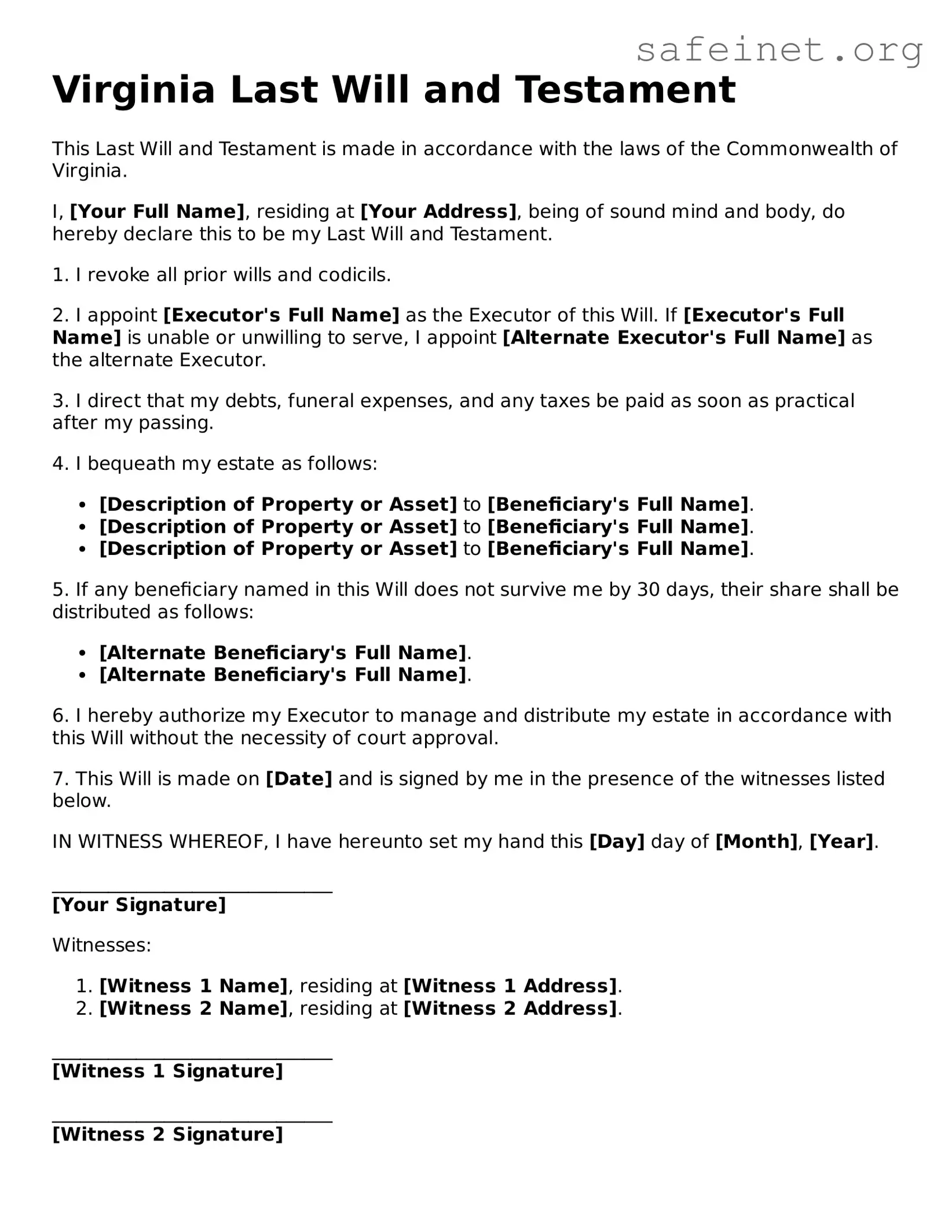
Creating a Last Will and Testament is a crucial step in ensuring that your wishes are honored after you pass away. In Virginia, this legal document outlines how your assets will be distributed, who will care for your minor children, and who will be responsible for executing your estate. The Virginia Last Will and Testament form provides a clear structure for detailing these important decisions. It typically includes sections for naming beneficiaries, appointing an executor, and specifying any special requests regarding your funeral or burial arrangements. Additionally, the form must be signed and witnessed to ensure its validity, making it essential to follow the state's specific requirements. Understanding these components can help you navigate the process of creating a will, giving you peace of mind that your affairs will be managed according to your wishes.
Virginia Last Will and Testament
This Last Will and Testament is made in accordance with the laws of the Commonwealth of Virginia.
I, [Your Full Name], residing at [Your Address], being of sound mind and body, do hereby declare this to be my Last Will and Testament.
1. I revoke all prior wills and codicils.
2. I appoint [Executor's Full Name] as the Executor of this Will. If [Executor's Full Name] is unable or unwilling to serve, I appoint [Alternate Executor's Full Name] as the alternate Executor.
3. I direct that my debts, funeral expenses, and any taxes be paid as soon as practical after my passing.
4. I bequeath my estate as follows:
5. If any beneficiary named in this Will does not survive me by 30 days, their share shall be distributed as follows:
6. I hereby authorize my Executor to manage and distribute my estate in accordance with this Will without the necessity of court approval.
7. This Will is made on [Date] and is signed by me in the presence of the witnesses listed below.
IN WITNESS WHEREOF, I have hereunto set my hand this [Day] day of [Month], [Year].
______________________________
[Your Signature]
Witnesses:
______________________________
[Witness 1 Signature]
______________________________
[Witness 2 Signature]
| Fact Name | Description |
|---|---|
| Governing Law | The Virginia Last Will and Testament is governed by Virginia Code § 64.2-404. |
| Age Requirement | You must be at least 18 years old to create a valid will in Virginia. |
| Witness Requirement | The will must be signed by at least two witnesses who are present at the same time. |
| Revocation | A will can be revoked by creating a new will or by destroying the original document. |
| Self-Proving Will | Virginia allows for self-proving wills, which simplify the probate process. |
| Executor Appointment | You can name an executor in your will to manage your estate after your death. |
| Residency | You do not need to be a Virginia resident to create a valid will in Virginia. |
Filling out the Virginia Last Will and Testament form is an important step in ensuring that your wishes regarding your estate are clearly articulated and legally recognized. After completing the form, you will need to sign it in the presence of witnesses and possibly have it notarized, depending on your preferences and specific requirements.
What is a Virginia Last Will and Testament?
A Virginia Last Will and Testament is a legal document that outlines how a person's assets and property should be distributed after their death. It allows individuals to specify beneficiaries, appoint an executor to manage the estate, and outline any specific wishes regarding funeral arrangements or guardianship for minor children. Having a will ensures that your wishes are honored and can help prevent disputes among surviving family members.
Who can create a Last Will and Testament in Virginia?
In Virginia, any individual who is at least 18 years old and of sound mind can create a Last Will and Testament. This means you must understand the nature of your actions and the consequences of creating a will. If you are a minor or deemed mentally incapacitated, you cannot legally create a will. It is advisable to consult with a legal professional to ensure that your will meets all legal requirements.
What are the requirements for a valid will in Virginia?
For a will to be valid in Virginia, it must be in writing and signed by the testator (the person creating the will) or by another person in their presence and at their direction. Additionally, the will must be witnessed by at least two individuals who are present at the same time. These witnesses must also sign the will. It's important to ensure that the witnesses are not beneficiaries of the will to avoid potential conflicts of interest.
Can a Last Will and Testament be changed or revoked in Virginia?
Yes, a Last Will and Testament can be changed or revoked in Virginia. To modify a will, you can create a new will that explicitly revokes the previous one or add a codicil, which is a legal amendment to the existing will. It is crucial to follow the same legal formalities as the original will when making changes. If you wish to revoke your will entirely, you can do so by destroying it or stating your intention to revoke in writing.
Not Signing the Will
One of the most common mistakes is forgetting to sign the will. In Virginia, your signature is essential for the will to be valid. Without it, the document holds no legal weight.
Failing to Date the Document
Many people overlook the importance of dating their will. If you do not include a date, it can create confusion about which version of the will is the most current, especially if you make changes later.
Not Having Witnesses
In Virginia, you must have at least two witnesses present when you sign your will. Failing to have witnesses can lead to your will being contested or deemed invalid.
Using Ambiguous Language
Be clear and specific in your language. Vague terms can lead to misunderstandings about your intentions. For example, instead of saying “my belongings,” specify what items you mean.
Not Updating the Will
Life changes, and so should your will. Failing to update it after major events—like marriage, divorce, or the birth of a child—can result in unintended distributions of your assets.
When preparing a Last Will and Testament in Virginia, it is often beneficial to consider additional documents that can complement your will. These documents serve various purposes, from managing your estate to addressing healthcare decisions. Below is a list of forms that may be used alongside your will.
Considering these documents alongside your Last Will and Testament can provide clarity and peace of mind. Each document plays a vital role in ensuring that your wishes are respected and that your loved ones are taken care of in accordance with your desires. It is advisable to consult with a legal professional to ensure that all documents are properly prepared and executed.
The Virginia Last Will and Testament form is similar to a Living Will, which outlines a person's preferences regarding medical treatment in case they become incapacitated. While a Last Will deals with the distribution of assets after death, a Living Will focuses on healthcare decisions. Both documents serve to express an individual's wishes and can prevent confusion among family members during difficult times.
Another document akin to the Last Will is the Durable Power of Attorney. This legal tool allows a person to appoint someone to make financial or legal decisions on their behalf if they become unable to do so. Like a Last Will, it ensures that an individual's preferences are respected, but it operates during their lifetime rather than after death.
A Revocable Trust shares similarities with a Last Will as both are used to manage and distribute assets. However, a Revocable Trust can take effect during a person’s lifetime and allows for the seamless transfer of assets upon death, avoiding the probate process. This can provide privacy and quicker access to assets for beneficiaries.
The Advance Healthcare Directive combines elements of a Living Will and a Durable Power of Attorney. It allows individuals to specify their healthcare preferences and appoint someone to make medical decisions if they are unable to do so. Like a Last Will, it helps ensure that a person's wishes are followed, but it specifically addresses health-related decisions.
A Codicil is a document that modifies an existing Last Will. It can add, change, or revoke provisions without the need to create an entirely new will. This makes it similar to a Last Will, as both documents must be executed with the same legal formalities to ensure they are valid and enforceable.
Letters of Instruction are not legally binding but serve as a companion to a Last Will. They provide guidance to executors and beneficiaries about personal wishes, funeral arrangements, or asset distribution. While a Last Will dictates the legal transfer of assets, Letters of Instruction offer additional context and clarity.
Beneficiary Designations are often found in financial accounts, insurance policies, and retirement plans. These designations determine who will receive the assets upon death. Similar to a Last Will, they ensure that an individual's wishes regarding asset distribution are honored, but they operate outside of the probate process.
A Joint Will is an agreement between two people, usually spouses, to create a single will that outlines how their assets will be distributed after both have passed. While it functions similarly to a Last Will, it is typically irrevocable and can complicate future estate planning, as changes cannot be made unilaterally.
A Testamentary Trust is established within a Last Will and becomes effective upon the testator's death. It allows for the management of assets for beneficiaries, particularly minors. Like a Last Will, it directs how assets will be handled, but it adds a layer of management to ensure that funds are used according to the deceased's wishes.
Finally, a Family Trust is similar to a Last Will in that it provides a mechanism for distributing assets. However, it is typically established during a person's lifetime and can provide benefits like avoiding probate and maintaining privacy. It allows for more flexible management of assets compared to a Last Will.
When filling out the Virginia Last Will and Testament form, it is essential to follow certain guidelines to ensure that the document is valid and accurately reflects your wishes. Below is a list of things you should and shouldn't do.
Adhering to these guidelines can help ensure that your Last Will and Testament is legally sound and reflects your true intentions.
Understanding the Virginia Last Will and Testament form is crucial for effective estate planning. However, several misconceptions can lead to confusion. Here are six common misconceptions:
By dispelling these misconceptions, individuals can approach their estate planning with greater confidence and clarity.
When filling out and using the Virginia Last Will and Testament form, keep these key takeaways in mind: