The Virginia Independent Contractor Agreement form is an important document for anyone engaging in work as an independent contractor in the state. This form outlines the relationship between the contractor and the hiring party, clarifying the terms of their engagement. It typically includes details such as the scope of work, payment terms, and deadlines. Additionally, it addresses confidentiality, ownership of work products, and the rights and responsibilities of both parties. By using this agreement, both the contractor and the hiring party can ensure they have a mutual understanding of their obligations, which helps to prevent misunderstandings and disputes. Understanding the key components of this form is essential for anyone looking to establish a clear and professional working relationship in Virginia.
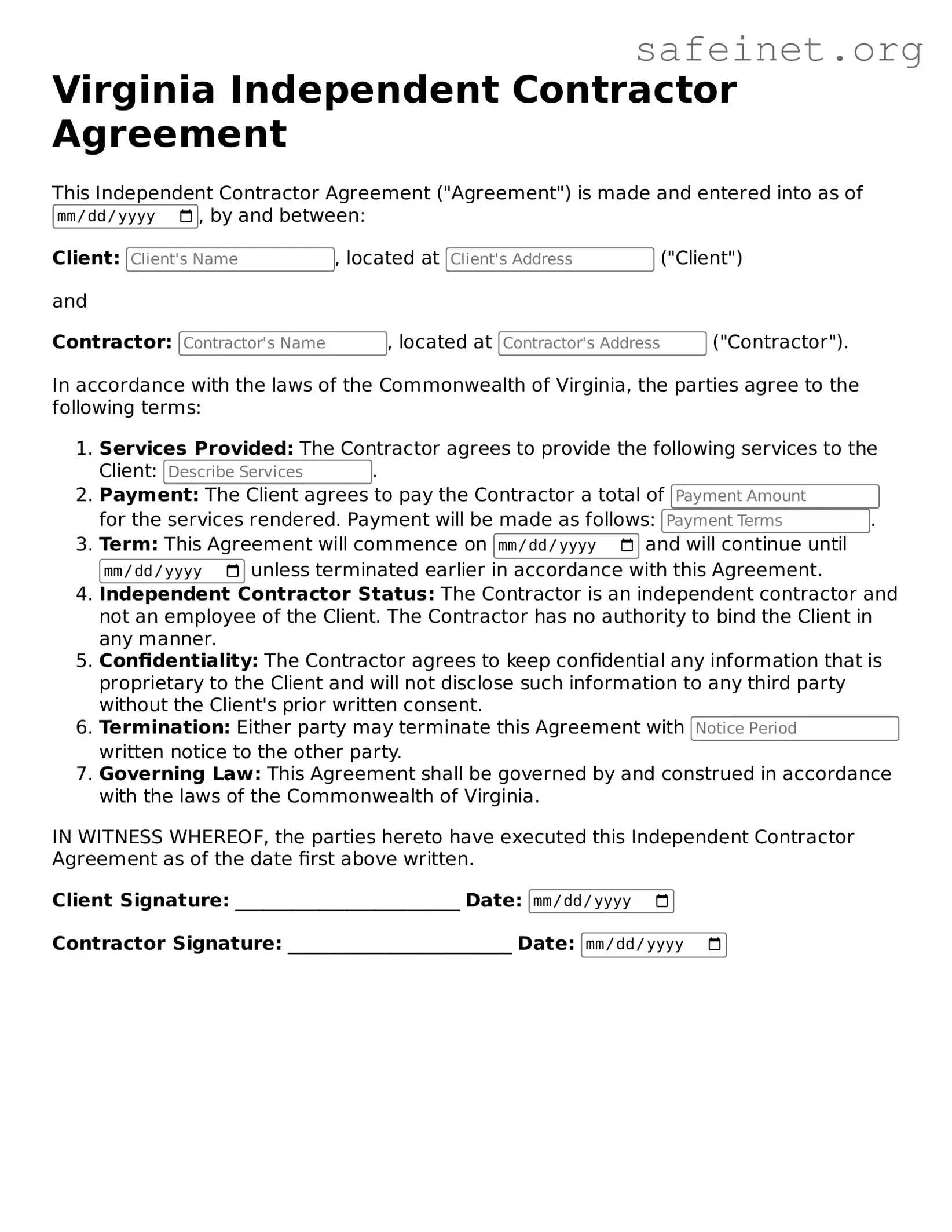
Virginia Independent Contractor Agreement
This Independent Contractor Agreement ("Agreement") is made and entered into as of , by and between:
Client: , located at ("Client")
and
Contractor: , located at ("Contractor").
In accordance with the laws of the Commonwealth of Virginia, the parties agree to the following terms:
IN WITNESS WHEREOF, the parties hereto have executed this Independent Contractor Agreement as of the date first above written.
Client Signature: ________________________ Date:
Contractor Signature: ________________________ Date:
| Fact Name | Description |
|---|---|
| Definition | The Virginia Independent Contractor Agreement outlines the terms between a business and an independent contractor. |
| Governing Law | This agreement is governed by the laws of the Commonwealth of Virginia. |
| Purpose | It clarifies the relationship and expectations between the contractor and the hiring entity. |
| Payment Terms | The agreement specifies how and when the contractor will be compensated for their services. |
| Duration | The length of the engagement can be defined, including start and end dates. |
| Confidentiality | It may include clauses to protect sensitive information shared during the contract period. |
| Termination Clause | The agreement often outlines conditions under which either party can terminate the contract. |
| Liability | It may address liability issues, clarifying that independent contractors are responsible for their own actions. |
Completing the Virginia Independent Contractor Agreement form is essential for establishing the terms of the working relationship between the contractor and the hiring party. Follow the steps below to accurately fill out the form.
What is a Virginia Independent Contractor Agreement?
The Virginia Independent Contractor Agreement is a legal document that outlines the terms and conditions between a business and an independent contractor. This agreement specifies the nature of the work, payment terms, and the rights and responsibilities of both parties. It serves to clarify the relationship, helping to avoid misunderstandings and potential disputes in the future.
Why is it important to have an Independent Contractor Agreement?
Having an Independent Contractor Agreement is crucial for several reasons. First, it establishes clear expectations for both the contractor and the hiring entity. This can prevent conflicts over work scope, deadlines, and payment. Second, it protects both parties legally, providing a written record of the terms agreed upon. Lastly, it helps to define the contractor's status, which is essential for tax and liability purposes.
What key elements should be included in the agreement?
Several important elements should be included in a Virginia Independent Contractor Agreement. These include the scope of work, payment details (including rates and payment schedule), confidentiality clauses, and termination conditions. It’s also wise to outline intellectual property rights and any specific legal compliance requirements relevant to the industry or project.
Can the agreement be modified after it is signed?
Yes, the agreement can be modified after it is signed, but both parties must agree to the changes. It is advisable to document any modifications in writing, either as an amendment to the original agreement or as a new agreement altogether. This ensures that all parties have a clear understanding of the new terms and helps maintain legal clarity.
What happens if there is a dispute regarding the agreement?
If a dispute arises regarding the Independent Contractor Agreement, the parties should first attempt to resolve the issue through open communication. If that fails, they may consider mediation or arbitration, as outlined in the agreement. If necessary, legal action may be pursued, but it is typically seen as a last resort. The agreement should specify the preferred method of dispute resolution to streamline this process.
Is it necessary to have a lawyer review the agreement?
While it is not strictly necessary to have a lawyer review the Independent Contractor Agreement, it is highly recommended. A legal professional can ensure that the agreement complies with Virginia laws and addresses all pertinent issues. This can provide peace of mind and help safeguard against potential legal challenges down the road.
Incorrect Personal Information: Failing to provide accurate names, addresses, or contact information can lead to confusion and delays.
Improper Classification: Misclassifying the nature of the work can result in legal issues down the line. Ensure the role is clearly defined.
Missing Signatures: Not signing the agreement or having the client sign can render the document invalid. Always check for signatures.
Omitting Payment Terms: Failing to specify payment details such as amount, schedule, and method can lead to disputes later.
Neglecting to Include Scope of Work: A vague description of the services to be provided can create misunderstandings. Be specific.
Ignoring Termination Clauses: Not outlining how either party can terminate the agreement may lead to complications if the working relationship needs to end.
Not Reviewing Local Laws: Each state has different regulations. Failing to consider Virginia-specific laws can lead to non-compliance.
Forgetting to Include Confidentiality Provisions: If sensitive information is shared, not including a confidentiality clause can expose both parties to risks.
When engaging an independent contractor in Virginia, several forms and documents may be necessary to ensure clarity and compliance with state regulations. Below is a list of common documents used alongside the Virginia Independent Contractor Agreement. Each serves a distinct purpose in the contracting process.
Utilizing these documents alongside the Virginia Independent Contractor Agreement can help establish a clear, professional relationship. It is important to keep all records organized and accessible for future reference. Proper documentation not only protects both parties but also fosters trust and transparency in the working relationship.
The Virginia Employment Agreement is similar to the Independent Contractor Agreement in that both documents outline the terms of a working relationship. They specify the responsibilities of each party, including payment terms and work expectations. However, the Employment Agreement typically covers employees, while the Independent Contractor Agreement is tailored for freelancers or contractors who operate independently. This distinction is important, as it affects tax obligations and benefits eligibility.
The Virginia Service Agreement also shares similarities with the Independent Contractor Agreement. Both documents establish a formal understanding between a service provider and a client. They detail the scope of work, timelines, and compensation. The Service Agreement may be broader in scope, covering various services beyond what an independent contractor might provide, but the core principles of clarity and mutual agreement remain consistent.
The Virginia Consulting Agreement is another document that parallels the Independent Contractor Agreement. Both are used when hiring a professional to provide expertise on a specific project or task. They outline deliverables, payment structures, and confidentiality clauses. The main difference lies in the nature of the work; consulting agreements often involve strategic advice, whereas independent contractor agreements may focus on tangible deliverables.
The Virginia Freelance Agreement is closely related to the Independent Contractor Agreement, as both are designed for individuals working on a temporary basis. They set forth the terms of the freelance work, including deadlines, payment rates, and intellectual property rights. The Freelance Agreement may be more casual, reflecting the nature of freelance work, but both documents aim to protect the interests of both parties involved.
The Virginia Non-Disclosure Agreement (NDA) can also be compared to the Independent Contractor Agreement. While the NDA focuses primarily on confidentiality, it is often included as part of the broader agreement when hiring an independent contractor. Both documents protect sensitive information, ensuring that proprietary data shared during the working relationship remains confidential.
The Virginia Partnership Agreement is similar in that it establishes the terms of a business relationship. While the Independent Contractor Agreement is for individual contractors, a Partnership Agreement is for two or more parties working together. Both documents outline roles, responsibilities, and profit-sharing arrangements, but the Partnership Agreement typically implies a deeper level of commitment and collaboration.
The Virginia Joint Venture Agreement also shares characteristics with the Independent Contractor Agreement. Both are used when two or more parties collaborate on a specific project. They define the roles and contributions of each party, as well as how profits and losses will be shared. The key difference is that a Joint Venture Agreement usually involves a temporary partnership for a specific goal, while an Independent Contractor Agreement is for ongoing contractor work.
The Virginia License Agreement is another document that can be compared to the Independent Contractor Agreement. Both agreements establish terms for using intellectual property or services. A License Agreement typically allows one party to use another's intellectual property under specific conditions, while an Independent Contractor Agreement focuses on the provision of services. Both protect the rights of the parties involved.
Finally, the Virginia Work-for-Hire Agreement is similar in that it addresses the ownership of work produced. Both agreements clarify that the contractor or creator relinquishes ownership rights to the work produced for the client. This is crucial in ensuring that the client retains full rights to the work, which is a common expectation in both Independent Contractor Agreements and Work-for-Hire Agreements.
When filling out the Virginia Independent Contractor Agreement form, it’s important to be thorough and accurate. Here’s a list of things to do and avoid to ensure the process goes smoothly.
Understanding the Virginia Independent Contractor Agreement form is essential for both contractors and businesses. However, several misconceptions can cloud this understanding. Here are six common misconceptions:
Many believe that independent contractors operate completely outside the realm of legal protections. In reality, independent contractors are entitled to certain rights under federal and state laws, including protections against discrimination and unfair labor practices.
This is a significant misconception. Each independent contractor agreement can vary greatly based on the nature of the work, the relationship between the parties, and specific legal requirements. A one-size-fits-all approach can lead to misunderstandings or legal issues.
While a signed agreement is important, it does not solely determine the status of a worker. The actual working relationship and how the work is performed play crucial roles in defining whether someone is an independent contractor or an employee.
This misconception undermines the nature of independent contracting. Contractors have the right to negotiate terms such as payment, deadlines, and the scope of work. This flexibility is one of the key advantages of being an independent contractor.
Some individuals mistakenly believe that independent contractors are exempt from paying taxes. In fact, independent contractors are responsible for reporting their income and paying self-employment taxes, which can include Social Security and Medicare taxes.
While it is true that contracts should be honored, they can be amended if both parties agree. Changes may be necessary due to evolving circumstances or mutual interests, and it is essential to document any modifications in writing.
By dispelling these misconceptions, both contractors and businesses can foster clearer communication and a better understanding of their rights and responsibilities under Virginia law.
Filling out and using the Virginia Independent Contractor Agreement form can be an important step in establishing a clear understanding between a business and an independent contractor. Here are some key takeaways to consider:
By keeping these points in mind, both businesses and independent contractors can establish a solid foundation for their working relationship.