For families considering homeschooling in Virginia, understanding the necessary paperwork is crucial for a smooth start. One of the first steps in this journey is the Virginia Homeschool Letter of Intent form. This simple yet essential document serves as a formal notification to the local school district that you intend to educate your child at home. It requires basic information, including the names and ages of your children, and it must be submitted annually. By completing this form, parents not only comply with state regulations but also lay the groundwork for a personalized and enriching educational experience. It’s important to note that while the form is straightforward, it represents a commitment to providing a quality education tailored to your child's unique needs. Understanding the ins and outs of this process can empower parents to navigate the homeschooling landscape with confidence and clarity.
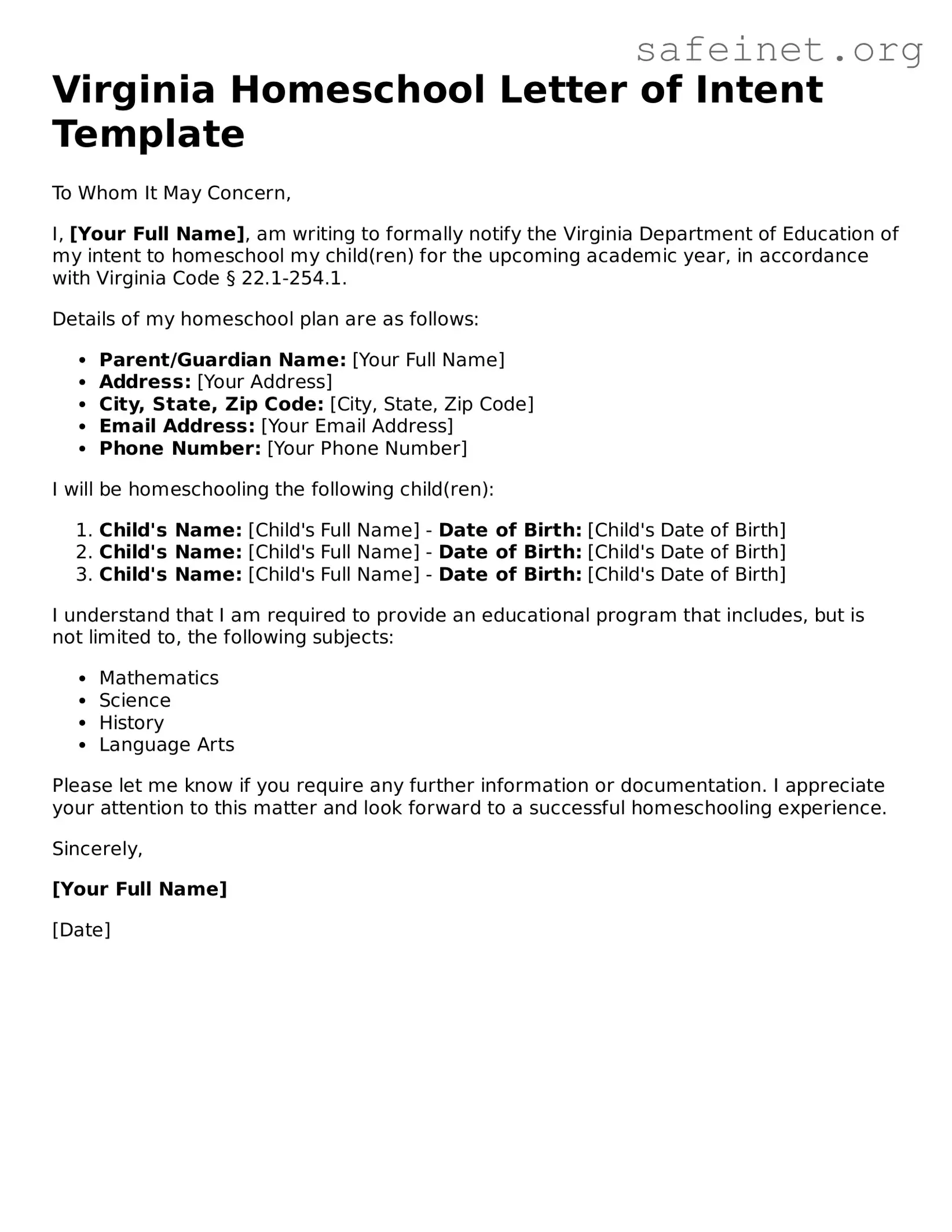
Virginia Homeschool Letter of Intent Template
To Whom It May Concern,
I, [Your Full Name], am writing to formally notify the Virginia Department of Education of my intent to homeschool my child(ren) for the upcoming academic year, in accordance with Virginia Code § 22.1-254.1.
Details of my homeschool plan are as follows:
I will be homeschooling the following child(ren):
I understand that I am required to provide an educational program that includes, but is not limited to, the following subjects:
Please let me know if you require any further information or documentation. I appreciate your attention to this matter and look forward to a successful homeschooling experience.
Sincerely,
[Your Full Name]
[Date]
| Fact Name | Description |
|---|---|
| Purpose | The Virginia Homeschool Letter of Intent form is used to officially notify the local school division of a parent's intent to homeschool their child. |
| Governing Law | This form is governed by the Code of Virginia, specifically § 22.1-254.1, which outlines the requirements for homeschooling in the state. |
| Submission Deadline | Parents must submit the Letter of Intent by August 15th for the upcoming school year, or within 30 days of beginning homeschooling if starting mid-year. |
| Required Information | The form requires basic information such as the child's name, age, and the planned educational approach or curriculum. |
| Annual Review | Once submitted, families must provide an annual notice of intent to continue homeschooling each year. |
| Resources | The Virginia Department of Education provides resources and guidelines to assist parents in the homeschooling process. |
Once you have decided to homeschool your child in Virginia, the next step involves completing the Homeschool Letter of Intent form. This form serves as a formal notification to your local school division that you intend to educate your child at home. After submitting this letter, you will be required to follow up with additional documentation and curriculum planning.
What is the Virginia Homeschool Letter of Intent?
The Virginia Homeschool Letter of Intent is a formal document that parents or guardians must submit to notify the local school division of their intention to homeschool their child. This letter is a crucial first step in the homeschooling process in Virginia.
Who needs to submit the Letter of Intent?
Any parent or guardian who wishes to homeschool a child in Virginia must submit this letter. This requirement applies to children of compulsory school age, typically between the ages of 5 and 18.
When should the Letter of Intent be submitted?
The Letter of Intent should be submitted at least five days before the start of the school year. If you are withdrawing a child from a public school to begin homeschooling, you should submit the letter as soon as possible to ensure compliance with state regulations.
What information must be included in the Letter of Intent?
The letter must include the name of the child, the age of the child, and the address of the residence where homeschooling will take place. It is also advisable to include the parent’s name and contact information, although this is not strictly required.
Is there a specific format for the Letter of Intent?
No specific format is mandated by the state. However, the letter should be clear and concise, providing all required information. Some families choose to use a template or sample letter for guidance.
Do I need to provide additional documentation with the Letter of Intent?
Typically, no additional documentation is required when submitting the Letter of Intent. However, if you are opting for a specific homeschool option, such as a religious exemption or a program through a private school, you may need to include additional information or forms.
What happens after I submit the Letter of Intent?
Once the local school division receives your Letter of Intent, they will review it to ensure it meets the state requirements. You should expect to receive confirmation of receipt. If there are any issues or questions, the school division will contact you for clarification.
Can I change my mind after submitting the Letter of Intent?
Yes, you can change your mind about homeschooling after submitting the Letter of Intent. If you decide to enroll your child in a public or private school instead, simply notify the school division of your decision. It is important to keep records of all communications for your reference.
Failing to include all required information. The form asks for specific details about the student and the educational program. Omitting any of these can lead to delays.
Not signing the form. A signature is necessary to validate the intent to homeschool. Without it, the form is incomplete.
Incorrectly identifying the educational curriculum. Parents must specify the type of curriculum they plan to use. Misrepresenting this can create complications.
Submitting the form late. Virginia law requires that the letter of intent be submitted by a certain date. Late submissions may result in penalties.
Not keeping a copy of the submitted form. It’s important to retain a copy for personal records. This can help in case of future inquiries.
Ignoring local school district requirements. Each district may have specific guidelines that need to be followed. Familiarizing oneself with these can prevent issues.
Overlooking the need for annual updates. Once the letter is submitted, families must keep the school district informed of any changes in their homeschooling status.
Neglecting to provide proof of educational progress. Some districts may require documentation of the student’s progress. Being unprepared can lead to misunderstandings.
When families in Virginia decide to homeschool their children, submitting the Virginia Homeschool Letter of Intent is just the first step. Along with this form, several other documents may be required or beneficial to ensure compliance with state regulations and to facilitate a smooth homeschooling experience.
Each of these documents plays a crucial role in the homeschooling process in Virginia. By preparing and maintaining these records, families can help ensure that their homeschooling journey is both fulfilling and compliant with state regulations.
The Virginia Homeschool Letter of Intent form is similar to the Notice of Intent form used in other states. This document serves as a formal notification to the local school district that a parent intends to homeschool their child. Like Virginia's form, it typically requires basic information about the student and the educational plan. Both forms aim to inform educational authorities of the parent's choice to educate their child outside of the traditional school system.
Another document that resembles the Virginia Homeschool Letter of Intent is the Home Education Affidavit. This affidavit is often used in states where parents must declare their intention to homeschool. Similar to the Letter of Intent, it may require parents to provide details about their educational approach and curriculum. Both documents serve as a way to establish the parent's commitment to homeschooling and to ensure compliance with state regulations.
The Educational Plan form is also comparable to the Virginia Homeschool Letter of Intent. This document outlines the specific educational goals and curriculum that parents plan to use for their homeschooled child. Like the Letter of Intent, it provides clarity to educational authorities about the homeschooling process. Both forms emphasize the importance of a structured educational approach, which is crucial for meeting state requirements.
The Declaration of Intent form is another document that shares similarities with the Virginia Homeschool Letter of Intent. This form is often required in states where parents must formally declare their choice to homeschool. It typically includes similar information, such as the child's name and age. Both forms serve the purpose of officially notifying the local education authorities about the homeschooling arrangement.
The Homeschool Registration form can also be likened to the Virginia Homeschool Letter of Intent. This form may require parents to register their intent to homeschool with the local school district. Like the Letter of Intent, it often includes essential details about the student and the planned educational framework. Both documents aim to ensure that parents fulfill their legal obligations regarding homeschooling.
The Homeschool Notification form is another document that parallels the Virginia Homeschool Letter of Intent. This form serves as a notification to the local school district about the parent's decision to homeschool. It often requires similar information regarding the student and the educational plan. Both documents help maintain communication between parents and educational authorities, ensuring that all parties are informed about the homeschooling process.
The Parent's Notice of Intent to Homeschool is also comparable to the Virginia Homeschool Letter of Intent. This notice is typically submitted to local education authorities to inform them of the parent's decision to educate their child at home. Like the Letter of Intent, it may require basic information about the student and the educational approach. Both documents aim to establish a formal record of the parent's choice to homeschool.
The Homeschool Enrollment form can be seen as similar to the Virginia Homeschool Letter of Intent. This form is often used to enroll a child in a homeschooling program or to notify the local school district of the parent's intent to homeschool. Both documents share the goal of providing essential information about the student and the educational plan. They help ensure that parents are in compliance with state homeschooling laws.
Lastly, the Curriculum Plan form is akin to the Virginia Homeschool Letter of Intent. This document outlines the educational materials and methods that parents intend to use for homeschooling. Like the Letter of Intent, it provides clarity to educational authorities about the homeschooling process. Both forms emphasize the importance of a well-defined educational strategy to meet state requirements.
When filling out the Virginia Homeschool Letter of Intent form, it is essential to follow certain guidelines to ensure a smooth process. Here are four things you should do and four things you should avoid.
Things You Should Do:
Things You Shouldn't Do:
When considering homeschooling in Virginia, many parents encounter various misconceptions about the Letter of Intent form. Here are eight common misunderstandings:
This is not true. Virginia does not require parents to have a teaching degree to homeschool their children. Parents can educate their children without formal teaching credentials.
In Virginia, once you submit your Letter of Intent, you do not need to resubmit it annually unless you change your educational approach or your child’s status.
Homeschooling is an option available to all families, regardless of background or educational philosophy. Many different families choose this path for various reasons.
While parents must provide an educational plan, they have the flexibility to choose or create a curriculum that suits their child’s learning style and interests.
The form is straightforward. It typically requires basic information about the student and the educational approach you plan to take.
Submitting the form does not subject families to ongoing oversight. Parents are generally free to educate their children as they see fit, as long as they comply with state regulations.
Many homeschooling families actively seek out socialization opportunities through co-ops, community activities, and extracurricular programs, ensuring their children interact with peers.
In Virginia, homeschoolers may have the option to participate in certain public school activities, such as sports and clubs, depending on local school district policies.
Understanding these misconceptions can help parents make informed decisions about homeschooling in Virginia.
Here are key takeaways regarding the Virginia Homeschool Letter of Intent form: