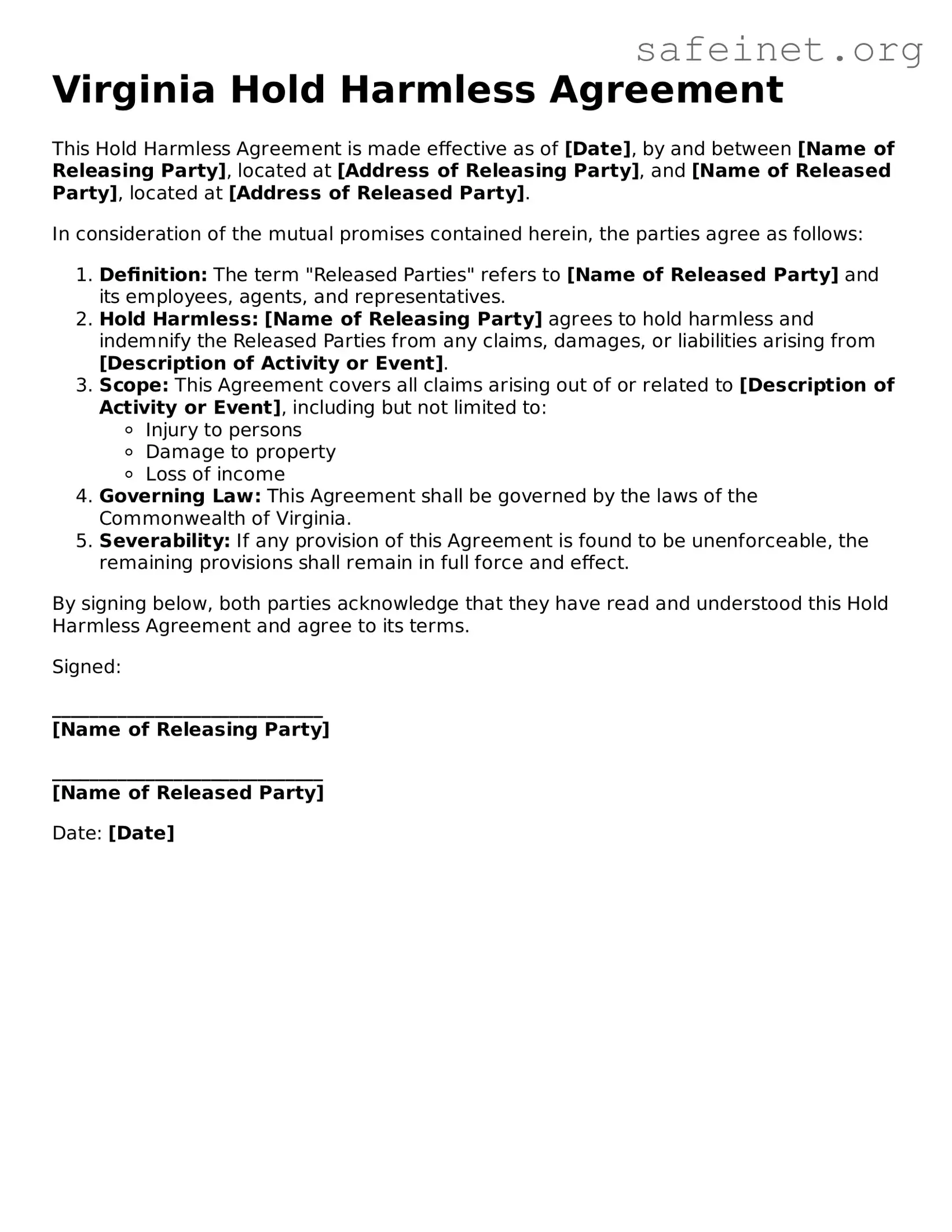
The Virginia Hold Harmless Agreement form serves as a crucial legal document designed to protect one party from liability claims resulting from the actions or negligence of another party. This agreement is commonly used in various contexts, including construction projects, rental agreements, and events where potential risks are involved. By signing this form, individuals or organizations agree to assume responsibility for any injuries or damages that may occur, thereby shielding the other party from legal repercussions. The agreement typically outlines the specific activities covered, the duration of the liability waiver, and any exceptions to the hold harmless clause. It is essential for both parties to clearly understand their rights and obligations under this agreement, as it can significantly impact their legal standing in the event of an incident. Ultimately, the Virginia Hold Harmless Agreement promotes a sense of security and accountability in situations where risk is inherent, allowing parties to engage in activities with a clearer understanding of their liabilities.
Virginia Hold Harmless Agreement
This Hold Harmless Agreement is made effective as of [Date], by and between [Name of Releasing Party], located at [Address of Releasing Party], and [Name of Released Party], located at [Address of Released Party].
In consideration of the mutual promises contained herein, the parties agree as follows:
By signing below, both parties acknowledge that they have read and understood this Hold Harmless Agreement and agree to its terms.
Signed:
_____________________________
[Name of Releasing Party]
_____________________________
[Name of Released Party]
Date: [Date]
| Fact Name | Description |
|---|---|
| Definition | A Hold Harmless Agreement is a legal document where one party agrees to not hold another party responsible for any potential losses or damages. |
| Purpose | This agreement is commonly used to protect individuals or organizations from liability in various situations, such as events or activities. |
| Governing Law | The laws of Virginia govern the Hold Harmless Agreement, ensuring it complies with state regulations. |
| Requirements | For the agreement to be valid, it must be in writing, clearly outline the responsibilities, and be signed by all parties involved. |
| Enforceability | Virginia courts generally uphold Hold Harmless Agreements as long as they are reasonable and not contrary to public policy. |
| Common Uses | These agreements are often used in rental contracts, construction contracts, and during recreational activities. |
Filling out the Virginia Hold Harmless Agreement form requires careful attention to detail. This document is important for protecting parties from liability in certain situations. Follow these steps to ensure the form is completed correctly.
After completing the form, keep a copy for your records. Ensure that all parties involved receive their copies as well.
What is a Virginia Hold Harmless Agreement?
A Virginia Hold Harmless Agreement is a legal document designed to protect one party from liability for any injuries or damages that may occur during an activity or event. This agreement typically states that one party agrees not to hold the other party responsible for any claims, losses, or damages that arise. It is commonly used in various situations, such as rental agreements, events, or activities involving physical risks.
Who should use a Hold Harmless Agreement?
This agreement can be beneficial for individuals or organizations that host events, provide services, or engage in activities where there is a risk of injury or damage. For example, event organizers, property owners, and service providers may use this agreement to protect themselves from potential legal claims made by participants or clients.
Are there any specific requirements for a Hold Harmless Agreement in Virginia?
While there are no specific statutory requirements for a Hold Harmless Agreement in Virginia, it is essential for the agreement to be clear and unambiguous. It should include the names of the parties involved, a description of the activity or event, and the specific liabilities being waived. Both parties should sign and date the document to ensure its enforceability.
Can a Hold Harmless Agreement be enforced in court?
Yes, a Hold Harmless Agreement can be enforceable in court, provided it meets certain legal standards. Courts generally uphold these agreements if they are clear, voluntary, and not unconscionable. However, there are exceptions. For instance, an agreement may not be enforceable if it attempts to waive liability for gross negligence or intentional misconduct.
Is legal advice necessary when drafting a Hold Harmless Agreement?
While it is not strictly necessary to seek legal advice when drafting a Hold Harmless Agreement, it is highly recommended. Consulting with a legal professional can help ensure that the agreement is comprehensive and compliant with Virginia law. Legal guidance can also help identify any specific risks associated with the activity or event and address them appropriately in the agreement.
Incomplete Information: One common mistake is failing to provide all required information. This includes names, addresses, and the specific details of the agreement. Leaving out any essential details can lead to misunderstandings or render the agreement unenforceable.
Not Reading the Terms: Many individuals rush through the agreement without fully understanding its terms. It is crucial to read and comprehend each clause. Misinterpretation can result in unintended liabilities or obligations.
Incorrect Signatures: Signatures must be provided by all parties involved. Sometimes, individuals forget to sign or mistakenly sign on behalf of someone else. This oversight can invalidate the agreement.
Failure to Date the Agreement: Not including a date can create confusion about when the agreement takes effect. This can lead to disputes regarding the timeline of obligations and liabilities.
The Virginia Hold Harmless Agreement is often used in various situations to protect one party from liability. When preparing this agreement, it is beneficial to have other related forms and documents on hand. Below is a list of forms that are commonly used in conjunction with the Hold Harmless Agreement.
Having these documents prepared alongside the Virginia Hold Harmless Agreement can help clarify responsibilities and protect all parties involved. It is advisable to review each document carefully to ensure they meet specific needs and legal requirements.
The Virginia Hold Harmless Agreement is similar to a Liability Waiver. Both documents aim to protect one party from legal liability for injuries or damages that may occur during an activity. In a Liability Waiver, participants acknowledge the risks involved and agree not to hold the organizer responsible. This type of agreement is often used in recreational activities, sports events, and other scenarios where there is a potential for injury. The key difference lies in the language and specific terms used, but the underlying principle of limiting liability remains consistent across both documents.
Another document that shares similarities is the Indemnity Agreement. Like the Hold Harmless Agreement, an Indemnity Agreement involves one party agreeing to compensate another for certain damages or losses. This document is often used in business transactions, construction projects, and service agreements. While the Hold Harmless Agreement primarily protects against third-party claims, the Indemnity Agreement can also cover direct losses incurred by the indemnified party. Both agreements serve to allocate risk and ensure that one party is not left bearing the financial burden of another's actions.
The Release of Liability form also resembles the Virginia Hold Harmless Agreement. In this document, individuals relinquish their right to pursue legal action against an organization or individual for injuries sustained during an activity. The release is typically signed before participating in events such as adventure sports, workshops, or community activities. While both documents aim to limit liability, the Release of Liability explicitly states that the signer waives their right to sue, whereas the Hold Harmless Agreement may not always include such a waiver but focuses on indemnification.
Similarly, the Consent to Treat form is another document that shares common ground with the Hold Harmless Agreement. This form is often used in medical settings, allowing healthcare providers to treat patients while protecting themselves from legal claims. Patients agree to receive treatment and acknowledge the risks involved. Both documents emphasize informed consent and the understanding of potential risks, thus safeguarding the provider from liability related to the treatment provided.
The Participant Agreement is another comparable document. This agreement outlines the terms and conditions under which individuals participate in an event or activity. It often includes clauses that limit liability and require participants to assume responsibility for their actions. The Participant Agreement serves a similar purpose as the Hold Harmless Agreement by clarifying expectations and minimizing potential legal disputes arising from participation in an event.
Finally, the Non-Disclosure Agreement (NDA) can be seen as related, although it serves a different primary purpose. An NDA protects confidential information shared between parties, preventing unauthorized disclosure. While it does not directly limit liability for physical injuries, it can include clauses that protect against claims arising from breaches of confidentiality. Both the NDA and the Hold Harmless Agreement are legal tools that help manage risks and protect parties involved in various agreements.
When filling out the Virginia Hold Harmless Agreement form, it's important to keep a few key points in mind. Here are some things you should and shouldn't do:
Understanding the Virginia Hold Harmless Agreement can be challenging, especially with various misconceptions surrounding it. Here are ten common misunderstandings that people often have:
Many believe that signing a Hold Harmless Agreement means they cannot be held responsible for any actions. In reality, it typically only protects against certain types of claims and does not cover gross negligence or willful misconduct.
While commonly used in business contexts, individuals can also use Hold Harmless Agreements in personal situations, such as during events or recreational activities.
Each Hold Harmless Agreement should be tailored to specific circumstances. A generic form may not adequately protect your interests.
Some think that signing this agreement removes the necessity for insurance. However, it is still wise to have insurance coverage to protect against unforeseen events.
While these agreements are generally enforceable, they can be challenged in court if deemed unfair or overly broad.
People often assume that a Hold Harmless Agreement covers all potential risks. It usually only addresses specific risks outlined in the document.
Not all Hold Harmless Agreements need to be notarized to be valid. However, having a notary can strengthen the document's credibility.
While they serve similar purposes, a waiver typically relinquishes a right, while a Hold Harmless Agreement shifts liability from one party to another.
Signing a Hold Harmless Agreement after an incident occurs may not provide the intended protection. It is best to have this document in place beforehand.
Even low-risk activities can carry potential liabilities. Having a Hold Harmless Agreement can still be beneficial to safeguard against unexpected issues.
Being aware of these misconceptions can help you make informed decisions about using a Hold Harmless Agreement in Virginia. Always consider consulting with a legal professional for personalized advice.
When navigating the Virginia Hold Harmless Agreement form, understanding its key elements can significantly enhance your experience and effectiveness. Here are some important takeaways to consider:
By keeping these key points in mind, you can effectively fill out and utilize the Virginia Hold Harmless Agreement form, ensuring that all parties are adequately protected.