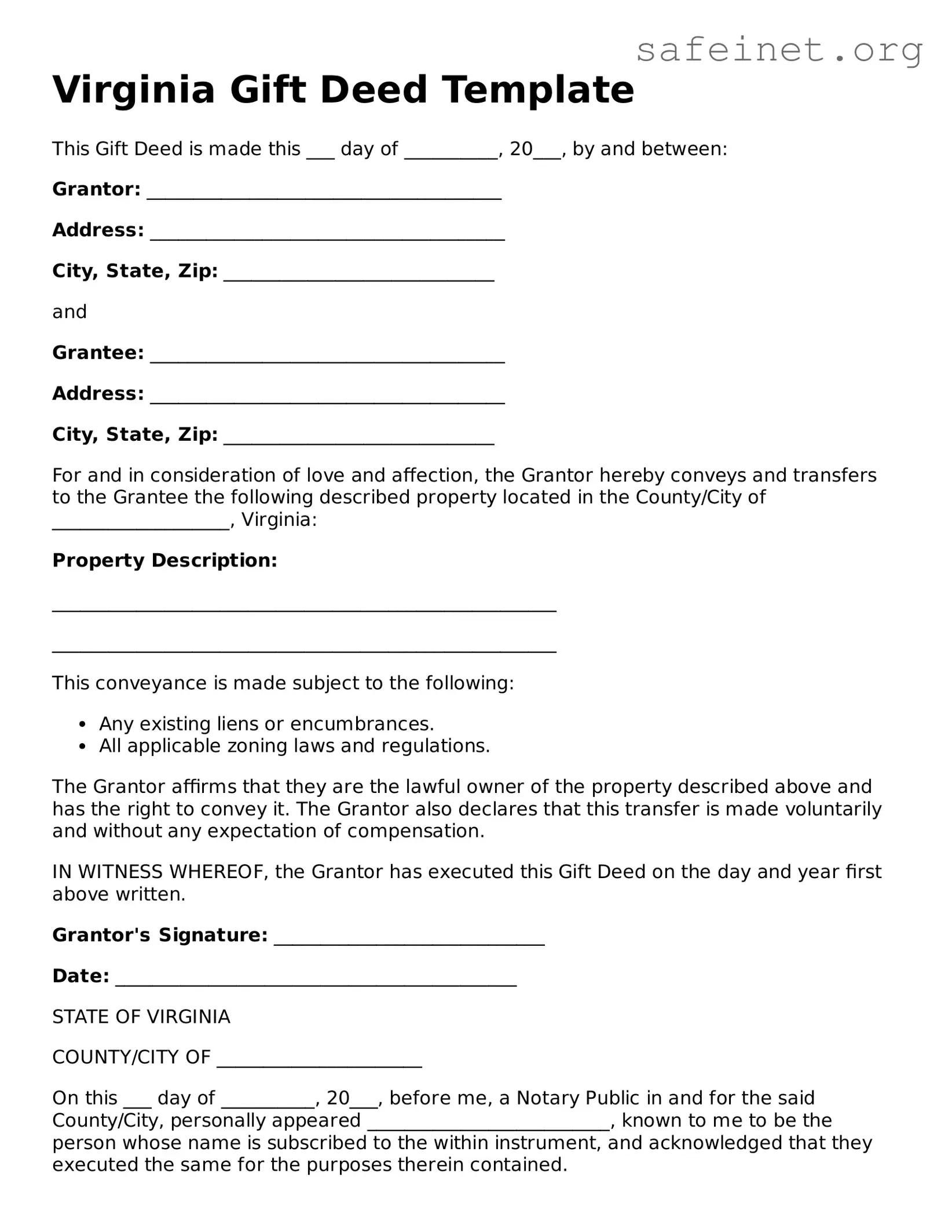
The Virginia Gift Deed form serves as a vital legal instrument for individuals wishing to transfer property without the exchange of monetary compensation. This document facilitates the voluntary transfer of real estate from one party to another, often between family members or close friends. The form outlines essential information, including the names of the donor and the recipient, a detailed description of the property being gifted, and the intention behind the transfer. Additionally, it requires the signatures of both parties, as well as a notary acknowledgment to ensure its validity. By clearly documenting the intent to give property, the Gift Deed helps prevent future disputes and establishes a clear record of ownership. Understanding the nuances of this form is crucial for anyone considering a property transfer in Virginia, as it ensures compliance with state laws and protects the interests of all parties involved.
Virginia Gift Deed Template
This Gift Deed is made this ___ day of __________, 20___, by and between:
Grantor: ______________________________________
Address: ______________________________________
City, State, Zip: _____________________________
and
Grantee: ______________________________________
Address: ______________________________________
City, State, Zip: _____________________________
For and in consideration of love and affection, the Grantor hereby conveys and transfers to the Grantee the following described property located in the County/City of ___________________, Virginia:
Property Description:
______________________________________________________
______________________________________________________
This conveyance is made subject to the following:
The Grantor affirms that they are the lawful owner of the property described above and has the right to convey it. The Grantor also declares that this transfer is made voluntarily and without any expectation of compensation.
IN WITNESS WHEREOF, the Grantor has executed this Gift Deed on the day and year first above written.
Grantor's Signature: _____________________________
Date: ___________________________________________
STATE OF VIRGINIA
COUNTY/CITY OF ______________________
On this ___ day of __________, 20___, before me, a Notary Public in and for the said County/City, personally appeared __________________________, known to me to be the person whose name is subscribed to the within instrument, and acknowledged that they executed the same for the purposes therein contained.
Given under my hand this ___ day of __________, 20___.
Notary Public: ________________________________
My Commission Expires: ______________________
| Fact Name | Details |
|---|---|
| Purpose | A Virginia Gift Deed is used to transfer property ownership as a gift without any exchange of money. |
| Governing Law | The Gift Deed is governed by the Virginia Code § 55.1-600 through § 55.1-609. |
| Requirements | The deed must be in writing, signed by the donor, and notarized to be valid. |
| Tax Implications | Gift tax considerations may apply, and it is advisable to consult a tax professional. |
After obtaining the Virginia Gift Deed form, you are ready to begin the process of completing it. Ensure you have all necessary information at hand, as this will streamline your efforts and help avoid any errors.
What is a Virginia Gift Deed?
A Virginia Gift Deed is a legal document that allows an individual (the donor) to transfer property ownership to another person (the recipient) without any exchange of money. This type of deed is often used to give real estate as a gift, making it a straightforward way to transfer property while avoiding the complexities of a sale. It’s essential to understand that this deed must be executed voluntarily and without any coercion, ensuring that the intent to gift is clear and unequivocal.
What are the requirements for a Gift Deed in Virginia?
To create a valid Gift Deed in Virginia, certain requirements must be met. First, the deed must be in writing and signed by the donor. It should clearly describe the property being gifted and identify both the donor and the recipient. Additionally, the deed must be notarized to ensure its authenticity. While it’s not legally required to record the deed with the county clerk, doing so is highly advisable. Recording the deed provides public notice of the transfer, which can protect the recipient’s ownership rights in the future.
Are there any tax implications associated with a Gift Deed?
Yes, there can be tax implications when transferring property through a Gift Deed. The donor may be subject to federal gift tax if the value of the property exceeds the annual exclusion limit, which is adjusted periodically. However, many donors do not owe taxes because they can use their lifetime gift tax exemption. The recipient typically does not incur tax liability upon receiving the gift. It’s wise to consult a tax professional to understand the specific implications and ensure compliance with tax laws.
Can a Gift Deed be revoked after it is executed?
Once a Gift Deed is executed and delivered, it is generally considered irrevocable. This means that the donor cannot change their mind and reclaim the property unless specific conditions are met, such as the recipient agreeing to return the gift. However, if the deed was executed under duress or if the donor lacked the mental capacity to understand the transaction, there may be grounds to challenge the validity of the deed. It’s crucial to approach the gifting process with careful consideration and clarity to avoid future disputes.
Incomplete Information: One common mistake is failing to provide all necessary details. This includes the full names and addresses of both the donor and the recipient. Omitting even one piece of information can lead to delays or complications in the transfer process.
Incorrect Property Description: Accurately describing the property being gifted is crucial. Many people mistakenly provide vague descriptions or fail to include relevant details such as the property's parcel number or exact location, which can create confusion later.
Improper Signatures: The Gift Deed must be signed by the donor. Sometimes, individuals forget to sign the document or do not have it notarized as required. Both steps are essential to validate the deed and ensure its legal standing.
Failure to Consider Tax Implications: Some people overlook the potential tax consequences of gifting property. Not understanding how the gift tax works can lead to unexpected liabilities for both the donor and the recipient.
Not Recording the Deed: After completing the Gift Deed, it is important to record it with the appropriate local government office. Failing to do so means that the transfer may not be legally recognized, potentially leading to disputes in the future.
Ignoring State-Specific Requirements: Each state has its own rules regarding gift deeds. Ignoring Virginia's specific requirements can result in a deed that is invalid or unenforceable. It’s essential to be familiar with local laws before completing the form.
When completing a Virginia Gift Deed, several other documents may be necessary to ensure a smooth transfer of property. These forms help clarify ownership, establish intent, and fulfill legal requirements. Below is a list of commonly used documents that accompany the Gift Deed.
These documents work together to facilitate the legal transfer of property through a Gift Deed. Ensuring that all necessary forms are completed accurately can help prevent future complications and protect both the giver and receiver.
A Quitclaim Deed is a legal document used to transfer ownership of real estate from one party to another without any warranties. Similar to a Gift Deed, a Quitclaim Deed does not involve a monetary exchange. The primary difference lies in the intent; while a Gift Deed explicitly indicates that the transfer is a gift, a Quitclaim Deed may not specify the nature of the transfer, making it more versatile for various transactions, including those involving family members or resolving title issues.
A Warranty Deed provides a stronger guarantee than a Gift Deed. This document transfers property ownership and assures the buyer that the title is clear of any claims. While a Gift Deed focuses on the act of giving property without consideration, a Warranty Deed includes assurances regarding the title's validity. Therefore, a Warranty Deed is often used in sales transactions, while a Gift Deed is used for non-commercial transfers.
A Deed of Trust is a document used in real estate transactions to secure a loan. Although it serves a different purpose, it shares similarities with a Gift Deed in that both documents facilitate the transfer of property rights. In a Deed of Trust, the borrower conveys property to a trustee to secure a loan, while a Gift Deed transfers property outright to the recipient without financial exchange.
A Life Estate Deed allows the property owner to retain the right to use the property during their lifetime while transferring ownership to another party upon their death. This is similar to a Gift Deed in that it involves transferring property rights, but it differs significantly in that the original owner retains certain rights until their death. The Gift Deed, in contrast, relinquishes all rights to the property immediately.
A Transfer on Death Deed (TODD) allows individuals to transfer property to beneficiaries upon death without going through probate. Like a Gift Deed, it is a means of transferring property, but the key distinction is that a Gift Deed transfers ownership immediately, while a TODD only takes effect after the owner's death. This allows the owner to maintain control over the property during their lifetime.
An Easement Deed grants a party the right to use a portion of another person's property for a specific purpose. While not a direct transfer of ownership like a Gift Deed, both documents involve property rights. The main difference is that an Easement Deed allows for limited use rather than full ownership transfer, whereas a Gift Deed completely relinquishes ownership to the recipient.
A Lease Agreement allows a property owner to rent their property to another party. Similar to a Gift Deed, it involves property rights, but the Lease Agreement establishes a temporary arrangement for use rather than a permanent transfer of ownership. While a Gift Deed is a one-time transfer without compensation, a Lease Agreement typically involves ongoing payments for the duration of the lease.
A Bill of Sale is a document used to transfer ownership of personal property, such as vehicles or equipment. Although it primarily deals with personal property rather than real estate, it shares the concept of transferring ownership without a monetary exchange. A Gift Deed, focused on real estate, serves a similar purpose in that it conveys ownership without requiring payment.
A Declaration of Trust is a document that outlines the terms under which a trust is created and managed. While it serves a different function, it can be similar to a Gift Deed in that both involve the transfer of property rights. In a Declaration of Trust, the property is held for the benefit of another, whereas a Gift Deed transfers ownership outright to the recipient.
When filling out the Virginia Gift Deed form, it is essential to approach the task with care. Here are some important guidelines to follow:
Understanding the Virginia Gift Deed form is essential for anyone considering transferring property as a gift. However, several misconceptions can lead to confusion. Here are ten common misconceptions:
Understanding these misconceptions can help ensure a smooth and legally compliant transfer of property. Always consider seeking professional advice when dealing with legal documents.
When filling out and using the Virginia Gift Deed form, it is important to keep several key points in mind: