When it comes to planning for the future, understanding the Virginia General Power of Attorney form is essential. This legal document empowers a designated individual, known as the agent, to make financial and legal decisions on behalf of another person, referred to as the principal. It covers a wide range of responsibilities, from managing bank accounts and paying bills to handling real estate transactions and filing taxes. The form can be tailored to fit specific needs, whether it’s for a temporary situation or a more long-term arrangement. Importantly, the principal retains the ability to revoke the power of attorney at any time, as long as they are mentally competent. This flexibility ensures that the principal can maintain control over their affairs while providing peace of mind that someone they trust can step in when necessary. Understanding the nuances of this form can make a significant difference in navigating life’s unexpected challenges.
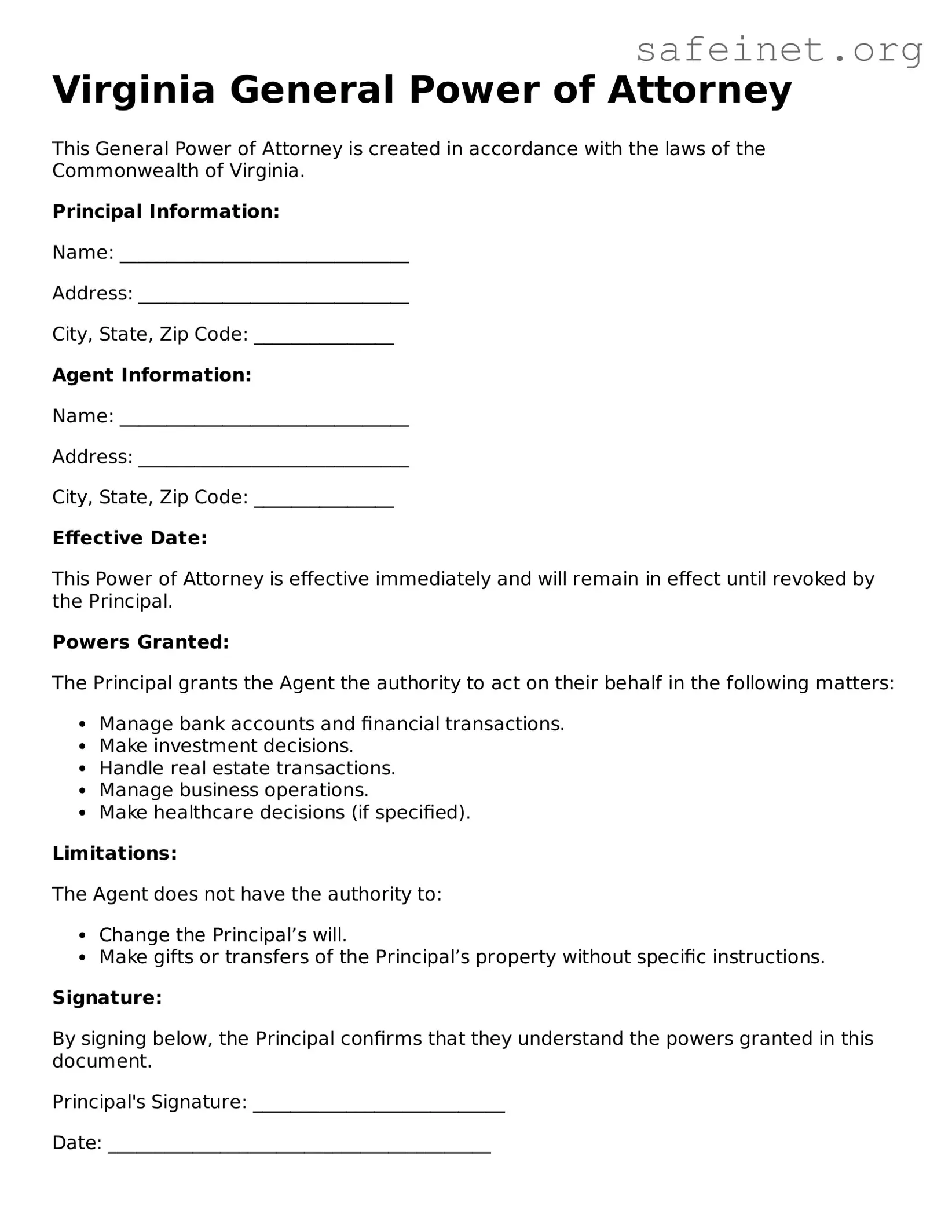
Virginia General Power of Attorney
This General Power of Attorney is created in accordance with the laws of the Commonwealth of Virginia.
Principal Information:
Name: _______________________________
Address: _____________________________
City, State, Zip Code: _______________
Agent Information:
Name: _______________________________
Address: _____________________________
City, State, Zip Code: _______________
Effective Date:
This Power of Attorney is effective immediately and will remain in effect until revoked by the Principal.
Powers Granted:
The Principal grants the Agent the authority to act on their behalf in the following matters:
Limitations:
The Agent does not have the authority to:
Signature:
By signing below, the Principal confirms that they understand the powers granted in this document.
Principal's Signature: ___________________________
Date: _________________________________________
Witness Information:
Witness Name: _______________________________
Witness Signature: ____________________________
Date: _________________________________________
Notary Acknowledgment:
State of Virginia
City/County of _____________________________
On this ____ day of ____________, 20___, before me, a Notary Public, personally appeared __________________________, known to me to be the person whose name is subscribed to this document.
Notary Public Signature: ______________________
My Commission Expires: ______________________
| Fact Name | Description |
|---|---|
| Definition | A Virginia General Power of Attorney allows an individual to appoint someone else to manage their financial and legal affairs. |
| Governing Law | This form is governed by the Virginia Uniform Power of Attorney Act, found in Virginia Code § 64.2-1600 et seq. |
| Durability | This document can be made durable, meaning it remains effective even if the principal becomes incapacitated. |
| Revocation | The principal can revoke the power of attorney at any time, as long as they are competent to do so. |
| Notarization | The Virginia General Power of Attorney must be signed in the presence of a notary public to be legally valid. |
Filling out the Virginia General Power of Attorney form is a straightforward process. Once you have completed the form, it will need to be signed and notarized to ensure its validity. Here are the steps to guide you through filling out the form.
What is a Virginia General Power of Attorney?
A Virginia General Power of Attorney is a legal document that allows one person, known as the "principal," to grant another person, called the "agent" or "attorney-in-fact," the authority to act on their behalf. This authority can cover a wide range of financial and legal matters, making it a powerful tool for managing one's affairs, especially if the principal becomes unable to do so themselves.
What powers does the agent have under this form?
The agent can be given broad powers to manage financial matters, including paying bills, managing investments, and handling real estate transactions. However, the principal can specify which powers the agent does or does not have, allowing for tailored control over the agent's authority. It’s important for the principal to clearly outline these powers to ensure their wishes are respected.
How do I create a General Power of Attorney in Virginia?
To create a General Power of Attorney in Virginia, the principal must complete the form, which can often be found online or through legal resources. It’s crucial to ensure that the form is filled out correctly and completely. After signing, the document should be notarized to enhance its validity. Consulting with a legal professional can provide additional peace of mind that the document meets all necessary requirements.
Can I revoke a General Power of Attorney in Virginia?
Yes, a principal can revoke a General Power of Attorney at any time, as long as they are mentally competent. This revocation must be documented in writing and should ideally be communicated to the agent and any institutions that may rely on the original power of attorney. Taking these steps ensures that there is no confusion about the authority granted.
What happens if the principal becomes incapacitated?
If the principal becomes incapacitated, the General Power of Attorney remains in effect unless it is explicitly stated that it becomes void upon incapacitation. However, if the principal wants the power of attorney to remain valid during such times, it’s advisable to consider a Durable Power of Attorney instead. This type of document is designed to remain effective even when the principal can no longer make decisions for themselves.
Is it necessary to have a lawyer to create a General Power of Attorney?
While it is not legally required to have a lawyer to create a General Power of Attorney in Virginia, seeking legal advice can be beneficial. A lawyer can help ensure that the document accurately reflects the principal's intentions and complies with state laws. This can prevent potential issues or misunderstandings in the future, providing both the principal and agent with confidence in the arrangement.
Not clearly identifying the principal. It’s essential to provide the full legal name and address of the person granting power.
Failing to specify the powers granted. Be specific about what decisions the agent can make. General terms can lead to confusion.
Not including a start date. Without a clear date, it can be unclear when the power takes effect.
Overlooking the need for witnesses or notarization. Virginia requires certain formalities for the document to be valid.
Choosing the wrong agent. It’s vital to select someone trustworthy and capable of handling your affairs.
Not discussing the decision with the agent beforehand. Open communication can prevent misunderstandings later.
Using outdated forms. Always ensure you are using the most current version of the General Power of Attorney form.
Neglecting to review the document regularly. Life changes can affect your choices, so periodic reviews are important.
Assuming that a General Power of Attorney is permanent. Understand that you can revoke it at any time, as long as you are competent.
A Virginia General Power of Attorney form allows an individual to appoint someone else to manage their financial and legal affairs. This document is often used in conjunction with other forms to ensure comprehensive management of one's affairs. Below is a list of related documents that may be utilized alongside the General Power of Attorney.
Using these documents in conjunction with the Virginia General Power of Attorney can help create a comprehensive plan for managing both financial and healthcare decisions. It is advisable to consult with a legal professional to ensure that all documents meet individual needs and comply with state laws.
The Virginia General Power of Attorney form is similar to a Durable Power of Attorney. Both documents allow an individual to appoint an agent to make decisions on their behalf. However, the Durable Power of Attorney remains effective even if the principal becomes incapacitated, while the General Power of Attorney typically ceases to be effective in such circumstances. This distinction is crucial for individuals who want to ensure their affairs are managed during periods of incapacity.
Another document similar to the Virginia General Power of Attorney is the Limited Power of Attorney. This form grants an agent authority to act on behalf of the principal for specific tasks or transactions. Unlike the General Power of Attorney, which provides broad authority, the Limited Power of Attorney restricts the agent's powers to defined activities, making it suitable for particular situations.
The Healthcare Power of Attorney also bears similarities to the Virginia General Power of Attorney. Both documents allow an individual to designate someone to make decisions on their behalf. However, the Healthcare Power of Attorney specifically focuses on medical and healthcare decisions, whereas the General Power of Attorney covers a broader range of financial and legal matters.
A Revocable Living Trust is another document that shares some characteristics with the Virginia General Power of Attorney. Both can be used to manage an individual's assets and affairs. However, a Revocable Living Trust allows for the transfer of assets into the trust, providing a mechanism for managing those assets during the individual's lifetime and distributing them after death. In contrast, the General Power of Attorney does not involve asset ownership but rather grants authority to act on behalf of the principal.
The Financial Power of Attorney is similar to the Virginia General Power of Attorney in that it allows an agent to handle financial matters for the principal. Both documents empower the agent to manage bank accounts, investments, and other financial transactions. However, the Financial Power of Attorney is often more focused on financial matters, while the General Power of Attorney may encompass a broader range of responsibilities.
A Special Power of Attorney is akin to the Virginia General Power of Attorney but is designed for specific purposes. This document allows the principal to grant authority to an agent for particular tasks, such as selling a property or managing a business transaction. The General Power of Attorney, in contrast, provides a more comprehensive authority without such limitations.
The Springing Power of Attorney shares similarities with the Virginia General Power of Attorney, particularly in its function to appoint an agent. However, the Springing Power of Attorney only becomes effective upon the occurrence of a specific event, such as the principal's incapacity. This contrasts with the General Power of Attorney, which is effective immediately upon signing unless otherwise specified.
The Business Power of Attorney is another document that resembles the Virginia General Power of Attorney. It allows an individual to designate someone to make business-related decisions on their behalf. While both documents grant authority, the Business Power of Attorney is tailored specifically for business operations, transactions, and management.
The Military Power of Attorney is similar in that it allows a service member to designate an agent to handle their affairs while they are deployed or stationed away from home. Like the Virginia General Power of Attorney, it grants authority to act on behalf of the principal. However, the Military Power of Attorney is specifically designed for military personnel and may include provisions relevant to their unique circumstances.
Finally, the Statutory Power of Attorney is comparable to the Virginia General Power of Attorney in that it follows a specific statutory format and provides a broad range of powers to an agent. This document is often used to simplify the process of creating a power of attorney, ensuring that it complies with state laws. The General Power of Attorney may not follow a statutory format but serves a similar purpose in granting authority to an agent.
When filling out the Virginia General Power of Attorney form, it is important to approach the task with care. Here is a list of things to do and avoid:
The Virginia General Power of Attorney (GPOA) form is a crucial legal document that allows an individual, known as the principal, to designate another person, called the agent, to act on their behalf in various matters. However, several misconceptions about this form can lead to confusion. Here is a list of common misunderstandings:
While a GPOA often includes financial authority, it can also grant the agent the power to make medical decisions, manage real estate, and handle other personal matters.
The agent is required to act in the best interest of the principal and must follow any specific instructions outlined in the document. They cannot misuse their authority.
The principal retains the right to revoke the GPOA at any time, as long as they are mentally competent. A revocation must be documented properly.
This is not true for durable powers of attorney. A durable GPOA remains in effect even if the principal becomes incapacitated, unless stated otherwise in the document.
A living will outlines an individual’s wishes regarding medical treatment in the event they cannot communicate. A GPOA, on the other hand, designates someone to make decisions on behalf of the principal.
While many states recognize each other's GPOA forms, it is advisable to use the Virginia-specific form to ensure compliance with local laws.
In Virginia, a GPOA must be signed in the presence of a notary public to be legally binding. Witnesses are not required, but having them can provide additional protection.
Changes can be made to a GPOA at any time before the principal becomes incapacitated. This includes updating the agent or modifying the powers granted.
Anyone can benefit from a GPOA, regardless of age. Unexpected events can occur at any time, making it wise to have a plan in place.
Understanding these misconceptions can help individuals make informed decisions about their legal rights and responsibilities when it comes to the Virginia General Power of Attorney form.
When filling out and using the Virginia General Power of Attorney form, consider the following key takeaways: