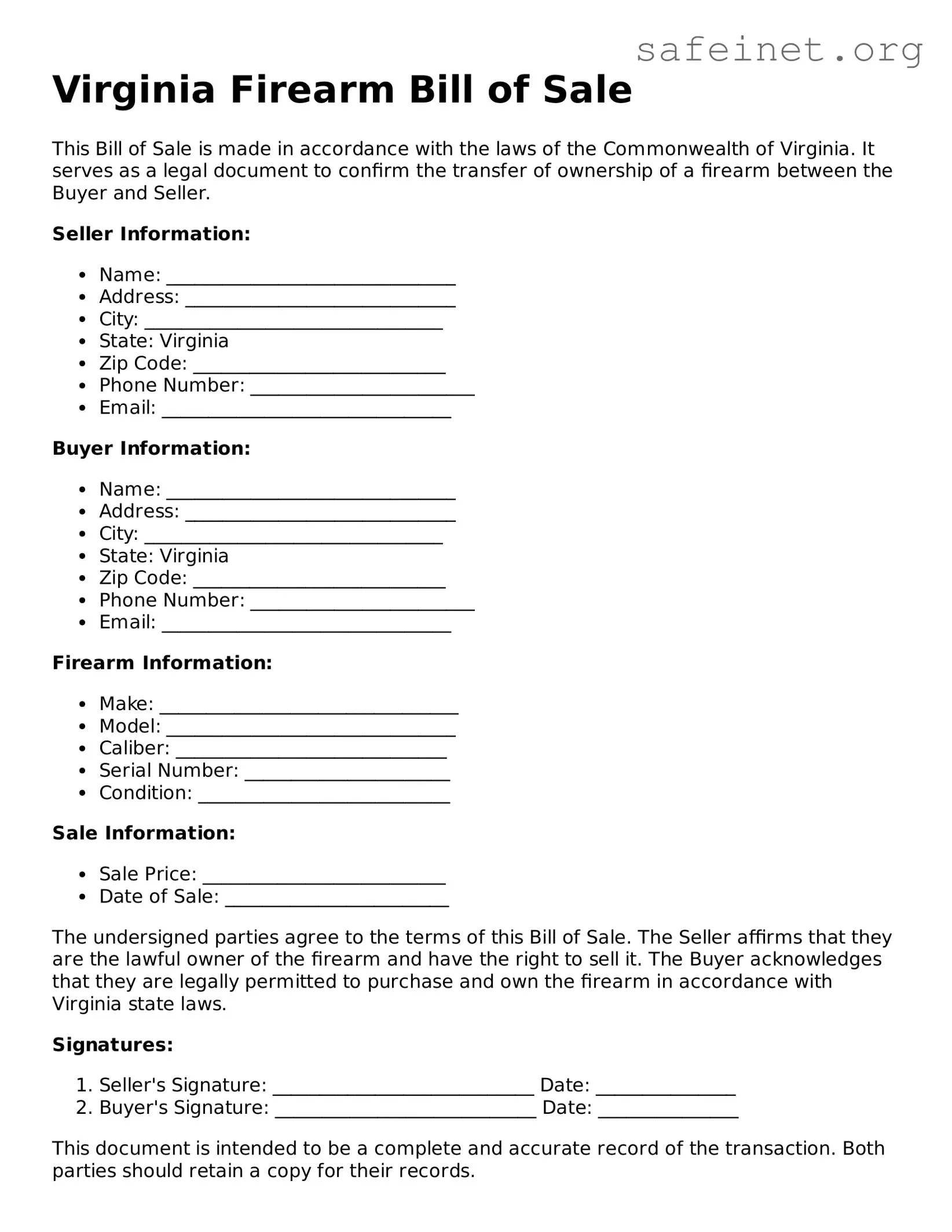
The Virginia Firearm Bill of Sale form serves as a critical document for individuals engaging in the sale or transfer of firearms within the state. This form not only provides essential details about the transaction but also protects both the buyer and seller by documenting the exchange. Key components of the form include the names and addresses of both parties, a description of the firearm being sold—including its make, model, and serial number—and the date of the transaction. Additionally, the form may require signatures from both parties to confirm their agreement and acknowledgment of the sale. By utilizing this document, individuals can ensure compliance with state laws and create a clear record that may be referenced in the future. Understanding the importance of this form is vital for anyone involved in firearm transactions in Virginia, as it helps to establish legal ownership and accountability.
Virginia Firearm Bill of Sale
This Bill of Sale is made in accordance with the laws of the Commonwealth of Virginia. It serves as a legal document to confirm the transfer of ownership of a firearm between the Buyer and Seller.
Seller Information:
Buyer Information:
Firearm Information:
Sale Information:
The undersigned parties agree to the terms of this Bill of Sale. The Seller affirms that they are the lawful owner of the firearm and have the right to sell it. The Buyer acknowledges that they are legally permitted to purchase and own the firearm in accordance with Virginia state laws.
Signatures:
This document is intended to be a complete and accurate record of the transaction. Both parties should retain a copy for their records.
| Fact Name | Description |
|---|---|
| Purpose | The Virginia Firearm Bill of Sale form is used to document the sale or transfer of a firearm between private parties. |
| Governing Law | This form is governed by Virginia Code § 18.2-308.2:2, which outlines the requirements for firearm transactions. |
| Required Information | The form typically requires the names, addresses, and signatures of both the buyer and the seller, along with details about the firearm. |
| Legal Age | Both parties must be at least 18 years old to legally complete a firearm transaction in Virginia. |
| Record Keeping | It is advisable for both the buyer and seller to retain a copy of the completed form for their records. |
| Notarization | While notarization is not required, having the document notarized can provide additional legal protection for both parties. |
Completing the Virginia Firearm Bill of Sale form requires careful attention to detail. After filling out the form, both the buyer and seller will have a clear record of the transaction, which can serve as proof of ownership and transfer of the firearm.
What is a Virginia Firearm Bill of Sale form?
The Virginia Firearm Bill of Sale form is a document used to record the sale or transfer of a firearm between two parties. This form serves as proof of the transaction and includes important details about the firearm, the seller, and the buyer. It helps protect both parties in case of future disputes regarding ownership.
Is a Bill of Sale required for private firearm sales in Virginia?
What information should be included in the Bill of Sale?
The Bill of Sale should include the names and addresses of both the seller and buyer, the date of the transaction, a description of the firearm (including make, model, caliber, and serial number), and the sale price. Both parties should sign the document to validate the transaction.
Do I need to have the Bill of Sale notarized?
No, notarization is not required for the Bill of Sale in Virginia. However, having the document notarized can add an extra layer of authenticity and may be beneficial if any disputes arise in the future.
Can I sell a firearm to someone from another state using this form?
What if I lose the Bill of Sale after the transaction?
If you lose the Bill of Sale after the transaction, it can be difficult to prove ownership. It's a good practice to keep a copy of the document for your records. If you cannot find it, you may want to create a new Bill of Sale with the buyer's consent, documenting the details again for clarity.
What should I do if I suspect the buyer may use the firearm illegally?
If you have concerns about the buyer's intentions, it is best to refrain from completing the sale. You can report your suspicions to local law enforcement. It is crucial to prioritize safety and ensure that firearms do not fall into the wrong hands.
Can I use a generic Bill of Sale template for firearms?
Failing to include complete information about the firearm. Buyers and sellers should provide details such as the make, model, caliber, and serial number. Omitting any of this information can lead to confusion or disputes later.
Not including the date of the transaction. It's essential to document when the sale took place. This can help establish a timeline and clarify ownership.
Neglecting to provide accurate personal information. Both parties must fill in their names, addresses, and contact information. Inaccurate details can complicate future communications.
Overlooking the signatures. Both the buyer and seller must sign the form to validate the transaction. A missing signature can render the bill of sale ineffective.
Not keeping a copy of the completed form. After filling out the Bill of Sale, both parties should retain a copy for their records. This document serves as proof of the transaction.
Assuming that the Bill of Sale is enough for legal purposes. While it provides a record of the sale, additional legal requirements may exist depending on local laws. Always check for specific regulations.
Using outdated forms. Firearm laws can change, and using an old version of the Bill of Sale may lead to issues. Always ensure you have the most current form.
When buying or selling a firearm in Virginia, the Firearm Bill of Sale form serves as a crucial document to record the transaction. However, it is often accompanied by other forms and documents that help ensure compliance with state and federal laws. Below is a list of additional documents that are commonly used in conjunction with the Firearm Bill of Sale.
Using these documents alongside the Virginia Firearm Bill of Sale can help facilitate a smooth transaction while ensuring compliance with legal requirements. Proper documentation protects both the buyer and the seller, providing clarity and security throughout the process.
The Virginia Firearm Bill of Sale form shares similarities with a standard Bill of Sale used for personal property transactions. Both documents serve as a written record of a sale, detailing the buyer, seller, and item being transferred. In the case of personal property, this could be a vehicle, furniture, or electronics. Each Bill of Sale includes essential information such as the date of the transaction and the purchase price, providing legal protection for both parties involved in the exchange.
Another document akin to the Virginia Firearm Bill of Sale is the Vehicle Title Transfer form. This form is used when ownership of a vehicle changes hands. Like the Firearm Bill of Sale, it captures critical details about the buyer and seller, as well as the specific vehicle being sold. Both documents must be completed accurately to ensure a smooth transfer of ownership and to protect the rights of the new owner against any future claims.
The Lease Agreement is another similar document, though it pertains to rental arrangements rather than sales. A Lease Agreement outlines the terms under which a property is rented, including the names of the parties, the rental property, and the duration of the lease. Both the Lease Agreement and the Firearm Bill of Sale establish a legal relationship between two parties, ensuring that the terms of the agreement are clear and enforceable.
A Purchase Agreement for real estate also bears resemblance to the Virginia Firearm Bill of Sale. This document outlines the terms and conditions under which a property is sold, including the purchase price and any contingencies. Both documents require detailed information about the parties involved and the item being sold, ensuring that all aspects of the transaction are documented to prevent disputes later on.
Lastly, a Receipt for Payment is another document that shares similarities with the Firearm Bill of Sale. A receipt provides proof of payment for goods or services rendered. While it may not detail the transfer of ownership as explicitly as the Firearm Bill of Sale, it serves as evidence that a transaction has occurred. Both documents are crucial for record-keeping and can be used in legal contexts to demonstrate that a sale has taken place.
When filling out the Virginia Firearm Bill of Sale form, it is important to ensure accuracy and compliance with state laws. Below are some guidelines to follow, including things you should do and things you should avoid.
Things You Should Do:
Things You Shouldn't Do:
Understanding the Virginia Firearm Bill of Sale form is crucial for anyone involved in buying or selling firearms in the state. However, several misconceptions can lead to confusion. Here are nine common misunderstandings:
Being informed about these misconceptions can help ensure that firearm transactions in Virginia are conducted legally and smoothly.
When it comes to buying or selling a firearm in Virginia, using a Bill of Sale form is an important step. This document serves as a record of the transaction and helps protect both the buyer and the seller. Here are some key takeaways to consider when filling out and using the Virginia Firearm Bill of Sale form:
By following these guidelines, individuals can navigate the process of buying or selling a firearm in Virginia with greater confidence and clarity.