In the realm of healthcare, the Virginia Do Not Resuscitate (DNR) Order form plays a crucial role in ensuring that individuals' wishes regarding end-of-life care are respected. This legal document allows patients to communicate their preferences about resuscitation efforts in the event of cardiac arrest or respiratory failure. It is essential for those facing serious illnesses or advanced age to consider this option, as it provides clarity to medical professionals during critical moments. The form must be completed and signed by a licensed physician, ensuring that the patient's choices are backed by professional medical guidance. Additionally, it is important to note that the DNR Order must be readily accessible to healthcare providers, as it guides their actions in emergencies. Understanding the implications of this form can empower individuals and their families to make informed decisions about their healthcare, ultimately leading to a more dignified approach to end-of-life situations.
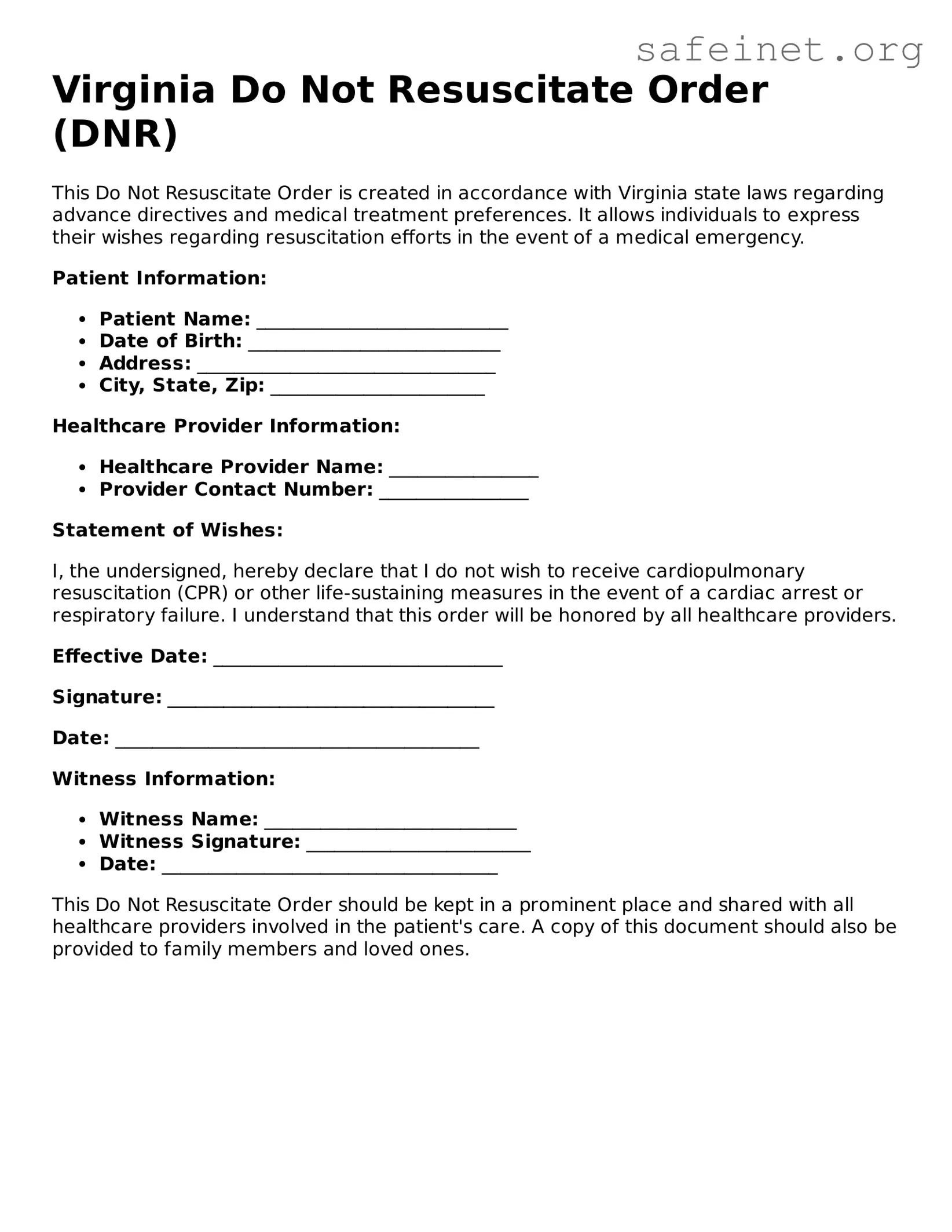
Virginia Do Not Resuscitate Order (DNR)
This Do Not Resuscitate Order is created in accordance with Virginia state laws regarding advance directives and medical treatment preferences. It allows individuals to express their wishes regarding resuscitation efforts in the event of a medical emergency.
Patient Information:
Healthcare Provider Information:
Statement of Wishes:
I, the undersigned, hereby declare that I do not wish to receive cardiopulmonary resuscitation (CPR) or other life-sustaining measures in the event of a cardiac arrest or respiratory failure. I understand that this order will be honored by all healthcare providers.
Effective Date: _______________________________
Signature: ___________________________________
Date: _______________________________________
Witness Information:
This Do Not Resuscitate Order should be kept in a prominent place and shared with all healthcare providers involved in the patient's care. A copy of this document should also be provided to family members and loved ones.
| Fact Name | Details |
|---|---|
| Purpose | The Virginia Do Not Resuscitate (DNR) Order form is used to indicate a person's wish not to receive cardiopulmonary resuscitation (CPR) in the event of cardiac or respiratory arrest. |
| Governing Law | The DNR Order is governed by the Virginia Code § 54.1-2981 through § 54.1-2987. |
| Eligibility | Any adult can complete a DNR Order, provided they are capable of making informed medical decisions. |
| Signature Requirement | The form must be signed by the patient or their legal representative to be valid. |
| Witnesses | Two witnesses must sign the form, but they cannot be related to the patient or involved in the patient's care. |
| Healthcare Provider | A physician must sign the DNR Order to ensure it aligns with medical standards and practices. |
| Revocation | The DNR Order can be revoked at any time by the patient or their representative. |
| Distribution | Once completed, copies of the DNR Order should be provided to the patient's healthcare providers and kept in a visible location. |
| Emergency Services | Emergency medical personnel must honor the DNR Order when it is presented at the scene. |
| Legal Protections | Individuals acting in accordance with a valid DNR Order are protected from legal liability under Virginia law. |
Filling out the Virginia Do Not Resuscitate Order form is an important step in expressing your healthcare preferences. It allows you to communicate your wishes regarding medical interventions in the event of a life-threatening situation. Here’s how to complete the form accurately.
After completing the form, keep it in a safe but accessible location. Ensure that your family members and healthcare team are aware of your wishes and have access to the document. This proactive step can provide peace of mind for you and your loved ones.
What is a Do Not Resuscitate (DNR) Order in Virginia?
A Do Not Resuscitate Order is a legal document that indicates a person's wishes regarding resuscitation efforts in the event of a medical emergency. In Virginia, this order directs healthcare providers not to perform cardiopulmonary resuscitation (CPR) or other life-saving measures if the individual stops breathing or their heart stops beating. It is important for individuals to understand that a DNR does not affect other types of medical care.
Who can request a DNR Order in Virginia?
In Virginia, a DNR Order can be requested by a patient who is at least 18 years old and has the capacity to make medical decisions. If the patient is unable to make decisions, a legally authorized representative, such as a family member or guardian, may request the order on their behalf.
How is a DNR Order created in Virginia?
To create a DNR Order in Virginia, a patient must complete the official DNR Order form, which is available through healthcare providers or online. The form must be signed by the patient and their physician. It is essential that both parties understand the implications of the order before signing.
Where should the DNR Order be kept?
Once the DNR Order is completed and signed, it should be kept in a place that is easily accessible. Many individuals choose to keep it in their medical records or carry a copy with them at all times. It is also advisable to inform family members and caregivers about the existence of the order.
Can a DNR Order be revoked?
Yes, a DNR Order can be revoked at any time by the patient or their authorized representative. To revoke the order, the individual should destroy the original document and inform their healthcare provider. It is important to ensure that all relevant parties are aware of the revocation to avoid any confusion during a medical emergency.
Will a DNR Order affect other medical treatments?
No, a DNR Order specifically pertains to resuscitation efforts. It does not limit other medical treatments or interventions that a patient may receive. Healthcare providers will continue to offer appropriate care and treatment based on the patient's medical condition and wishes.
Is a DNR Order legally binding in Virginia?
Yes, a properly executed DNR Order is legally binding in Virginia. Healthcare providers are required to honor the wishes expressed in the order, as long as it is valid and meets all necessary legal requirements. It is advisable to ensure that the order is completed correctly to avoid any potential issues.
How can I find more information about DNR Orders in Virginia?
For more information about DNR Orders in Virginia, individuals can consult their healthcare provider or visit the Virginia Department of Health website. There, resources and guidance are available to help individuals understand their rights and options regarding end-of-life care.
Not including the patient’s full name. It’s crucial to provide the complete name to avoid any confusion.
Failing to date the form. A date helps to establish when the order was created, which is important for legal reasons.
Not signing the document. The signature is necessary for the order to be considered valid.
Forgetting to have a witness sign. A witness is often required to verify the authenticity of the document.
Using outdated forms. Ensure that the most recent version of the Do Not Resuscitate Order form is used.
Not discussing the order with healthcare providers. Communication with medical professionals ensures everyone understands the patient's wishes.
Leaving out important medical information. Including relevant medical history can help clarify the reasons for the order.
Misunderstanding the implications of the order. It’s important to fully understand what a Do Not Resuscitate Order entails.
Not keeping copies of the form. It’s wise to have multiple copies for different healthcare settings.
Neglecting to review the order regularly. As circumstances change, the order may need to be updated to reflect current wishes.
The Virginia Do Not Resuscitate (DNR) Order form is an important document that outlines a patient's wishes regarding resuscitation efforts in the event of a medical emergency. Alongside this form, several other documents are commonly used to ensure comprehensive end-of-life care planning. Below is a list of these documents, each serving a specific purpose in conveying a patient's healthcare preferences.
These documents work together to create a clear picture of an individual's healthcare preferences. By having these forms in place, patients can ensure their wishes are respected and that their loved ones have guidance during difficult times.
The Virginia Do Not Resuscitate (DNR) Order form shares similarities with an Advance Directive. An Advance Directive is a legal document that outlines a person's wishes regarding medical treatment in situations where they may be unable to communicate their preferences. Like the DNR, it allows individuals to express their healthcare choices in advance, ensuring that their values and desires are respected. Both documents aim to provide clarity for healthcare providers and family members, reducing confusion during critical moments.
Another document comparable to the DNR is a Physician Orders for Life-Sustaining Treatment (POLST) form. The POLST form is designed for individuals with serious health conditions and outlines specific medical interventions they wish to receive or avoid. Similar to the DNR, the POLST is actionable and provides clear guidance to medical personnel. Both documents prioritize patient autonomy and ensure that healthcare decisions align with the individual's goals and preferences.
A Living Will is also akin to the DNR Order. This document specifies an individual’s wishes regarding end-of-life care, particularly when they are terminally ill or in a persistent vegetative state. While the DNR focuses specifically on resuscitation efforts, the Living Will encompasses a broader range of medical treatments. Both documents empower individuals to make their healthcare choices known, fostering a sense of control over their medical care even when they cannot speak for themselves.
Lastly, a Healthcare Power of Attorney (POA) is similar in purpose to the DNR. This document designates a trusted person to make healthcare decisions on behalf of an individual if they become incapacitated. While the DNR specifies preferences regarding resuscitation, the Healthcare POA allows for broader decision-making authority. Both documents work together to ensure that a person's medical wishes are honored, reflecting their values and beliefs even when they are unable to advocate for themselves.
When filling out the Virginia Do Not Resuscitate Order form, it is important to follow certain guidelines to ensure that your wishes are clearly communicated. Here are five things you should and shouldn't do:
Many people hold misconceptions about the Virginia Do Not Resuscitate (DNR) Order form. Understanding the truth behind these misconceptions can help individuals make informed decisions regarding their healthcare preferences. Below are four common misconceptions:
This is not accurate. A DNR order specifically addresses resuscitation efforts in the event of cardiac or respiratory arrest. It does not prevent other medical treatments or interventions from being provided.
This misconception overlooks the fact that anyone can request a DNR order, regardless of their health status. Individuals may choose this option for various personal reasons, not solely based on terminal illness.
While a DNR order is recognized by healthcare providers, it may not be applicable in certain emergency situations, such as when a patient is outside of a healthcare facility. In these cases, first responders may not be aware of the DNR order.
This is incorrect. Individuals have the right to change or revoke their DNR order at any time. It is important to communicate any changes to healthcare providers and ensure that updated documents are accessible.
By addressing these misconceptions, individuals can better navigate their healthcare choices and ensure their wishes are respected in critical situations.
Understanding the Virginia Do Not Resuscitate Order (DNR) form is essential for anyone considering end-of-life care options. Here are some key takeaways:
Being informed about the DNR process can help ensure that your healthcare choices are respected and followed. Take the time to understand and communicate your wishes clearly.