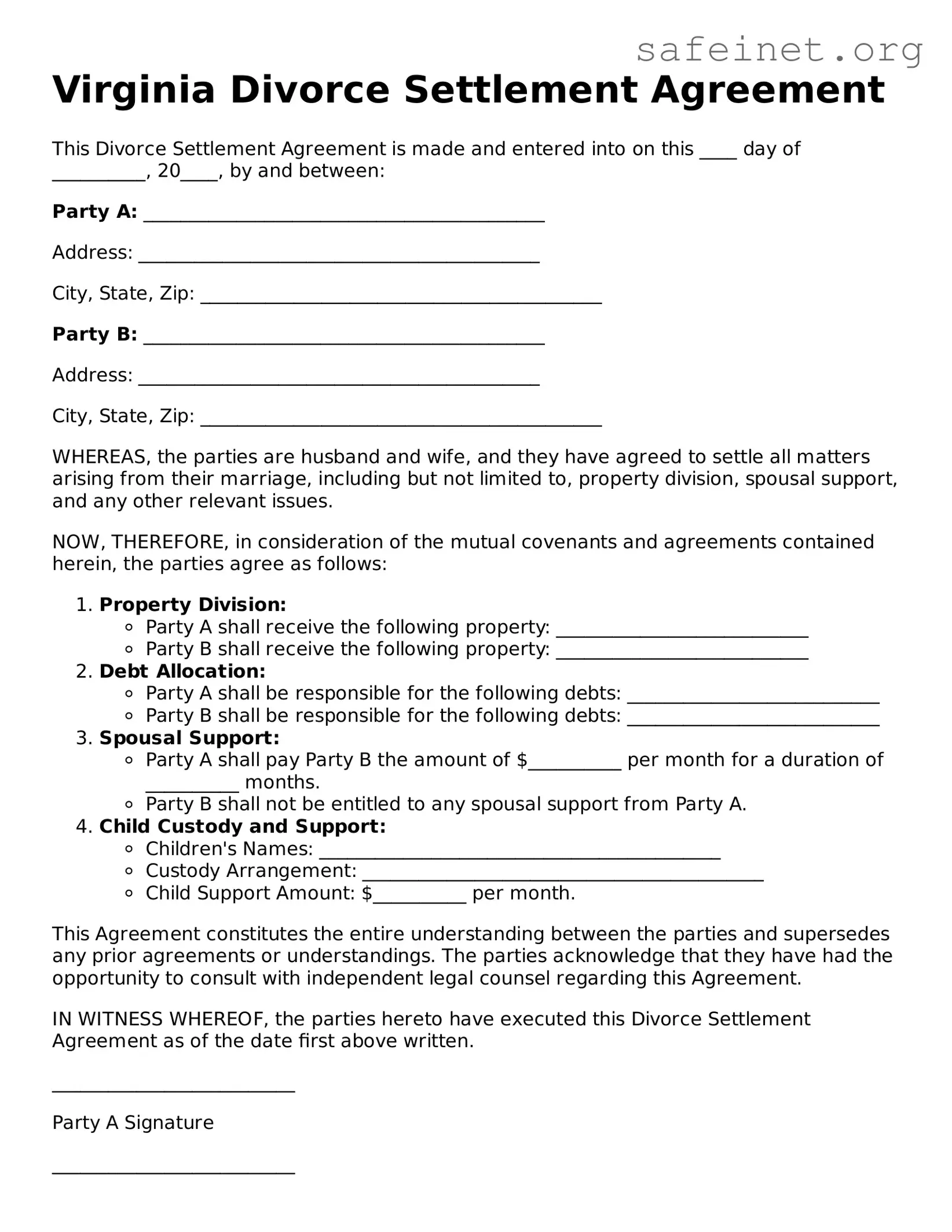
The Virginia Divorce Settlement Agreement form serves as a crucial document in the divorce process, outlining the terms agreed upon by both parties regarding various aspects of their separation. This form addresses key issues such as the division of marital property, spousal support, child custody, and child support. By detailing these arrangements, the form aims to provide clarity and prevent future disputes. It is essential for both parties to understand their rights and responsibilities as stipulated in the agreement. Additionally, the form must be signed by both spouses to ensure its validity and enforceability. Completing this document accurately can facilitate a smoother transition into post-divorce life, allowing individuals to focus on rebuilding their futures.
Virginia Divorce Settlement Agreement
This Divorce Settlement Agreement is made and entered into on this ____ day of __________, 20____, by and between:
Party A: ___________________________________________
Address: ___________________________________________
City, State, Zip: ___________________________________________
Party B: ___________________________________________
Address: ___________________________________________
City, State, Zip: ___________________________________________
WHEREAS, the parties are husband and wife, and they have agreed to settle all matters arising from their marriage, including but not limited to, property division, spousal support, and any other relevant issues.
NOW, THEREFORE, in consideration of the mutual covenants and agreements contained herein, the parties agree as follows:
This Agreement constitutes the entire understanding between the parties and supersedes any prior agreements or understandings. The parties acknowledge that they have had the opportunity to consult with independent legal counsel regarding this Agreement.
IN WITNESS WHEREOF, the parties hereto have executed this Divorce Settlement Agreement as of the date first above written.
__________________________
Party A Signature
__________________________
Party B Signature
__________________________
Date
| Fact Name | Details |
|---|---|
| Governing Law | The Virginia Divorce Settlement Agreement is governed by Virginia state law, specifically under Title 20, Chapter 6 of the Code of Virginia. |
| Purpose | This form is used to outline the terms of a divorce settlement between spouses, covering issues such as property division, alimony, and child custody. |
| Mutual Agreement | Both parties must agree to the terms outlined in the settlement agreement for it to be valid and enforceable. |
| Filing Requirement | The completed agreement must be filed with the court as part of the divorce proceedings. |
| Child Support | If children are involved, the agreement must include provisions for child support, which must comply with Virginia's child support guidelines. |
| Property Division | The agreement should clearly specify how marital property will be divided between the spouses. |
| Legal Representation | While not required, it is advisable for both parties to seek legal counsel to ensure that their rights are protected. |
| Modification | Once signed, the agreement can be modified only by mutual consent of both parties, typically requiring a new written agreement. |
| Notarization | In Virginia, it is recommended, though not mandatory, to have the settlement agreement notarized to enhance its credibility. |
After gathering the necessary information and documents, you are ready to fill out the Virginia Divorce Settlement Agreement form. This form is essential for outlining the terms of your divorce and ensuring that both parties agree on key issues. Follow these steps to complete the form accurately.
Once the form is completed and signed, it will need to be filed with the appropriate court. This step is crucial for finalizing your divorce settlement and ensuring that it is legally binding.
What is a Virginia Divorce Settlement Agreement?
A Virginia Divorce Settlement Agreement is a legal document that outlines the terms of a divorce between two parties. It covers various aspects such as property division, alimony, child custody, and support. This agreement helps both parties avoid lengthy court battles by providing a clear framework for their separation.
Why is a Divorce Settlement Agreement important?
This agreement is crucial as it ensures that both parties have a mutual understanding of their rights and responsibilities. It can prevent future disputes and provide a sense of closure. Additionally, a well-drafted agreement can expedite the divorce process and may lead to a more amicable resolution.
What should be included in the agreement?
Key components of a Divorce Settlement Agreement include the division of marital property, arrangements for child custody and visitation, child support obligations, and any spousal support (alimony) terms. It’s also important to address any debts and liabilities incurred during the marriage.
Can I modify the agreement after it is signed?
Yes, modifications can be made to the agreement after it is signed, but both parties must consent to any changes. It is advisable to document any amendments in writing and have them signed by both parties to ensure clarity and enforceability.
Do I need a lawyer to create a Divorce Settlement Agreement?
While it is possible to draft a Divorce Settlement Agreement without legal assistance, consulting with a lawyer is highly recommended. A legal professional can ensure that your rights are protected and that the agreement complies with Virginia law, reducing the risk of future complications.
How is the agreement submitted to the court?
Once both parties have signed the Divorce Settlement Agreement, it should be submitted to the court as part of the divorce proceedings. This typically occurs when filing for divorce or during a scheduled court hearing. The judge will review the agreement to ensure it is fair and reasonable before granting the divorce.
What happens if one party does not comply with the agreement?
If one party fails to comply with the terms of the Divorce Settlement Agreement, the other party may seek enforcement through the court. This could involve filing a motion for contempt or seeking a modification of the agreement. Courts take these matters seriously, and it is important to document any non-compliance.
Failing to provide complete information. Many individuals overlook the importance of filling out all sections of the form. Incomplete information can lead to delays or complications in the divorce process.
Not specifying asset division clearly. People often assume that their understanding of asset division is mutual. Without clear specifications, disputes may arise later.
Ignoring debts. It is crucial to address both assets and debts in the agreement. Failing to do so can result in one party being unfairly burdened with financial obligations.
Overlooking child custody arrangements. Parents sometimes neglect to detail custody and visitation schedules. This can create confusion and conflict post-divorce.
Not including child support terms. Many forget to specify child support amounts and payment schedules. This omission can lead to financial strain and misunderstandings.
Using ambiguous language. Clear and precise language is essential. Vague terms can lead to different interpretations, causing disputes in the future.
Failing to review state laws. Each state has specific requirements for divorce agreements. Ignoring these can result in a settlement that is not enforceable.
Not seeking legal advice. Many individuals attempt to fill out the form without consulting a legal professional. This can lead to mistakes that might have been avoided with proper guidance.
When navigating the process of divorce in Virginia, various forms and documents may be required alongside the Divorce Settlement Agreement. These documents help ensure that all aspects of the divorce are addressed comprehensively. Below is a list of commonly used forms that can facilitate a smoother transition during this challenging time.
Each of these documents plays a crucial role in the divorce process, addressing specific aspects of the separation. Understanding their purpose can help individuals navigate this complex journey with greater clarity and confidence.
The Virginia Divorce Settlement Agreement form shares similarities with the Marital Settlement Agreement. Both documents outline the terms agreed upon by spouses regarding the division of assets, debts, and child custody arrangements. A Marital Settlement Agreement is typically used in divorce cases to clarify the rights and responsibilities of each party, ensuring that both individuals have a clear understanding of the terms they have agreed to. This helps to minimize potential disputes in the future.
Another comparable document is the Separation Agreement. This form is often utilized when couples decide to live apart but are not yet ready to divorce. Like the Divorce Settlement Agreement, the Separation Agreement addresses issues such as property division, support obligations, and child custody. It serves to formalize the arrangement between the parties, providing a clear framework for their ongoing relationship while living separately.
The Child Custody Agreement is also similar in that it focuses specifically on the arrangements for children involved in a divorce or separation. This document outlines the custody and visitation rights of each parent, as well as any child support obligations. While the Divorce Settlement Agreement may include these elements, the Child Custody Agreement hones in on the best interests of the child, ensuring that their needs are prioritized in the arrangement.
The Property Settlement Agreement is another related document. This form specifically addresses the division of marital property and debts. It provides a detailed account of how assets will be allocated between the parties, which is a crucial aspect of the divorce process. Like the Divorce Settlement Agreement, it aims to create a fair distribution of property, thus reducing the likelihood of future conflicts regarding ownership and financial responsibilities.
The Parenting Plan is also comparable, as it focuses on the parenting arrangements for children after a divorce. This document details how parents will share responsibilities and make decisions regarding their children’s upbringing. While the Divorce Settlement Agreement may cover these aspects, the Parenting Plan emphasizes cooperation and communication between parents, aiming to foster a positive environment for the children involved.
Lastly, the Financial Affidavit is similar in that it provides a comprehensive overview of each party's financial situation. This document includes information about income, expenses, assets, and liabilities. It is often used in divorce proceedings to ensure that both parties are fully informed about each other's financial circumstances, which is essential for fair negotiations regarding support and property division. Like the Divorce Settlement Agreement, the Financial Affidavit aims to promote transparency and equity in the divorce process.
When filling out the Virginia Divorce Settlement Agreement form, it is important to follow certain guidelines to ensure accuracy and completeness. Here are some key do's and don'ts:
By following these guidelines, you can help ensure that your Divorce Settlement Agreement is completed correctly and efficiently.
Understanding the Virginia Divorce Settlement Agreement form is essential for anyone navigating the divorce process. However, several misconceptions can lead to confusion. Below is a list of common misunderstandings regarding this important document.
Addressing these misconceptions can help individuals approach their divorce with a clearer perspective, ensuring that they make informed decisions throughout the process.
Filling out and using the Virginia Divorce Settlement Agreement form can seem daunting, but understanding the key aspects can simplify the process. Here are some essential takeaways:
By following these key points, individuals can navigate the Virginia Divorce Settlement Agreement form more effectively, leading to a smoother divorce process.