When entering into a commercial lease in Virginia, understanding the lease agreement form is essential for both landlords and tenants. This document outlines the terms and conditions that govern the rental of commercial property, ensuring that both parties are clear on their rights and responsibilities. Key aspects of the Virginia Commercial Lease Agreement include the duration of the lease, rental payments, maintenance obligations, and any specific use clauses that dictate how the property can be utilized. Additionally, it addresses security deposits, renewal options, and termination procedures, providing a comprehensive framework for the leasing relationship. By familiarizing themselves with these components, both landlords and tenants can navigate the leasing process with confidence and clarity.
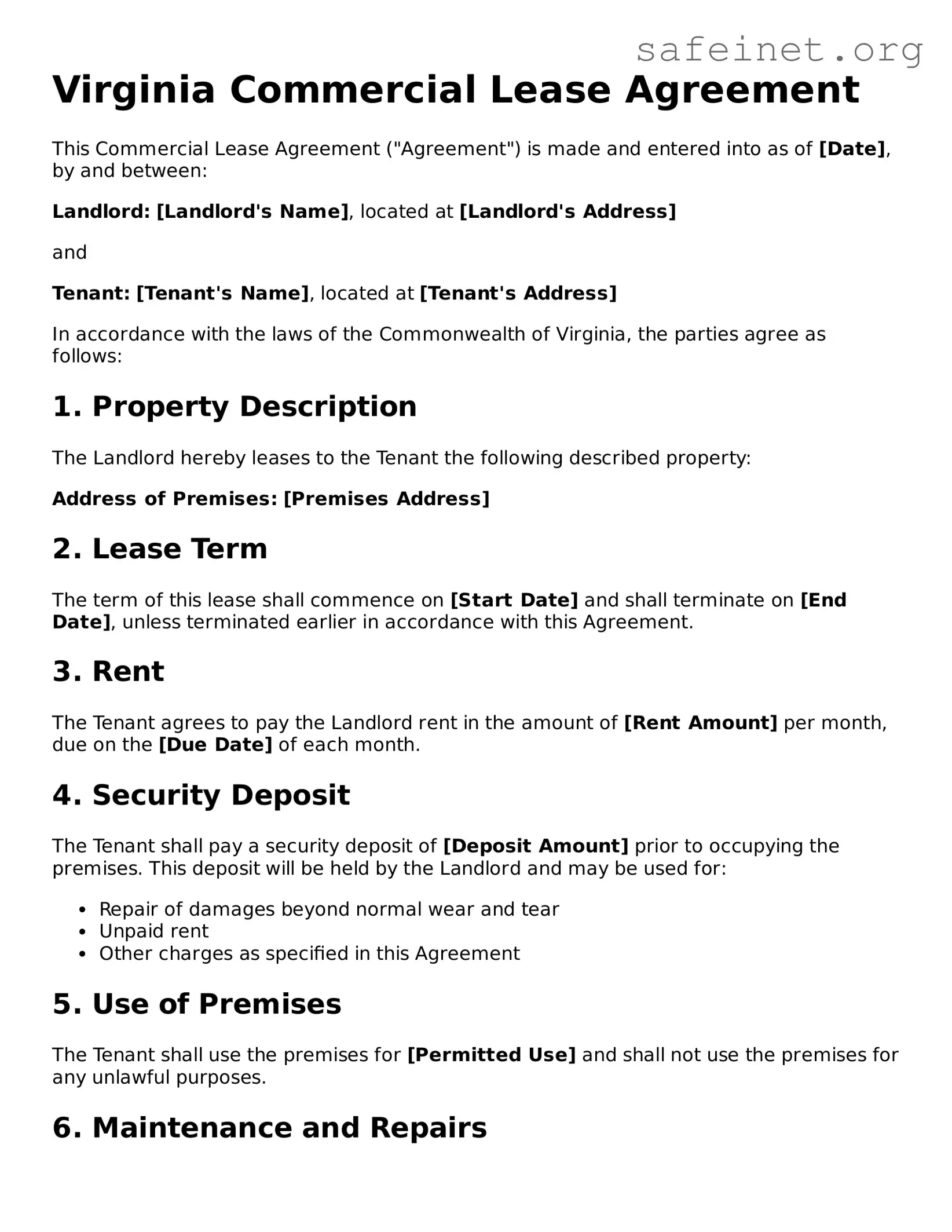
Virginia Commercial Lease Agreement
This Commercial Lease Agreement ("Agreement") is made and entered into as of [Date], by and between:
Landlord: [Landlord's Name], located at [Landlord's Address]
and
Tenant: [Tenant's Name], located at [Tenant's Address]
In accordance with the laws of the Commonwealth of Virginia, the parties agree as follows:
1. Property Description
The Landlord hereby leases to the Tenant the following described property:
Address of Premises: [Premises Address]
2. Lease Term
The term of this lease shall commence on [Start Date] and shall terminate on [End Date], unless terminated earlier in accordance with this Agreement.
3. Rent
The Tenant agrees to pay the Landlord rent in the amount of [Rent Amount] per month, due on the [Due Date] of each month.
4. Security Deposit
The Tenant shall pay a security deposit of [Deposit Amount] prior to occupying the premises. This deposit will be held by the Landlord and may be used for:
5. Use of Premises
The Tenant shall use the premises for [Permitted Use] and shall not use the premises for any unlawful purposes.
6. Maintenance and Repairs
The Tenant is responsible for:
The Landlord will be responsible for:
7. Termination
Either party may terminate this Agreement by providing written notice of [Notice Period] days to the other party.
8. Governing Law
This Agreement shall be governed by and construed in accordance with the laws of the Commonwealth of Virginia.
9. Signatures
IN WITNESS WHEREOF, the parties hereto have executed this Commercial Lease Agreement as of the date first above written.
Landlord Signature: ___________________________ Date: ___________
Tenant Signature: ___________________________ Date: ___________
| Fact Name | Description |
|---|---|
| Governing Law | The Virginia Commercial Lease Agreement is governed by the laws of the Commonwealth of Virginia. |
| Parties Involved | The agreement typically involves a landlord (lessor) and a tenant (lessee). |
| Property Description | The lease must include a detailed description of the commercial property being leased. |
| Lease Term | The duration of the lease should be clearly stated, whether it’s short-term or long-term. |
| Rent Payment | Details regarding the amount of rent, payment due dates, and acceptable payment methods must be included. |
| Security Deposit | The agreement often requires a security deposit, which protects the landlord against damages. |
| Use of Premises | The lease should specify the permitted use of the property, such as retail, office, or industrial purposes. |
| Maintenance Responsibilities | Responsibilities for maintenance and repairs should be clearly outlined to avoid disputes. |
| Termination Clause | The lease should include conditions under which either party can terminate the agreement. |
| Signatures | Both parties must sign the lease for it to be legally binding, indicating their agreement to the terms. |
Completing the Virginia Commercial Lease Agreement form is an essential step in establishing a clear understanding between the landlord and tenant. This document outlines the terms of the lease and ensures both parties are aware of their rights and responsibilities. Follow these steps carefully to fill out the form accurately.
After filling out the form, review all entries to ensure accuracy. It’s advisable to keep a copy for personal records and provide one to the other party involved in the lease agreement.
What is a Virginia Commercial Lease Agreement?
A Virginia Commercial Lease Agreement is a legally binding contract between a landlord and a business tenant. It outlines the terms under which the tenant can occupy and use a commercial property. This agreement typically includes details about rent, duration of the lease, maintenance responsibilities, and other important conditions relevant to the use of the property.
What are the key components of a Commercial Lease Agreement?
Key components include the names of the parties involved, a description of the property, the lease term, rent amount and payment schedule, security deposit requirements, maintenance responsibilities, and any restrictions on property use. It may also cover renewal options and conditions for terminating the lease.
How long does a typical commercial lease last in Virginia?
The duration of a commercial lease can vary widely, but it often ranges from one to five years. Some leases may be longer or shorter depending on the needs of the tenant and the landlord’s preferences. It’s important to negotiate a term that suits your business plans.
Can I modify the lease agreement?
Yes, lease agreements can be modified, but any changes must be agreed upon by both parties and documented in writing. Verbal agreements are not enforceable, so it’s crucial to ensure all modifications are formally included in the lease document.
What happens if I want to terminate the lease early?
Terminating a lease early can be complicated. Most leases include a specific process for termination, which may involve penalties or fees. It’s essential to review the lease terms carefully and discuss your options with the landlord. In some cases, finding a replacement tenant can help mitigate penalties.
Are there any specific laws governing commercial leases in Virginia?
Yes, commercial leases in Virginia are governed by state law, which includes regulations about lease agreements, tenant rights, and landlord obligations. Familiarizing yourself with these laws can help you understand your rights and responsibilities under the lease.
What should I do if there is a dispute with my landlord?
If a dispute arises, the first step is to communicate directly with your landlord to try to resolve the issue amicably. If that doesn’t work, you may consider mediation or legal action. Documenting all communications and keeping records of any issues can be helpful if the situation escalates.
Is it advisable to have a lawyer review my lease before signing?
Absolutely. Having a lawyer review your lease can help identify any potential issues or unfavorable terms. This step can provide peace of mind and ensure that your interests are protected before you commit to a long-term agreement.
Not reading the entire lease agreement. Many people skip sections, missing important details that could affect their rights and responsibilities.
Failing to specify the lease term. It’s crucial to clearly state how long the lease will last. Without this, disputes may arise later.
Ignoring renewal options. If the lease includes a renewal clause, it should be clearly outlined to avoid confusion in the future.
Overlooking maintenance responsibilities. Both parties should understand who is responsible for repairs and maintenance. This should be clearly defined in the agreement.
Not including the rent amount. Clearly stating the rent amount and due dates helps prevent misunderstandings about payments.
Forgetting to address utilities. Specify which utilities are included in the lease. This can save tenants from unexpected costs.
Neglecting to include any additional fees. Any fees beyond rent, such as maintenance or service charges, should be explicitly listed.
Failing to include a security deposit clause. Clearly stating the amount and conditions for the security deposit can prevent future disputes.
Not understanding the termination clause. Knowing how and when either party can terminate the lease is essential for both sides.
Skipping the signature section. Both parties must sign the lease for it to be legally binding. Without signatures, the agreement is not valid.
When entering into a commercial lease agreement in Virginia, several other forms and documents are often used to ensure clarity and protect the interests of all parties involved. Here’s a brief overview of these important documents.
These documents play a crucial role in the leasing process. They help to clarify responsibilities and expectations, making the relationship between landlords and tenants smoother and more transparent.
The Virginia Commercial Lease Agreement is similar to the Residential Lease Agreement. Both documents outline the terms under which one party rents property from another. They specify the rental amount, duration of the lease, and responsibilities of both the landlord and tenant. However, while the residential lease typically focuses on living spaces, the commercial lease is tailored for business operations, addressing unique needs such as zoning regulations and business hours.
Another comparable document is the Sublease Agreement. This agreement allows a tenant to lease out part or all of their rented space to another party. Similar to a commercial lease, it includes terms about rent, duration, and responsibilities. The primary difference lies in the relationship between the original tenant and the subtenant, which can introduce additional complexities regarding liability and property management.
The Letter of Intent (LOI) also shares similarities with the Commercial Lease Agreement. An LOI outlines the preliminary terms of a lease before the formal agreement is drafted. It serves as a starting point for negotiations and includes key elements like rental rates and lease duration. While it is not legally binding, it helps both parties understand each other's expectations and can streamline the lease drafting process.
A Purchase Agreement is another document that bears resemblance to a commercial lease. This agreement is used when one party intends to buy property from another. Both documents require detailed descriptions of the property, price, and conditions of the transaction. However, a purchase agreement results in ownership transfer, while a lease agreement maintains the landlord-tenant relationship.
The Commercial Real Estate Purchase and Sale Agreement is similar in that it governs the sale of commercial property. Like the commercial lease, it includes terms and conditions relevant to the transaction. However, it focuses on the sale rather than the rental of property. Both documents require careful consideration of terms, but the purchase agreement ultimately leads to a change in ownership.
Lastly, the Option to Lease Agreement is akin to a commercial lease in that it grants a potential tenant the right to lease a property at a future date. This document outlines the terms under which the tenant can exercise their option. While the commercial lease binds the parties to immediate terms, the option to lease provides flexibility and time for the tenant to make decisions about the property.
When filling out the Virginia Commercial Lease Agreement form, it is important to follow certain guidelines to ensure accuracy and compliance. Here are five things you should and shouldn't do:
Understanding the Virginia Commercial Lease Agreement form is crucial for both landlords and tenants. However, several misconceptions can lead to confusion. Here are nine common misconceptions:
This is not true. Each lease can vary significantly based on the specific terms negotiated between the parties involved. Factors such as duration, rent, and responsibilities can differ widely.
Both landlords and tenants should thoroughly understand the lease. Each party has rights and responsibilities that can affect the success of their business operations.
While verbal agreements may seem convenient, they are often difficult to enforce. A written lease provides clarity and legal protection for both parties.
Many landlords require a security deposit to cover potential damages or unpaid rent. This is a common practice in commercial leases.
This is a misconception. Commercial leases must adhere to local, state, and federal laws, including zoning regulations and safety codes.
Most leases require tenants to obtain landlord approval before making significant changes to the property. Unauthorized alterations could lead to disputes.
Rent terms, including increases, can often be negotiated. Open communication between landlords and tenants can lead to mutually beneficial agreements.
Ending a lease can be complex. Both parties must understand the terms regarding termination, including notice periods and penalties.
Commercial leases can be for a fixed term or month-to-month. Understanding the length of the lease is essential for planning business operations.
By addressing these misconceptions, both landlords and tenants can navigate the complexities of commercial leases more effectively.
When filling out and using the Virginia Commercial Lease Agreement form, consider the following key takeaways: