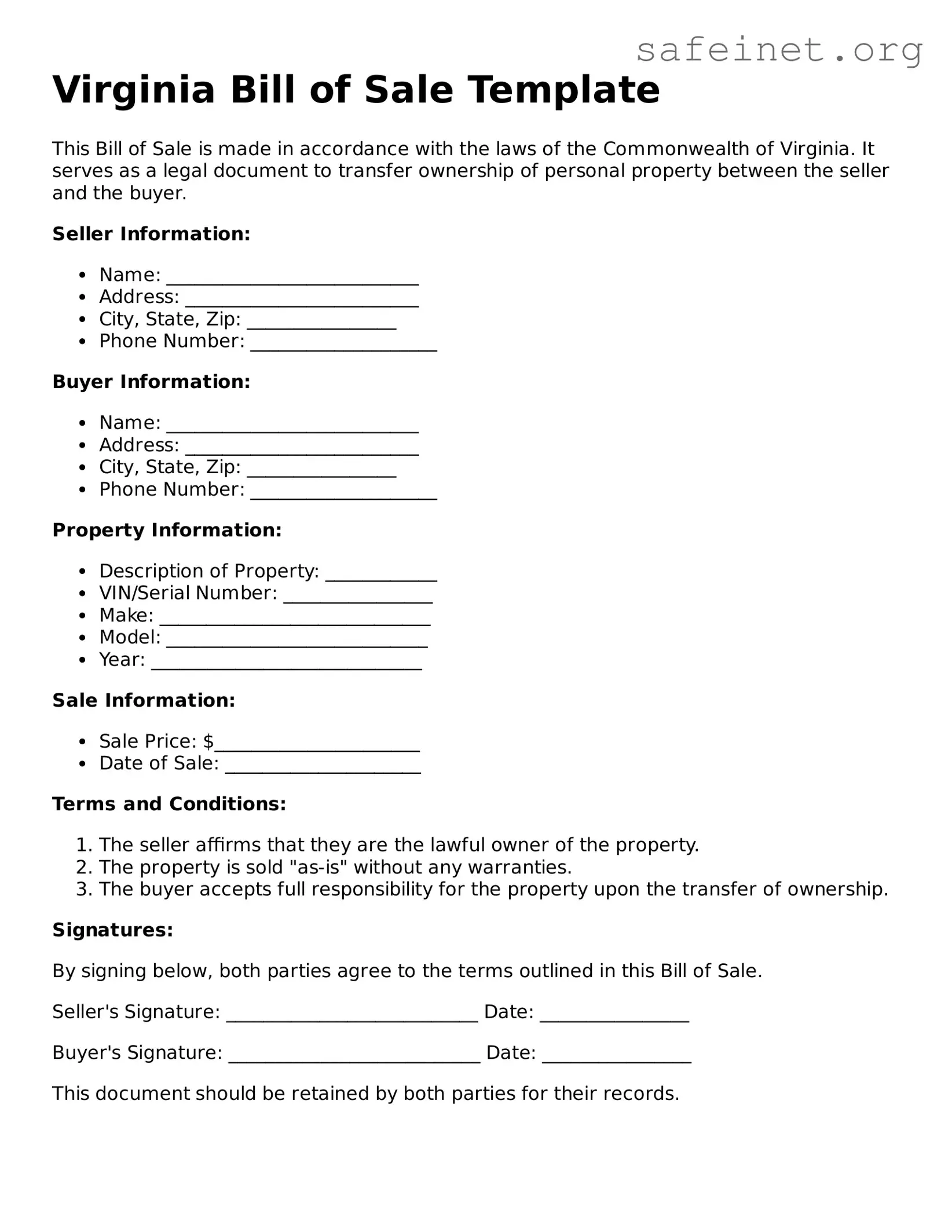
When it comes to buying or selling personal property in Virginia, a Bill of Sale form plays a crucial role in documenting the transaction. This form serves as a written record that outlines the details of the sale, including the names of the buyer and seller, a description of the item being sold, and the sale price. It can apply to various types of property, such as vehicles, boats, or even furniture. Having a Bill of Sale is important for both parties, as it provides proof of ownership transfer and can protect against potential disputes in the future. Additionally, certain items, like vehicles, may require specific information, such as the Vehicle Identification Number (VIN) and odometer reading. Understanding the components of the Virginia Bill of Sale form can help ensure a smooth transaction and provide peace of mind for both buyers and sellers.
Virginia Bill of Sale Template
This Bill of Sale is made in accordance with the laws of the Commonwealth of Virginia. It serves as a legal document to transfer ownership of personal property between the seller and the buyer.
Seller Information:
Buyer Information:
Property Information:
Sale Information:
Terms and Conditions:
Signatures:
By signing below, both parties agree to the terms outlined in this Bill of Sale.
Seller's Signature: ___________________________ Date: ________________
Buyer's Signature: ___________________________ Date: ________________
This document should be retained by both parties for their records.
| Fact Name | Details |
|---|---|
| Definition | A Bill of Sale is a legal document that transfers ownership of personal property from one person to another. |
| Purpose | This form is used to provide proof of sale and ownership for items like vehicles, equipment, and other goods. |
| Governing Laws | The Virginia Bill of Sale is governed by Virginia Code § 46.2-605 for vehicle sales and general property transfer laws. |
| Required Information | The form typically includes the names and addresses of the buyer and seller, a description of the item, and the sale price. |
| Notarization | While notarization is not always required, having the document notarized can add an extra layer of legitimacy. |
| Use for Vehicles | A Bill of Sale is essential for transferring vehicle ownership and is often required for registration purposes. |
| Use for Personal Property | This form can also be used for the sale of personal property, such as furniture or electronics. |
| Record Keeping | Both the buyer and seller should keep a copy of the Bill of Sale for their records. |
| State-Specific Forms | Virginia offers specific templates for Bills of Sale, which can be found online or at local government offices. |
Once you have the Virginia Bill of Sale form in hand, you will need to complete it accurately to ensure a smooth transaction. This document will require specific details about the sale, including information about the buyer, seller, and the item being sold. Follow the steps below to fill out the form correctly.
What is a Virginia Bill of Sale form?
A Virginia Bill of Sale form is a legal document that records the transfer of ownership of personal property from one party to another. This form serves as proof of the transaction and includes details such as the names of the buyer and seller, a description of the item being sold, and the sale price. It is commonly used for vehicles, boats, and other valuable items to ensure that both parties have a clear record of the sale.
Is a Bill of Sale required in Virginia?
While a Bill of Sale is not legally required for every transaction in Virginia, it is highly recommended, especially for significant purchases like vehicles. A Bill of Sale provides legal protection for both the buyer and the seller by documenting the terms of the sale. Additionally, when registering a vehicle, the Virginia Department of Motor Vehicles (DMV) often requires a Bill of Sale as part of the registration process.
What information should be included in a Virginia Bill of Sale?
A comprehensive Virginia Bill of Sale should include the following information: the full names and addresses of both the buyer and seller, a detailed description of the item being sold (including make, model, year, and VIN for vehicles), the sale price, the date of the transaction, and any warranties or representations made by the seller. Both parties should sign and date the document to validate the sale.
Can I create my own Bill of Sale in Virginia?
Yes, individuals can create their own Bill of Sale in Virginia. It is important, however, to ensure that the document includes all necessary information and complies with state laws. Templates are available online, but customizing the document to reflect the specifics of the transaction is advisable. This ensures clarity and legal enforceability.
What if the item sold has a lien against it?
If the item being sold has a lien, it is crucial for the seller to disclose this information to the buyer. The Bill of Sale should indicate that the item is being sold with a lien, and the seller should provide details on how the lien will be satisfied. Failing to disclose a lien can lead to legal complications and may result in the buyer being responsible for the outstanding debt.
Do I need to have the Bill of Sale notarized?
In Virginia, notarization is not a requirement for a Bill of Sale. However, having the document notarized can add an extra layer of authenticity and may be beneficial if disputes arise in the future. Notarization can serve as evidence that both parties willingly entered into the agreement.
Where should I keep my Bill of Sale?
It is essential to keep the Bill of Sale in a safe place after the transaction is complete. Both the buyer and seller should retain a copy for their records. This document may be needed for future reference, such as during vehicle registration, tax purposes, or if disputes arise regarding the sale.
Not including all necessary information: When filling out the Virginia Bill of Sale form, it's crucial to provide complete details. This includes the names and addresses of both the buyer and seller, a description of the item being sold, and the sale price. Omitting any of this information can lead to confusion or disputes later on.
Incorrectly describing the item: A vague or inaccurate description of the item can create problems. For example, if you're selling a vehicle, include the make, model, year, and Vehicle Identification Number (VIN). This helps ensure that both parties are clear about what is being sold.
Failing to sign the document: Both the buyer and seller must sign the Bill of Sale. Without signatures, the document may not be legally binding. Remember, a signed Bill of Sale acts as proof of the transaction.
Not keeping a copy: After filling out the form, it's important to keep a copy for your records. This can be useful for future reference, especially if any issues arise regarding the sale.
Ignoring state-specific requirements: Virginia may have specific requirements for certain types of sales, like vehicles or boats. Always check to ensure you comply with any local laws or regulations to avoid potential legal issues.
When completing a transaction in Virginia, especially for the sale of personal property, several documents often accompany the Virginia Bill of Sale. These forms help clarify the terms of the sale and protect both the buyer and seller. Here are five commonly used documents:
Using these documents alongside the Virginia Bill of Sale can streamline the transaction process and provide necessary protections for both parties involved. Always ensure that all forms are filled out accurately to avoid potential issues down the line.
A title transfer document is similar to a Bill of Sale in that it officially records the change of ownership of a vehicle or property. This document is typically required by the Department of Motor Vehicles (DMV) when a vehicle is sold. It includes details such as the vehicle identification number (VIN), the names of the buyer and seller, and the sale date. Both documents serve as proof of the transaction and can be used to resolve disputes regarding ownership.
A purchase agreement is another document that shares similarities with a Bill of Sale. This agreement outlines the terms of the sale, including the purchase price, payment method, and any contingencies. While a Bill of Sale serves as a receipt for the transaction, a purchase agreement details the obligations of both parties before the sale is finalized. Both documents protect the interests of buyers and sellers.
An affidavit of ownership is similar to a Bill of Sale because it provides a sworn statement about the ownership of an item, often used when the original documents are lost. This affidavit can serve as a substitute for a Bill of Sale in some situations. Both documents help establish and confirm ownership, providing legal backing in case of disputes.
When filling out the Virginia Bill of Sale form, it's important to follow certain guidelines to ensure accuracy and legality. Here are five things you should and shouldn't do:
Understanding the Virginia Bill of Sale form is crucial for both buyers and sellers. However, several misconceptions can lead to confusion. Here are nine common misunderstandings:
It is not legally required. Many believe a Bill of Sale is mandatory for all transactions. While it is not always required, having one is highly recommended for record-keeping and protection.
It is only for vehicles. Some people think a Bill of Sale applies only to vehicle transactions. In reality, it can be used for various items, including personal property and equipment.
It must be notarized. While notarization adds an extra layer of authenticity, it is not a legal requirement for a Bill of Sale in Virginia.
All information must be handwritten. Many assume that a Bill of Sale must be completed by hand. Typed or printed forms are perfectly acceptable as long as they contain the necessary information.
It does not need to include the buyer's and seller's information. Some think that a simple description of the item suffices. However, including both parties' full names and addresses is essential for clarity and legal protection.
It is only for sales. A Bill of Sale is often viewed solely as a sales document. It can also be used for gifts or trades, providing proof of the transaction.
It is not necessary if a receipt is provided. While receipts are useful, they do not replace the need for a Bill of Sale, which serves a different purpose in legal documentation.
It has no expiration date. Some believe that a Bill of Sale is valid indefinitely. In fact, its relevance may diminish over time, especially if the item changes hands multiple times.
It cannot be modified. Many think that once a Bill of Sale is signed, it cannot be changed. In reality, both parties can agree to modifications, but they should be documented properly.
Being aware of these misconceptions can help ensure that transactions are smooth and legally sound. Always consider consulting with a legal expert if you have specific questions or concerns.
When filling out and using the Virginia Bill of Sale form, there are several important aspects to consider. Here are some key takeaways to keep in mind:
Understanding these key points can help facilitate a smooth transaction and protect the interests of both the buyer and seller.