When embarking on the journey of establishing a business in Virginia, one of the first and most crucial steps involves the completion of the Articles of Incorporation form. This essential document serves as the foundation for your corporation, outlining its fundamental structure and purpose. It includes vital information such as the corporation's name, which must be unique and compliant with state regulations, and the number of shares the corporation is authorized to issue. Additionally, the form requires the designation of a registered agent, a key player responsible for receiving legal documents on behalf of the corporation. The Articles of Incorporation also specify the corporation's duration, which can be perpetual or for a defined period, and may include provisions regarding the management structure and initial directors. By carefully filling out this form, business owners set the stage for their corporation's legal existence, ensuring compliance with Virginia's corporate laws and paving the way for future growth and success.
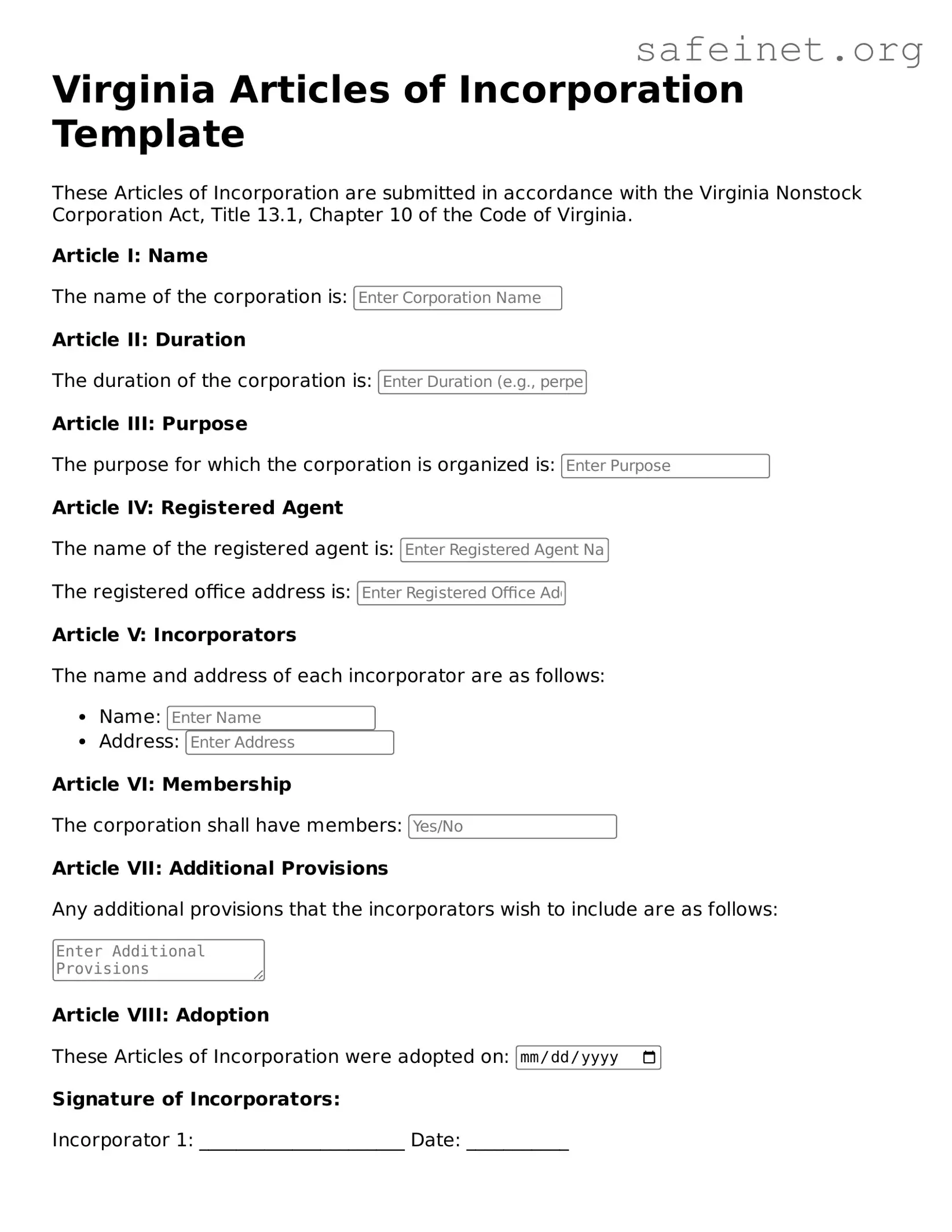
Virginia Articles of Incorporation Template
These Articles of Incorporation are submitted in accordance with the Virginia Nonstock Corporation Act, Title 13.1, Chapter 10 of the Code of Virginia.
Article I: Name
The name of the corporation is:
Article II: Duration
The duration of the corporation is:
Article III: Purpose
The purpose for which the corporation is organized is:
Article IV: Registered Agent
The name of the registered agent is:
The registered office address is:
Article V: Incorporators
The name and address of each incorporator are as follows:
Article VI: Membership
The corporation shall have members:
Article VII: Additional Provisions
Any additional provisions that the incorporators wish to include are as follows:
Article VIII: Adoption
These Articles of Incorporation were adopted on:
Signature of Incorporators:
Incorporator 1: ______________________ Date: ___________
Incorporator 2: ______________________ Date: ___________
Upon completion, these Articles of Incorporation must be filed with the Virginia State Corporation Commission. Ensure compliance with all relevant state laws and regulations.
| Fact Name | Description |
|---|---|
| Purpose | The Virginia Articles of Incorporation form is used to legally establish a corporation in the state of Virginia. |
| Governing Law | This form is governed by the Virginia Business Corporation Act, specifically Title 13.1 of the Code of Virginia. |
| Filing Requirement | Filing the Articles of Incorporation with the Virginia State Corporation Commission is mandatory for incorporation. |
| Information Required | The form requires details such as the corporation's name, registered agent, and number of shares authorized. |
| Processing Time | Typically, the processing time for the Articles of Incorporation is about 5 to 10 business days. |
Once you have gathered all necessary information, you are ready to fill out the Virginia Articles of Incorporation form. This document is essential for officially establishing your corporation in the state of Virginia. Completing the form accurately is crucial for a smooth registration process.
After filling out the form, you will need to submit it to the appropriate Virginia state office along with the required filing fee. Keep a copy for your records. Once processed, you will receive confirmation of your corporation's official status.
What is the purpose of the Virginia Articles of Incorporation form?
The Virginia Articles of Incorporation form is a legal document that establishes a corporation in the state of Virginia. This form outlines essential information about the corporation, including its name, purpose, registered agent, and the number of shares it is authorized to issue. Filing this form is a critical step in the process of forming a corporation, as it provides legal recognition and protection to the business entity.
Who needs to file the Articles of Incorporation?
Any individual or group looking to create a corporation in Virginia must file the Articles of Incorporation. This includes for-profit corporations, non-profit organizations, and professional corporations. It is essential for the founders to ensure that they meet all state requirements before submitting the form.
What information is required on the Articles of Incorporation form?
The form requires several key pieces of information, including the corporation's name, the purpose of the corporation, the name and address of the registered agent, the number of shares the corporation is authorized to issue, and the names and addresses of the incorporators. Providing accurate and complete information is crucial to avoid delays in processing.
How much does it cost to file the Articles of Incorporation in Virginia?
The filing fee for the Articles of Incorporation in Virginia varies depending on the type of corporation being formed. Generally, the fee ranges from $25 to $100. Additional fees may apply if expedited processing is requested. It is advisable to check the latest fee schedule on the Virginia State Corporation Commission's website for the most accurate information.
How long does it take to process the Articles of Incorporation?
The processing time for the Articles of Incorporation can vary. Typically, it takes about 5 to 7 business days for standard processing. However, if expedited service is requested, the processing time may be reduced to as little as 24 hours. It is important to plan accordingly, especially if the corporation needs to commence operations quickly.
Can I file the Articles of Incorporation online?
Yes, Virginia allows for online filing of the Articles of Incorporation through the Virginia State Corporation Commission's website. This method is often faster and more convenient than filing by mail. Online filing also provides immediate confirmation of submission, which can be beneficial for record-keeping purposes.
What happens after the Articles of Incorporation are filed?
Once the Articles of Incorporation are filed and approved, the corporation becomes a legal entity. The corporation will receive a certificate of incorporation, which serves as proof of its existence. Following this, the corporation must comply with ongoing requirements, such as obtaining necessary licenses, holding initial meetings, and filing annual reports.
Can I amend the Articles of Incorporation after they are filed?
Yes, amendments to the Articles of Incorporation can be made after the initial filing. If there are changes to the corporation's name, purpose, or other significant details, an amendment must be filed with the Virginia State Corporation Commission. This process ensures that the public record accurately reflects the current status and structure of the corporation.
Is legal assistance necessary for filing the Articles of Incorporation?
While legal assistance is not required to file the Articles of Incorporation, it can be beneficial. A legal professional can help ensure that the form is completed correctly, advise on compliance with state laws, and provide guidance on the best corporate structure for the business. For those unfamiliar with the process, consulting with a lawyer may save time and prevent potential issues.
Failing to choose a unique name for the corporation. The name must not be similar to existing businesses in Virginia.
Not including the required designation, such as “Corporation” or “Inc.” in the name of the business.
Incorrectly stating the purpose of the corporation. The purpose must be clear and specific.
Omitting the registered agent's information. The registered agent must have a physical address in Virginia.
Not providing the correct number of shares the corporation is authorized to issue. This must be clearly defined.
Failing to include the names and addresses of the initial directors. This information is essential for the formation.
Using incorrect formatting for the document. Adhering to the specific format outlined by the state is crucial.
Not signing the form. All incorporators must sign the Articles of Incorporation.
Forgetting to pay the required filing fee. The fee must accompany the submission of the form.
Submitting the form without reviewing it for errors. A thorough review can prevent delays or rejections.
When forming a corporation in Virginia, the Articles of Incorporation are essential. However, several other documents are commonly required or recommended to ensure compliance with state laws and to facilitate smooth business operations. Below is a list of these important forms and documents.
Each of these documents plays a vital role in establishing and maintaining a corporation in Virginia. Ensuring that all necessary forms are completed accurately and submitted on time can help prevent legal complications and promote a successful business venture.
The Articles of Organization is a document similar to the Articles of Incorporation, but it is used for limited liability companies (LLCs) instead of corporations. Like the Articles of Incorporation, the Articles of Organization establishes the existence of the LLC in the state. It includes essential information such as the name of the LLC, its principal office address, and the names of its members. Both documents serve as foundational papers for their respective business entities, ensuring legal recognition and compliance with state laws.
The Certificate of Formation is another document that shares similarities with the Articles of Incorporation. This document is often used interchangeably with the Articles of Organization in some states. It outlines the basic details of a business entity, including its name, purpose, and registered agent. Like the Articles of Incorporation, the Certificate of Formation is filed with the state to formally create the business entity. The purpose of both documents is to provide a legal framework for the business to operate within the state.
The Bylaws of a corporation are closely related to the Articles of Incorporation. While the Articles of Incorporation establish the corporation's existence, the Bylaws outline the internal rules and procedures for governance. This includes how meetings are conducted, how directors are elected, and how decisions are made. Both documents are essential for a corporation's operation, but they serve different purposes. The Articles provide a legal identity, while the Bylaws govern the day-to-day functioning of the corporation.
The Operating Agreement is a document similar to the Bylaws but is used for LLCs. This agreement outlines the management structure and operational procedures of the LLC. Like the Bylaws, it details how decisions are made and how profits are distributed among members. Both the Operating Agreement and Bylaws are crucial for ensuring smooth operations within their respective entities, providing clarity and structure to business activities.
The Partnership Agreement is another document that resembles the Articles of Incorporation in terms of establishing a business structure. This agreement outlines the terms and conditions under which a partnership operates. It includes details about each partner's contributions, profit-sharing arrangements, and management responsibilities. Like the Articles, it serves as a foundational document, ensuring that all partners are on the same page regarding their roles and expectations.
The Certificate of Good Standing is similar to the Articles of Incorporation in that it provides proof of a business's legal existence. This certificate is issued by the state and confirms that a corporation or LLC has complied with all necessary regulations and is authorized to conduct business. While the Articles of Incorporation establish the entity, the Certificate of Good Standing serves as verification that the entity is in good standing with the state, which is often required for various business transactions.
The Annual Report is another important document that shares a connection with the Articles of Incorporation. While the Articles establish a business entity, the Annual Report provides updates on its status and activities. Most states require corporations and LLCs to file an Annual Report to maintain their good standing. This report typically includes information about the business's current address, management changes, and financial status. It helps ensure that the state has up-to-date information about the entity.
The Statement of Information is similar to the Articles of Incorporation in that it provides essential details about a business entity. This document is often required by states to keep records current. It includes information such as the business's address, the names of its officers, and other relevant details. Like the Articles, the Statement of Information helps maintain transparency and accountability within the business structure.
The Foreign Qualification Application is a document that allows a business incorporated in one state to operate in another state. It is similar to the Articles of Incorporation in that it establishes legal recognition of the business in a new jurisdiction. This application typically requires information about the business, including its original Articles of Incorporation and details about its registered agent in the new state. Both documents serve to formalize the business's existence, albeit in different contexts.
When preparing to fill out the Virginia Articles of Incorporation form, it's essential to approach the task with care. Here is a list of ten important dos and don'ts to guide you through the process.
Following these guidelines will help ensure that your Articles of Incorporation are completed correctly, setting a solid foundation for your new business venture.
When it comes to the Virginia Articles of Incorporation, there are several misconceptions that can lead to confusion for those looking to establish a business. Understanding these common myths can help streamline the incorporation process and ensure compliance with state laws.
By addressing these misconceptions, aspiring business owners can make informed decisions about incorporating in Virginia and better understand the responsibilities that come with it.
Filling out and using the Virginia Articles of Incorporation form is an essential step for anyone looking to establish a corporation in the state. Here are some key takeaways to keep in mind:
By following these guidelines, you can navigate the process of incorporating your business in Virginia with greater confidence.