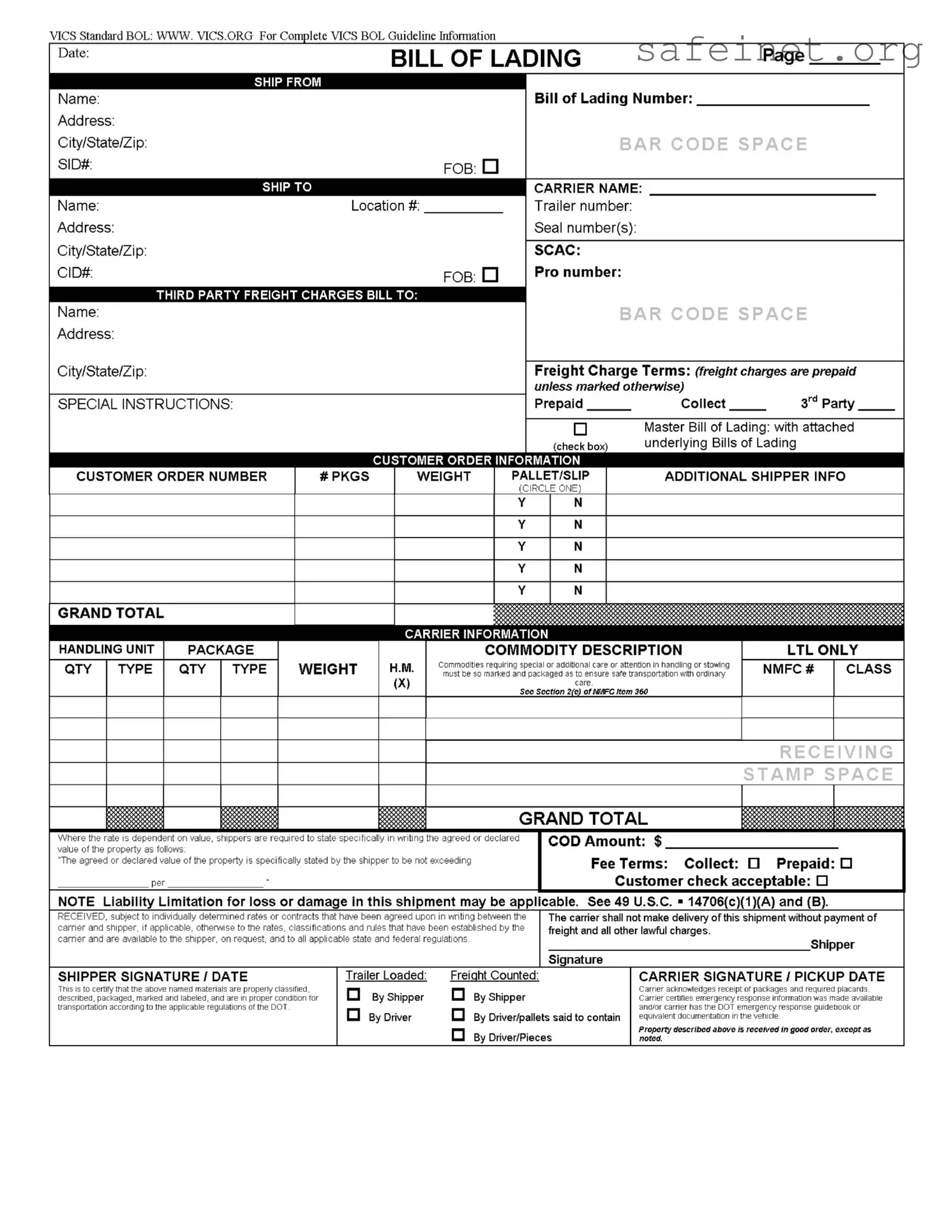
The VICS Bol form serves as a vital document in the shipping and logistics industry, encapsulating essential information for the transportation of goods. This standardized Bill of Lading (BOL) outlines the responsibilities and agreements between shippers and carriers, ensuring clarity and compliance throughout the shipping process. Key elements of the form include the shipper and carrier details, such as names, addresses, and identification numbers, which facilitate easy tracking and accountability. Additionally, the form specifies freight charge terms, indicating whether charges are prepaid or to be collected upon delivery. Special instructions can be included to highlight any unique requirements for handling specific commodities, ensuring that they receive the appropriate care during transit. The VICS Bol also addresses the declaration of value for the shipment, which is crucial for determining liability in case of loss or damage. Furthermore, it emphasizes the importance of adhering to federal and state regulations, reinforcing the need for proper classification and packaging of goods. With its comprehensive structure, the VICS Bol form not only streamlines the shipping process but also safeguards the interests of all parties involved.
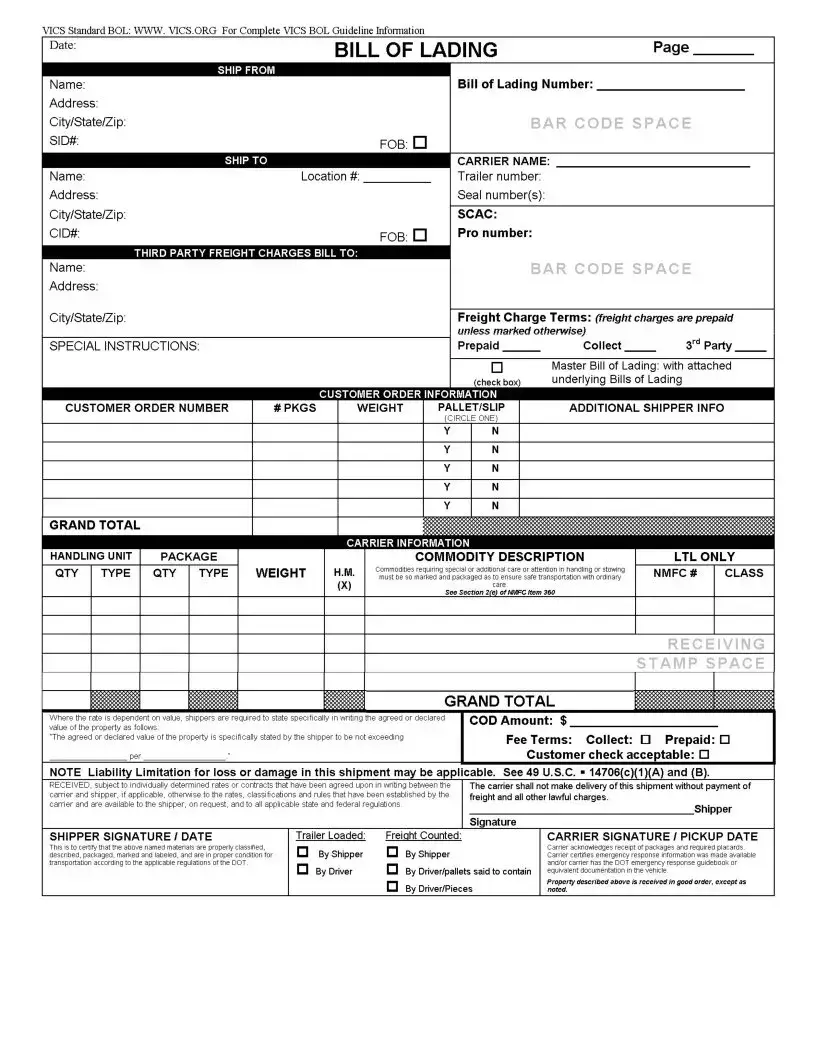
VICS Standard BQL: WWW. VICS.QRG For Complete VICS BQL Guideline Information
I Date: |
|
BILL OF LADING |
|
Page |
|
|
|
|
|||
Name: |
|
|
Bill of Lading Number: |
|
|
Address: |
|
|
|
|
|
City/State/Zip: |
|
|
BAR CODE SPACE |
||
SID#: |
|
FOB: |
|
|
|
|
|
|
CARRIER NAME: |
|
|
|
|
|
Trailer number: |
|
|
|
|
|
Seal number(s): |
|
|
|
|
|
SCAC: |
|
|
|
|
|
Pro number: |
|
|
|
|
|
BAR CODE SPACE |
||
|
|
|
Freight Charge Terms: (freight charges are prepaid |
||
|
|
|
unless marked otherwise) |
3rd Party |
|
SPECIAL INSTRUCTIONS: |
|
|
Prepaid |
Collect |
|
|
|
|
|
Master Bill of Lading: with attached |
|
|
|
|
(check box) |
underlying Bills of Lading |
|
CUSTOMER ORDER NUMBER |
# PKGS |
WEIGHT |
PALLET/SLIP |
ADDITIONAL SHIPPER INFO |
|
|
|
|
(CIRCLE ONE) |
|
|
GRAND TOTAL
HANDLING UNIT |
PACKAGE |
WEIGHT |
COMMODITY DESCRIPTION |
LTL ONLY |
|
QTY TYPE |
QTY TYPE |
Commodities requiring special or additional care or attention in handling or stowing |
NMFC# |
CLASS |
|
must be so marked and packaged as to ensure safe transportation with ordinary |
|||||
care.
See Section 2(e) ofNMFC Item 360
RECEIVING
STAMP SPACE
GRAND TOTAL
Where the rate is dependent on value, shippers are required to state specifically in writing the agreed or declared value of the property as follows:
COD Amount: $
"The agreed or declared value of the property is specifically stated by the shipper to be not exceeding |
Fee Terms: Collect: |
Prepaid: |
|
||
per |
Customer check acceptable: |
|
NOTE Liability Limitation for loss or damage in this shipment may be applicable. See 49 U.S.C. ■ 14706(c)(1)(A) and (B).
RECEIVED, subject to individually determined rates or contracts that have been agreed upon in writing between the |
The carrier shall not make delivery of this shipment without payment of |
carrier and shipper, if applicable, otherwise to the rates, classifications and rules that have been established by the |
freight and all other lawful charges. |
carrier and are available to the shipper, on request, and to all applicable state and federal regulations. |
Shipper |
|
|
|
Signature |
SHIPPER SIGNATURE / DATE |
Trailer Loaded: |
Freight Counted: |
|
This is to certify that the above named materials are properly classified, |
О |
By Shipper |
О By Shipper |
described, packaged, marked and labeled, and are in proper condition for |
|||
transportation according to the applicable regulations of the DOT. |
Q |
By Driver |
О By Driver/pallets said to contain |
|
|||
CARRIER SIGNATURE / PICKUP DATE
Carrier acknowledges receipt of packages and required placards. Carrier certifies emergency response information was made available and/or carrier has the DOT emergency response guidebook or equivalent documentation in the vehicle.
О By Driver/Pieces |
Property described above is received in good order, except as |
|
noted. |
||
|
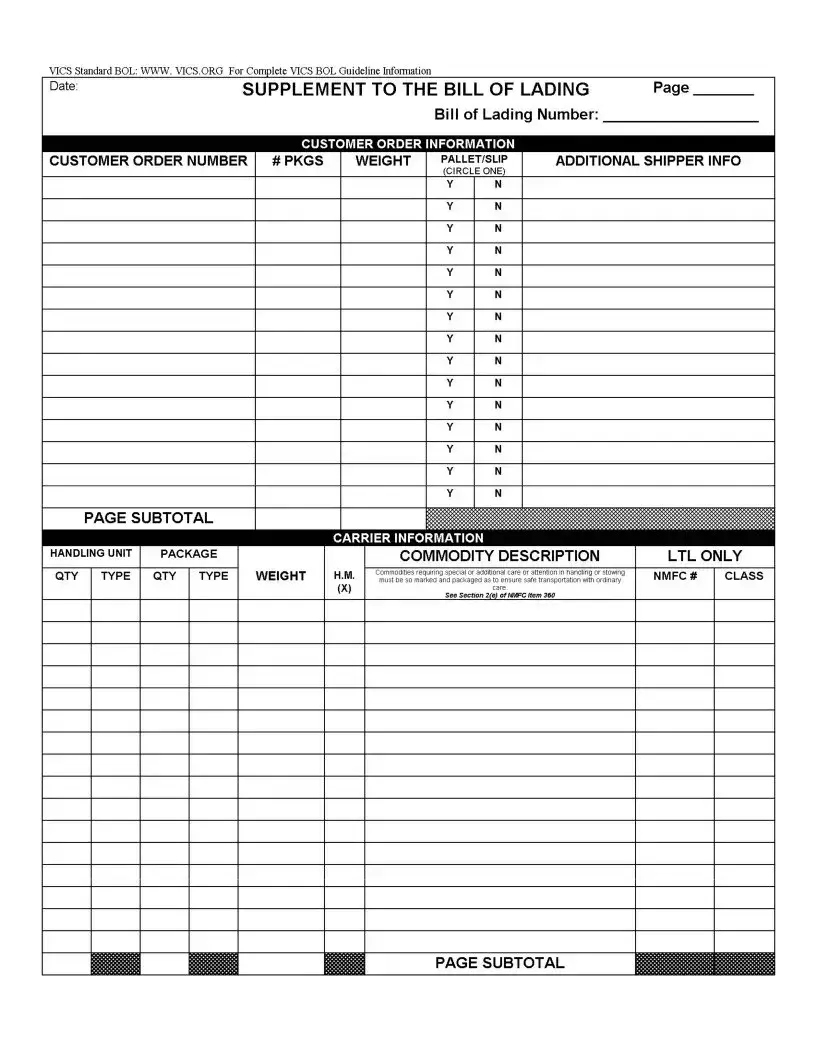
VICS Standard BQL: WWW.VICS.ORG For Complete VICS BQL Guideline Information__________________________________________________________________
Date |
SUPPLEMENT TO THE BILL OF LADING |
Page |
|
Bill of Lading Number: |
|
| Fact Name | Description |
|---|---|
| Purpose | The VICS BOL (Bill of Lading) is used for shipping goods and serves as a receipt for the carrier and shipper. |
| Governing Law | This form is governed by federal regulations and specific state laws, including 49 U.S.C. § 14706(c)(1)(A) and (B). |
| Shipping Instructions | Shippers must provide clear instructions, including freight charge terms and any special handling requirements. |
| Liability Limitations | There are limitations on liability for loss or damage during shipment, which shippers should be aware of. |
| Certification | The shipper certifies that all materials are properly classified and in good condition for transportation. |
Completing the VICS Bill of Lading (BOL) form is essential for ensuring proper documentation of shipping details. Follow the steps outlined below to accurately fill out the form.
After completing the form, ensure that all information is accurate and legible. Retain a copy for your records and provide the necessary documentation to the relevant parties involved in the shipping process.
What is the VICS BOL form used for?
The VICS Bill of Lading (BOL) form is a crucial document in the shipping industry. It serves as a receipt for goods, a contract between the shipper and the carrier, and a document of title. This form ensures that all parties involved in the shipping process have a clear understanding of the shipment details, including the type of goods, their weight, and the terms of transport.
What information is required on the VICS BOL form?
The VICS BOL form requires several key pieces of information. Shippers must provide their name, address, and contact details, as well as the Bill of Lading number and the carrier's name. Additionally, details about the shipment, such as the customer order number, the number of packages, weight, and any special instructions, must be included. It’s also essential to specify freight charge terms, such as whether charges are prepaid or collect.
How do I handle special commodities on the VICS BOL form?
If your shipment includes commodities that require special care, you must clearly mark and package these items to ensure their safe transportation. The VICS BOL form allows you to indicate such requirements. It’s important to follow the guidelines outlined in Section 2(e) of NMFC item 360 to avoid any issues during transit.
What are the freight charge terms on the VICS BOL form?
Freight charge terms dictate who is responsible for paying shipping costs. The options typically include prepaid, collect, or third-party billing. If you do not mark a specific option, freight charges are generally considered prepaid. It’s vital to clarify these terms to avoid any misunderstandings regarding payment responsibilities.
What is the significance of the liability limitation on the VICS BOL form?
The liability limitation clause informs shippers about potential restrictions on the carrier's liability for loss or damage during transport. According to 49 U.S.C. § 14706(c)(1)(A) and (B), shippers must understand these limitations and may need to declare the value of their goods to ensure appropriate coverage. This is particularly important for high-value shipments.
How do I certify the information on the VICS BOL form?
To certify the information on the VICS BOL form, the shipper must sign and date the document. This signature confirms that the materials are properly classified, described, packaged, and labeled, and that they comply with applicable Department of Transportation regulations. Additionally, the carrier must also sign to acknowledge receipt of the shipment and its condition.
Incomplete Information: One of the most common mistakes is failing to fill out all required fields. Leaving out important details, like the shipper’s name or address, can lead to delays.
Incorrect Bill of Lading Number: Entering the wrong Bill of Lading number can create confusion and may result in lost shipments. Always double-check this number!
Misunderstanding Freight Charge Terms: It’s crucial to clearly indicate whether the freight charges are prepaid, collect, or billed to a third party. Mislabeling can lead to unexpected charges.
Omitting Special Instructions: If there are specific handling requirements, failing to include them can result in mishandling. Always utilize the special instructions section!
Neglecting to Specify Weight: Not providing the weight of the shipment can lead to issues with transportation and billing. Make sure to weigh your packages accurately.
Ignoring Liability Limitations: Not acknowledging or understanding liability limitations for loss or damage can leave shippers unprotected. Read this section carefully!
Improperly Marking Commodities: If your shipment includes items that require special care, failing to mark them appropriately can lead to damage. Always label these items clearly.
Forgetting Signatures: Missing signatures from either the shipper or carrier can invalidate the Bill of Lading. Ensure all necessary parties sign before submission.
The VICS Bill of Lading (BOL) form is an essential document in shipping and logistics. Along with the BOL, several other forms and documents are often used to ensure a smooth transportation process. Here’s a list of some of those documents, along with brief descriptions of each.
Using these documents alongside the VICS BOL can help streamline the shipping process, ensuring clarity and compliance at every step. Proper documentation is vital for successful logistics management, protecting both the shipper and the receiver.
The Bill of Lading (BOL) is a crucial document in shipping and logistics, serving as a receipt for goods and a contract between the shipper and carrier. Similar to the VICS BOL form, the standard BOL includes essential details such as the shipper's and carrier's information, a description of the goods, and terms of transportation. Both documents facilitate the safe transfer of goods and ensure that all parties are aware of their responsibilities. The standard BOL also outlines freight charge terms, similar to the VICS version, providing clarity on payment obligations.
The Master Bill of Lading is another document closely related to the VICS BOL. It consolidates multiple shipments under one document and links to underlying Bills of Lading. This is particularly useful for freight forwarders who manage various shipments for different clients. Like the VICS BOL, the Master Bill includes detailed information about the shipper, consignee, and cargo, ensuring all parties have access to the same critical data for tracking and accountability.
The Air Waybill (AWB) serves a similar purpose for air freight as the VICS BOL does for ground transportation. It acts as a receipt for goods, a contract of carriage, and a document of title. The AWB contains information about the shipper, recipient, and cargo details, mirroring the structure of the VICS BOL. Both documents are essential for ensuring compliance with transportation regulations and facilitating smooth logistics operations.
The Uniform Commercial Code (UCC) Bill of Lading provides a legal framework for the sale of goods and transportation. While it is more focused on the legal aspects of transactions, it shares similarities with the VICS BOL in that both documents outline the responsibilities and rights of the parties involved. The UCC Bill of Lading includes details about the goods being shipped, terms of payment, and delivery instructions, ensuring that all parties are clear on their obligations.
The Freight Bill is another document that parallels the VICS BOL, as it details the charges associated with transporting goods. While the VICS BOL serves primarily as a receipt and contract, the Freight Bill focuses on the financial aspect, outlining the costs incurred during transportation. Both documents are essential for maintaining accurate records and ensuring prompt payment for services rendered.
The Delivery Receipt is a document that confirms the receipt of goods by the consignee. Similar to the VICS BOL, it includes details about the shipment and serves as proof that the goods were delivered in the condition specified. This document is crucial for both the shipper and the recipient, as it helps to resolve any disputes regarding the condition of the goods upon arrival.
The Packing List is another important document that complements the VICS BOL. It provides a detailed breakdown of the contents of a shipment, including item descriptions, quantities, and weights. While the VICS BOL outlines the terms of transportation, the Packing List ensures that all items are accounted for and assists in verifying the shipment upon delivery.
The Certificate of Origin is a document that certifies the country of origin of the goods being shipped. While it serves a different purpose than the VICS BOL, it is essential for international shipments, as it may affect tariffs and trade regulations. Both documents require accurate information to ensure compliance with legal requirements and to facilitate smooth customs clearance.
Finally, the Shipper's Letter of Instruction (SLI) is a document that provides specific instructions to the carrier regarding the shipment. Similar to the VICS BOL, it includes details about the shipment and any special handling requirements. The SLI ensures that the carrier understands the shipper's needs and expectations, which is crucial for successful transportation and delivery.
When filling out the VICS Bill of Lading (BOL) form, attention to detail is crucial. Here are eight guidelines to follow and avoid:
Understanding the VICS Bill of Lading (BOL) form is essential for those involved in shipping and logistics. However, several misconceptions can lead to confusion. Here are five common misconceptions about the VICS BOL form:
This is not true. The VICS BOL can be used for shipments of all sizes, including small packages. It is designed to standardize documentation for various types of shipments.
In fact, the VICS BOL serves as a legal document that outlines the terms of the shipment. It holds both the shipper and carrier accountable for the conditions stated within the form.
While it may seem that way, special instructions are crucial. They provide necessary guidance for handling specific shipments, ensuring that all parties understand the requirements.
This is misleading. Freight charges are typically prepaid unless otherwise marked. It is essential to check the box indicating the payment terms to avoid misunderstandings.
On the contrary, the VICS BOL requires comprehensive details, including weight, package type, and commodity description. This information is vital for proper handling and transportation.
When filling out and using the VICS Bill of Lading (BOL) form, it is essential to follow specific guidelines to ensure accurate documentation and smooth transportation processes. Here are seven key takeaways:
By adhering to these guidelines, you can facilitate a smoother shipping process and reduce the risk of complications during transportation.