The Vermont Transfer-on-Death Deed (TODD) form serves as a crucial estate planning tool for property owners seeking to simplify the transfer of real estate upon their death. This legal instrument allows individuals to designate beneficiaries who will automatically inherit the property, bypassing the often lengthy and costly probate process. By completing and recording this deed, property owners retain full control over their property during their lifetime, ensuring they can sell, mortgage, or alter the property as they see fit. The form requires clear identification of the property and the beneficiaries, which can include individuals or entities. Importantly, the TODD can be revoked or amended at any time before the owner's death, providing flexibility in estate planning. Additionally, it is essential for property owners to understand that this deed does not create any interest in the property for the beneficiaries until the owner's passing, thereby protecting the owner's rights until that time. Overall, the Vermont Transfer-on-Death Deed form streamlines the transfer of property and offers peace of mind to those looking to secure their legacy for future generations.
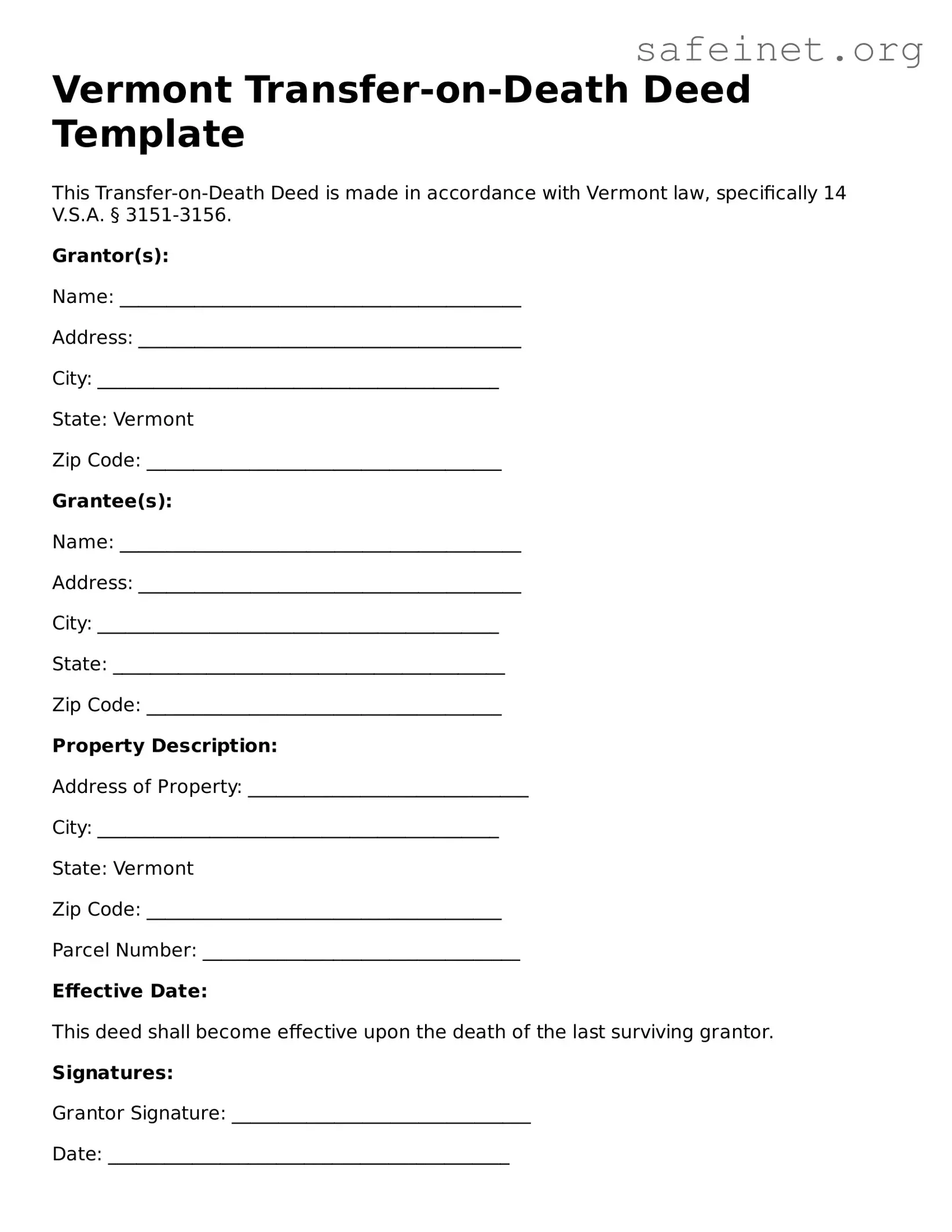
Vermont Transfer-on-Death Deed Template
This Transfer-on-Death Deed is made in accordance with Vermont law, specifically 14 V.S.A. § 3151-3156.
Grantor(s):
Name: ___________________________________________
Address: _________________________________________
City: ___________________________________________
State: Vermont
Zip Code: ______________________________________
Grantee(s):
Name: ___________________________________________
Address: _________________________________________
City: ___________________________________________
State: __________________________________________
Zip Code: ______________________________________
Property Description:
Address of Property: ______________________________
City: ___________________________________________
State: Vermont
Zip Code: ______________________________________
Parcel Number: __________________________________
Effective Date:
This deed shall become effective upon the death of the last surviving grantor.
Signatures:
Grantor Signature: ________________________________
Date: ___________________________________________
Witnesses:
Witness 1 Name: _________________________________
Witness 1 Signature: ____________________________
Date: ___________________________________________
Witness 2 Name: _________________________________
Witness 2 Signature: ____________________________
Date: ___________________________________________
Notary Public:
State of Vermont
County of ______________________________________
On this ____ day of ____________, 20____, before me, a Notary Public, personally appeared the above-named Grantor(s) and acknowledged this deed to be their free act and deed.
Notary Public Signature: __________________________
My Commission Expires: _________________________
| Fact Name | Description |
|---|---|
| Definition | A Transfer-on-Death Deed allows property owners to designate beneficiaries who will receive their property upon death, bypassing probate. |
| Governing Law | The Transfer-on-Death Deed in Vermont is governed by Title 14, Chapter 12 of the Vermont Statutes Annotated. |
| Eligibility | Any individual who owns real estate in Vermont can create a Transfer-on-Death Deed. |
| Beneficiary Designation | Property owners can name one or more beneficiaries in the deed, allowing for flexibility in estate planning. |
| Revocation | The deed can be revoked at any time by the property owner, provided they follow the proper legal procedures. |
| Recording Requirement | To be effective, the Transfer-on-Death Deed must be recorded in the land records of the town where the property is located. |
| Tax Implications | Transfer-on-Death Deeds do not trigger gift taxes while the property owner is alive. |
| Survivorship | If a named beneficiary predeceases the property owner, their share may pass to their heirs unless otherwise specified. |
| Limitations | Transfer-on-Death Deeds cannot be used for all types of property, such as certain business interests or life estates. |
Once you have the Vermont Transfer-on-Death Deed form, you can begin filling it out. Make sure to have all necessary information at hand, such as property details and the names of the beneficiaries. After completing the form, it will need to be signed and recorded with the appropriate local office.
What is a Vermont Transfer-on-Death Deed?
A Vermont Transfer-on-Death Deed is a legal document that allows a property owner to designate a beneficiary who will receive the property upon the owner's death. This deed helps avoid probate, simplifying the transfer process for the beneficiary.
Who can create a Transfer-on-Death Deed in Vermont?
Any individual who owns real estate in Vermont can create a Transfer-on-Death Deed. The owner must be of sound mind and at least 18 years old. Joint owners can also execute this deed, but all owners must agree to the terms.
How does the Transfer-on-Death Deed work?
The property owner fills out the Transfer-on-Death Deed form, specifying the beneficiary. Once the owner passes away, the property automatically transfers to the designated beneficiary without going through probate. This transfer occurs as long as the deed is properly executed and recorded.
What are the benefits of using a Transfer-on-Death Deed?
One significant benefit is the avoidance of probate, which can be a lengthy and costly process. Additionally, the property owner retains full control of the property during their lifetime. They can sell, mortgage, or change the beneficiary at any time before their death.
Are there any limitations to a Transfer-on-Death Deed?
Yes, there are limitations. For instance, the deed cannot be used for certain types of property, such as property held in a trust or property subject to a life estate. Furthermore, if the owner has outstanding debts or liens against the property, these may complicate the transfer.
How do I revoke a Transfer-on-Death Deed?
To revoke a Transfer-on-Death Deed, the property owner must complete a formal revocation document. This document should be executed and recorded in the same manner as the original deed. Simply destroying the original deed is not legally sufficient.
What happens if the beneficiary dies before the property owner?
If the designated beneficiary dies before the property owner, the property will not automatically transfer to the beneficiary's heirs. Instead, the property owner should update the Transfer-on-Death Deed to designate a new beneficiary to ensure a smooth transfer after their death.
Can I designate multiple beneficiaries in a Transfer-on-Death Deed?
Yes, you can designate multiple beneficiaries. The deed should clearly outline how the property will be divided among them. For example, you can specify equal shares or different percentages. Clear language is essential to avoid confusion later.
How do I record a Transfer-on-Death Deed in Vermont?
To record the deed, you must file it with the town clerk's office in the municipality where the property is located. It’s crucial to do this before the property owner's death. Recording the deed ensures that it is legally recognized and enforceable.
Not providing accurate property information. Make sure to include the correct legal description of the property. Omitting details can lead to confusion or disputes.
Forgetting to sign the deed. Both the grantor and the witnesses must sign the document. Without these signatures, the deed will not be valid.
Neglecting to have the deed notarized. A notary public must witness the signing of the deed to ensure its authenticity. Failing to do so can invalidate the transfer.
Not recording the deed. After completing the form, it must be filed with the appropriate town or city office. If it is not recorded, the transfer may not be recognized.
Overlooking the need for clear beneficiary designations. It is essential to specify who will receive the property upon the grantor's death. Ambiguities can lead to legal challenges.
Ignoring state-specific requirements. Each state may have unique rules regarding transfer-on-death deeds. Familiarize yourself with Vermont's specific regulations to ensure compliance.
When utilizing the Vermont Transfer-on-Death Deed form, several other documents may be necessary to ensure a smooth transfer of property upon the owner's passing. Below is a list of commonly associated forms that can help facilitate the process.
In summary, while the Vermont Transfer-on-Death Deed form is a key document for transferring property, these additional forms can provide clarity and support throughout the process. Ensuring that all necessary paperwork is completed can help avoid complications and ensure that the wishes of the property owner are honored.
The Vermont Transfer-on-Death Deed form shares similarities with a Last Will and Testament. Both documents serve to dictate the distribution of a person's assets after their death. However, while a will goes through the probate process, which can be lengthy and costly, a Transfer-on-Death Deed allows property to pass directly to the designated beneficiary without the need for probate. This can simplify the transfer of property and provide a more efficient way for individuals to ensure their assets are handled according to their wishes.
Another document that resembles the Transfer-on-Death Deed is a Revocable Living Trust. Like the Transfer-on-Death Deed, a living trust allows individuals to manage their assets during their lifetime and specify how those assets should be distributed upon their death. The key difference lies in the management of assets; a trust can hold various types of property and may provide more comprehensive management options, while the Transfer-on-Death Deed specifically pertains to real estate and is simpler to execute.
A Beneficiary Designation form is also similar to the Transfer-on-Death Deed. This document allows individuals to designate beneficiaries for specific assets, such as bank accounts or retirement funds, which can pass directly to the beneficiaries upon death. Both documents aim to streamline the transfer process and avoid probate, but the Beneficiary Designation form typically applies to financial accounts rather than real estate.
A Life Estate Deed is another document that bears similarities to the Transfer-on-Death Deed. With a Life Estate Deed, a property owner can grant someone else the right to use the property during their lifetime while retaining ownership rights until death. Upon the owner's death, the property automatically transfers to the designated beneficiary. Both documents aim to simplify property transfers, but a Life Estate Deed involves more complex arrangements regarding property use and ownership during the grantor's lifetime.
The Quitclaim Deed also parallels the Transfer-on-Death Deed in that it transfers property ownership. However, a Quitclaim Deed transfers whatever interest the grantor has in the property without guaranteeing that interest is valid or free of encumbrances. In contrast, the Transfer-on-Death Deed specifically allows for the transfer of property upon death, ensuring that the designated beneficiary receives the property directly without the complications of a quitclaim transfer.
A Power of Attorney can be likened to the Transfer-on-Death Deed in that both documents deal with the management of assets. A Power of Attorney allows an individual to designate someone else to manage their affairs, including property, while they are alive. However, the Transfer-on-Death Deed comes into play only upon the individual's death, allowing for a seamless transition of property ownership to the designated beneficiary without the need for additional management or decision-making during the grantor's lifetime.
Lastly, the Declaration of Trust can be compared to the Transfer-on-Death Deed. A Declaration of Trust outlines the terms of a trust agreement, detailing how assets will be managed and distributed. While both documents serve to manage property and provide for beneficiaries, the Declaration of Trust is generally more comprehensive, often covering a broader range of assets and providing more extensive management options than the straightforward property transfer facilitated by a Transfer-on-Death Deed.
When filling out the Vermont Transfer-on-Death Deed form, there are important considerations to keep in mind. Here are five things you should do and five things you should avoid:
Things You Should Do:
Things You Shouldn't Do:
Understanding the Vermont Transfer-on-Death Deed can be challenging. Here are some common misconceptions about this legal document:
When dealing with the Vermont Transfer-on-Death Deed form, there are several important points to consider. This form allows property owners to designate beneficiaries who will receive the property upon their death, simplifying the transfer process. Here are key takeaways to keep in mind:
By understanding these key points, you can navigate the process of using the Vermont Transfer-on-Death Deed form more effectively, ensuring a smoother transition of your property to your chosen beneficiaries.