The Vermont Small Estate Affidavit form serves as a valuable tool for individuals dealing with the estate of a deceased person. When the total value of the estate falls below a certain threshold, this form simplifies the process of transferring assets without the need for formal probate proceedings. It allows heirs or beneficiaries to claim property, such as bank accounts, real estate, or personal belongings, directly from financial institutions or other entities holding the deceased's assets. By completing this affidavit, individuals can assert their right to the estate, provided they meet specific eligibility requirements set by Vermont law. This streamlined process not only saves time and money but also reduces the emotional burden often associated with settling an estate. Understanding the steps involved in completing the Small Estate Affidavit is essential for anyone navigating this process, ensuring that the transition of assets occurs smoothly and efficiently.
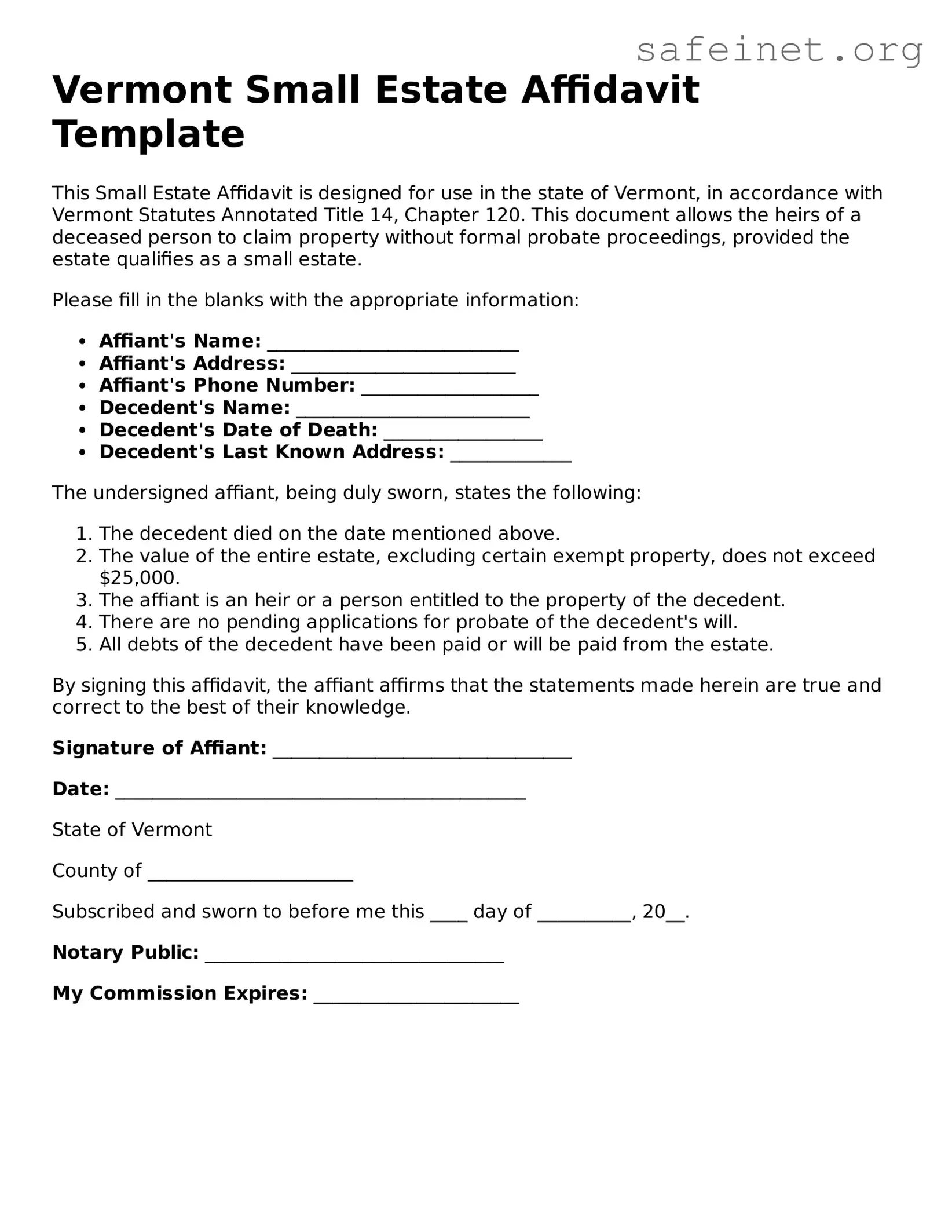
Vermont Small Estate Affidavit Template
This Small Estate Affidavit is designed for use in the state of Vermont, in accordance with Vermont Statutes Annotated Title 14, Chapter 120. This document allows the heirs of a deceased person to claim property without formal probate proceedings, provided the estate qualifies as a small estate.
Please fill in the blanks with the appropriate information:
The undersigned affiant, being duly sworn, states the following:
By signing this affidavit, the affiant affirms that the statements made herein are true and correct to the best of their knowledge.
Signature of Affiant: ________________________________
Date: ____________________________________________
State of Vermont
County of ______________________
Subscribed and sworn to before me this ____ day of __________, 20__.
Notary Public: ________________________________
My Commission Expires: ______________________
| Fact Name | Details |
|---|---|
| Purpose | The Vermont Small Estate Affidavit allows individuals to claim assets of a deceased person without going through probate if the estate's value is below a certain threshold. |
| Threshold Amount | As of 2023, the threshold for using the Small Estate Affidavit in Vermont is $25,000 for personal property. |
| Governing Law | The Vermont Small Estate Affidavit is governed by 14 V.S.A. § 3501-3504. |
| Eligibility | Only heirs or beneficiaries of the deceased can use the Small Estate Affidavit to claim assets. |
| Filing Process | The affidavit must be completed and signed under oath. It should then be presented to the financial institution or asset holder to claim the assets. |
| Time Frame | The Small Estate Affidavit can be used immediately after the death of the individual, provided the estate meets the value requirements. |
After obtaining the Vermont Small Estate Affidavit form, the next step involves carefully filling it out to ensure that all necessary information is provided. This form is essential for claiming assets of a deceased person when the estate falls below a certain value threshold. Follow the steps below to complete the form accurately.
Once the affidavit is filed, the court will review it. If everything is in order, you will be able to claim the assets listed in the affidavit. Be prepared to provide any additional documentation if requested by the court.
What is the Vermont Small Estate Affidavit form?
The Vermont Small Estate Affidavit form is a legal document that allows individuals to claim assets of a deceased person without going through the full probate process. This form is typically used when the total value of the estate is below a certain threshold, making the process simpler and faster for heirs.
Who can use the Small Estate Affidavit?
Generally, the Small Estate Affidavit can be used by any individual who is entitled to inherit from the deceased. This includes heirs, beneficiaries named in a will, or individuals who can prove their right to the estate under Vermont law. It’s important to ensure that the estate qualifies under the state's value limits.
What is the value limit for a small estate in Vermont?
As of October 2023, the value limit for a small estate in Vermont is $25,000 for individuals who died without a will. If there is a will, the limit is $50,000. Always check for any updates to these limits, as they can change over time.
How do I complete the Small Estate Affidavit form?
To complete the form, gather all necessary information about the deceased, including their full name, date of death, and a list of assets. Fill out the affidavit with accurate details, ensuring that you meet the requirements for a small estate. Once completed, it must be signed in front of a notary public.
Do I need to file the Small Estate Affidavit with the court?
No, the Small Estate Affidavit is not filed with the court. Instead, you present it to the institutions or individuals holding the deceased's assets, such as banks or insurance companies. They will require this affidavit to release the assets to you.
What types of assets can be claimed using the Small Estate Affidavit?
You can claim various types of assets, including bank accounts, vehicles, and personal property. However, real estate typically requires a different process. Verify the specific assets you wish to claim to ensure they qualify under the small estate provisions.
Is there a deadline for using the Small Estate Affidavit?
There is no strict deadline for using the Small Estate Affidavit, but it’s advisable to act promptly. Delays can complicate matters, especially if other potential heirs come forward. Taking timely action helps ensure a smoother process.
What if there are disputes among heirs?
If disputes arise among heirs, it may complicate the use of the Small Estate Affidavit. It’s recommended to seek legal advice in such situations. Open communication among heirs can also help resolve issues before they escalate.
Can I use the Small Estate Affidavit if there is a will?
Yes, you can use the Small Estate Affidavit if there is a will, provided the estate falls within the value limits. The will must be valid and clearly indicate your right to inherit. Ensure that all requirements are met to avoid complications.
Where can I obtain the Vermont Small Estate Affidavit form?
The Vermont Small Estate Affidavit form can typically be obtained from the Vermont Secretary of State's website or local probate court offices. Make sure to use the most current version of the form to ensure compliance with state requirements.
Incorrect Value of the Estate: Many people underestimate or overestimate the total value of the estate. It’s crucial to accurately assess the value of all assets, including real estate, bank accounts, and personal property.
Failure to List All Assets: Some individuals forget to include certain assets, such as vehicles or collectibles. Every asset must be accounted for to avoid legal complications.
Missing Signatures: The affidavit requires signatures from all heirs. Neglecting to obtain these signatures can delay the process significantly.
Inaccurate Personal Information: Errors in names, addresses, or dates of birth can lead to confusion and potential legal issues. Double-checking this information is essential.
Not Including a Death Certificate: Failing to attach a certified copy of the death certificate is a common mistake. This document is necessary to validate the claim.
Ignoring State-Specific Requirements: Each state has its own rules regarding small estate affidavits. Not adhering to Vermont’s specific requirements can result in rejection of the affidavit.
Improper Notarization: The affidavit must be notarized. Skipping this step or using an unlicensed notary can invalidate the document.
Not Keeping Copies: Failing to make copies of the completed affidavit and supporting documents can create problems later. Always retain copies for personal records.
Neglecting to Update the Affidavit: If circumstances change, such as the discovery of new assets, the affidavit should be updated. Ignoring this can lead to legal complications.
Submitting to the Wrong Court: Small estate affidavits must be filed in the correct court. Submitting to the wrong jurisdiction can cause unnecessary delays.
The Vermont Small Estate Affidavit is a useful tool for individuals dealing with the estate of a deceased person when the total value of the estate is below a certain threshold. However, there are several other forms and documents that may accompany this affidavit to ensure a smooth process. Below are some commonly used documents.
These documents can significantly aid in the efficient handling of a small estate in Vermont. It is important to gather all necessary paperwork to facilitate a smooth transition and ensure compliance with state laws.
The Vermont Small Estate Affidavit is similar to a will in that both documents serve to dictate the distribution of a deceased person's assets. A will outlines the wishes of the deceased regarding how their property should be divided among heirs. While a will typically requires probate, the Small Estate Affidavit provides a streamlined process for transferring assets without going through court, making it an efficient alternative for smaller estates. Both documents reflect the intentions of the deceased, but the Small Estate Affidavit is specifically designed for simpler situations where the total value of the estate falls below a certain threshold.
An estate inventory is another document that shares similarities with the Vermont Small Estate Affidavit. An estate inventory lists all the assets and liabilities of a deceased person, providing a clear picture of what is available for distribution. While the Small Estate Affidavit allows heirs to claim assets directly, the estate inventory serves as a foundational document that can help in understanding the scope of the estate. It can be useful in conjunction with the affidavit, ensuring that all parties are aware of what is being claimed and distributed.
The living trust is also comparable to the Vermont Small Estate Affidavit. A living trust allows individuals to place their assets into a trust during their lifetime, which can then be distributed to beneficiaries upon their death without the need for probate. Like the Small Estate Affidavit, a living trust can simplify the transfer of assets. However, a living trust requires more upfront planning and management, while the Small Estate Affidavit is a straightforward option for those with smaller estates.
Finally, the affidavit of heirship is another document that is similar in purpose to the Vermont Small Estate Affidavit. An affidavit of heirship is a legal document that establishes the heirs of a deceased person, often used when there is no will. It serves to clarify who is entitled to inherit the deceased's assets. Both documents facilitate the transfer of property without the need for a lengthy probate process, but the affidavit of heirship focuses specifically on identifying heirs, while the Small Estate Affidavit is used to claim and distribute the assets directly.
When filling out the Vermont Small Estate Affidavit form, it is important to follow certain guidelines to ensure that the process goes smoothly. Here are six things you should and shouldn't do:
There are several misconceptions surrounding the Vermont Small Estate Affidavit form. Understanding the facts can help individuals navigate the estate process more effectively. Here are seven common misconceptions:
This is not true. The Small Estate Affidavit is available for estates that meet specific value limits, making it accessible to a broader range of individuals.
While it is true that the Small Estate Affidavit simplifies the process for smaller estates, it can still be used if there are debts, provided the estate's assets can cover those debts.
This is a misconception. Only the individual named in the affidavit needs to sign it, but all heirs should be informed about the process.
Not all assets qualify. Certain assets, like real estate, may require different procedures, and the affidavit is typically used for personal property.
The Small Estate Affidavit is designed to be a simplified alternative to probate. It typically requires less paperwork and can be processed more quickly.
In many cases, the process can be completed relatively quickly. Once the affidavit is filed, the distribution of assets can happen without significant delays.
While having legal assistance can be helpful, it is not a requirement. Many individuals successfully file the affidavit on their own.
By clarifying these misconceptions, individuals can better understand the Vermont Small Estate Affidavit process and make informed decisions regarding estate management.
When dealing with the Vermont Small Estate Affidavit form, understanding the process and requirements can significantly ease the burden during a challenging time. Here are some key takeaways to consider: