In the realm of real estate transactions, the Vermont Quitclaim Deed serves as a crucial tool for property owners looking to transfer their interests in a property without the complexities often associated with traditional deeds. This form allows the granter, or current property owner, to relinquish any claims they may have to the property in question, effectively passing those rights to the grantee, or new owner. Unlike warranty deeds, which guarantee a clear title, a quitclaim deed offers no such assurances, making it essential for both parties to understand the implications of this type of transfer. The form itself typically includes vital information such as the names of the granter and grantee, a legal description of the property, and the date of the transfer. Additionally, it may require notarization to ensure its validity and may be subject to local recording requirements. Understanding the nuances of the Vermont Quitclaim Deed is vital for anyone engaged in property transactions, as it can simplify the process of transferring ownership while also carrying inherent risks that should not be overlooked.
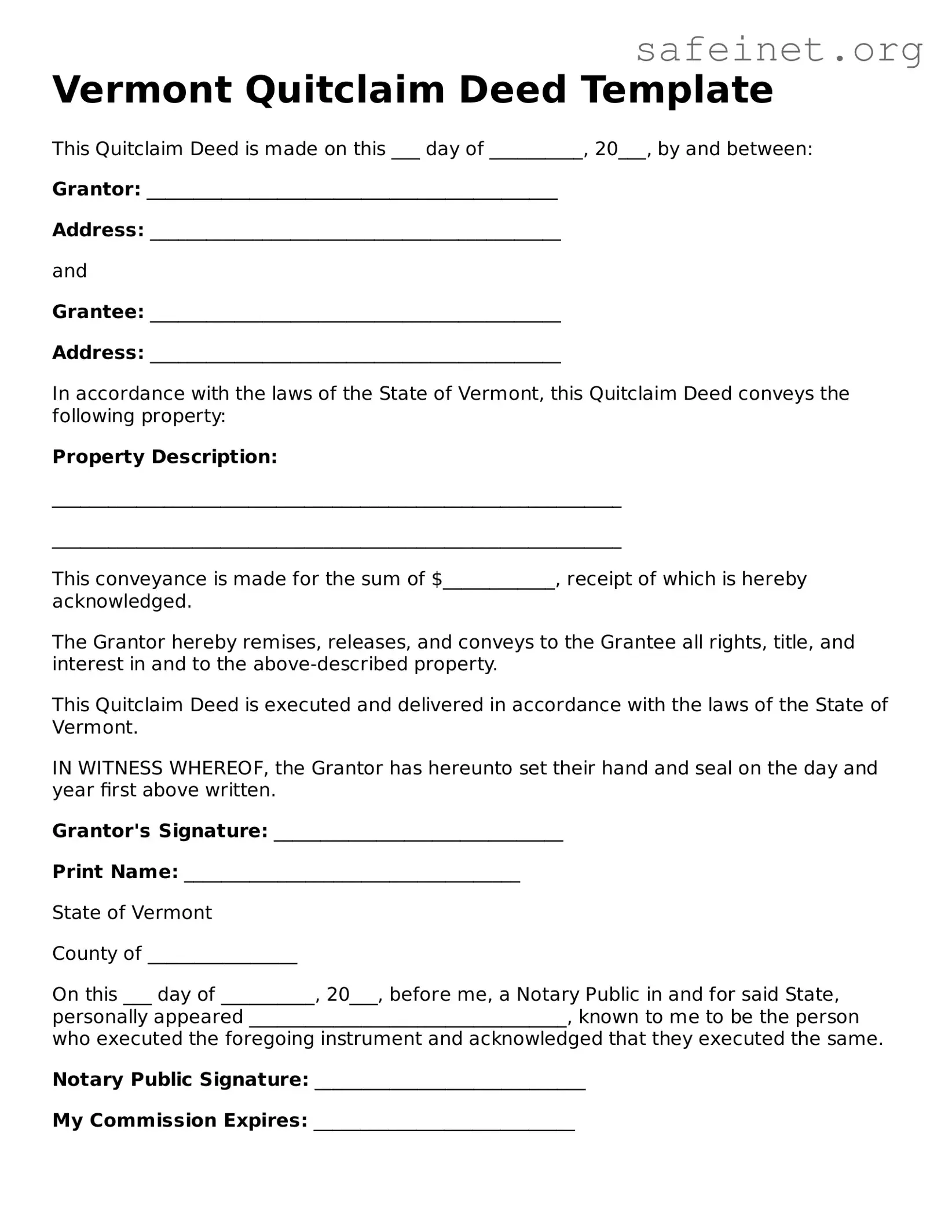
Vermont Quitclaim Deed Template
This Quitclaim Deed is made on this ___ day of __________, 20___, by and between:
Grantor: ____________________________________________
Address: ____________________________________________
and
Grantee: ____________________________________________
Address: ____________________________________________
In accordance with the laws of the State of Vermont, this Quitclaim Deed conveys the following property:
Property Description:
_____________________________________________________________
_____________________________________________________________
This conveyance is made for the sum of $____________, receipt of which is hereby acknowledged.
The Grantor hereby remises, releases, and conveys to the Grantee all rights, title, and interest in and to the above-described property.
This Quitclaim Deed is executed and delivered in accordance with the laws of the State of Vermont.
IN WITNESS WHEREOF, the Grantor has hereunto set their hand and seal on the day and year first above written.
Grantor's Signature: _______________________________
Print Name: ____________________________________
State of Vermont
County of ________________
On this ___ day of __________, 20___, before me, a Notary Public in and for said State, personally appeared __________________________________, known to me to be the person who executed the foregoing instrument and acknowledged that they executed the same.
Notary Public Signature: _____________________________
My Commission Expires: ____________________________
| Fact Name | Description |
|---|---|
| Definition | A Vermont Quitclaim Deed is a legal document used to transfer ownership of real property from one party to another without any warranties regarding the title. |
| Governing Law | The use and requirements of the Quitclaim Deed in Vermont are governed by Title 27, Chapter 3 of the Vermont Statutes Annotated. |
| Parties Involved | The form involves two main parties: the grantor (the person transferring the property) and the grantee (the person receiving the property). |
| Consideration | While not always required, it is common to include a nominal consideration (payment) to validate the transfer. |
| Recording | To ensure the transfer is legally recognized, the Quitclaim Deed must be recorded in the appropriate county clerk's office. |
| Signature Requirements | The deed must be signed by the grantor in the presence of a notary public to be valid. |
| Property Description | A clear and accurate description of the property being transferred is essential for the deed to be enforceable. |
| Limitations | The Quitclaim Deed does not guarantee that the grantor has good title to the property; it merely conveys whatever interest the grantor has. |
| Usage Scenarios | This type of deed is often used among family members or in situations where the parties know each other well. |
Once you have the Vermont Quitclaim Deed form in hand, you can proceed to fill it out. Make sure you have all the necessary information ready. This will help ensure a smooth process.
After completing the form, you will need to file it with your local land records office. This step is crucial to ensure the transfer of property is legally recognized.
What is a Vermont Quitclaim Deed?
A Vermont Quitclaim Deed is a legal document used to transfer ownership of real estate from one party to another without any guarantees or warranties regarding the property title. This means that the grantor (the person transferring the property) does not guarantee that they have clear title to the property. The deed simply conveys whatever interest the grantor has in the property at the time of the transfer.
When should I use a Quitclaim Deed?
A Quitclaim Deed is often used in situations where the parties know each other and trust each other, such as transferring property between family members or in divorce settlements. It is also commonly used to clear up title issues or to add or remove someone from the title.
How do I complete a Vermont Quitclaim Deed?
To complete a Quitclaim Deed in Vermont, you need to include the names of the grantor and grantee, a legal description of the property, and the date of the transfer. It's important to ensure that all information is accurate. Once completed, the deed must be signed by the grantor in the presence of a notary public.
Is a Quitclaim Deed the same as a Warranty Deed?
No, a Quitclaim Deed is not the same as a Warranty Deed. A Warranty Deed provides guarantees about the title and protects the grantee from any claims against the property. In contrast, a Quitclaim Deed offers no such protection. The grantee accepts the property "as is," with no assurances from the grantor.
Do I need to file the Quitclaim Deed with the county?
Yes, after completing the Quitclaim Deed, it must be filed with the appropriate county clerk's office in Vermont. This step is crucial for making the transfer official and ensuring that the public record reflects the new ownership.
Are there any fees associated with filing a Quitclaim Deed in Vermont?
Yes, there are typically fees for filing a Quitclaim Deed with the county clerk's office. These fees can vary by county, so it is advisable to check with the local office for the exact amount. Additionally, there may be costs associated with notarization.
Can I revoke a Quitclaim Deed after it has been executed?
Once a Quitclaim Deed is executed and recorded, it generally cannot be revoked. The transfer of ownership is considered final. If you wish to change the ownership again, a new deed would need to be created to reverse the transfer.
What if the grantor is deceased?
If the grantor of a Quitclaim Deed is deceased, the deed cannot be executed by them. Instead, the property would need to be transferred through the estate of the deceased, often requiring probate proceedings. The heirs or personal representative of the estate would need to handle the transfer of the property.
Can I use a Quitclaim Deed for commercial property?
Yes, a Quitclaim Deed can be used for commercial property, just as it can for residential property. However, it is essential to understand the implications of using a Quitclaim Deed, especially regarding the lack of warranties. Consulting with a real estate professional may be beneficial in these cases.
Incomplete Information: One common mistake is failing to provide all required information. Each field on the Vermont Quitclaim Deed form must be filled out completely. Missing details can lead to delays or rejection of the deed.
Incorrect Property Description: Providing an inaccurate or vague description of the property is another frequent error. The legal description must be precise to avoid confusion and ensure proper transfer of ownership.
Not Notarizing the Document: A Quitclaim Deed must be notarized to be valid. Some individuals forget this crucial step, which can invalidate the deed and complicate the transfer process.
Failure to Record the Deed: After completing the form, it is essential to record the Quitclaim Deed with the appropriate county office. Neglecting to do so can lead to issues with ownership claims in the future.
When engaging in property transactions in Vermont, the Quitclaim Deed is a vital document. However, it is often accompanied by other forms and documents that facilitate the transfer process and ensure compliance with local laws. Understanding these additional documents can provide clarity and enhance the efficiency of your property dealings.
Utilizing these documents alongside the Vermont Quitclaim Deed can streamline the property transfer process and safeguard the interests of all parties involved. Properly preparing and understanding each of these forms can lead to a more successful and less stressful transaction.
The Vermont Quitclaim Deed is similar to a Warranty Deed, which is commonly used in real estate transactions. While both documents transfer ownership of property, the key difference lies in the level of protection they offer to the buyer. A Warranty Deed guarantees that the seller holds clear title to the property and is responsible for any claims against it. In contrast, a Quitclaim Deed simply transfers whatever interest the seller has in the property, without any assurances regarding the title. This means that if there are any issues with the title, the buyer may have limited recourse.
Another document that shares similarities with the Vermont Quitclaim Deed is the Bargain and Sale Deed. Like the Quitclaim Deed, the Bargain and Sale Deed transfers property ownership but does so with certain implied warranties. This type of deed suggests that the seller has the right to sell the property, but it does not guarantee that the title is free of defects. Therefore, while both documents facilitate the transfer of property, the Bargain and Sale Deed offers slightly more assurance to the buyer than a Quitclaim Deed.
The Special Warranty Deed is also comparable to the Quitclaim Deed. This document provides a limited warranty, meaning that the seller only guarantees the title against defects that may have arisen during their ownership of the property. In contrast, a Quitclaim Deed offers no warranties at all. This distinction is crucial for buyers who seek some level of protection regarding the title, as the Special Warranty Deed provides more assurance than a Quitclaim Deed, albeit less than a full Warranty Deed.
A Deed of Trust, while primarily used in financing transactions, bears some resemblance to the Quitclaim Deed in terms of transferring interest in property. A Deed of Trust involves three parties: the borrower, the lender, and a trustee. The borrower conveys the property to the trustee as security for the loan. Although the Quitclaim Deed does not involve a loan, it similarly transfers an interest in property. Both documents serve to establish rights and interests, but a Deed of Trust is more complex and includes obligations tied to the loan.
Lastly, the Life Estate Deed is another document that shares characteristics with the Quitclaim Deed. A Life Estate Deed allows an individual to transfer property to another person while retaining the right to use the property during their lifetime. This type of deed can be executed using a Quitclaim format, meaning the grantor can transfer their interest in the property without warranty. However, unlike a standard Quitclaim Deed, a Life Estate Deed creates a unique arrangement where the original owner retains certain rights even after the transfer, reflecting a more nuanced approach to property ownership.
When completing the Vermont Quitclaim Deed form, it is essential to approach the task with care. Below is a list of things to do and avoid to ensure the process goes smoothly.
By following these guidelines, individuals can navigate the process of filling out the Vermont Quitclaim Deed form with greater confidence and accuracy.
When it comes to real estate transactions, the Vermont Quitclaim Deed is often misunderstood. Here are seven common misconceptions about this legal document:
Understanding these misconceptions can help individuals make informed decisions when dealing with property transfers in Vermont and beyond.
When filling out and using the Vermont Quitclaim Deed form, it is essential to understand several key aspects to ensure the process is completed correctly. Below are important takeaways: