In the picturesque state of Vermont, couples contemplating marriage often consider the importance of a prenuptial agreement, a legal document that outlines the distribution of assets and responsibilities should the marriage end in divorce. This form serves as a proactive measure to protect individual interests and clarify financial expectations, fostering transparency and mutual understanding. Key components of the Vermont Prenuptial Agreement include the identification of separate and marital property, provisions for spousal support, and the handling of debts incurred before and during the marriage. Additionally, the agreement may address issues related to inheritance, business interests, and other financial matters that could arise. By engaging in open discussions about these topics before tying the knot, couples can create a solid foundation for their future together while safeguarding their individual rights and interests.
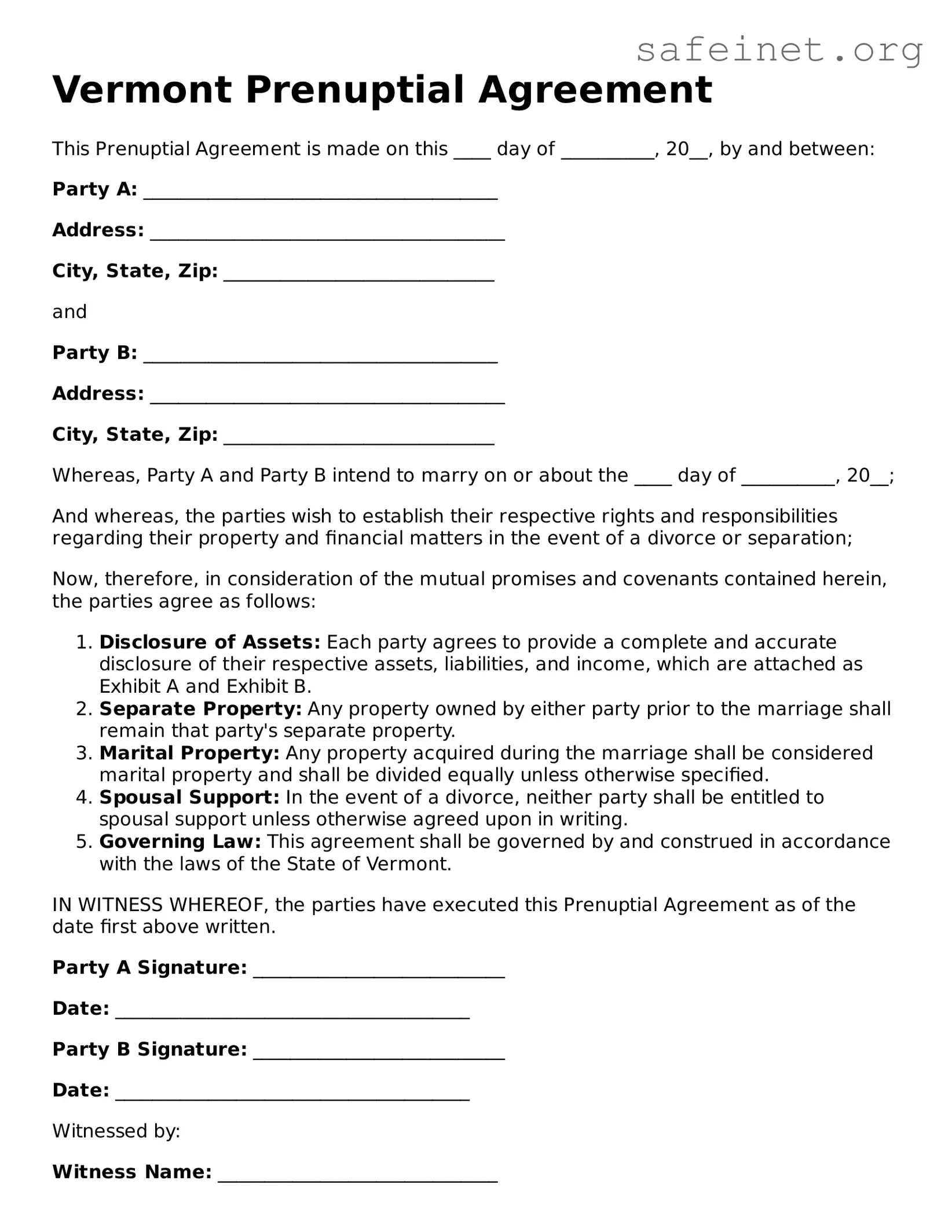
Vermont Prenuptial Agreement
This Prenuptial Agreement is made on this ____ day of __________, 20__, by and between:
Party A: ______________________________________
Address: ______________________________________
City, State, Zip: _____________________________
and
Party B: ______________________________________
Address: ______________________________________
City, State, Zip: _____________________________
Whereas, Party A and Party B intend to marry on or about the ____ day of __________, 20__;
And whereas, the parties wish to establish their respective rights and responsibilities regarding their property and financial matters in the event of a divorce or separation;
Now, therefore, in consideration of the mutual promises and covenants contained herein, the parties agree as follows:
IN WITNESS WHEREOF, the parties have executed this Prenuptial Agreement as of the date first above written.
Party A Signature: ___________________________
Date: ______________________________________
Party B Signature: ___________________________
Date: ______________________________________
Witnessed by:
Witness Name: ______________________________
Signature: _________________________________
Date: ______________________________________
| Fact Name | Description |
|---|---|
| Definition | A prenuptial agreement, or prenup, is a contract between two individuals before marriage outlining the division of assets and responsibilities in the event of divorce or separation. |
| Governing Law | Vermont law governs prenuptial agreements under Title 15, Chapter 8 of the Vermont Statutes. |
| Enforceability | For a prenup to be enforceable in Vermont, it must be in writing and signed by both parties. |
| Full Disclosure | Both parties must provide a fair and reasonable disclosure of their financial situations. This helps ensure transparency and fairness. |
| Voluntariness | The agreement must be entered into voluntarily. Coercion or duress can lead to it being invalidated. |
| Legal Representation | While not required, it is advisable for both parties to seek independent legal advice to ensure their rights are protected. |
| Modification | Prenuptial agreements can be modified or revoked after marriage, but this must be done in writing and signed by both parties. |
| Judicial Review | If disputes arise, Vermont courts will review the prenup for fairness and adherence to legal standards at the time of signing. |
| Common Misconceptions | Many believe prenups are only for the wealthy. In reality, they can benefit anyone wanting to clarify financial matters before marriage. |
Filling out the Vermont Prenuptial Agreement form is an important step for couples considering a legally binding arrangement before marriage. After completing the form, both parties should review it carefully, ensuring all information is accurate and complete. Once finalized, the agreement will need to be signed and possibly notarized to be legally enforceable.
What is a prenuptial agreement in Vermont?
A prenuptial agreement, often referred to as a "prenup," is a legal document that a couple signs before getting married. It outlines the ownership of assets and responsibilities in the event of divorce or separation. In Vermont, this agreement can help protect individual property and clarify financial obligations during the marriage and in the event of its dissolution.
Why should I consider a prenuptial agreement?
Considering a prenuptial agreement can provide peace of mind. It allows couples to define their financial rights and responsibilities, protecting personal assets and ensuring clarity regarding property division. This proactive approach can prevent misunderstandings and conflicts in the future.
What can be included in a Vermont prenuptial agreement?
A Vermont prenuptial agreement can include various provisions, such as the division of property, spousal support, and debt responsibilities. Couples may also address issues like inheritance rights and the management of joint assets. However, certain matters, such as child custody and child support, cannot be predetermined in a prenup.
How do I create a valid prenuptial agreement in Vermont?
To create a valid prenuptial agreement in Vermont, both parties must fully disclose their assets and debts. It is advisable for each party to seek independent legal counsel to ensure that the agreement is fair and enforceable. The agreement should be in writing, signed by both parties, and executed voluntarily without any coercion.
Can a prenuptial agreement be modified or revoked?
Yes, a prenuptial agreement can be modified or revoked after marriage. Both parties must agree to any changes, and it is recommended to document these modifications in writing. Consulting with legal counsel during this process is wise to ensure compliance with state laws.
Is a prenuptial agreement enforceable in Vermont?
Yes, a prenuptial agreement is enforceable in Vermont, provided it meets certain legal requirements. These include full disclosure of assets, voluntary execution by both parties, and fairness at the time of signing. Courts generally uphold prenups unless they are deemed unconscionable or were signed under duress.
When should I start discussing a prenuptial agreement with my partner?
It is best to discuss a prenuptial agreement early in the engagement process. Open communication about financial matters can strengthen your relationship and set a positive tone for the marriage. Waiting until closer to the wedding date can create unnecessary tension and pressure.
What happens if we do not have a prenuptial agreement?
If a couple does not have a prenuptial agreement and later divorces, Vermont's laws will govern the division of assets and debts. This may result in a less favorable outcome for one party, as the court will follow statutory guidelines rather than the couple's personal preferences. Having a prenup allows couples to make decisions that reflect their unique circumstances.
Can I use a template for a prenuptial agreement?
While templates can provide a starting point, it is essential to tailor the agreement to your specific situation. Each couple's financial circumstances are different, and a one-size-fits-all approach may not address all necessary issues. It is advisable to work with a legal professional to ensure that the agreement is comprehensive and legally sound.
Not fully understanding the purpose of a prenuptial agreement. Many people overlook the importance of this document in protecting their assets and defining financial responsibilities.
Failing to disclose all assets and debts. It’s crucial to be transparent about financial situations. Incomplete information can lead to disputes later.
Using vague language. Clear and specific terms help prevent misunderstandings. Ambiguities can cause confusion in the future.
Not considering future changes. Life circumstances can change. It’s important to address how the agreement will adapt to significant life events.
Forgetting to include provisions for children. If there are children involved or anticipated, addressing their financial needs is essential.
Neglecting to have the agreement reviewed by a lawyer. Legal advice can provide valuable insights and ensure the document meets state requirements.
Not signing the agreement in front of a notary. A notary's signature can add an extra layer of validation to the document.
Rushing the process. Taking time to discuss and negotiate terms can lead to a more satisfactory agreement for both parties.
Assuming the agreement is permanent. Regular reviews and updates are necessary as circumstances evolve over time.
A Vermont Prenuptial Agreement is often accompanied by several other documents that help clarify financial arrangements and responsibilities between parties before marriage. These documents can provide additional context and legal backing to the terms outlined in the prenuptial agreement. Below is a list of commonly used forms and documents that may be relevant.
Each of these documents serves a specific purpose and can complement the Vermont Prenuptial Agreement. It is important for individuals to consider their unique circumstances and consult with legal professionals when preparing these documents to ensure their rights and interests are adequately protected.
A Cohabitation Agreement is similar to a Prenuptial Agreement in that both documents are designed to outline the rights and responsibilities of partners in a relationship. While a Prenuptial Agreement is typically used by couples planning to marry, a Cohabitation Agreement serves couples who choose to live together without formalizing their relationship through marriage. This document can address issues such as property ownership, financial responsibilities, and how assets will be divided if the relationship ends. Both agreements aim to protect individual interests and clarify expectations, fostering a sense of security in the relationship.
A Postnuptial Agreement is another document that shares similarities with a Prenuptial Agreement. This agreement is created after a couple is already married and serves to clarify financial matters and property rights. Couples may choose to draft a Postnuptial Agreement for various reasons, such as changes in financial circumstances or a desire to redefine asset ownership. Like a Prenuptial Agreement, it helps set clear guidelines for asset division in the event of a divorce or separation, providing peace of mind for both partners.
A Separation Agreement is closely related to a Prenuptial Agreement as it outlines the terms of a couple’s separation. This document is particularly useful for couples who are contemplating divorce but want to agree on various aspects of their lives, such as child custody, support, and division of assets, before finalizing their divorce. By addressing these issues in advance, a Separation Agreement can streamline the divorce process and reduce conflict, much like a Prenuptial Agreement aims to do before marriage.
An Estate Plan is another document that bears resemblance to a Prenuptial Agreement, though it serves a different purpose. Both documents focus on the distribution of assets, but an Estate Plan is concerned with what happens to a person's assets after they pass away. It can include wills, trusts, and powers of attorney. Just as a Prenuptial Agreement helps couples decide how to manage their assets during their marriage and in the event of divorce, an Estate Plan ensures that individuals have a say in how their assets are handled after their death.
Lastly, a Financial Disclosure Statement is a document that complements a Prenuptial Agreement by providing a clear picture of each partner’s financial situation. While a Prenuptial Agreement outlines how assets will be divided, the Financial Disclosure Statement ensures that both parties fully understand each other’s financial standing before entering into the agreement. This transparency is crucial for building trust and making informed decisions about asset management, much like the goals of a Prenuptial Agreement.
When completing the Vermont Prenuptial Agreement form, it is important to approach the process with care and consideration. Here is a list of things to do and avoid to ensure the agreement is valid and meets the needs of both parties.
Many people have misunderstandings about prenuptial agreements in Vermont. Here are four common misconceptions:
Understanding these misconceptions can help individuals make informed decisions about their prenuptial agreements in Vermont.
When considering a prenuptial agreement in Vermont, it’s essential to understand the key aspects of the process. Here are some important takeaways to keep in mind:
By keeping these points in mind, you can navigate the prenuptial agreement process more effectively.