In Vermont, the Power of Attorney form serves as a crucial legal document that allows individuals to appoint someone they trust to make decisions on their behalf. This arrangement can be particularly beneficial in situations where a person may be unable to manage their affairs due to illness, absence, or incapacity. The form encompasses various powers, ranging from managing financial matters to making healthcare decisions, depending on the specific needs and preferences of the individual granting authority. Importantly, the document must be executed with certain formalities to ensure its validity, including the requirement for notarization and, in some cases, witnesses. Understanding the nuances of the Vermont Power of Attorney form is essential for anyone considering this legal tool, as it provides a way to maintain control over personal and financial matters while ensuring that trusted individuals can step in when necessary. Whether you are planning for the future or addressing immediate concerns, knowing how to properly utilize this form can offer peace of mind and security.
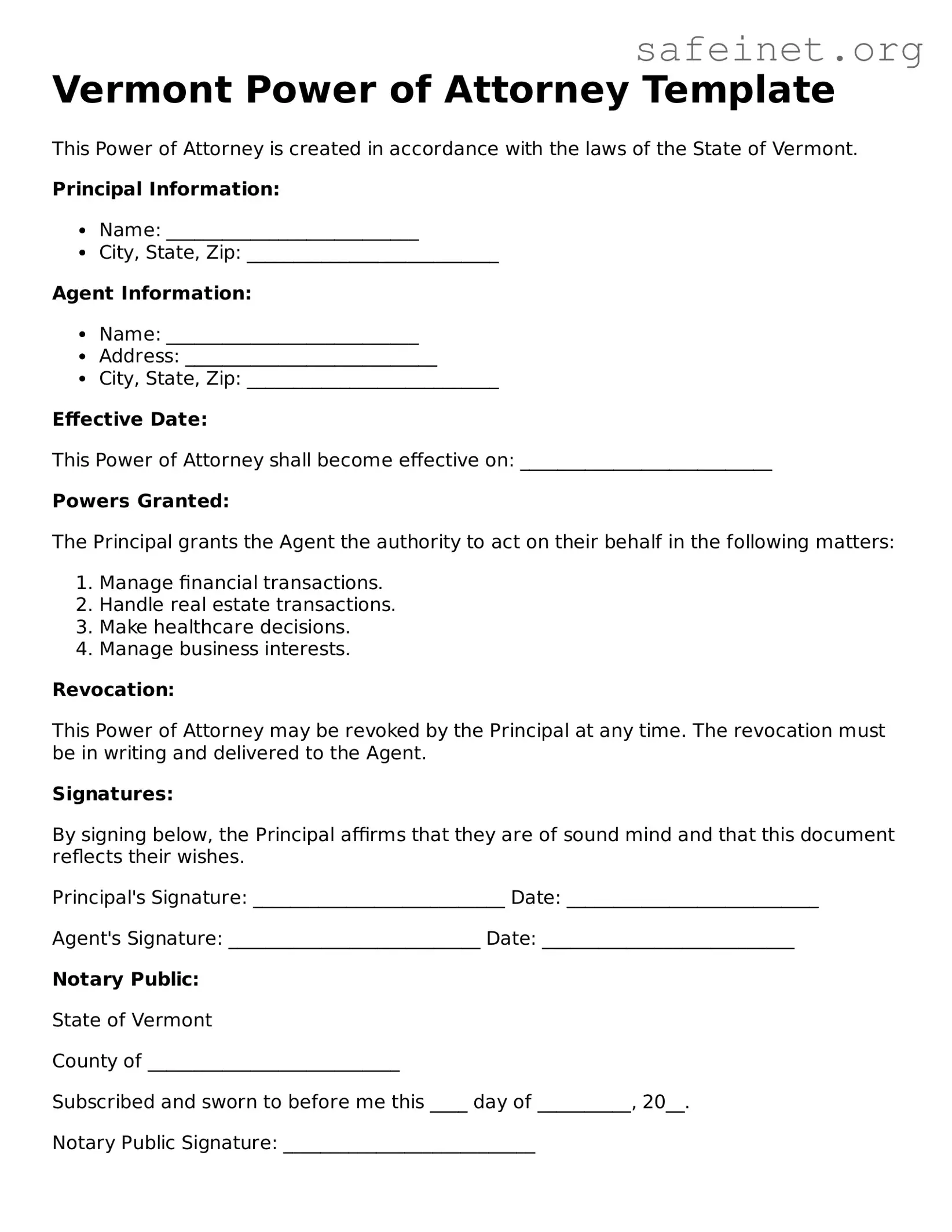
Vermont Power of Attorney Template
This Power of Attorney is created in accordance with the laws of the State of Vermont.
Principal Information:
Agent Information:
Effective Date:
This Power of Attorney shall become effective on: ___________________________
Powers Granted:
The Principal grants the Agent the authority to act on their behalf in the following matters:
Revocation:
This Power of Attorney may be revoked by the Principal at any time. The revocation must be in writing and delivered to the Agent.
Signatures:
By signing below, the Principal affirms that they are of sound mind and that this document reflects their wishes.
Principal's Signature: ___________________________ Date: ___________________________
Agent's Signature: ___________________________ Date: ___________________________
Notary Public:
State of Vermont
County of ___________________________
Subscribed and sworn to before me this ____ day of __________, 20__.
Notary Public Signature: ___________________________
My Commission Expires: ___________________________
| Fact Name | Description |
|---|---|
| Governing Law | The Vermont Power of Attorney is governed by Title 14, Chapter 166 of the Vermont Statutes Annotated. |
| Purpose | This form allows an individual to designate another person to make decisions on their behalf. |
| Types of Authority | It can grant broad or limited powers, depending on the needs of the principal. |
| Durability | A Power of Attorney in Vermont can be durable, meaning it remains effective even if the principal becomes incapacitated. |
| Principal Requirements | The principal must be at least 18 years old and mentally competent to execute the form. |
| Agent Requirements | The agent must also be at least 18 years old and can be an individual or an institution. |
| Execution | The form must be signed by the principal and acknowledged by a notary public or witnessed by two individuals. |
| Revocation | The principal can revoke the Power of Attorney at any time, as long as they are competent to do so. |
| Use in Financial Matters | The form is often used for financial transactions, including managing bank accounts and real estate. |
| Healthcare Decisions | While it can address healthcare decisions, a separate Advance Directive is recommended for medical choices. |
Once you have your Vermont Power of Attorney form ready, it’s time to fill it out carefully. This document allows you to appoint someone to make decisions on your behalf. Follow these steps to ensure that you complete the form correctly.
After completing these steps, your Power of Attorney will be ready for use. Make sure to keep the original document in a safe place and inform your agent about its location. This preparation ensures that your wishes are respected when the time comes.
What is a Power of Attorney in Vermont?
A Power of Attorney (POA) in Vermont is a legal document that allows one person, known as the principal, to grant another person, called the agent or attorney-in-fact, the authority to act on their behalf. This can include managing financial matters, making healthcare decisions, or handling real estate transactions. The principal can specify the powers granted and can limit or expand the authority as needed.
How do I create a Power of Attorney in Vermont?
To create a Power of Attorney in Vermont, you must fill out the appropriate form, which can be found through legal resources or state websites. The document must be signed by the principal in the presence of a notary public. It's important to ensure that the form clearly outlines the powers granted and any limitations. Once completed, the POA should be stored in a safe place, and copies should be provided to the agent and any relevant institutions.
Can I revoke a Power of Attorney in Vermont?
Yes, you can revoke a Power of Attorney in Vermont at any time as long as you are mentally competent. To revoke it, you should create a written notice of revocation, sign it, and deliver it to your agent and any institutions that have a copy of the original POA. It's advisable to also destroy any copies of the original document to prevent confusion.
What happens if the principal becomes incapacitated?
If the principal becomes incapacitated, the Power of Attorney remains in effect unless it is a non-durable POA, which would terminate upon incapacity. A durable Power of Attorney, however, continues to be valid even if the principal can no longer make decisions. This is why many people choose a durable POA for healthcare and financial matters.
Can I limit the powers granted in a Power of Attorney?
Absolutely. When drafting a Power of Attorney, you can specify exactly what powers you wish to grant to your agent. This might include limitations on financial transactions, healthcare decisions, or specific actions related to property. Clearly outlining these limitations in the document helps ensure your wishes are followed.
Is it necessary to have a lawyer to create a Power of Attorney in Vermont?
No, it is not strictly necessary to have a lawyer to create a Power of Attorney in Vermont. Many people successfully complete the process on their own using templates and resources available online. However, consulting with a lawyer can provide peace of mind and ensure that the document meets all legal requirements and adequately protects your interests.
Incomplete Information: Many individuals fail to provide all required details. This includes missing names, addresses, or signatures. Each section must be filled out completely to ensure the document is valid.
Not Specifying Powers Clearly: Some people do not clearly outline the powers they wish to grant. Vague language can lead to confusion and may result in the agent not having the authority to act as intended.
Forgetting to Date the Document: A common oversight is neglecting to date the Power of Attorney form. Without a date, it may be difficult to determine when the powers become effective, potentially complicating matters later.
Improper Witnessing or Notarization: Failing to have the document properly witnessed or notarized is another frequent mistake. Depending on the specific requirements, not meeting these can invalidate the form.
When preparing a Power of Attorney in Vermont, several other forms and documents may be necessary to ensure comprehensive legal coverage. Each document serves a specific purpose and can complement the Power of Attorney effectively.
These documents can help clarify intentions and ensure that a person's wishes are respected in various situations. It is advisable to consider each document's relevance and seek professional guidance when necessary.
The Vermont Power of Attorney (POA) form shares similarities with the General Power of Attorney. Both documents grant authority to an agent to make decisions on behalf of the principal. A General POA is often broader in scope, allowing the agent to handle a wide range of financial and legal matters. However, it can be revoked or become ineffective if the principal becomes incapacitated, unless it is specifically designated as durable.
Another document similar to the Vermont Power of Attorney is the Durable Power of Attorney. This type of POA remains effective even if the principal becomes incapacitated. It is particularly important for individuals who want to ensure their financial and medical decisions are managed by a trusted person during periods of incapacity. The Vermont POA can also be made durable, ensuring continuous authority for the agent.
The Medical Power of Attorney is another relevant document. This form specifically authorizes an agent to make healthcare decisions on behalf of the principal when they are unable to do so. While the Vermont POA can include healthcare decisions, a Medical POA is tailored for this purpose and often includes specific instructions regarding medical treatments and interventions.
A Living Will also bears resemblance to the Vermont Power of Attorney, particularly regarding healthcare decisions. A Living Will outlines an individual’s preferences for medical treatment in end-of-life situations. While the Vermont POA can appoint someone to make these decisions, a Living Will provides explicit instructions that guide the agent’s choices in critical situations.
The Springing Power of Attorney is another document that operates similarly. It only becomes effective under specific conditions, typically when the principal becomes incapacitated. This type of POA allows individuals to maintain control over their affairs until they are no longer able to manage them, ensuring that authority is only granted when truly necessary.
The Financial Power of Attorney is closely related as well. This document gives an agent the authority to manage financial matters on behalf of the principal. While the Vermont POA can cover financial decisions, a Financial POA is specifically designed for this purpose, often detailing the scope of financial authority granted to the agent.
A Revocation of Power of Attorney is also pertinent to this discussion. This document formally terminates any existing Power of Attorney, including the Vermont POA. It is crucial for individuals to understand how to revoke a POA when circumstances change, ensuring that their current wishes are accurately reflected in their legal documents.
Lastly, the Trust document is similar in that it allows for the management of assets, but it operates differently. A Trust can hold and manage assets for beneficiaries, while a Power of Attorney is primarily about delegating authority to make decisions. However, both documents can be used in tandem to achieve comprehensive estate planning goals.
When filling out the Vermont Power of Attorney form, it's essential to approach the task with care and attention. Here are five key do's and don'ts to keep in mind:
By following these guidelines, you can help ensure that your Power of Attorney is executed properly and serves your intended purpose.
Understanding the Vermont Power of Attorney form is essential for anyone considering its use. However, several misconceptions can lead to confusion. Below are five common misconceptions about this legal document.
This is not true. While many people use a Power of Attorney for financial decisions, it can also be used for healthcare decisions, legal matters, and other personal affairs.
In reality, a Power of Attorney can be revoked at any time, as long as the principal is mentally competent. The principal must follow the proper procedures to ensure the revocation is legally recognized.
This statement is misleading. While many individuals can serve as agents, they must be of legal age and mentally competent. Additionally, some individuals may be disqualified due to certain legal restrictions.
Although consulting a lawyer can be beneficial, it is not a requirement. Individuals can complete the Vermont Power of Attorney form on their own, provided they understand the implications and requirements.
This is incorrect. The principal retains control over their affairs and can set specific limitations on the agent's authority. Furthermore, the principal can revoke the Power of Attorney at any time if they choose.
When filling out and using the Vermont Power of Attorney form, it's essential to keep a few key points in mind: