When parents or guardians find themselves in situations where they cannot be present to care for their child, having a Vermont Power of Attorney for a Child form can provide peace of mind and ensure that the child's needs are met. This legal document allows a parent or guardian to appoint another trusted adult to make decisions on behalf of the child, covering areas such as medical care, education, and general welfare. The form is designed to be straightforward, enabling parents to specify the duration of the authority granted, whether it be for a short trip or an extended period. It is essential to understand that this document does not terminate parental rights; instead, it temporarily delegates specific responsibilities to another individual. By clearly outlining the powers granted, the Vermont Power of Attorney for a Child form serves as a vital tool in safeguarding a child's well-being during times of parental absence.
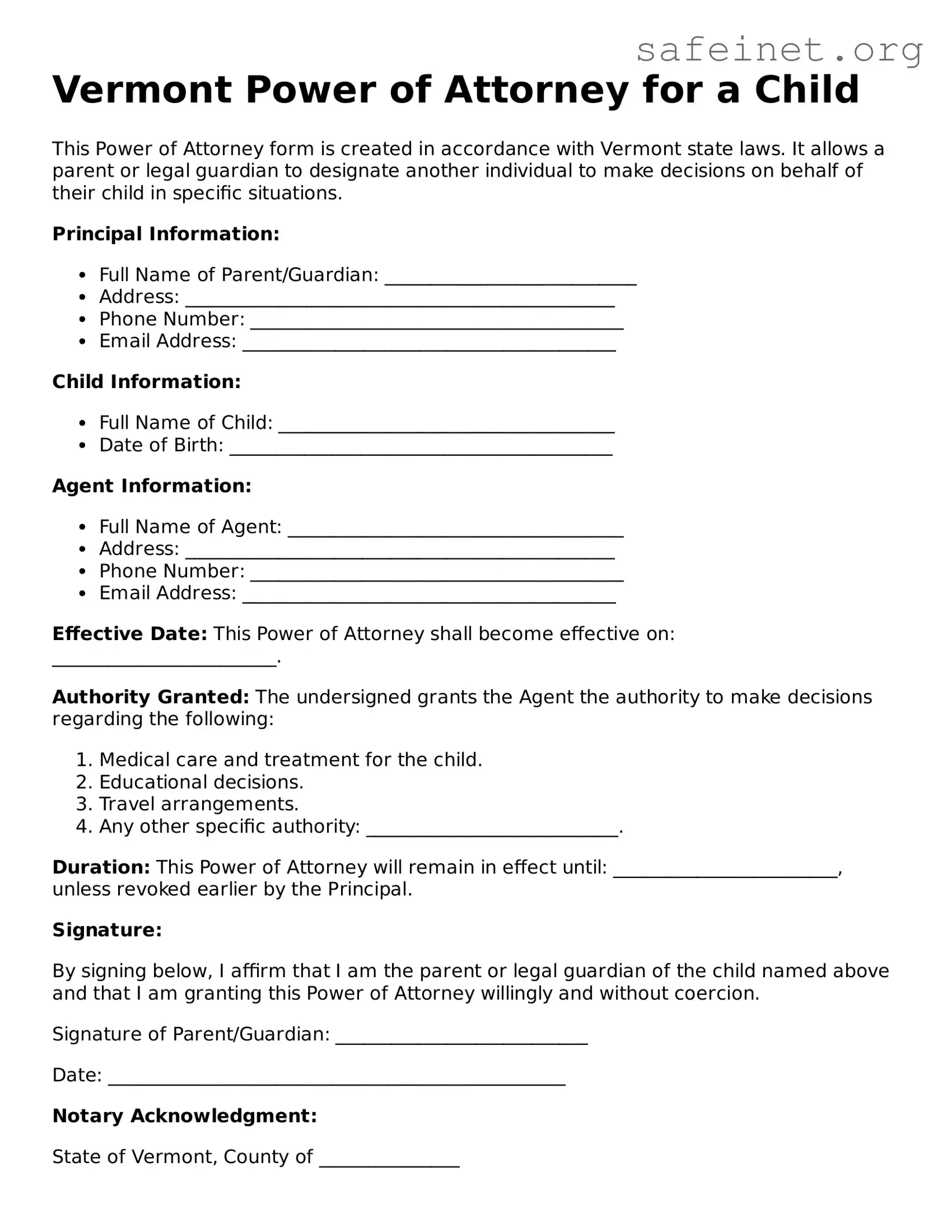
Vermont Power of Attorney for a Child
This Power of Attorney form is created in accordance with Vermont state laws. It allows a parent or legal guardian to designate another individual to make decisions on behalf of their child in specific situations.
Principal Information:
Child Information:
Agent Information:
Effective Date: This Power of Attorney shall become effective on: ________________________.
Authority Granted: The undersigned grants the Agent the authority to make decisions regarding the following:
Duration: This Power of Attorney will remain in effect until: ________________________, unless revoked earlier by the Principal.
Signature:
By signing below, I affirm that I am the parent or legal guardian of the child named above and that I am granting this Power of Attorney willingly and without coercion.
Signature of Parent/Guardian: ___________________________
Date: _________________________________________________
Notary Acknowledgment:
State of Vermont, County of _______________
On this _____ day of _______________, 20____, before me, a Notary Public, personally appeared ____________________, known to me to be the person who executed the foregoing Power of Attorney.
Notary Public Signature: ________________________________
My Commission Expires: ________________________________
| Fact Name | Details |
|---|---|
| Purpose | The Vermont Power of Attorney for a Child form allows a parent or legal guardian to designate another adult to make decisions on behalf of their child in their absence. |
| Governing Law | This form is governed by Vermont Statutes Title 14, Chapter 31, which outlines the laws regarding powers of attorney. |
| Duration | The authority granted through this form typically remains in effect until the parent or guardian revokes it or until a specified date, whichever comes first. |
| Signatures Required | The form must be signed by the parent or guardian and may require notarization to be legally binding. |
Once you have gathered the necessary information, you can proceed to fill out the Vermont Power of Attorney for a Child form. This document allows a parent or legal guardian to designate another adult to make decisions on behalf of their child for a specified period. Follow these steps to complete the form accurately.
After completing the form, ensure that all parties involved receive a copy for their records. This will help in maintaining clear communication and understanding of the responsibilities assigned.
What is a Vermont Power of Attorney for a Child form?
The Vermont Power of Attorney for a Child form is a legal document that allows a parent or legal guardian to grant another adult the authority to make decisions on behalf of their child. This can include decisions related to education, healthcare, and general welfare. It is particularly useful for temporary situations, such as when a parent is traveling or unable to care for the child for a period of time.
Who can be appointed as an agent in the Power of Attorney for a Child?
Any responsible adult can be appointed as an agent in this form. This could be a relative, family friend, or neighbor. The key requirement is that the person must be trustworthy and capable of making decisions in the best interest of the child. Parents should carefully consider who they choose, as this individual will have significant responsibilities during the period of the power of attorney.
How long is the Power of Attorney for a Child valid?
The validity of the Power of Attorney for a Child can vary based on the specifications included in the document. Typically, it remains effective until the specified end date, which can be set by the parent or guardian. It can also be revoked at any time by the parent, provided they notify the agent and any relevant parties. It is essential to keep a copy of the document and any revocation notices for reference.
What decisions can the agent make on behalf of the child?
The agent can make a variety of decisions regarding the child's welfare. This includes, but is not limited to, decisions about education, medical care, and general day-to-day activities. However, the scope of authority can be limited by the parent or guardian when completing the form. It is crucial to clearly outline what decisions the agent can and cannot make to avoid any confusion later.
Do I need to have the Power of Attorney for a Child form notarized?
Yes, the Vermont Power of Attorney for a Child form must be notarized to be legally valid. This step ensures that the document is recognized by authorities and can be used effectively in situations requiring the agent to act on behalf of the child. It is advisable to consult with a legal professional to ensure that all requirements are met and that the form is completed correctly.
Not providing complete information about the child. Ensure that the child's full name, date of birth, and any other required details are included.
Failing to clearly identify the agent. The person designated to act on behalf of the child must be named clearly, along with their contact information.
Overlooking the duration of the Power of Attorney. Specify how long the authority will last. This can prevent misunderstandings later.
Neglecting to sign and date the form. A signature is necessary for the document to be valid. Make sure to date it as well.
Not having the document notarized. In Vermont, notarization may be required for the Power of Attorney to be recognized legally.
Using vague language. Be specific about the powers granted to the agent to avoid confusion regarding their authority.
Failing to communicate with the agent. Discuss the responsibilities and expectations with the person designated to ensure they are prepared.
Not keeping a copy of the completed form. Retain a copy for your records and provide one to the agent for their reference.
When considering a Power of Attorney for a Child in Vermont, it's important to be aware of other documents that may be beneficial for comprehensive planning. These forms can help ensure that all aspects of a child's care and legal needs are addressed effectively.
Being proactive and preparing these documents can help prevent misunderstandings and ensure that your child's needs are met. It's essential to review each form carefully and consider consulting with a legal professional to ensure everything is in order.
The Vermont Power of Attorney for a Child form is similar to the General Power of Attorney. Both documents allow an individual to designate another person to make decisions on their behalf. However, while a General Power of Attorney can cover a wide range of decisions, the Vermont Power of Attorney for a Child specifically focuses on decisions related to the care and welfare of a minor child. This makes it a more tailored option for parents or guardians who need to temporarily delegate authority regarding their child's upbringing.
Another document that shares similarities is the Medical Power of Attorney. This form allows an individual to appoint someone to make healthcare decisions for them if they are unable to do so. Like the Vermont Power of Attorney for a Child, it is designed to ensure that someone trusted can step in when necessary. The key difference lies in the focus; the Medical Power of Attorney is specifically for health-related decisions, while the Vermont form encompasses broader aspects of a child's welfare.
The Child Custody Agreement is also comparable. This document outlines the arrangements for a child's living situation and parental responsibilities. While the Vermont Power of Attorney for a Child allows for temporary decision-making authority, a Child Custody Agreement is more permanent and typically involves legal proceedings. Both aim to serve the best interests of the child, but they operate in different contexts and with different legal implications.
Another related document is the Temporary Guardianship Agreement. This form allows a parent to temporarily assign guardianship of their child to another individual. Similar to the Vermont Power of Attorney for a Child, it is often used in situations where the parent cannot be present. However, a guardianship agreement usually grants broader authority and may last longer than a power of attorney, which is often intended for short-term situations.
The Consent to Medical Treatment form is relevant as well. This document allows a parent or guardian to give permission for medical treatment on behalf of their child. Like the Vermont Power of Attorney for a Child, it ensures that someone can act in the child's best interest when the parent is unavailable. However, it is more focused on medical decisions, whereas the power of attorney encompasses various aspects of a child's care.
The Adoption Consent form is another document that shares some similarities. In adoption, a parent relinquishes their rights and consents to the adoption of their child by another person or couple. While the Vermont Power of Attorney for a Child does not terminate parental rights, it does allow for the temporary transfer of decision-making authority, which can be important in certain situations where parents need support.
The Child Support Agreement is also noteworthy. This document outlines financial responsibilities for a child's upbringing. While it does not grant decision-making authority, it is essential for ensuring that a child's needs are met. Both the Child Support Agreement and the Vermont Power of Attorney for a Child aim to protect the child's welfare, albeit from different angles.
The Special Needs Trust is another document that can be compared. This trust is designed to provide financial support for a child with special needs without jeopardizing their eligibility for government benefits. While the Vermont Power of Attorney for a Child focuses on decision-making authority, both documents are concerned with ensuring a child's well-being and future security.
Lastly, the Family Care Plan is relevant. This document outlines how a family will care for a child in various circumstances, including emergencies. Like the Vermont Power of Attorney for a Child, it emphasizes planning for the child's care. However, a Family Care Plan may not grant legal authority to anyone, whereas the power of attorney explicitly allows someone to act on behalf of the parent.
When filling out the Vermont Power of Attorney for a Child form, it is important to follow certain guidelines to ensure the document is completed correctly. Below is a list of things to do and things to avoid.
Many people have misunderstandings about the Vermont Power of Attorney for a Child form. Here are some common misconceptions:
Filling out and using the Vermont Power of Attorney for a Child form is an important process for parents and guardians. Here are key takeaways to consider:
These steps will help ensure that the Power of Attorney for a Child form is filled out correctly and used effectively.