The Vermont Operating Agreement form serves as a foundational document for limited liability companies (LLCs) operating within the state. This form outlines the essential rules and regulations governing the internal management of the LLC, ensuring that all members understand their rights and responsibilities. Key aspects include the allocation of profits and losses, management structure, and procedures for adding or removing members. Additionally, the agreement addresses decision-making processes and dispute resolution methods, providing a clear framework for operations. By establishing these guidelines, the Operating Agreement promotes transparency and helps prevent conflicts among members. It is not merely a formality; rather, it is a critical tool that can safeguard the interests of all parties involved and enhance the overall stability of the business.
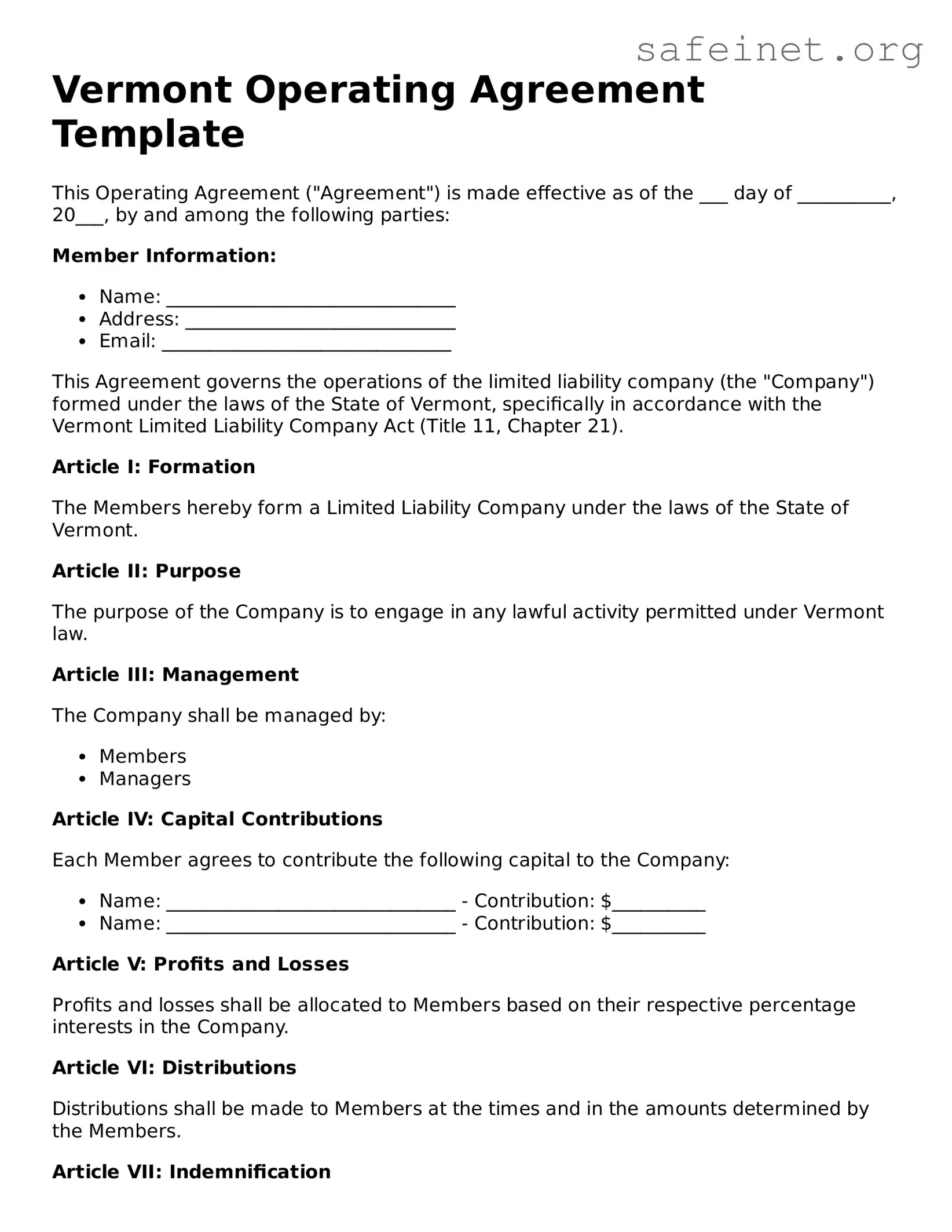
Vermont Operating Agreement Template
This Operating Agreement ("Agreement") is made effective as of the ___ day of __________, 20___, by and among the following parties:
Member Information:
This Agreement governs the operations of the limited liability company (the "Company") formed under the laws of the State of Vermont, specifically in accordance with the Vermont Limited Liability Company Act (Title 11, Chapter 21).
Article I: Formation
The Members hereby form a Limited Liability Company under the laws of the State of Vermont.
Article II: Purpose
The purpose of the Company is to engage in any lawful activity permitted under Vermont law.
Article III: Management
The Company shall be managed by:
Article IV: Capital Contributions
Each Member agrees to contribute the following capital to the Company:
Article V: Profits and Losses
Profits and losses shall be allocated to Members based on their respective percentage interests in the Company.
Article VI: Distributions
Distributions shall be made to Members at the times and in the amounts determined by the Members.
Article VII: Indemnification
The Company shall indemnify its Members and Managers to the fullest extent permitted by law.
Article VIII: Amendments
This Agreement may be amended only by a written agreement signed by all Members.
Article IX: Governing Law
This Agreement shall be governed by and construed in accordance with the laws of the State of Vermont.
IN WITNESS WHEREOF, the Members have executed this Operating Agreement as of the date first above written.
Member Signatures:
| Fact Name | Details |
|---|---|
| Purpose | The Vermont Operating Agreement form outlines the management structure and operating procedures of a limited liability company (LLC) in Vermont. |
| Governing Law | This form is governed by the Vermont Limited Liability Company Act, specifically Title 11, Chapter 21 of the Vermont Statutes. |
| Required Information | The form typically requires information about the LLC's members, management structure, and operational guidelines. |
| Filing Requirements | While the Operating Agreement itself does not need to be filed with the state, it is essential for internal governance and may be requested by banks or other entities. |
Filling out the Vermont Operating Agreement form is an essential step in establishing your business structure. This document outlines the management and operational procedures for your company. Following the steps below will help ensure that you complete the form accurately and efficiently.
After completing the form, keep a copy for your records and provide copies to all members involved. This agreement will serve as a foundational document for your business operations moving forward.
What is a Vermont Operating Agreement?
A Vermont Operating Agreement is a legal document that outlines the management structure and operating procedures of a limited liability company (LLC) in Vermont. It serves as an internal guideline for members, detailing their rights, responsibilities, and the rules governing the company’s operations.
Is an Operating Agreement required in Vermont?
While Vermont does not legally require LLCs to have an Operating Agreement, it is highly recommended. Having one can help prevent misunderstandings among members and provide a clear framework for resolving disputes. Additionally, it can protect your limited liability status by demonstrating that your LLC is a separate entity from its members.
Who should draft the Operating Agreement?
The Operating Agreement can be drafted by any member of the LLC, but it is often advisable to seek legal assistance. A lawyer can ensure that the agreement complies with Vermont laws and accurately reflects the intentions of the members. However, members can also use templates or online resources to create their own agreement.
What key elements should be included in the Operating Agreement?
Essential elements of a Vermont Operating Agreement typically include the LLC's name and address, the purpose of the LLC, the names of members, their ownership percentages, management structure, voting rights, and procedures for adding or removing members. It may also cover profit distribution, dispute resolution processes, and procedures for dissolving the LLC.
Can the Operating Agreement be changed?
Yes, the Operating Agreement can be amended. Members can decide to make changes through a vote, as specified in the agreement itself. It is important to document any amendments in writing and have all members sign off on them to maintain clarity and legal standing.
What happens if there is no Operating Agreement?
If an LLC operates without an Operating Agreement, it will be governed by Vermont's default LLC laws. These laws may not align with the members' intentions, leading to potential conflicts and confusion. Without a tailored agreement, members may face challenges in decision-making and profit-sharing.
How does an Operating Agreement affect taxes?
An Operating Agreement does not directly affect the tax status of an LLC, but it can outline how profits and losses are distributed among members. This can influence how members report income on their personal tax returns. It is advisable to consult a tax professional for guidance specific to your situation.
Can an Operating Agreement be verbal?
While an Operating Agreement can technically be verbal, it is not recommended. A written agreement provides clarity and serves as evidence of the members' intentions. Verbal agreements can lead to misunderstandings and disputes that are difficult to resolve.
Where should the Operating Agreement be kept?
The Operating Agreement should be kept in a safe place, accessible to all members. It is common to store it with other important business documents, such as the Articles of Organization and tax records. Members should also keep copies for their records.
Can a member be added or removed from the LLC through the Operating Agreement?
Yes, the Operating Agreement can outline the process for adding or removing members. This may include stipulations on how new members are admitted and the conditions under which a member can exit the LLC. Clearly defining these processes helps to avoid potential disputes in the future.
Incomplete Information: Many individuals fail to provide all necessary details. This can include missing names, addresses, or the purpose of the business.
Incorrect Member Designation: Some people mistakenly classify members as managers or vice versa. Understanding the roles is crucial for proper governance.
Failure to Specify Ownership Percentages: Neglecting to outline each member's ownership stake can lead to disputes later on.
Omitting Voting Rights: Not detailing how voting will occur can create confusion. Clearly defining voting rights is essential for decision-making.
Ignoring Amendment Procedures: Some individuals overlook the process for making changes to the agreement. Including this information helps manage future adjustments.
Not Including a Dissolution Clause: Failing to address how the business will be dissolved can lead to complications if the need arises.
Neglecting to Sign and Date: A common oversight is not signing or dating the document. This step is vital for the agreement to be legally binding.
Using Ambiguous Language: Vague terms can lead to misinterpretation. Clarity in language ensures all members understand their rights and responsibilities.
The Vermont Operating Agreement is a crucial document for limited liability companies (LLCs) as it outlines the management structure and operating procedures of the business. Alongside this agreement, several other forms and documents are commonly utilized to ensure compliance and effective operation of the LLC. Below is a list of these documents, each serving a specific purpose.
Each of these documents plays an important role in the establishment and ongoing management of an LLC in Vermont. It is advisable to ensure that all necessary forms are properly completed and filed to maintain compliance with state regulations and to facilitate smooth operations within the company.
The Vermont Operating Agreement form is similar to the Limited Liability Company (LLC) Articles of Organization. Both documents are essential for establishing an LLC in Vermont. While the Articles of Organization serve as the foundational document filed with the state to officially create the LLC, the Operating Agreement outlines the internal governance structure, including management responsibilities, member rights, and operational procedures. Together, they provide a comprehensive framework for both legal recognition and day-to-day management of the business.
Another document that shares similarities with the Vermont Operating Agreement is the Partnership Agreement. Like the Operating Agreement, a Partnership Agreement details the roles and responsibilities of each partner, including profit-sharing arrangements and decision-making processes. Both documents aim to prevent disputes by clearly defining expectations and obligations among the parties involved. However, the Partnership Agreement is specific to partnerships, while the Operating Agreement is tailored for LLCs.
The Bylaws of a corporation are also comparable to the Vermont Operating Agreement. Bylaws govern the internal management of a corporation, similar to how an Operating Agreement governs an LLC. Both documents address issues such as the election of officers, meeting protocols, and voting rights. While Bylaws are specific to corporations, they serve a similar purpose in establishing rules and procedures for the organization’s operation and governance.
Finally, the Shareholder Agreement can be likened to the Vermont Operating Agreement. A Shareholder Agreement is used by corporations to outline the rights and obligations of shareholders, including the transfer of shares and decision-making processes. Similarly, the Operating Agreement details the rights and responsibilities of LLC members. Both documents are designed to protect the interests of the parties involved and ensure smooth operation within their respective entities.
When filling out the Vermont Operating Agreement form, it is important to follow certain guidelines to ensure accuracy and completeness. Here is a list of things to do and avoid:
Below is a list of common misconceptions regarding the Vermont Operating Agreement form. Understanding these misconceptions can help clarify the purpose and importance of this document.
While it is highly recommended for LLCs to have an Operating Agreement, Vermont does not legally require all LLCs to file one with the state.
Single-member LLCs can also benefit from an Operating Agreement. It helps clarify the management structure and operational guidelines.
The Operating Agreement is an internal document and does not need to be submitted to the Vermont Secretary of State.
Operating Agreements can be amended. Members can revise the document as needed to reflect changes in the business or membership.
While most provisions are enforceable, certain clauses may not hold up in court if they violate state laws or public policy.
Having an Operating Agreement helps reinforce the limited liability status of an LLC, which can protect personal assets from business debts.
Small businesses and startups also benefit from having an Operating Agreement, as it sets clear expectations and guidelines.
While verbal agreements may be made, a written Operating Agreement provides a clear record and reduces misunderstandings among members.
It should be reviewed regularly and updated as the business evolves or as membership changes occur.
While consensus is important, the agreement can outline how decisions are made, allowing for flexibility in member input.
When filling out and using the Vermont Operating Agreement form, it’s essential to understand several key points to ensure compliance and effectiveness. Here are some important takeaways:
By keeping these points in mind, you can create a solid Operating Agreement that supports the smooth functioning of your business.