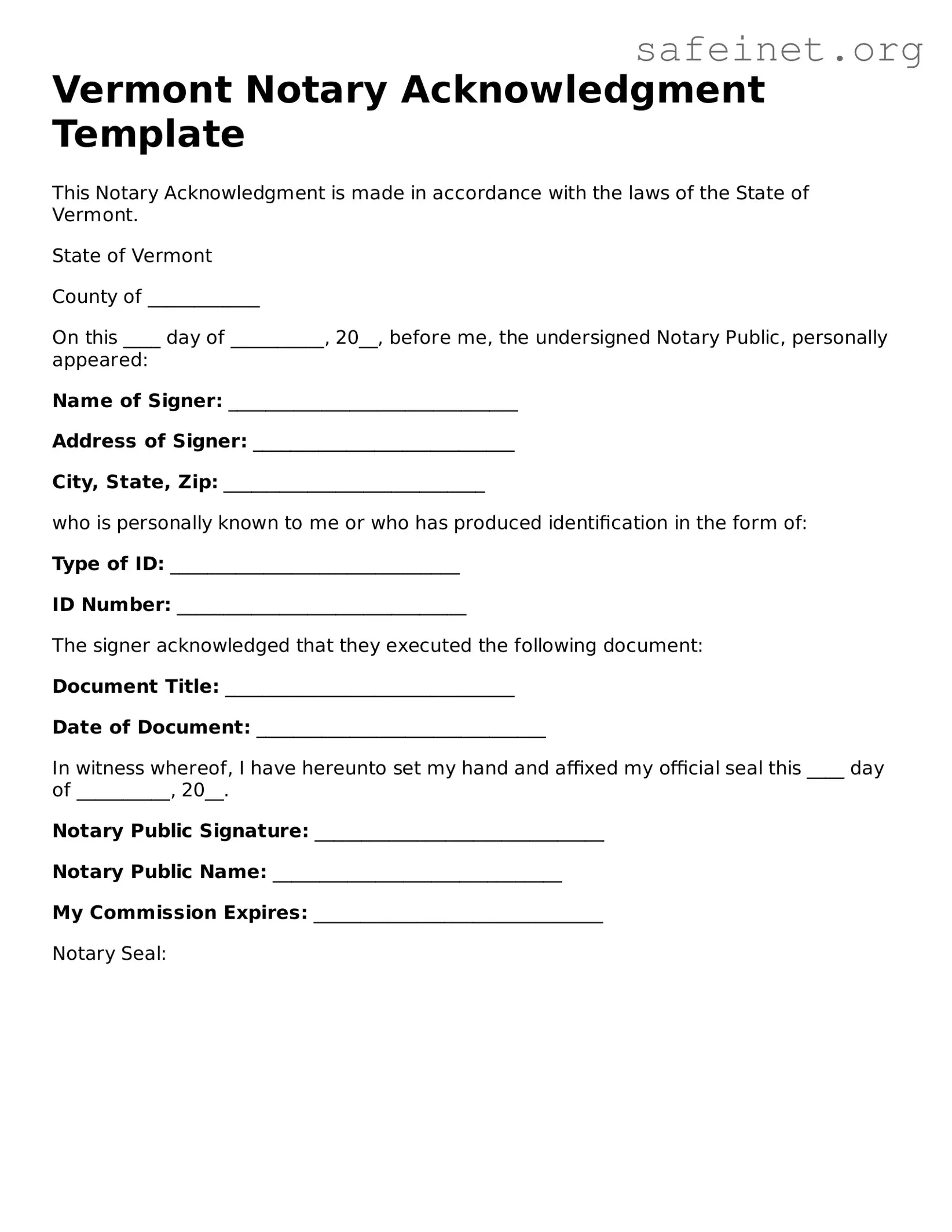
The Vermont Notary Acknowledgment form plays a crucial role in the notarization process, ensuring that documents are legally recognized and that the identities of signers are verified. This form is often utilized in various legal and business transactions, such as real estate deals, contracts, and other official agreements. It serves to confirm that the signer willingly appeared before a notary public and acknowledged their signature on the document. Essential components of the form include the names of the parties involved, the date of the acknowledgment, and the notary's signature and seal. By providing a clear record of the acknowledgment, this form helps prevent fraud and ensures that all parties are protected under the law. Understanding its importance and proper usage can significantly impact the validity of legal documents in Vermont.
Vermont Notary Acknowledgment Template
This Notary Acknowledgment is made in accordance with the laws of the State of Vermont.
State of Vermont
County of ____________
On this ____ day of __________, 20__, before me, the undersigned Notary Public, personally appeared:
Name of Signer: _______________________________
Address of Signer: ____________________________
City, State, Zip: ____________________________
who is personally known to me or who has produced identification in the form of:
Type of ID: _______________________________
ID Number: _______________________________
The signer acknowledged that they executed the following document:
Document Title: _______________________________
Date of Document: _______________________________
In witness whereof, I have hereunto set my hand and affixed my official seal this ____ day of __________, 20__.
Notary Public Signature: _______________________________
Notary Public Name: _______________________________
My Commission Expires: _______________________________
Notary Seal:
| Fact Name | Details |
|---|---|
| Definition | A Vermont Notary Acknowledgment form is a legal document that verifies the identity of a signer and their willingness to sign a document. |
| Governing Law | The use of the notary acknowledgment form in Vermont is governed by Title 24, Chapter 206 of the Vermont Statutes Annotated. |
| Purpose | This form serves to prevent fraud by ensuring that the signer is who they claim to be and that they are signing voluntarily. |
| Components | The form typically includes the name of the signer, the date of the acknowledgment, and the notary's signature and seal. |
| Notary Requirements | In Vermont, a notary must be commissioned by the Secretary of State and meet specific qualifications to perform acknowledgments. |
| Signature Verification | The notary verifies the identity of the signer through personal knowledge or by examining an acceptable form of identification. |
| Record Keeping | Notaries are required to keep a record of all acknowledgments performed, including details about the signer and the document. |
| Legal Effect | Documents executed with a proper notary acknowledgment are generally considered valid and enforceable in legal proceedings. |
| Common Uses | This form is commonly used for real estate transactions, powers of attorney, and various legal documents requiring notarization. |
Once you have the Vermont Notary Acknowledgment form in hand, you are ready to begin the process of completing it. This form is essential for verifying the identity of the signer and confirming that they willingly signed the document in question. Follow the steps below to ensure that you fill it out correctly.
With these steps completed, the form is ready for submission or filing as required. Make sure to keep a copy for your records, as this could be important for future reference.
What is a Vermont Notary Acknowledgement form?
The Vermont Notary Acknowledgement form is a legal document used to confirm that a specific individual has willingly signed a particular document in the presence of a notary public. This form serves as proof that the person who signed the document is indeed who they claim to be, and it helps to prevent fraud in legal transactions.
When do I need to use a Notary Acknowledgement?
You typically need to use a Notary Acknowledgement when signing important documents such as contracts, deeds, or powers of attorney. This form is particularly crucial in real estate transactions, where verifying the identity of the signer can protect all parties involved. If you are unsure whether a document requires notarization, it is wise to consult with a legal expert.
Who can act as a notary in Vermont?
In Vermont, a notary public must be a resident of the state and meet specific qualifications set by the Secretary of State. They must complete an application process, which includes a background check and training. Once appointed, a notary can perform their duties throughout the state, providing essential services to the community.
What information is required on the Notary Acknowledgement form?
The Notary Acknowledgement form generally requires several key pieces of information. This includes the name and signature of the person signing the document, the date of the acknowledgment, and the notary's signature and seal. Additionally, the form may include a description of the document being acknowledged, ensuring clarity and specificity.
Is there a fee for notarization in Vermont?
Yes, notaries in Vermont are allowed to charge a fee for their services. The maximum fee is set by state law, and it is typically modest. However, the exact fee may vary depending on the notary and the complexity of the service provided. Always ask about fees in advance to avoid surprises.
Can I get a Notary Acknowledgement if I am not physically present?
Generally, a Notary Acknowledgement requires the signer to be physically present before the notary. However, some states have begun to allow remote notarization, which can be done via video conferencing. Vermont has specific rules regarding remote notarization, so it's essential to check the current regulations if this option interests you.
How long is a Notary Acknowledgement valid?
A Notary Acknowledgement does not have an expiration date in itself; it remains valid as long as the document it accompanies is valid. However, certain documents may have their own time limitations. Always ensure that any legal documents are updated and compliant with current laws to maintain their validity.
Missing Signatures: One common mistake is forgetting to sign the document. The notary acknowledgment requires the signature of the person whose identity is being verified. Without this signature, the acknowledgment is incomplete.
Incorrect Date: Entering the wrong date can lead to confusion. It’s essential to ensure that the date matches the day the acknowledgment is being signed. An incorrect date can invalidate the document.
Not Including the Notary’s Information: The notary must provide their name, title, and commission number. Omitting any of this information can cause the acknowledgment to be rejected.
Failing to Identify the Signer: The form requires a clear identification of the signer. If the notary does not include the full name of the individual being acknowledged, the form may be deemed incomplete.
Using Incorrect Language: The wording in the acknowledgment must be precise. Any deviations from the standard language can lead to legal complications. It's best to use the exact phrasing provided in the form.
Not Notarizing in the Correct Jurisdiction: Notaries must operate within their authorized areas. If the acknowledgment is notarized outside the notary's jurisdiction, it may not be valid.
Neglecting to Check for Witnesses: Some documents may require witnesses in addition to notarization. Failing to include the necessary witnesses can invalidate the document, depending on its purpose.
The Vermont Notary Acknowledgment form is a crucial document used to verify the identity of individuals signing legal documents. It often accompanies other forms and documents that require notarization. Below is a list of commonly used documents in conjunction with the Vermont Notary Acknowledgment form.
Understanding these accompanying documents can enhance the effectiveness of the Vermont Notary Acknowledgment form. Each plays a vital role in ensuring legal transactions are conducted smoothly and securely.
The Vermont Notary Acknowledgment form is similar to the Affidavit. An affidavit is a written statement confirmed by oath or affirmation, used as evidence in court. Both documents require the presence of a notary public, who verifies the identity of the signer and ensures that the statement is made voluntarily. Like the acknowledgment, an affidavit serves to authenticate the information provided, lending credibility to the document in legal proceedings.
Another document that shares similarities with the Vermont Notary Acknowledgment is the Power of Attorney. This document allows one person to act on behalf of another in legal or financial matters. Both the Power of Attorney and the acknowledgment require notarization to confirm the identity of the parties involved and to affirm that the document was executed willingly. This ensures that the authority granted in the Power of Attorney is legitimate and recognized by third parties.
The Certificate of Authenticity also bears resemblance to the Vermont Notary Acknowledgment. This document is often used to verify the authenticity of signatures or documents. Like the acknowledgment, it involves a notary who confirms the identity of the signer and the legitimacy of the document. Both serve to provide assurance to recipients that the documents are genuine and that the signatures are valid.
Lastly, the Deed is another document that aligns closely with the Vermont Notary Acknowledgment. A deed is a legal document that conveys property from one person to another. Both documents require notarization to confirm the identities of the parties involved and to ensure that the transaction is executed willingly. The acknowledgment in a deed serves to provide evidence that the transfer of property is valid and legally binding.
When filling out the Vermont Notary Acknowledgment form, it is crucial to follow specific guidelines to ensure the document is valid and enforceable. Here are six important do's and don'ts to consider:
Following these guidelines will help ensure that the acknowledgment is executed properly and maintains its legal integrity. Be diligent and attentive to detail throughout the process.
Below is a list of common misconceptions about the Vermont Notary Acknowledgement form, along with clarifications for each.
In Vermont, notaries are not authorized to certify copies of documents. Their role is limited to witnessing signatures and acknowledging that a person has signed a document willingly.
Not all documents need a notary acknowledgement. It is typically required for documents that will be recorded or filed with a government agency, but many private agreements do not require notarization.
Notaries are not allowed to provide legal advice. Their function is to verify identities and witness signatures, not to interpret laws or provide guidance on legal matters.
While it is generally required for the notary to be present when the document is signed, in some cases, a notary can acknowledge a signature based on a previous signing if certain conditions are met.
Notaries can refuse to notarize a document if they believe the signer is not acting voluntarily, lacks the mental capacity to understand the transaction, or if the document is incomplete.
Notary acknowledgements do not have a universal expiration date. However, the validity of the document may depend on the specific requirements of the agency or entity receiving it.
Notaries in Vermont are discouraged from notarizing documents for immediate family members to avoid conflicts of interest. It is advisable to seek an impartial notary.
Notary laws and practices vary by state. Each state has its own regulations governing notaries, including their powers and the forms they use.
A notarization does not prevent changes to a document. However, any changes made after notarization may require a new notarization to ensure validity.
When filling out and using the Vermont Notary Acknowledgement form, keep the following key takeaways in mind: