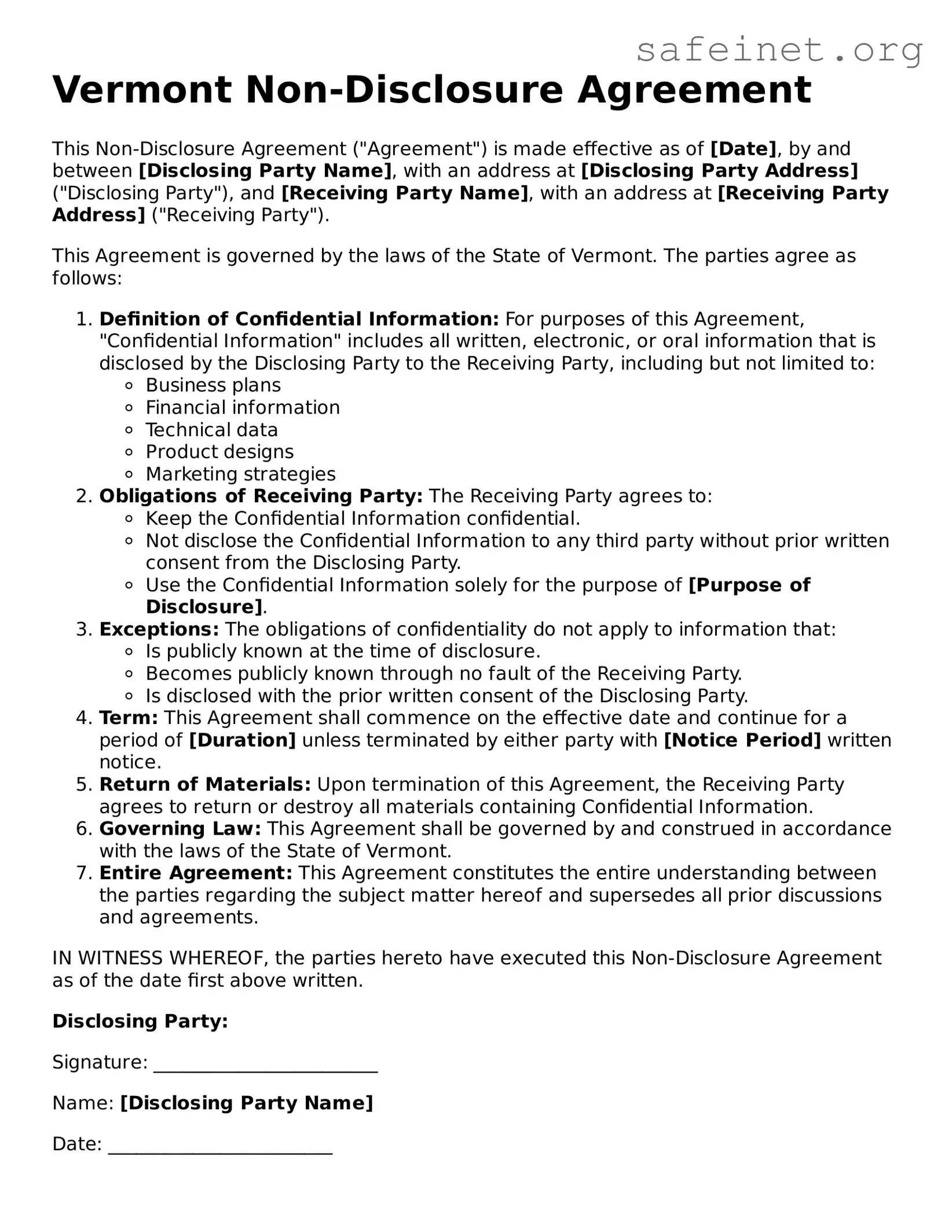
In the realm of business and professional relationships, confidentiality plays a crucial role in protecting sensitive information. The Vermont Non-disclosure Agreement (NDA) form serves as a vital tool for individuals and organizations looking to safeguard their proprietary data, trade secrets, and other confidential materials. This legally binding document outlines the obligations of the parties involved, ensuring that any shared information remains private. Key aspects of the Vermont NDA include the definition of confidential information, the duration of the confidentiality obligation, and the permissible uses of the disclosed information. Additionally, the form specifies the consequences of breaching the agreement, providing a clear framework for accountability. By utilizing this NDA, parties can foster trust and collaboration while minimizing the risk of information leaks that could jeopardize their competitive edge.
Vermont Non-Disclosure Agreement
This Non-Disclosure Agreement ("Agreement") is made effective as of [Date], by and between [Disclosing Party Name], with an address at [Disclosing Party Address] ("Disclosing Party"), and [Receiving Party Name], with an address at [Receiving Party Address] ("Receiving Party").
This Agreement is governed by the laws of the State of Vermont. The parties agree as follows:
IN WITNESS WHEREOF, the parties hereto have executed this Non-Disclosure Agreement as of the date first above written.
Disclosing Party:
Signature: ________________________
Name: [Disclosing Party Name]
Date: ________________________
Receiving Party:
Signature: ________________________
Name: [Receiving Party Name]
Date: ________________________
| Fact Name | Description |
|---|---|
| Purpose | The Vermont Non-disclosure Agreement (NDA) is designed to protect confidential information shared between parties. |
| Parties Involved | The NDA typically involves at least two parties: the disclosing party and the receiving party. |
| Governing Law | The NDA is governed by the laws of the State of Vermont, ensuring that any disputes are handled under Vermont law. |
| Duration of Confidentiality | The agreement specifies how long the information must remain confidential, which can vary based on the nature of the information. |
| Permitted Disclosures | The NDA outlines any exceptions where disclosure of the confidential information may be permitted, such as legal obligations. |
| Consequences of Breach | Breaching the NDA can lead to legal consequences, including potential damages and injunctions to prevent further disclosures. |
| Mutual vs. Unilateral | NDAs can be mutual, where both parties share confidential information, or unilateral, where only one party discloses information. |
After obtaining the Vermont Non-disclosure Agreement form, you will need to complete it accurately to ensure all necessary information is provided. This will help facilitate a clear understanding between the parties involved regarding confidentiality.
What is a Vermont Non-disclosure Agreement (NDA)?
A Vermont Non-disclosure Agreement is a legal contract designed to protect confidential information shared between parties. It ensures that sensitive information, such as business secrets, proprietary data, or trade secrets, remains confidential and is not disclosed to unauthorized individuals or entities.
Who should use a Vermont NDA?
Any individual or business that plans to share confidential information should consider using a Vermont NDA. This includes startups sharing ideas with potential investors, businesses engaging in partnerships, or employees accessing sensitive company data. It helps safeguard your interests and maintain confidentiality.
What information can be protected under a Vermont NDA?
A Vermont NDA can protect a wide range of information, including but not limited to business plans, financial data, marketing strategies, customer lists, and product designs. Essentially, any information that is not public and provides a competitive advantage can be covered by the NDA.
How long does the confidentiality obligation last?
The duration of confidentiality obligations varies based on the terms set in the NDA. Typically, the obligation lasts for a specified period, often between two to five years. However, some information may remain confidential indefinitely, especially if it is classified as a trade secret.
What happens if someone breaches the NDA?
If a party breaches the NDA, the affected party may seek legal remedies. This can include seeking damages for any losses incurred due to the breach or requesting injunctive relief to prevent further disclosure of the confidential information. Legal action can be costly, so it's essential to adhere to the terms outlined in the agreement.
Can an NDA be modified after it is signed?
Yes, an NDA can be modified after it is signed, but both parties must agree to the changes. It is advisable to document any modifications in writing to avoid misunderstandings. Verbal agreements may not be enforceable, so always put changes in writing.
Is a Vermont NDA enforceable in other states?
Generally, a Vermont NDA is enforceable in other states, but the enforceability can depend on the specific laws of the state in question. It's important to consider the jurisdiction and any governing law clauses included in the NDA. Consulting with a legal professional can provide clarity on enforceability across state lines.
Failing to clearly identify the parties involved. It is crucial to specify who is disclosing information and who is receiving it. Without this clarity, the agreement may not be enforceable.
Not defining the confidential information properly. A vague description can lead to misunderstandings about what information is protected. Be specific about the types of information considered confidential.
Overlooking the duration of confidentiality. The agreement should state how long the information must remain confidential. Failing to include a timeframe can lead to disputes later.
Neglecting to include exceptions to confidentiality. There are situations where disclosure may be necessary, such as legal obligations. Not addressing these exceptions can create legal issues.
Not including the governing law. Specify which state's laws will apply to the agreement. This is important for resolving any potential disputes.
Forgetting to include remedies for breach. The agreement should outline what happens if someone violates the terms. This can deter breaches and provide a clear course of action.
Using overly complex language. While legal terms may seem necessary, using simple language can make the agreement clearer and more accessible for all parties involved.
Failing to have all parties sign the agreement. An unsigned agreement is not legally binding. Ensure that everyone involved has reviewed and signed the document.
When entering into a Non-disclosure Agreement (NDA) in Vermont, several other forms and documents may be useful to ensure a comprehensive understanding of the terms and conditions involved. These documents help clarify responsibilities, protect sensitive information, and outline the framework of the relationship between parties. Below is a list of commonly used forms that accompany an NDA.
Incorporating these documents alongside a Vermont Non-disclosure Agreement can significantly enhance the protection of sensitive information and clarify the roles and responsibilities of all parties involved. Each form serves a specific purpose, contributing to a more secure and well-defined relationship.
The Vermont Non-Disclosure Agreement (NDA) shares similarities with the Confidentiality Agreement. Both documents are designed to protect sensitive information from being disclosed to unauthorized parties. A Confidentiality Agreement typically outlines the specific information that must be kept confidential, the obligations of the parties involved, and the duration of the confidentiality obligation. Like the NDA, it seeks to prevent the sharing of proprietary information, ensuring that trade secrets and other sensitive data remain protected.
Another document akin to the Vermont NDA is the Mutual Non-Disclosure Agreement. This type of agreement is particularly useful when both parties plan to share confidential information with one another. It establishes a reciprocal obligation to protect each other's sensitive information. The key similarity lies in the commitment to confidentiality, but the mutual aspect allows for a more balanced approach to information sharing.
The Employment Non-Disclosure Agreement is also comparable to the Vermont NDA. This document is often used by employers to safeguard their business interests when hiring employees. It requires employees to keep company secrets confidential during and after their employment. Like the Vermont NDA, it emphasizes the importance of protecting proprietary information, but it specifically targets the employer-employee relationship.
Similarly, the Proprietary Information Agreement serves a purpose similar to that of the Vermont NDA. This document is commonly used to protect proprietary information shared between businesses and their partners or contractors. It defines what constitutes proprietary information and outlines the obligations of the parties involved. Both agreements focus on maintaining confidentiality and preventing unauthorized disclosure of sensitive information.
The License Agreement can also be viewed as similar to the Vermont NDA in certain contexts. While primarily focused on granting rights to use intellectual property, a License Agreement often includes confidentiality clauses that protect the licensor's proprietary information. Both documents aim to safeguard sensitive information, although the License Agreement's primary function is to define the terms of use rather than solely to protect confidentiality.
Lastly, the Partnership Agreement may bear resemblance to the Vermont NDA when it includes confidentiality provisions. This document outlines the terms of a partnership between two or more parties, often incorporating clauses that protect shared confidential information. While the Partnership Agreement addresses a broader range of issues regarding the partnership, it also emphasizes the importance of confidentiality in the context of shared business interests, similar to the Vermont NDA.
When filling out the Vermont Non-disclosure Agreement (NDA) form, attention to detail is crucial. Here are some important guidelines to follow to ensure the process goes smoothly.
Following these guidelines will help protect your interests and maintain confidentiality. It is essential to approach this process with care and diligence.
Understanding the Vermont Non-disclosure Agreement (NDA) is crucial for anyone considering entering into one. However, several misconceptions can lead to confusion. Here’s a list of common misunderstandings about this important legal document:
By clarifying these misconceptions, individuals and businesses can better navigate the world of NDAs and protect their sensitive information effectively.
When considering the Vermont Non-disclosure Agreement (NDA) form, several important aspects should be noted to ensure proper use and compliance.
Understanding these key elements can facilitate a smoother process when drafting and executing the Vermont Non-disclosure Agreement.