In the realm of employment agreements, the Vermont Non-compete Agreement form plays a crucial role in defining the boundaries of professional relationships. This document is designed to protect employers' legitimate business interests while balancing the rights of employees to seek new opportunities. Key components of the form include the duration of the non-compete clause, the geographical area it covers, and the specific activities that are restricted. Employers must ensure that the terms are reasonable and not overly burdensome, as Vermont law emphasizes the need for fairness in these agreements. Additionally, the form requires clear language to avoid ambiguity, allowing both parties to understand their rights and obligations. By utilizing this form, employers can safeguard their trade secrets and client relationships, while employees can navigate their career paths with a clear understanding of any limitations they may face after leaving a job.
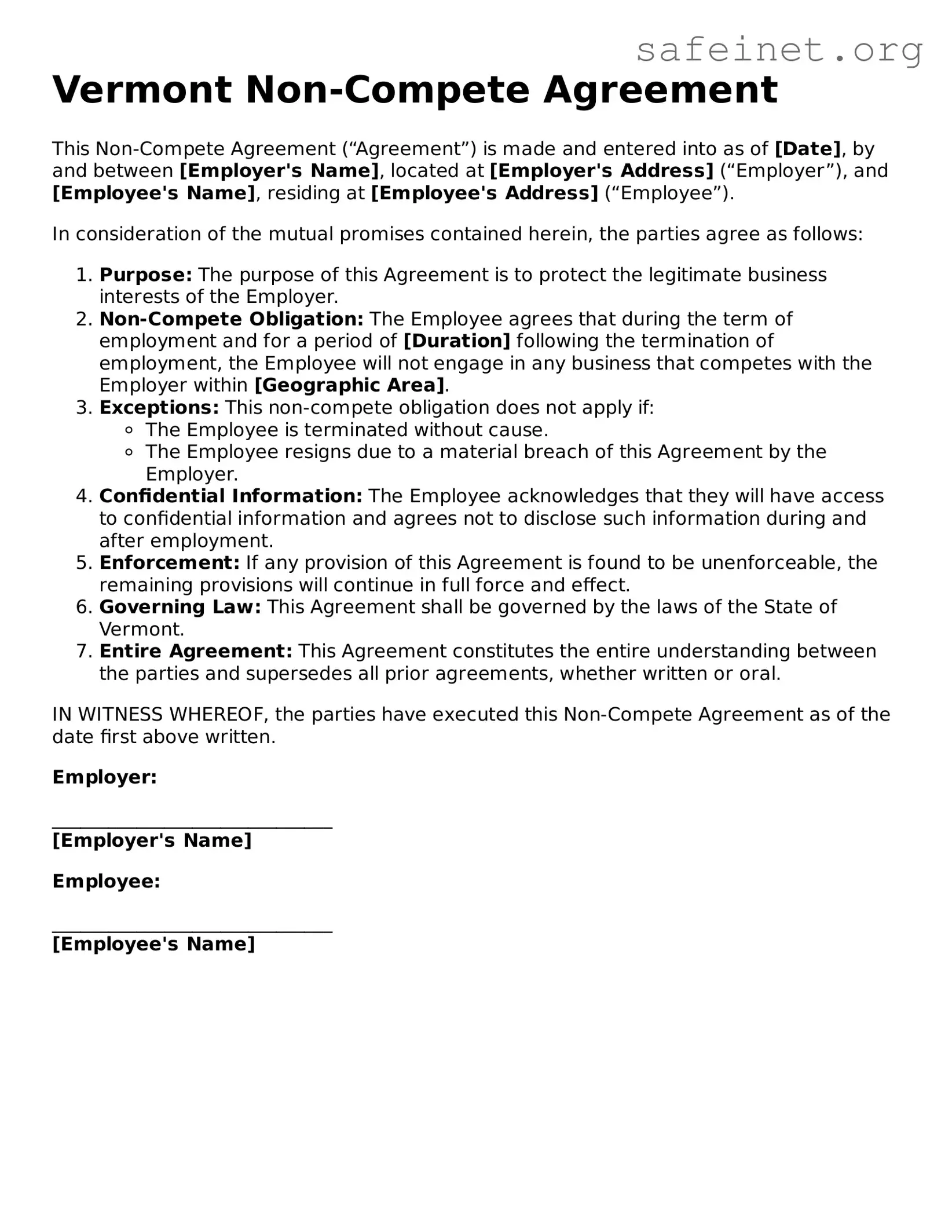
Vermont Non-Compete Agreement
This Non-Compete Agreement (“Agreement”) is made and entered into as of [Date], by and between [Employer's Name], located at [Employer's Address] (“Employer”), and [Employee's Name], residing at [Employee's Address] (“Employee”).
In consideration of the mutual promises contained herein, the parties agree as follows:
IN WITNESS WHEREOF, the parties have executed this Non-Compete Agreement as of the date first above written.
Employer:
______________________________
[Employer's Name]
Employee:
______________________________
[Employee's Name]
| Fact Name | Description |
|---|---|
| Governing Law | The Vermont Non-compete Agreement is governed by Vermont state law. |
| Enforceability | Non-compete agreements in Vermont are generally enforceable if they are reasonable in scope and duration. |
| Employee Protections | Vermont law prohibits non-compete agreements for certain employees, including those in low-wage positions. |
| Duration Limits | The agreement should specify a reasonable duration, typically not exceeding one year. |
| Geographic Scope | The geographic area covered by the non-compete must be reasonable and related to the employer's business interests. |
Filling out the Vermont Non-compete Agreement form is an important step in ensuring that both parties understand the terms of the agreement. After completing the form, it will need to be signed by both parties and kept on file for future reference. Here’s how to fill it out:
What is a Vermont Non-compete Agreement?
A Vermont Non-compete Agreement is a legal contract between an employer and an employee. It restricts the employee from working for a competitor or starting a similar business for a certain period after leaving the company. The goal is to protect the employer's business interests and confidential information.
Are Non-compete Agreements enforceable in Vermont?
Yes, Non-compete Agreements can be enforceable in Vermont, but they must meet certain criteria. The agreement should be reasonable in duration and geographic scope. It must also protect legitimate business interests, such as trade secrets or customer relationships. Courts will review the agreement carefully to ensure it is fair to both parties.
How long can a Non-compete Agreement last in Vermont?
The duration of a Non-compete Agreement in Vermont should be reasonable. Typically, agreements lasting six months to two years are more likely to be upheld. However, the specifics can vary based on the nature of the job and the industry. It's essential to ensure that the length of the restriction is justifiable.
Can I negotiate the terms of a Non-compete Agreement?
Yes, you can negotiate the terms of a Non-compete Agreement before signing it. If you feel that certain terms are too restrictive or unfair, it's important to discuss those concerns with your employer. Open communication can lead to a more balanced agreement that works for both parties.
What should I do if I think my Non-compete Agreement is unfair?
If you believe your Non-compete Agreement is unfair, consider seeking legal advice. A lawyer can help you understand your rights and options. They can also assist in negotiating terms or challenging the agreement if necessary. It's important to address any concerns early to avoid potential legal issues later.
Not reading the entire form: Many individuals skip sections or fail to understand the complete terms, leading to unintended consequences.
Using vague language: Ambiguous terms can create confusion. Be specific about the scope and duration of the non-compete.
Ignoring state laws: Vermont has specific regulations regarding non-compete agreements. Ensure compliance with local laws.
Failing to define “competitive activities”: Clearly outline what constitutes competition to avoid future disputes.
Not considering geographic limitations: Specify the geographical area where the non-compete applies to prevent overreach.
Overly restrictive terms: Agreements that are too broad may not be enforceable. Balance protection with fairness.
Neglecting to include a time frame: Specify how long the non-compete will last. Indefinite terms are often problematic.
Not consulting with a legal professional: Seek advice to ensure the agreement is legally sound and meets your needs.
Failing to keep a copy: Always retain a signed copy for your records. This is crucial for reference in case of disputes.
When entering into a Vermont Non-compete Agreement, several other forms and documents may be relevant to ensure clarity and protection for both parties involved. Below is a list of these documents, along with a brief description of each.
Understanding these documents can help both employers and employees navigate their rights and responsibilities effectively. Each form plays a vital role in creating a clear and fair working relationship, ensuring that all parties are on the same page regarding expectations and obligations.
The Vermont Non-compete Agreement form shares similarities with the Employment Contract. Both documents outline the terms of the employment relationship, including duties, rights, and obligations of the parties involved. While the employment contract focuses on job responsibilities and compensation, the non-compete agreement specifically addresses the limitations on the employee's ability to work in similar industries or for competitors after leaving the job. This ensures that sensitive company information remains protected.
Another document similar to the Vermont Non-compete Agreement is the Confidentiality Agreement. This agreement, often referred to as a Non-Disclosure Agreement (NDA), restricts the sharing of proprietary information. Like the non-compete, it aims to protect the employer's interests. However, while a confidentiality agreement primarily deals with information security, the non-compete focuses on employment restrictions following termination.
The Non-solicitation Agreement is also comparable. This document prevents former employees from soliciting clients or employees of the company after their departure. Similar to the non-compete agreement, it seeks to protect the company’s business relationships and workforce. However, a non-solicitation agreement may allow the former employee to work in the same industry, as long as they do not actively pursue the company's clients or employees.
The Proprietary Information Agreement is another related document. This agreement specifically addresses the handling of proprietary information and trade secrets during and after employment. It shares the goal of protecting the employer's intellectual property, much like the non-compete agreement. However, the proprietary information agreement does not restrict employment opportunities; rather, it focuses on confidentiality.
In addition, the Release of Claims document bears resemblance to the non-compete agreement. This document is often signed when an employee leaves a company, releasing the employer from any future claims. While it does not impose restrictions on future employment, it may include clauses that relate to non-compete terms, ensuring that the employee acknowledges their obligations under the non-compete agreement.
The Settlement Agreement can also be seen as similar. This document often arises when a dispute is resolved between an employer and employee. It may include non-compete clauses as part of the settlement terms. Like the non-compete agreement, it aims to protect the employer's business interests, particularly in cases where the employee might move to a competitor.
The Severance Agreement is another document that can relate to non-compete agreements. This agreement outlines the terms of severance pay and benefits upon termination. It may also include non-compete clauses, ensuring that the employee understands their restrictions after leaving the company. This provides the employer with an added layer of protection regarding their competitive position.
The Partnership Agreement is similar in that it may contain non-compete clauses for partners in a business. This document outlines the terms of the partnership, including profit sharing and responsibilities. Non-compete clauses within a partnership agreement help protect the business from partners who may wish to start a competing venture after leaving the partnership.
Lastly, the Independent Contractor Agreement can resemble the non-compete agreement. This document governs the relationship between a company and an independent contractor. It may include non-compete clauses to protect the company’s interests, similar to how it operates in an employment context. The key difference lies in the nature of the relationship, as independent contractors are not employees but still may have access to sensitive information.
When filling out the Vermont Non-compete Agreement form, it is essential to approach the process with care. Understanding what to do and what to avoid can help ensure that your rights and interests are protected. Below is a list of important guidelines to consider.
By following these guidelines, you can navigate the process of completing the Vermont Non-compete Agreement form with greater confidence and clarity. Taking the time to understand your rights will serve you well in the long run.
Non-compete agreements are often misunderstood, leading to confusion among employees and employers alike. Here are six common misconceptions about the Vermont Non-compete Agreement form:
This is not true. Vermont law places strict limits on the enforceability of non-compete agreements. They must be reasonable in scope and duration to be upheld in court.
Not all employees can be bound by a non-compete. Vermont law restricts these agreements, especially for low-wage workers, making it less likely that they will be enforceable.
This is misleading. While a non-compete may limit where and how one can work, it does not necessarily prevent all employment in the field. The specifics of the agreement dictate the limitations.
While it is common practice to have non-compete agreements signed at the beginning of employment, they can also be presented at any time during the employment relationship. However, consideration must be provided.
This is incorrect. Non-compete agreements typically have a defined duration, which must be reasonable. Once the specified time period expires, the agreement no longer applies.
This is a misconception. Non-compete agreements can vary significantly in terms of language, scope, and enforceability. Each agreement should be evaluated on its own terms.
Understanding these misconceptions can help individuals navigate the complexities of non-compete agreements in Vermont more effectively.
When considering a Non-compete Agreement in Vermont, it is essential to understand its implications and requirements. Here are six key takeaways to keep in mind: