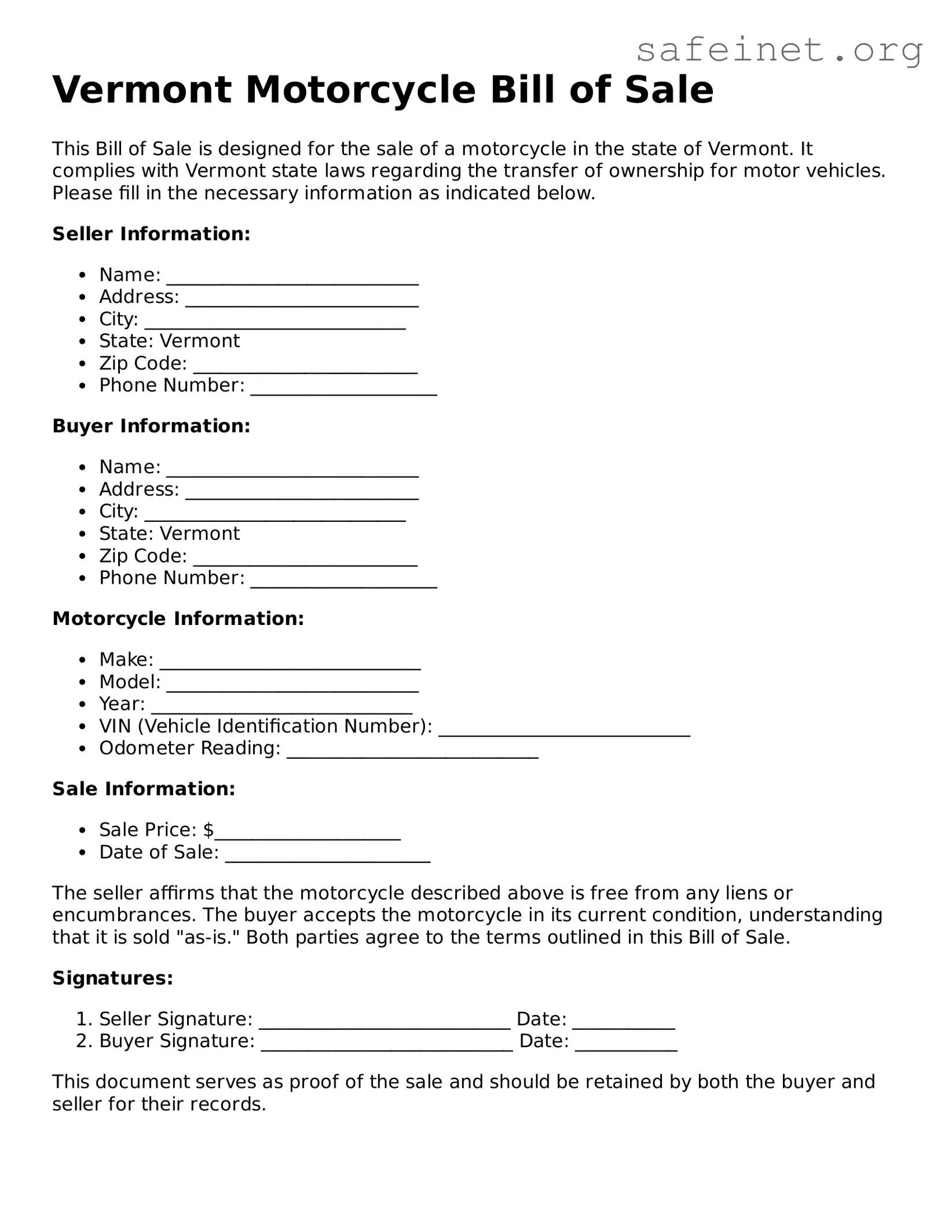
When buying or selling a motorcycle in Vermont, a Motorcycle Bill of Sale form is an essential document that facilitates the transfer of ownership. This form serves as a written record of the transaction, detailing important information such as the motorcycle's make, model, year, and Vehicle Identification Number (VIN). It also includes the seller's and buyer's names, addresses, and signatures, ensuring that both parties have a clear understanding of the sale. Additionally, the bill of sale may outline the purchase price and any conditions of the sale, providing legal protection for both the buyer and the seller. By completing this form, individuals can help prevent future disputes and ensure a smooth transition of ownership, making it a crucial step in the motorcycle buying process.
Vermont Motorcycle Bill of Sale
This Bill of Sale is designed for the sale of a motorcycle in the state of Vermont. It complies with Vermont state laws regarding the transfer of ownership for motor vehicles. Please fill in the necessary information as indicated below.
Seller Information:
Buyer Information:
Motorcycle Information:
Sale Information:
The seller affirms that the motorcycle described above is free from any liens or encumbrances. The buyer accepts the motorcycle in its current condition, understanding that it is sold "as-is." Both parties agree to the terms outlined in this Bill of Sale.
Signatures:
This document serves as proof of the sale and should be retained by both the buyer and seller for their records.
| Fact Name | Description |
|---|---|
| Purpose | The Vermont Motorcycle Bill of Sale form serves as a legal document that records the sale of a motorcycle between a seller and a buyer. |
| Governing Law | This form is governed by Vermont state laws related to vehicle sales and transfers, specifically Title 23, Chapter 13 of the Vermont Statutes. |
| Information Required | The form typically requires details such as the motorcycle's make, model, year, Vehicle Identification Number (VIN), and the sale price. |
| Signatures | Both the seller and buyer must sign the form to validate the transaction and confirm the transfer of ownership. |
| Notarization | While notarization is not required, having the bill of sale notarized can provide additional legal protection for both parties. |
| Record Keeping | It is advisable for both the seller and buyer to keep a copy of the completed bill of sale for their records, as it may be needed for registration or tax purposes. |
| Tax Implications | The sale price listed on the bill of sale may be used to determine sales tax obligations when registering the motorcycle. |
| Transfer of Title | Completing the bill of sale is often a necessary step in the process of transferring the title from the seller to the buyer. |
| Availability | The Vermont Motorcycle Bill of Sale form can typically be found online through state government websites or legal document services. |
Filling out the Vermont Motorcycle Bill of Sale form is a straightforward process. After completing the form, you will have a record of the transaction that can be used for registration and title transfer purposes. Make sure to gather all necessary information before you begin.
What is a Vermont Motorcycle Bill of Sale form?
The Vermont Motorcycle Bill of Sale form is a document used to record the sale of a motorcycle between a buyer and a seller. It serves as proof of the transaction and outlines important details such as the motorcycle's make, model, year, Vehicle Identification Number (VIN), sale price, and the names and addresses of both parties involved. This form is essential for the buyer to register the motorcycle in their name and for the seller to have a record of the sale.
Is the Vermont Motorcycle Bill of Sale form required for all motorcycle sales?
How do I complete the Vermont Motorcycle Bill of Sale form?
To complete the Vermont Motorcycle Bill of Sale form, gather all necessary information about the motorcycle and the parties involved. Fill in the motorcycle's make, model, year, and VIN. Include the sale price and the date of the transaction. Both the buyer and seller should sign the document to validate the sale. It is advisable to keep copies of the completed form for personal records.
Can I use a generic Bill of Sale for my motorcycle sale?
Yes, you can use a generic Bill of Sale for your motorcycle sale, but it is recommended to use the specific Vermont Motorcycle Bill of Sale form. This form is tailored to meet the state's requirements and includes all necessary details pertinent to motorcycle transactions. Using the appropriate form can help ensure that you have all the information needed for a smooth registration process.
What should I do if I lose the Bill of Sale after the transaction?
If the Bill of Sale is lost after the transaction, the buyer may still be able to register the motorcycle using other documentation, such as a title or previous registration. However, it is advisable for both parties to keep a copy of the Bill of Sale for their records. If necessary, the seller can create a new Bill of Sale, referencing the original transaction details, to provide to the buyer.
Where can I obtain a Vermont Motorcycle Bill of Sale form?
The Vermont Motorcycle Bill of Sale form can typically be obtained from the Vermont Department of Motor Vehicles (DMV) website or in person at a DMV office. Additionally, many online resources provide templates for the Bill of Sale, which can be customized to meet your needs. Ensure that any form you use complies with Vermont state requirements.
Incomplete Information: Many individuals forget to fill out all required fields, such as the buyer's and seller's names, addresses, and contact information. This can lead to delays in processing the sale.
Incorrect Vehicle Identification Number (VIN): A common mistake is providing an inaccurate VIN. This number is crucial for identifying the motorcycle, and any errors can cause significant issues down the line.
Failure to Sign: Some sellers neglect to sign the document, which is essential for validating the sale. Without a signature, the bill of sale may not be considered legally binding.
Not Including Sale Price: Leaving out the sale price is another frequent error. This information is important for both parties and can affect future tax obligations.
Omitting Date of Sale: Failing to include the date of the transaction can lead to confusion regarding ownership and liability. Always ensure the date is clearly stated.
Neglecting to Provide a Bill of Sale Copy: Many sellers forget to give the buyer a copy of the bill of sale. Both parties should retain a copy for their records.
Not Notarizing the Document: While notarization is not always required, some sellers choose to have the bill of sale notarized for added security. Skipping this step can sometimes lead to disputes.
Using Incorrect Form: Some individuals mistakenly use an outdated or incorrect version of the bill of sale form. It’s essential to use the most current version provided by the state.
Ignoring State-Specific Requirements: Each state may have unique requirements for motorcycle sales. Failing to adhere to Vermont’s specific rules can result in complications.
Not Disclosing Existing Liens: Sellers sometimes forget to mention any existing liens on the motorcycle. This can create legal issues for the buyer if not disclosed.
When purchasing or selling a motorcycle in Vermont, several important documents accompany the Motorcycle Bill of Sale form. Each document plays a crucial role in ensuring a smooth transaction and proper registration of the vehicle.
Having these documents ready and properly completed will facilitate a seamless transaction and help ensure compliance with Vermont's regulations. It is advisable to keep copies of all documents for personal records as well.
The Vermont Motorcycle Bill of Sale form shares similarities with the Vehicle Bill of Sale. Both documents serve to transfer ownership of a vehicle from one party to another. They include essential details such as the buyer and seller's names, addresses, and signatures, along with the vehicle's identification number (VIN) and sale price. This ensures that both parties have a clear record of the transaction, which can be vital for future reference or for legal purposes.
Another document akin to the Motorcycle Bill of Sale is the Boat Bill of Sale. Like the motorcycle version, this document facilitates the transfer of ownership for a watercraft. It contains similar information, including the buyer and seller's details, the boat's registration number, and the sale price. Both documents aim to provide a clear and legal record of the sale, protecting the interests of both parties involved.
The ATV Bill of Sale is also comparable to the Motorcycle Bill of Sale. This form is used for the sale of all-terrain vehicles and includes necessary information such as the VIN, buyer and seller information, and the agreed-upon sale price. Just like the motorcycle bill, it serves as proof of ownership transfer and is essential for registration purposes.
A classic car Bill of Sale shares many features with the Motorcycle Bill of Sale. This document is tailored for vintage or collectible vehicles and includes pertinent details such as the car's make, model, year, VIN, and sale price. Both documents provide legal protection for the buyer and seller, ensuring that ownership is properly documented and recognized.
The Trailer Bill of Sale is another document similar to the Motorcycle Bill of Sale. It is used to transfer ownership of a trailer, whether it be for personal use or commercial purposes. This form includes the buyer and seller's information, the trailer's identification number, and the sale price. Both documents serve the same purpose of legally recording the transaction and safeguarding the interests of both parties.
The Snowmobile Bill of Sale is also comparable to the Motorcycle Bill of Sale. This document is specifically designed for the sale of snowmobiles and includes similar elements such as the VIN, buyer and seller details, and sale price. Both forms are essential for ensuring that ownership is clearly transferred and documented, which is crucial for registration and potential future sales.
The RV Bill of Sale mirrors the Motorcycle Bill of Sale in many respects. This document is used for the sale of recreational vehicles and contains similar information, including the buyer and seller's names, the RV's VIN, and the sale price. Both documents provide a legal record of the transaction, protecting both parties in case of disputes or future ownership claims.
The Mobile Home Bill of Sale is another document that aligns closely with the Motorcycle Bill of Sale. It is used for the transfer of ownership of mobile homes and includes necessary details such as the buyer and seller's information, the home's serial number, and the sale price. Both documents serve to formalize the sale and ensure that ownership is properly recorded.
Lastly, the Firearm Bill of Sale is similar to the Motorcycle Bill of Sale in that it documents the transfer of ownership of a firearm. This document includes information about the buyer and seller, the firearm's make and model, and the sale price. Both forms provide a legal record of the transaction, which is important for compliance with local laws and regulations.
When filling out the Vermont Motorcycle Bill of Sale form, it’s important to be careful and thorough. Here are some guidelines to help you complete the form correctly.
By following these guidelines, you can ensure a smooth transaction and avoid potential pitfalls. Take your time and be thorough, and you'll be on the right track.
Understanding the Vermont Motorcycle Bill of Sale form can be challenging, especially with the various misconceptions that circulate. Here are eight common misunderstandings, clarified for your benefit.
While it may not be mandatory to have a Bill of Sale for every transaction, having one is highly recommended. It serves as proof of purchase and can help resolve disputes.
This is incorrect. A Bill of Sale is useful for both new and used motorcycles. It provides a record of the transaction regardless of the motorcycle's age.
This misconception overlooks the fact that each state has its own requirements. Vermont's Bill of Sale may differ from those in other states, so it’s important to use the correct format.
While signing the Bill of Sale is a significant step, other actions may still be necessary, such as transferring the title and registering the motorcycle with the DMV.
In Vermont, notarization is not a requirement for the Bill of Sale. However, having it notarized can add an extra layer of security and validation.
Both the buyer and the seller should retain a copy. This ensures that both parties have a record of the transaction, which can be crucial for future reference.
This is a common misunderstanding. The Bill of Sale is a receipt for the transaction, while the title is an official document that proves ownership of the motorcycle.
A verbal agreement is not sufficient. A written Bill of Sale provides clear evidence of the transaction and is essential for legal protection.
By addressing these misconceptions, individuals can navigate the process of buying or selling a motorcycle in Vermont more effectively. Having a clear understanding of the Bill of Sale can prevent potential issues down the line.
When completing the Vermont Motorcycle Bill of Sale form, there are several important aspects to keep in mind. This document serves as a crucial record for both the buyer and the seller. Here are some key takeaways:
Taking these steps seriously will facilitate a smooth transaction and ensure compliance with Vermont's regulations regarding motorcycle sales.