The Vermont Motor Vehicle Power of Attorney form is a vital document for anyone looking to delegate authority over vehicle-related matters. This form allows an individual, known as the principal, to appoint another person, referred to as the agent, to act on their behalf in transactions involving motor vehicles. Whether it’s registering a vehicle, transferring ownership, or handling title issues, this power of attorney simplifies processes that might otherwise require the principal’s direct involvement. It’s particularly useful for those who may be unable to attend to these matters in person due to distance, health issues, or busy schedules. Understanding how to complete this form correctly is essential, as it ensures that the appointed agent has the legal authority to perform necessary actions without complications. Additionally, knowing the specific powers granted and any limitations can help prevent misunderstandings and protect the interests of the principal. Overall, the Vermont Motor Vehicle Power of Attorney form serves as a practical tool for managing vehicle affairs efficiently and effectively.
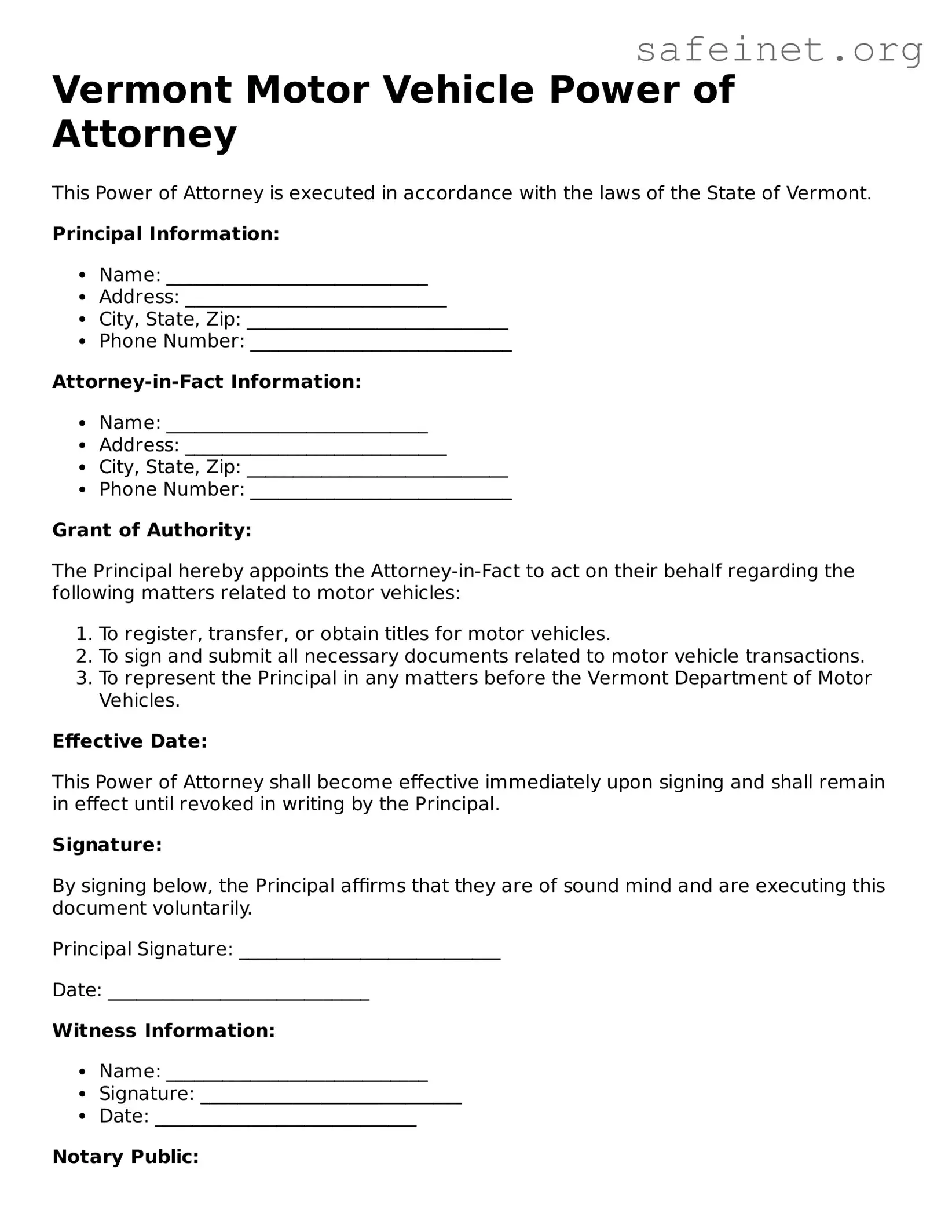
Vermont Motor Vehicle Power of Attorney
This Power of Attorney is executed in accordance with the laws of the State of Vermont.
Principal Information:
Attorney-in-Fact Information:
Grant of Authority:
The Principal hereby appoints the Attorney-in-Fact to act on their behalf regarding the following matters related to motor vehicles:
Effective Date:
This Power of Attorney shall become effective immediately upon signing and shall remain in effect until revoked in writing by the Principal.
Signature:
By signing below, the Principal affirms that they are of sound mind and are executing this document voluntarily.
Principal Signature: ____________________________
Date: ____________________________
Witness Information:
Notary Public:
State of Vermont
County of ____________________________
Subscribed and sworn to before me this ____ day of __________, 20__.
Notary Public Signature: ____________________________
My Commission Expires: ____________________________
| Fact Name | Details |
|---|---|
| Purpose | The Vermont Motor Vehicle Power of Attorney form allows an individual to designate another person to act on their behalf regarding motor vehicle transactions. |
| Governing Law | This form is governed by Vermont Statutes Title 23, Chapter 4, which pertains to motor vehicles. |
| Signature Requirement | The form must be signed by the principal (the person granting the power) in the presence of a notary public. |
| Revocation | The power of attorney can be revoked at any time by the principal, provided that a written notice is given to the agent. |
Once you have the Vermont Motor Vehicle Power of Attorney form in front of you, it’s time to get started on filling it out. This form allows you to designate someone to act on your behalf regarding motor vehicle transactions. Carefully follow the steps below to ensure everything is completed accurately.
After completing the form, ensure you keep a copy for your records. You may need to provide the original or a copy to your attorney-in-fact or relevant authorities when they act on your behalf.
What is a Vermont Motor Vehicle Power of Attorney form?
The Vermont Motor Vehicle Power of Attorney form is a legal document that allows an individual to appoint another person to act on their behalf regarding motor vehicle transactions. This can include tasks like transferring ownership, registering a vehicle, or obtaining title documents. It is particularly useful when the vehicle owner cannot be present to complete these actions themselves.
Who can be appointed as an agent in the Power of Attorney?
Any competent adult can be appointed as your agent. This could be a family member, friend, or even a professional service. It’s important to choose someone you trust, as they will have the authority to make decisions related to your vehicle on your behalf.
How do I complete the Vermont Motor Vehicle Power of Attorney form?
To complete the form, you will need to provide your name and contact information, along with the details of the agent you are appointing. You must also specify the powers you are granting them. After filling out the form, both you and your agent should sign it. It may be a good idea to have the signatures notarized to ensure the document is legally binding.
Is there a fee associated with filing this form?
Generally, there is no fee for completing the Vermont Motor Vehicle Power of Attorney form itself. However, if you need to have the document notarized, there may be a small fee for that service. Additionally, there could be fees associated with any vehicle transactions that your agent conducts on your behalf.
How long is the Power of Attorney valid?
The Vermont Motor Vehicle Power of Attorney remains valid until you revoke it or until the specific task or transaction is completed. If you wish to revoke the power granted to your agent, you must do so in writing. It’s important to communicate any changes to your agent promptly to avoid confusion.
What should I do if my agent is unable to fulfill their duties?
If your appointed agent is unable to fulfill their duties, you have the option to revoke their authority and appoint a new agent. It’s advisable to do this in writing and inform both the previous agent and any relevant parties, such as the DMV, to ensure that your vehicle transactions can continue without interruption.
Failing to include the principal's name and address. Without this information, the form lacks essential identification.
Not specifying the agent's name clearly. The agent must be identifiable to avoid confusion.
Leaving out the date of signing. This detail is crucial for establishing the document's validity.
Using an incomplete or incorrect signature. The principal must sign the form as required to ensure its enforceability.
Neglecting to have the form witnessed or notarized when necessary. Some situations may require additional verification.
Not providing clear instructions about the powers granted to the agent. Ambiguity can lead to misunderstandings.
Forgetting to check the expiration date of the power of attorney. An expired document is no longer valid.
Failing to provide a copy of the form to the agent. The agent needs this for reference when acting on behalf of the principal.
Not considering the state laws that may affect the form. Each state has specific requirements that must be followed.
Overlooking the need for updates to the form if circumstances change. Life events can necessitate revisions to the document.
The Vermont Motor Vehicle Power of Attorney form allows an individual to designate another person to act on their behalf regarding motor vehicle transactions. This legal document is often accompanied by other forms that facilitate various aspects of vehicle ownership and transfer. Below are four common forms and documents that are frequently used alongside the Power of Attorney in Vermont.
Understanding these documents can streamline the process of vehicle transactions in Vermont. When used together, they help ensure that all legal requirements are met, providing clarity and protection for both buyers and sellers.
The Vermont Motor Vehicle Power of Attorney form shares similarities with the General Power of Attorney. Both documents grant an individual the authority to act on behalf of another person in various matters. However, the General Power of Attorney is broader in scope, allowing the agent to manage financial, legal, and personal affairs, while the Vermont Motor Vehicle Power of Attorney is specifically tailored for matters related to motor vehicle transactions. This specificity can help streamline processes related to vehicle registration, title transfers, and other automotive concerns.
Another document similar to the Vermont Motor Vehicle Power of Attorney is the Durable Power of Attorney. Like the Vermont form, the Durable Power of Attorney allows one person to designate another to act on their behalf. The key difference lies in the durability of the authority granted. The Durable Power of Attorney remains effective even if the principal becomes incapacitated, whereas the Vermont Motor Vehicle Power of Attorney typically becomes void if the principal is unable to make decisions.
The Limited Power of Attorney also bears resemblance to the Vermont Motor Vehicle Power of Attorney. This document allows the principal to specify particular tasks or transactions that the agent can perform. In contrast to the Vermont form, which is focused on motor vehicle matters, the Limited Power of Attorney can cover a variety of specific tasks. Both documents empower individuals to delegate authority while maintaining control over the scope of that authority.
The Medical Power of Attorney is another related document, though it serves a different purpose. This form allows an individual to designate someone to make healthcare decisions on their behalf if they become unable to do so. While the Vermont Motor Vehicle Power of Attorney deals with automotive matters, both documents underscore the importance of appointing trusted individuals to act in one's best interests during specific circumstances.
A Bill of Sale is also comparable, particularly in its use within vehicle transactions. While the Vermont Motor Vehicle Power of Attorney grants authority to act on behalf of the principal, a Bill of Sale documents the transfer of ownership of a vehicle. Both are crucial in the process of buying or selling a vehicle, but they serve distinct roles in the transaction.
The Vehicle Title Application is another document that shares a connection with the Vermont Motor Vehicle Power of Attorney. When someone uses the Power of Attorney to facilitate a vehicle transaction, they may also need to complete a Vehicle Title Application. This application is necessary for registering a vehicle under a new owner’s name. Both documents work in tandem to ensure proper ownership transfer and compliance with state regulations.
The Release of Liability form is similar in that it addresses ownership and responsibility issues related to vehicles. When a vehicle is sold, the seller often completes a Release of Liability to inform the state that they are no longer responsible for the vehicle. The Vermont Motor Vehicle Power of Attorney may be utilized during this process, allowing the agent to act on behalf of the seller to complete necessary paperwork.
The Affidavit of Heirship is another document that can relate to vehicle ownership, especially in cases where a vehicle is inherited. This affidavit serves as a legal declaration of the rightful heirs of a deceased person's estate, including any vehicles. While the Vermont Motor Vehicle Power of Attorney allows an agent to manage vehicle transactions, the Affidavit of Heirship is used to establish ownership in situations involving inheritance.
Finally, the Title Transfer form is directly connected to the Vermont Motor Vehicle Power of Attorney. This form is required when ownership of a vehicle is transferred from one person to another. The Power of Attorney can empower an agent to complete this form on behalf of the principal, facilitating a smooth transfer process. Both documents are integral to ensuring that vehicle ownership is properly documented and recognized by the state.
When completing the Vermont Motor Vehicle Power of Attorney form, it's essential to follow specific guidelines to ensure accuracy and legality. Here are some important dos and don'ts to consider:
Understanding the Vermont Motor Vehicle Power of Attorney form is essential for anyone looking to manage vehicle-related transactions on behalf of another person. However, several misconceptions can lead to confusion. Here are nine common misconceptions:
This is not true. Individuals can create a Power of Attorney form themselves, as long as they follow the state’s guidelines.
While many people associate Power of Attorney with financial decisions, it can also cover vehicle-related issues, such as title transfers and registration.
This misconception is false. A Power of Attorney can be revoked at any time, provided the principal is competent to do so.
The agent can be anyone the principal trusts, including friends or professional services, as long as they are of legal age.
While the form is specific to Vermont, a Power of Attorney can be recognized in other states, depending on their laws.
This is incorrect. A Power of Attorney can grant broad or limited powers, depending on how it is drafted.
Not all Powers of Attorney are created equal. They can vary significantly in terms of authority granted and specific purposes.
This is a misconception. The principal retains control and can dictate the terms of the Power of Attorney.
In Vermont, certain Powers of Attorney may require witnesses or notarization to be valid, depending on the specific circumstances.
By clearing up these misconceptions, individuals can better understand the Vermont Motor Vehicle Power of Attorney form and how it can serve their needs.
When it comes to handling motor vehicle transactions in Vermont, the Motor Vehicle Power of Attorney form is an essential tool. Here are some key takeaways to keep in mind:
Understanding these points can help ensure that your experience with the Vermont Motor Vehicle Power of Attorney form is smooth and effective. Always consider consulting with a legal professional if you have specific questions or concerns.