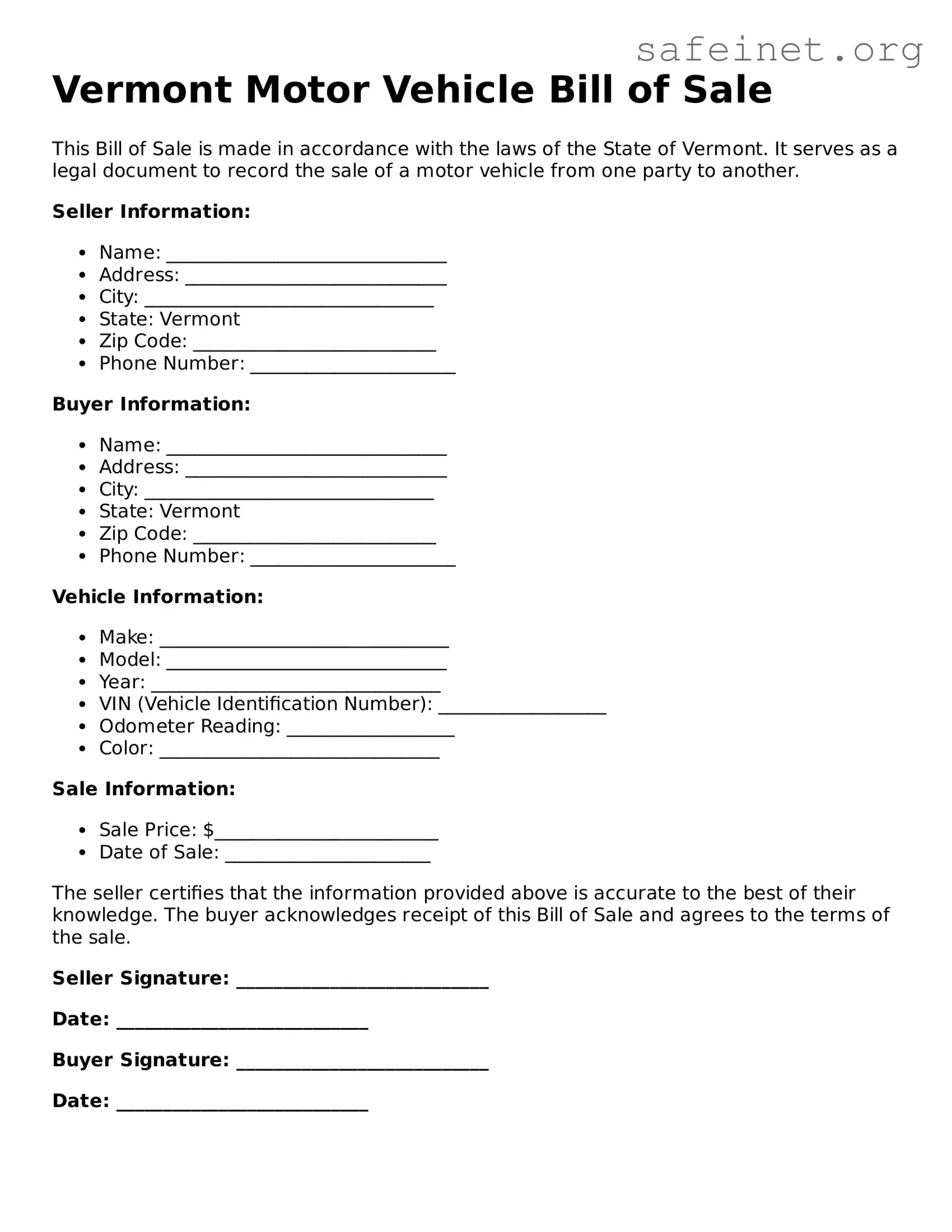
When buying or selling a vehicle in Vermont, one crucial document plays a significant role in the transaction: the Motor Vehicle Bill of Sale form. This form serves as a legal record that outlines the details of the sale, providing essential information such as the names and addresses of both the buyer and seller, the vehicle's identification number (VIN), make, model, and year. Additionally, it includes the sale price and the date of the transaction, ensuring that both parties have a clear understanding of the terms. The form not only protects the interests of both the buyer and seller but also serves as proof of ownership transfer. It is important to note that while the Bill of Sale is not required for every vehicle transaction in Vermont, having one can simplify the process of registering the vehicle with the Department of Motor Vehicles (DMV) and can be particularly useful in the event of any disputes. By properly completing this form, individuals can ensure a smoother transaction and a clear record of ownership for their vehicle.
Vermont Motor Vehicle Bill of Sale
This Bill of Sale is made in accordance with the laws of the State of Vermont. It serves as a legal document to record the sale of a motor vehicle from one party to another.
Seller Information:
Buyer Information:
Vehicle Information:
Sale Information:
The seller certifies that the information provided above is accurate to the best of their knowledge. The buyer acknowledges receipt of this Bill of Sale and agrees to the terms of the sale.
Seller Signature: ___________________________
Date: ___________________________
Buyer Signature: ___________________________
Date: ___________________________
| Fact Name | Description |
|---|---|
| Purpose | The Vermont Motor Vehicle Bill of Sale form is used to document the sale of a vehicle between a buyer and a seller. |
| Governing Law | This form is governed by Vermont state law, specifically Title 23, Chapter 4 of the Vermont Statutes Annotated. |
| Required Information | Essential details include the vehicle's make, model, year, VIN, and the sale price. |
| Signatures | Both the seller and the buyer must sign the document to make it legally binding. |
| Transfer of Ownership | The Bill of Sale serves as proof of ownership transfer and is necessary for registering the vehicle in the buyer's name. |
| Notarization | While notarization is not mandatory, it is highly recommended to enhance the document's authenticity. |
| Record Keeping | Both parties should keep a copy of the completed Bill of Sale for their records, as it may be needed for future reference. |
Once you have the Vermont Motor Vehicle Bill of Sale form in front of you, it is time to fill it out accurately. This form is essential for transferring ownership of a vehicle from one party to another. Careful attention to detail will ensure a smooth transaction.
What is a Vermont Motor Vehicle Bill of Sale?
A Vermont Motor Vehicle Bill of Sale is a legal document that records the sale of a vehicle between a seller and a buyer. This form serves as proof of the transaction and outlines important details such as the vehicle's make, model, year, Vehicle Identification Number (VIN), and the sale price. It protects both parties by providing a clear record of the sale and can be useful for future reference, especially for title transfers or registration purposes.
Do I need a Bill of Sale to sell a vehicle in Vermont?
While a Bill of Sale is not legally required to sell a vehicle in Vermont, it is highly recommended. This document can help establish ownership and provide evidence of the sale in case of disputes. Additionally, if the buyer needs to register the vehicle or apply for a title, having a Bill of Sale can simplify the process and ensure that all necessary information is documented.
What information should be included in the Bill of Sale?
A comprehensive Bill of Sale should include several key pieces of information. This includes the names and addresses of both the seller and the buyer, the vehicle's details (make, model, year, VIN, and odometer reading), the sale price, and the date of the transaction. Both parties should sign the document to confirm their agreement to the terms of the sale. Including this information helps ensure clarity and reduces the risk of misunderstandings.
Can I create my own Bill of Sale, or do I need a specific form?
You can create your own Bill of Sale as long as it includes all the necessary information. However, using a specific form can help ensure that you don’t miss any important details. Vermont provides a standard Bill of Sale form that you can use, which simplifies the process and ensures that all required information is included. You can often find this form online or at local DMV offices.
What should I do with the Bill of Sale after the transaction?
After completing the transaction, both the seller and the buyer should keep a copy of the Bill of Sale for their records. The seller should retain it as proof that they no longer own the vehicle, while the buyer will need it for registration and title transfer purposes. It’s a good idea to store these documents in a safe place, as they may be needed for future reference or in case of any disputes that arise later.
Failing to include the date of sale. This is crucial for both parties to establish when the transaction took place.
Not providing accurate vehicle information. This includes the make, model, year, and VIN (Vehicle Identification Number). Incorrect details can lead to confusion or disputes later.
Omitting the purchase price. This amount should reflect the agreed-upon price for the vehicle. Leaving it blank can create issues with taxes and registration.
Not signing the form. Both the buyer and seller must sign the Bill of Sale. A missing signature can invalidate the document.
Using an outdated version of the form. Always ensure you are using the most current version to avoid any compliance issues.
Forgetting to include contact information. Both parties should provide their names, addresses, and phone numbers for future reference.
Neglecting to check for liens or encumbrances on the vehicle. Buyers should ensure the vehicle is free of any legal claims before completing the sale.
Not keeping a copy of the Bill of Sale. Both parties should retain a copy for their records. This can be important for future reference or disputes.
Failing to verify the identity of the seller. Buyers should confirm that the seller is the rightful owner of the vehicle to avoid scams.
When completing a vehicle transaction in Vermont, several important documents accompany the Motor Vehicle Bill of Sale. These documents help ensure a smooth transfer of ownership and compliance with state regulations.
Having these documents prepared and properly filled out can simplify the vehicle transfer process. This approach helps protect both the buyer and the seller, ensuring a clear and legal transaction.
The Vermont Motor Vehicle Bill of Sale form shares similarities with the general Bill of Sale, which is a document used in many states for the transfer of ownership of personal property. This document outlines the details of the transaction, including the buyer and seller’s information, a description of the item being sold, and the sale price. Like the Vermont form, a general Bill of Sale serves as proof of ownership transfer and can be used for various items, from furniture to electronics. The clarity and specificity in both documents help protect the interests of both parties involved in the sale.
Another document that resembles the Vermont Motor Vehicle Bill of Sale is the Boat Bill of Sale. This document is specifically tailored for the sale of boats and includes similar elements such as the buyer and seller’s names, the boat's description, and the sale price. Both forms serve the same purpose: to provide a legal record of the transaction and establish ownership transfer. Just like with motor vehicles, having a Boat Bill of Sale can be crucial for registration and insurance purposes.
The Motorcycle Bill of Sale is also comparable to the Vermont Motor Vehicle Bill of Sale. This document is used when buying or selling motorcycles and contains similar information, including the motorcycle’s make, model, and Vehicle Identification Number (VIN). Both forms ensure that the transaction is documented, helping to prevent disputes and offering protection to both the buyer and seller. The Motorcycle Bill of Sale also serves as a vital record for registration and titling.
A more specialized document is the RV Bill of Sale, which is used for the sale of recreational vehicles. Much like the Vermont Motor Vehicle Bill of Sale, it includes essential details about the buyer and seller, a description of the RV, and the sale price. Both documents aim to formalize the transaction and provide proof of ownership, which is important for both registration and potential future sales.
The Trailer Bill of Sale is another document that aligns closely with the Vermont Motor Vehicle Bill of Sale. This form is specifically designed for the sale of trailers, whether they are utility trailers, travel trailers, or others. Similar to the motor vehicle bill of sale, it includes the necessary details to complete the transaction and serves as a legal record of ownership transfer. This ensures that both parties have clarity and protection in the sale process.
The Commercial Vehicle Bill of Sale serves a similar purpose for the sale of commercial vehicles. This document includes the same fundamental elements as the Vermont form, such as identification of the buyer and seller, a description of the vehicle, and the sale price. It is particularly important for businesses that need to document the transfer of ownership for tax and liability purposes, ensuring that all legal requirements are met.
The Aircraft Bill of Sale is another document that parallels the Vermont Motor Vehicle Bill of Sale. Used for the sale of aircraft, this form contains detailed information about the aircraft, including its make, model, and serial number, similar to how a vehicle’s details are recorded. Both documents aim to provide legal proof of ownership transfer, which is essential for registration and compliance with aviation regulations.
The Mobile Home Bill of Sale is also akin to the Vermont Motor Vehicle Bill of Sale. This document is specifically for the sale of mobile homes and includes information about the buyer, seller, and the mobile home itself. Like the motor vehicle bill of sale, it serves as a legal record of the transaction, ensuring that ownership is clearly established and that both parties have documentation of the sale.
Lastly, the Equipment Bill of Sale is comparable to the Vermont Motor Vehicle Bill of Sale when it comes to the sale of heavy machinery or equipment. This document includes details about the equipment, the buyer and seller, and the sale price. Both documents provide necessary legal protection and clarity, ensuring that ownership is transferred correctly and that both parties are aware of their rights and responsibilities in the transaction.
When filling out the Vermont Motor Vehicle Bill of Sale form, it is essential to follow certain guidelines to ensure the document is completed accurately. Below is a list of recommended actions and those to avoid.
Understanding the Vermont Motor Vehicle Bill of Sale form is essential for anyone buying or selling a vehicle in the state. However, several misconceptions often arise. Here’s a look at seven common misunderstandings:
Many people believe a bill of sale is only needed for dealership transactions. In reality, it is crucial for private sales as well, providing proof of the transaction and protecting both parties.
Some assume that a bill of sale is standardized across all states. Each state, including Vermont, has its specific requirements and forms, so using the correct one is vital.
While notarization is not always required, having the bill of sale notarized can add an extra layer of legitimacy and protection for both the buyer and seller.
Some people think that only the seller's signature is necessary. In fact, both the buyer and seller should sign the bill of sale to validate the transaction.
Many believe that a bill of sale is irrelevant for taxes. However, it serves as proof of the sale price, which can be important when calculating sales tax and for future reference.
Some individuals think that a verbal agreement is enough to finalize a sale. This is misleading; a written bill of sale provides clear documentation of the transaction.
People often think they can fill out the bill of sale after the transaction has occurred. However, it’s best to complete it at the time of sale to ensure accuracy and agreement on the details.
By addressing these misconceptions, buyers and sellers can navigate the vehicle transaction process more effectively and protect their interests.
When filling out and using the Vermont Motor Vehicle Bill of Sale form, there are several important points to keep in mind. These key takeaways can help ensure a smooth transaction.
By following these guidelines, individuals can help facilitate a successful vehicle sale in Vermont.