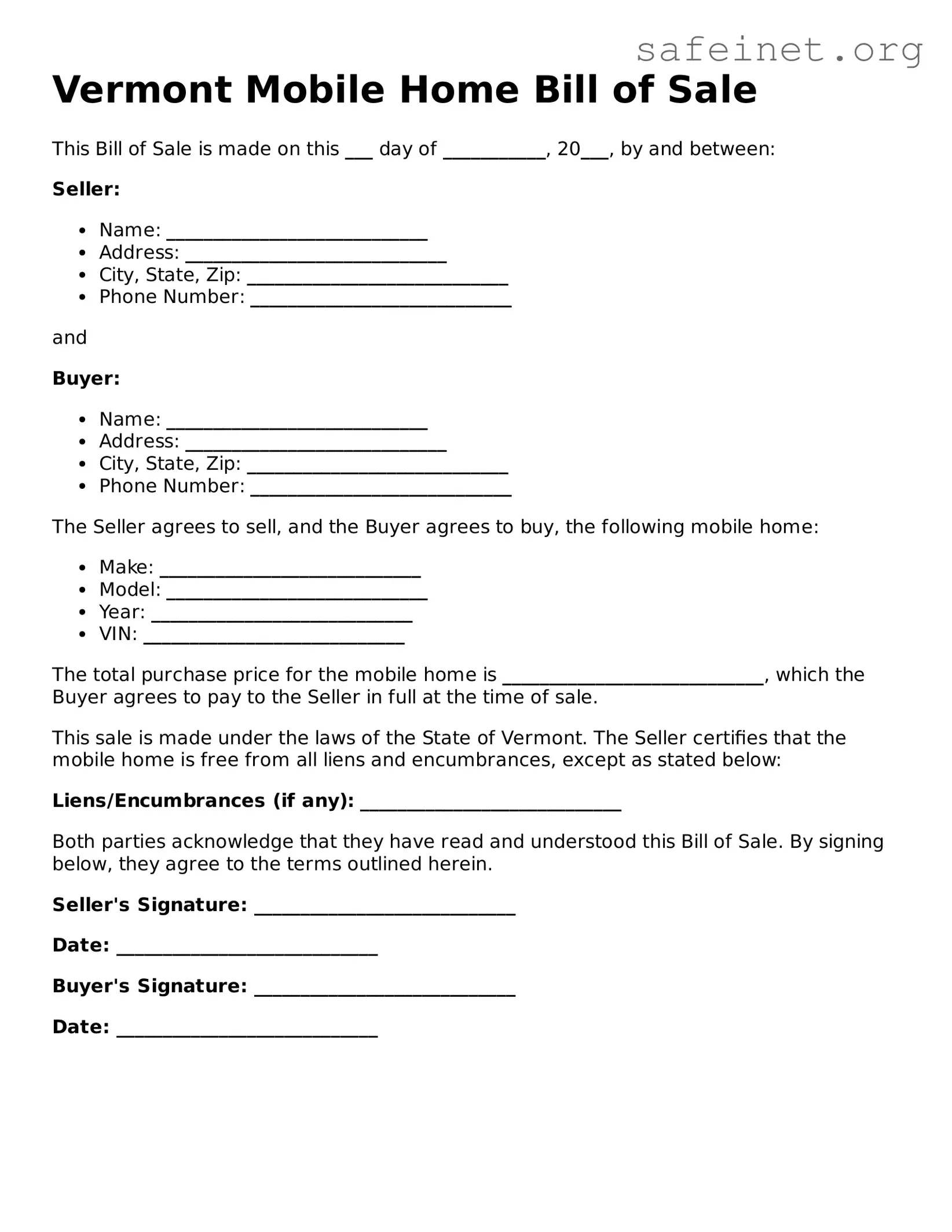
The Vermont Mobile Home Bill of Sale form serves as a crucial document in the transfer of ownership for mobile homes within the state. This form outlines essential details such as the names and addresses of the buyer and seller, a description of the mobile home being sold, and the purchase price. It also includes information regarding the mobile home’s identification number, which is vital for registration purposes. By providing a clear record of the transaction, the form helps protect both parties involved, ensuring that the seller can confirm the sale and the buyer can establish ownership. Additionally, the document may require signatures from both parties, signifying their agreement to the terms outlined. Understanding the importance of this form can aid individuals in navigating the complexities of mobile home ownership transfers, making the process smoother and more transparent.
Vermont Mobile Home Bill of Sale
This Bill of Sale is made on this ___ day of ___________, 20___, by and between:
Seller:
and
Buyer:
The Seller agrees to sell, and the Buyer agrees to buy, the following mobile home:
The total purchase price for the mobile home is ____________________________, which the Buyer agrees to pay to the Seller in full at the time of sale.
This sale is made under the laws of the State of Vermont. The Seller certifies that the mobile home is free from all liens and encumbrances, except as stated below:
Liens/Encumbrances (if any): ____________________________
Both parties acknowledge that they have read and understood this Bill of Sale. By signing below, they agree to the terms outlined herein.
Seller's Signature: ____________________________
Date: ____________________________
Buyer's Signature: ____________________________
Date: ____________________________
| Fact Name | Description |
|---|---|
| Purpose | The Vermont Mobile Home Bill of Sale form is used to document the sale of a mobile home between a seller and a buyer. |
| Governing Law | This form is governed by Vermont Statutes Title 9, Chapter 137, which covers the sale of mobile homes. |
| Parties Involved | The form requires the names and addresses of both the seller and the buyer, ensuring clear identification of all parties. |
| Mobile Home Description | A detailed description of the mobile home is necessary, including make, model, year, and Vehicle Identification Number (VIN). |
| Purchase Price | The agreed-upon purchase price must be clearly stated to avoid future disputes regarding the transaction. |
| Payment Terms | The form may outline payment terms, including whether the transaction is a cash sale or involves financing. |
| Signatures | Both parties are required to sign the form, indicating their agreement to the terms of the sale. |
| Witness Requirement | While not mandatory, having a witness sign the form can provide additional validation to the transaction. |
| Record Keeping | It is advisable for both parties to keep a copy of the completed Bill of Sale for their records and future reference. |
Once you have the Vermont Mobile Home Bill of Sale form ready, you will need to provide specific information to complete it. This process ensures that all necessary details are accurately recorded, which is essential for the transfer of ownership.
What is a Vermont Mobile Home Bill of Sale?
A Vermont Mobile Home Bill of Sale is a legal document that records the sale of a mobile home between a seller and a buyer. It provides essential details about the transaction, including the names of both parties, the mobile home's identification details, and the sale price. This document serves as proof of ownership transfer and can be crucial for future transactions or registrations.
Why do I need a Bill of Sale for my mobile home?
A Bill of Sale is important for several reasons. It legally confirms the transfer of ownership from the seller to the buyer. This document protects both parties by providing a clear record of the transaction. Additionally, it may be required by the state when registering the mobile home or applying for a title.
What information is included in the Vermont Mobile Home Bill of Sale?
The Bill of Sale typically includes the names and addresses of the seller and buyer, a description of the mobile home (including make, model, year, and identification number), the sale price, and the date of the transaction. It may also include any warranties or conditions related to the sale.
Is the Bill of Sale required to register my mobile home in Vermont?
Yes, to register a mobile home in Vermont, you will need a Bill of Sale. This document serves as proof of ownership and is often required by the Vermont Department of Motor Vehicles (DMV) when applying for a title or registration. Without it, you may face difficulties in the registration process.
Can I create my own Bill of Sale, or do I need a specific form?
You can create your own Bill of Sale, but it must include all necessary information to be legally binding. Using a specific form designed for Vermont mobile home sales can help ensure that you include all required details. This can simplify the process and reduce the risk of missing important information.
Do I need to have the Bill of Sale notarized?
Notarization is not typically required for a Vermont Mobile Home Bill of Sale. However, having it notarized can add an extra layer of security and authenticity to the document. This may be especially helpful in case of future disputes or for proving the transaction's validity.
What should I do after completing the Bill of Sale?
After completing the Bill of Sale, both the seller and buyer should keep a copy for their records. The seller should also provide the buyer with any additional documents, such as the mobile home's title. Finally, the buyer should take the Bill of Sale to the DMV to register the mobile home and obtain a new title in their name.
What if there are issues with the sale after the Bill of Sale is signed?
If issues arise after the Bill of Sale is signed, both parties should first refer to the terms outlined in the document. If disputes cannot be resolved amicably, it may be necessary to seek legal advice or mediation. Having a well-drafted Bill of Sale can help clarify responsibilities and rights, making it easier to address any problems that may come up.
How can I ensure the Bill of Sale is valid?
To ensure the Bill of Sale is valid, make sure it includes all required information and is signed by both parties. Keeping copies for your records is also essential. If needed, consider consulting with a legal professional to confirm that the document meets all legal requirements for your specific situation.
Incomplete Information: One common mistake is not filling out all required fields. Ensure that the names, addresses, and other essential details of both the buyer and seller are complete. Missing information can lead to confusion or disputes later on.
Incorrect Mobile Home Details: Providing inaccurate information about the mobile home itself is another frequent error. Double-check the make, model, year, and identification number. Any discrepancies may complicate the transfer of ownership.
Not Signing the Document: Failing to sign the Bill of Sale is a critical oversight. Both the seller and buyer must sign the document for it to be legally binding. Without signatures, the transaction may not be recognized.
Neglecting to Keep Copies: After completing the form, some individuals forget to make copies. It's important to retain a copy for personal records. This can serve as proof of the transaction and protect both parties in case of future issues.
When completing a transaction involving a mobile home in Vermont, several additional forms and documents may be necessary to ensure a smooth process. These documents help clarify ownership, provide necessary disclosures, and facilitate registration with the state. Below is a list of commonly used forms alongside the Vermont Mobile Home Bill of Sale.
Having these documents prepared and organized can simplify the buying or selling process. They help protect both parties and ensure compliance with state regulations. Always consult with local authorities or a professional if you have questions about specific requirements in your area.
The Vermont Mobile Home Bill of Sale form shares similarities with the standard Vehicle Bill of Sale. Both documents serve as proof of transfer of ownership from one party to another. They typically include details such as the buyer and seller’s names, addresses, and signatures. Just like the Mobile Home Bill of Sale, the Vehicle Bill of Sale may also require information about the item being sold, such as its make, model, year, and identification number. This ensures clarity and legal protection for both parties involved in the transaction.
Another document akin to the Vermont Mobile Home Bill of Sale is the Boat Bill of Sale. This form is used when a boat is sold, and it functions similarly by documenting the sale and transferring ownership. Both forms include essential information about the buyer and seller, along with details about the boat or mobile home being sold. The Boat Bill of Sale also serves as a record for registration purposes, just as the Mobile Home Bill of Sale does for mobile homes.
The RV Bill of Sale is also comparable to the Vermont Mobile Home Bill of Sale. When purchasing a recreational vehicle, this document outlines the terms of the sale and confirms the transfer of ownership. Both forms require the identification of the parties involved and a description of the item being sold. Furthermore, they both protect the interests of the buyer and seller by providing a clear record of the transaction.
Similar to the Mobile Home Bill of Sale is the Trailer Bill of Sale. This document is used when a trailer is sold and serves the same purpose: to provide proof of ownership transfer. Both forms include buyer and seller information and details about the item. They help ensure that all parties are on the same page regarding the sale, which can be crucial for future registration and legal matters.
The Lease Agreement is another document that, while different in purpose, shares some similarities with the Mobile Home Bill of Sale. Both documents involve the transfer of rights related to property. A Lease Agreement outlines the terms under which a tenant can use a property, while the Mobile Home Bill of Sale signifies the transfer of ownership. Each document protects the interests of the parties involved and provides a clear understanding of their rights and responsibilities.
The Warranty Deed is also relevant when discussing property transfer documents. Though it is typically used for real estate transactions, it serves a similar purpose to the Mobile Home Bill of Sale in that it formalizes the transfer of ownership. Both documents require detailed information about the parties involved and the property in question. They provide legal protection and clarity, ensuring that ownership rights are clearly defined.
The Quitclaim Deed is another document that parallels the Mobile Home Bill of Sale in terms of ownership transfer. This form is used to relinquish any claim to a property without guaranteeing that the title is clear. While the Quitclaim Deed is often used in family transactions or to clear up title issues, it shares the same fundamental goal of transferring ownership, albeit in a different context than the sale of a mobile home.
The Promissory Note can also be compared to the Vermont Mobile Home Bill of Sale. This document outlines a borrower’s promise to pay back a loan, often used in conjunction with a sale. While it does not transfer ownership itself, it may be part of a mobile home sale where financing is involved. Both documents require clear terms and information about the parties involved, ensuring that all terms are understood and agreed upon.
The Power of Attorney can be seen as a related document in terms of property transactions. This legal document allows one person to act on behalf of another in legal matters, including the sale of a mobile home. While it does not serve as proof of sale like the Mobile Home Bill of Sale, it can facilitate the transaction by enabling one party to sign documents and make decisions on behalf of another, ensuring that the sale process runs smoothly.
Lastly, the Affidavit of Ownership is similar in that it serves to confirm ownership of an item, such as a mobile home. This document is often used when there is no formal title or bill of sale available. Both the Affidavit of Ownership and the Mobile Home Bill of Sale provide a way to establish legal ownership and can be crucial in situations where ownership is contested or unclear.
When filling out the Vermont Mobile Home Bill of Sale form, it’s important to follow certain guidelines to ensure accuracy and compliance. Here are four things you should and shouldn't do:
Understanding the Vermont Mobile Home Bill of Sale form can be challenging, and several misconceptions often arise. Here are four common misunderstandings, along with clarifications to help ensure a smooth transaction.
This is not true. The Vermont Mobile Home Bill of Sale is required for both new and used mobile home transactions. Whether you are buying or selling a mobile home, this form serves as a legal record of the sale.
In fact, the seller must provide detailed information about the mobile home, including its make, model, year, and vehicle identification number (VIN). This information is crucial for establishing ownership and for future registration.
While having the document notarized can add an extra layer of authenticity, it is not a requirement for the Bill of Sale to be valid in Vermont. The form must simply be signed by both the buyer and the seller.
This is misleading. In addition to the Bill of Sale, other documents may be necessary, such as proof of ownership and any relevant warranties. Buyers should also check local regulations to ensure compliance with all requirements.
Being informed about these misconceptions can help individuals navigate the process more effectively. Clarity in the sale of a mobile home is essential for both parties involved.
When dealing with the Vermont Mobile Home Bill of Sale form, it is essential to understand the key aspects to ensure a smooth transaction. Here are nine important takeaways:
Following these key points can help ensure that the transaction is completed correctly and legally.