The Vermont Medical Power of Attorney form is an essential legal document that allows individuals to designate a trusted person to make healthcare decisions on their behalf in the event they become unable to do so. This form outlines the authority granted to the appointed agent, ensuring that their medical preferences and values are respected. It is important for individuals to understand the scope of the authority, which can include decisions about medical treatments, procedures, and end-of-life care. The form also provides space for individuals to express specific wishes regarding their medical treatment, offering guidance to the appointed agent. By completing this document, individuals can ensure that their healthcare decisions align with their personal beliefs and desires, while also relieving family members from the burden of making difficult choices during times of crisis. Proper execution of the form requires signatures from the individual and witnesses, adhering to Vermont's legal requirements to ensure its validity.
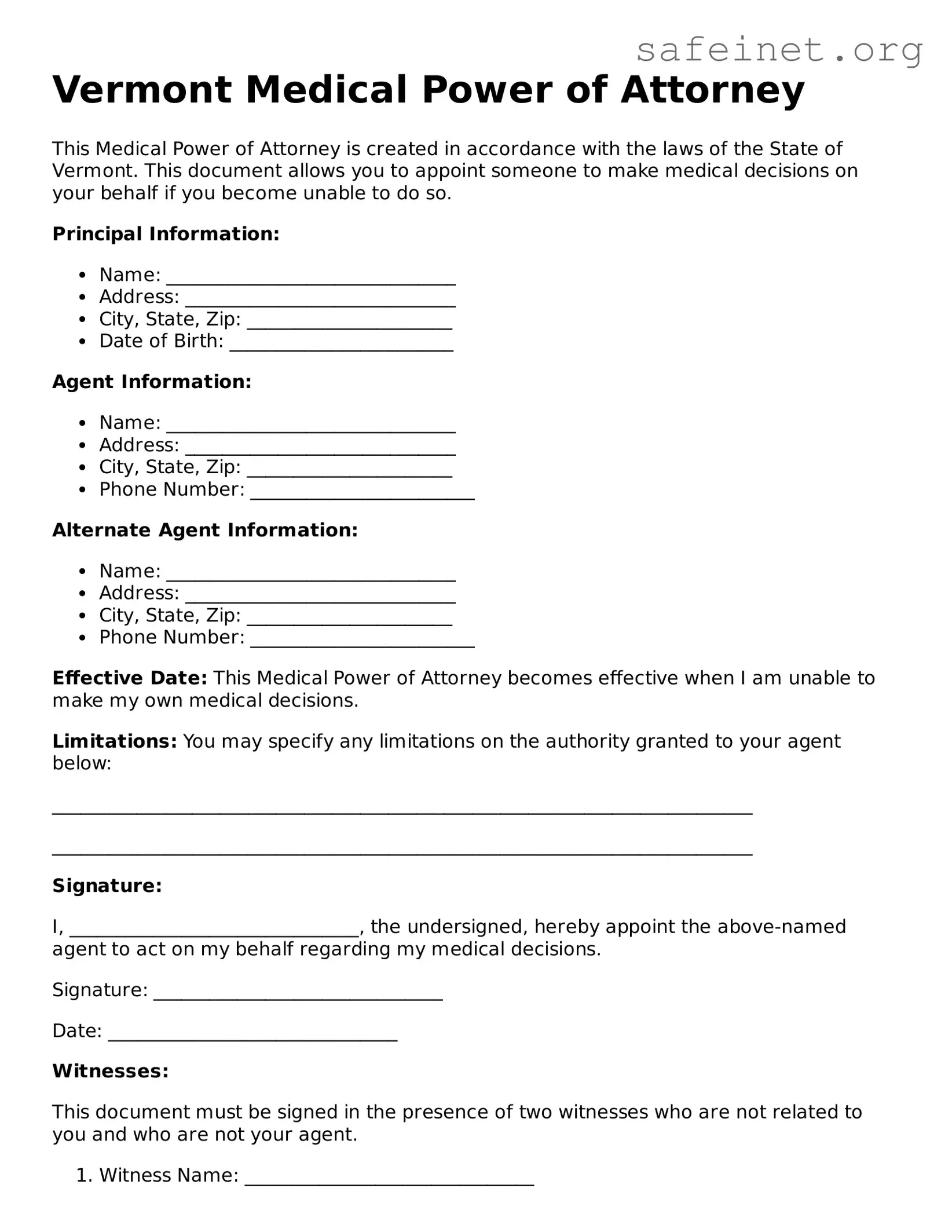
Vermont Medical Power of Attorney
This Medical Power of Attorney is created in accordance with the laws of the State of Vermont. This document allows you to appoint someone to make medical decisions on your behalf if you become unable to do so.
Principal Information:
Agent Information:
Alternate Agent Information:
Effective Date: This Medical Power of Attorney becomes effective when I am unable to make my own medical decisions.
Limitations: You may specify any limitations on the authority granted to your agent below:
___________________________________________________________________________
___________________________________________________________________________
Signature:
I, _______________________________, the undersigned, hereby appoint the above-named agent to act on my behalf regarding my medical decisions.
Signature: _______________________________
Date: _______________________________
Witnesses:
This document must be signed in the presence of two witnesses who are not related to you and who are not your agent.
Notarization:
State of Vermont
County of _______________________________
On this ____ day of ____________, 20__, before me, a Notary Public, personally appeared __________________________, known to me to be the person who executed this Medical Power of Attorney.
Notary Public Signature: __________________________
My Commission Expires: __________________________
| Fact Name | Details |
|---|---|
| Definition | A Vermont Medical Power of Attorney allows an individual to designate someone to make healthcare decisions on their behalf if they become unable to do so. |
| Governing Law | This form is governed by Vermont Statutes Title 18, Chapter 231, which outlines the laws regarding health care decisions and advance directives. |
| Eligibility | Any competent adult can create a Medical Power of Attorney in Vermont. This includes individuals aged 18 and older. |
| Revocation | The principal can revoke the Medical Power of Attorney at any time, as long as they are still competent to make decisions. |
| Witness Requirements | In Vermont, the form must be signed in the presence of at least two witnesses who are not related to the principal or beneficiaries. |
Filling out the Vermont Medical Power of Attorney form is an important step in ensuring that your healthcare decisions are made according to your wishes. This document allows you to appoint someone to make medical decisions on your behalf if you are unable to do so. Follow these steps carefully to complete the form accurately.
What is a Medical Power of Attorney in Vermont?
A Medical Power of Attorney is a legal document that allows you to appoint someone to make healthcare decisions on your behalf if you become unable to do so. This person, known as your agent or proxy, will have the authority to make medical decisions based on your wishes and best interests when you cannot communicate them yourself.
Who can be appointed as my agent in a Medical Power of Attorney?
You can choose any competent adult as your agent. This could be a family member, friend, or trusted advisor. It is important to select someone who understands your values and preferences regarding medical treatment. You should discuss your wishes with them before completing the document.
Do I need a lawyer to create a Medical Power of Attorney in Vermont?
No, you do not need a lawyer to create a Medical Power of Attorney in Vermont. However, it can be helpful to consult with one to ensure that your document reflects your wishes accurately and complies with state laws. There are also many resources available online that can guide you through the process.
How do I complete the Medical Power of Attorney form?
To complete the form, you will need to provide your personal information and that of your chosen agent. Clearly outline the powers you wish to grant your agent regarding medical decisions. After filling out the form, you must sign it in the presence of a notary public or witnesses, as required by Vermont law.
Can I change or revoke my Medical Power of Attorney?
Yes, you can change or revoke your Medical Power of Attorney at any time as long as you are competent. To do this, you should create a new document or a written revocation notice. It’s important to inform your agent and any healthcare providers about the changes to avoid confusion.
What happens if I do not have a Medical Power of Attorney?
If you do not have a Medical Power of Attorney and become unable to make your own healthcare decisions, your family may have to go to court to appoint a guardian or conservator to make those decisions for you. This process can be lengthy and may not reflect your personal wishes.
Is a Medical Power of Attorney valid in other states?
A Medical Power of Attorney created in Vermont is generally valid in other states, but laws can vary. It’s a good idea to check the specific requirements of the state where you may be receiving care. If you travel frequently, consider having a document that meets the requirements of multiple states.
Not Designating a Specific Agent: One common mistake is failing to clearly designate a specific person as the agent. The form should explicitly name the individual who will make medical decisions on behalf of the principal. Leaving this section blank can lead to confusion and potential disputes among family members.
Inadequate Signature and Date: Another frequent error is not signing and dating the form correctly. The principal must sign the document in the appropriate space, and it should also be dated. Omitting either can render the document invalid.
Neglecting Witness Requirements: Vermont law requires that the Medical Power of Attorney be signed in the presence of witnesses. Failing to have the necessary witnesses present during the signing can invalidate the document. It is essential to ensure that the witnesses meet the legal requirements.
Not Updating the Document: People often forget to update their Medical Power of Attorney when their circumstances change. Changes in health, relationships, or preferences may necessitate a revision of the agent or the instructions provided. Regularly reviewing and updating the document is crucial to ensure it reflects current wishes.
When preparing a Vermont Medical Power of Attorney, it is often beneficial to consider additional documents that can complement or enhance your healthcare planning. Each of these forms serves a specific purpose and can provide clarity and direction regarding your medical care and preferences.
These documents can work together to ensure your healthcare preferences are honored and your wishes are respected. It is advisable to consult with a legal professional to ensure all forms are completed accurately and reflect your intentions clearly.
The Vermont Medical Power of Attorney form is similar to the General Power of Attorney. Both documents allow an individual to designate someone else to make decisions on their behalf. However, while the General Power of Attorney can cover a wide range of financial and legal matters, the Medical Power of Attorney is specifically focused on healthcare decisions. This means that if you become incapacitated, the person you appoint through the Medical Power of Attorney can make choices about your medical treatment, while the General Power of Attorney may not have that authority unless explicitly stated.
Another document that shares similarities is the Advance Healthcare Directive. This document combines the functions of a Medical Power of Attorney and a living will. Like the Medical Power of Attorney, it allows you to appoint a healthcare agent to make decisions for you. Additionally, it lets you outline your preferences for medical treatment in specific situations, such as end-of-life care. Both documents aim to ensure that your healthcare wishes are respected when you are unable to communicate them yourself.
The Healthcare Proxy is also akin to the Medical Power of Attorney. In many states, a Healthcare Proxy serves the same purpose as a Medical Power of Attorney, allowing you to appoint someone to make medical decisions on your behalf. The key difference lies in the terminology and the specific requirements of each state. In Vermont, the term "Medical Power of Attorney" is used, but the underlying principle of appointing a trusted individual to manage healthcare decisions remains consistent.
A Living Will is another important document that relates closely to the Medical Power of Attorney. While the Medical Power of Attorney designates someone to make decisions for you, a Living Will explicitly states your wishes regarding medical treatment in situations where you cannot express your preferences. For instance, if you are terminally ill or in a persistent vegetative state, a Living Will can guide your healthcare providers and loved ones about the types of interventions you do or do not want, complementing the authority granted in a Medical Power of Attorney.
Lastly, the Do Not Resuscitate (DNR) order can be considered similar in purpose to the Medical Power of Attorney, though it serves a more specific function. A DNR order instructs medical personnel not to perform CPR or other life-saving measures if your heart stops or you stop breathing. While the Medical Power of Attorney allows someone to make broader healthcare decisions, a DNR provides explicit instructions regarding resuscitation efforts. Both documents work together to ensure that your healthcare preferences are honored, particularly in critical situations.
When filling out the Vermont Medical Power of Attorney form, it’s important to approach the task with care and attention. This document allows you to designate someone to make medical decisions on your behalf if you become unable to do so. Here are some guidelines to follow and avoid:
By following these dos and don'ts, you can create a Medical Power of Attorney that accurately reflects your desires and provides peace of mind for you and your loved ones.
Many people have misunderstandings about the Vermont Medical Power of Attorney form. Here are some common misconceptions and clarifications:
This is not true. Anyone can create a Medical Power of Attorney, regardless of age, to ensure their medical wishes are honored.
While both documents deal with healthcare decisions, a Living Will outlines specific wishes about end-of-life care, whereas a Medical Power of Attorney appoints someone to make decisions on your behalf.
You can revoke or update your Medical Power of Attorney at any time, as long as you are mentally competent.
While legal advice can be helpful, you do not need a lawyer to fill out a Medical Power of Attorney form in Vermont.
Your agent can be anyone you trust, including friends or other individuals, as long as they are at least 18 years old.
A Medical Power of Attorney is generally valid across states, but it's important to check each state's specific laws if you travel.
You can designate multiple agents, but it’s best to clarify how they should act together to avoid confusion.
This form allows your agent to make decisions when you are unable to do so, but it can also be used if you choose to have assistance with your medical decisions.
Filling out a Medical Power of Attorney (MPOA) form in Vermont is an important step in ensuring that your healthcare wishes are respected. Here are some key takeaways to keep in mind:
Being proactive about your healthcare decisions can provide peace of mind for both you and your loved ones.